 By
By 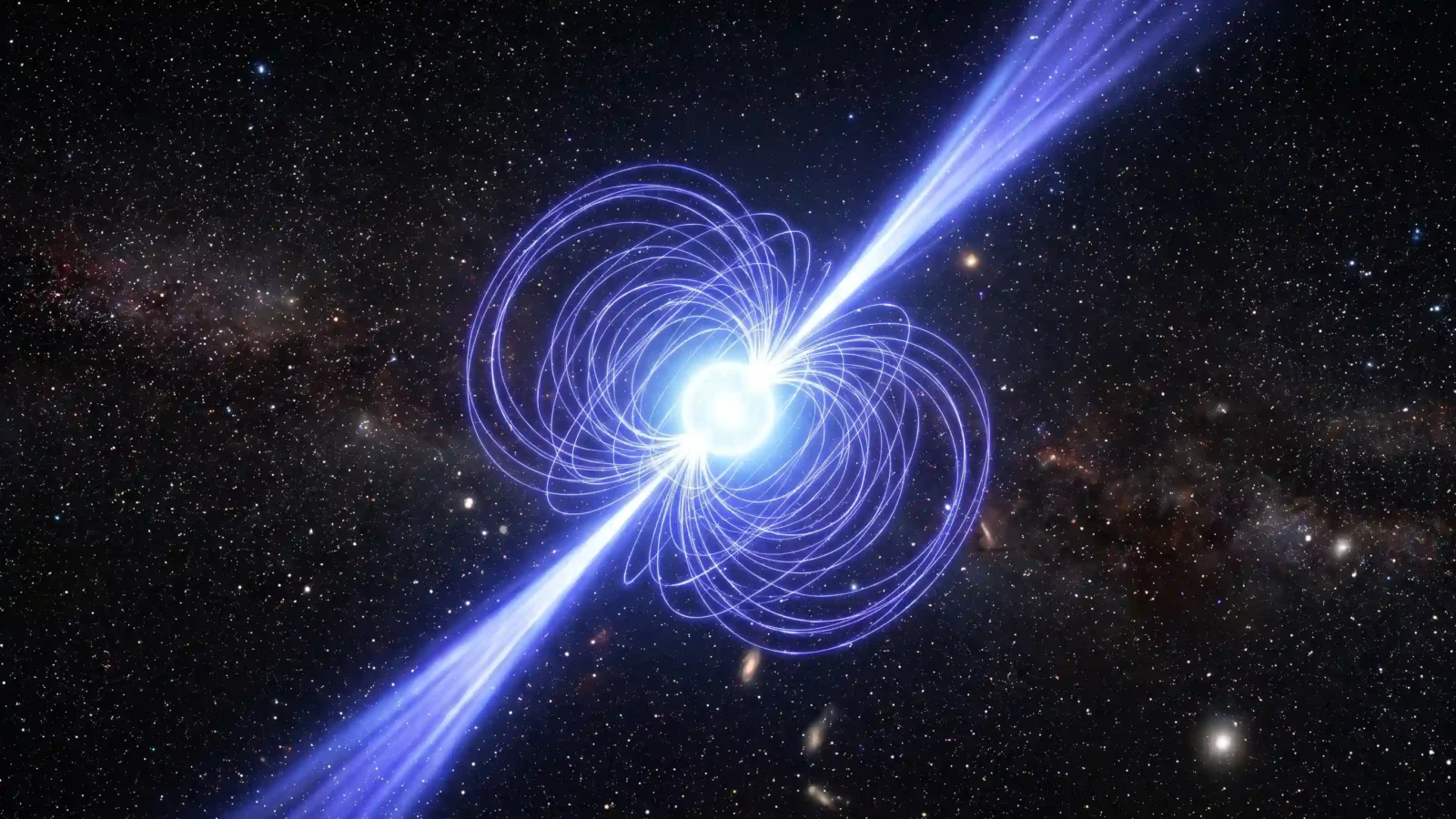
Quick Answer
A neutron star is the ultra-dense collapsed core of a massive star that exploded as a supernova. It packs more mass than the Sun into a sphere only about 20 kilometres across, so a single teaspoon of its material would weigh roughly a billion tonnes on Earth — about the mass of a mountain. Neutron stars are the densest objects in the universe short of black holes, and their extreme gravity, spin, and magnetism make them among the strangest things we know to exist.
To call a neutron star dense barely begins to cover it. Imagine crushing all of humanity into the volume of a single sugar cube, then doing the same to the entire mass of the Sun and squeezing it into a city. That is the everyday physics of these stellar corpses. This guide explains what neutron stars are, how they form, just how absurd their density really is, what their hidden interior might contain, and how the most magnetic ones — magnetars — push the laws of physics to the breaking point.
What is a neutron star?
A neutron star is what remains after a massive star runs out of fuel and its core collapses. When the collapse halts, the result is an object roughly 1.4 times the mass of our Sun compressed into a sphere only about 20 kilometres in diameter — smaller than most cities. At that point the material is so compressed that protons and electrons have merged into neutrons, which is where the name comes from. It is, in effect, a single gigantic atomic nucleus the size of a mountain range, held together by gravity and held up by the refusal of quantum particles to be squeezed any further.
The numbers defy intuition. A neutron star’s surface gravity is around 100 billion times stronger than Earth’s. A marshmallow dropped onto one would hit the surface with the energy of an atomic bomb. The escape velocity is a sizeable fraction of the speed of light. And underneath a wafer-thin atmosphere of hot plasma lies a crust of crystalline nuclei billions of times stronger than steel.
These objects are not rare curiosities. Astronomers estimate the Milky Way contains around a billion neutron stars, the leftovers of generations of dead massive stars. Most are old, cold, and effectively invisible, but the young ones blaze in X-rays, spin hundreds of times a second, and sweep the galaxy with beams of radiation.
Predicted before they were ever seen
Neutron stars are a rare case where theory ran decades ahead of observation. In 1934 — just two years after the neutron itself was discovered — astronomers Walter Baade and Fritz Zwicky proposed that supernovae mark the transition of an ordinary star into a “neutron star,” an object made of tightly packed neutrons. It was an extraordinary leap of imagination, and for over thirty years it stayed pure theory; such a tiny, faint object seemed impossible to ever detect.
That changed in 1967, when graduate student Jocelyn Bell Burnell, working with Antony Hewish, picked up an impossibly regular radio pulse — the first pulsar. It turned out to be exactly the spinning neutron star Baade and Zwicky had imagined. The discovery earned a Nobel Prize (controversially awarded to Hewish, not Bell) and transformed neutron stars from a bold hypothesis into one of the most-studied objects in astrophysics. In between, in 1939, Oppenheimer and Volkoff had already calculated the mass limit beyond which a neutron star must collapse into a black hole — the boundary that still bears their names today.
How neutron stars form: the death of a massive star
Neutron stars are born in one of the most violent events in nature — the death of a star far heavier than the Sun. A star spends most of its life fusing hydrogen into helium, balancing the inward pull of gravity against the outward push of fusion energy. But for the most massive stars — those born with roughly eight to twenty-five times the Sun’s mass — that balance eventually fails catastrophically.
Core collapse and the supernova
As a massive star ages, it fuses heavier and heavier elements in onion-like shells: helium into carbon, carbon into oxygen, and so on, all the way up to iron. Iron is the dead end. Fusing iron does not release energy — it absorbs it. So when the core becomes a ball of iron about 1.4 times the Sun’s mass (a threshold called the Chandrasekhar limit), fusion can no longer hold gravity at bay.
The core collapses in less than a second, its outer edge falling inward at up to a quarter of the speed of light. The infalling material slams into the now-rigid centre and rebounds, and a flood of neutrinos blasts outward, reviving a stalled shockwave that tears the star apart. The result is a supernova — for a few weeks it can outshine an entire galaxy of hundreds of billions of stars. What is left at the centre is the newborn neutron star.
Why electrons and protons fuse into neutrons
During the collapse, the pressure becomes so extreme that the normal rules of matter break down. Electrons are crushed into protons in a process called electron capture (a form of inverse beta decay), converting each pair into a neutron and releasing a neutrino. The collapsing core sheds almost all of its electrons and protons this way, becoming an object made overwhelmingly of neutrons packed together at the density of an atomic nucleus.
What finally halts the collapse is a quantum effect called neutron degeneracy pressure. The Pauli exclusion principle forbids identical neutrons from occupying the same quantum state, so once they’re squeezed shoulder to shoulder, they resist further compression with enormous force. If the core is too heavy for even this to hold — above roughly 2.2 to 2.3 solar masses — nothing can stop it, and it collapses all the way into a black hole instead.
Just how dense is a neutron star?
Density is the headline property of a neutron star, and the figures are genuinely hard to picture.
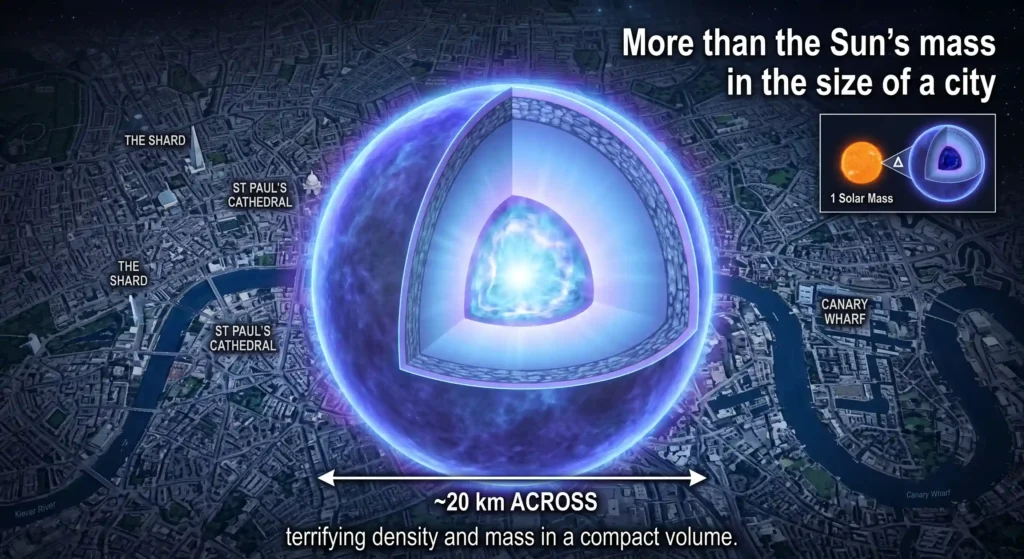
- Mass: typically about 1.4 times the Sun, up to roughly 2.2 solar masses.
- Radius: only about 10–12 km (a sphere ~20–24 km across).
- Density: around 4 × 10¹⁷ kilograms per cubic metre — comparable to an atomic nucleus.
- Surface gravity: roughly 100 billion times Earth’s.
- Escape velocity: about one-third to one-half the speed of light.
Put differently, a neutron star squeezes more than the Sun’s entire mass into a ball you could drive across in twenty minutes. Its gravity is so strong that the surface is warped measurably by general relativity, and light leaving it is stretched to redder wavelengths as it climbs out of the gravitational well. In fact, gravity bends the light so much that you can see slightly around the far side of the star — a bit more than half its surface is visible at once.
Take 1.4 solar masses (2.8 × 10³⁰ kg) in a sphere of radius 12 km:
Volume = (4/3)π(12,000 m)³ ≈ 7.2 × 10¹² m³ → Density ≈ 3.9 × 10¹⁷ kg/m³.
A teaspoon (5 mL) of that: 3.9 × 10¹⁷ × 5 × 10⁻⁶ ≈ 2 billion tonnes — roughly the mass of a small mountain, in a spoon. A sugar-cube-sized piece would weigh about as much as all of humanity put together.
That density is not just trivia; it’s what makes everything else possible. The crushing gravity, the blistering surface, the rapid spin, and the colossal magnetic fields all flow from cramming a star’s worth of matter into a city-sized volume.
Inside a neutron star: layers of the impossible
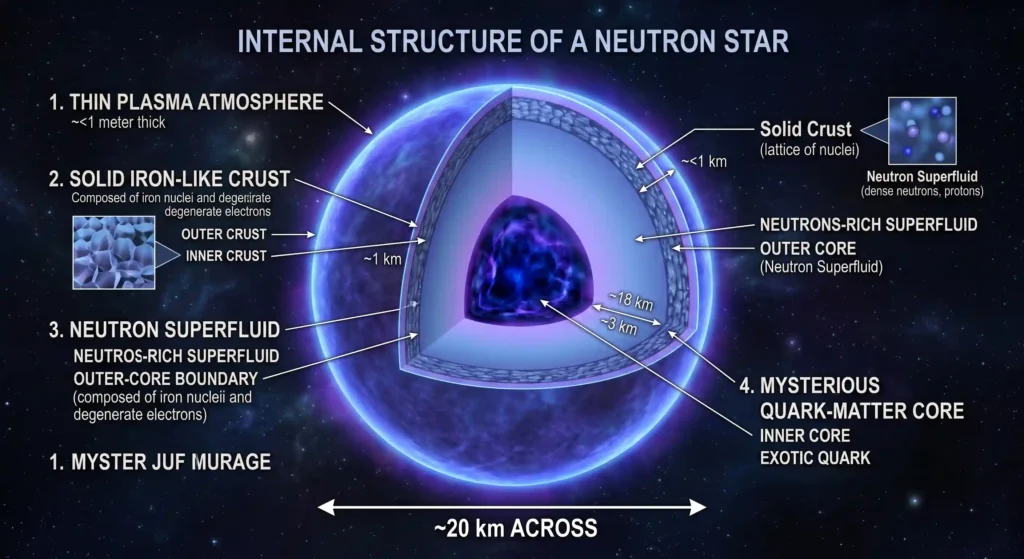
A neutron star is not a uniform ball of neutrons. It has a layered structure, and the deeper you go, the stranger and less understood it becomes.
Atmosphere and crust
The outermost layer is an atmosphere of plasma just centimetres thick, shaping the X-rays we detect. Below it lies a solid crust — a crystalline lattice of nuclei, growing denser with depth, and by some measures the strongest material in the universe, roughly ten billion times stronger than steel. It’s the cracking of this crust under magnetic stress that produces “starquakes.”
The neutron superfluid
Beneath the crust, neutrons form an exotic superfluid — a frictionless liquid that flows without resistance and stores the star’s spin in tiny quantized vortices. When some of these vortices suddenly release, the whole star momentarily spins up in an event called a glitch, one of the few direct windows into the interior.
The core: physics’ great unknown
At the very centre, matter is squeezed beyond anything we can reproduce or fully calculate. It may be even denser neutron matter, or the neutrons themselves may dissolve into their constituent quarks. Working out the relationship between a neutron star’s density and pressure — physicists call it the equation of state — is one of the biggest open problems in nuclear physics, and every precise measurement of a neutron star’s size and mass helps pin it down.
Pulsars — neutron stars that beam like lighthouses
Many neutron stars announce themselves as pulsars: rapidly rotating neutron stars that emit beams of radio waves (and sometimes X-rays or gamma rays) from their magnetic poles. Because the magnetic poles are usually not aligned with the spin axis, the beams sweep around like a lighthouse. If one crosses Earth, we detect a metronome-steady pulse — once per rotation.
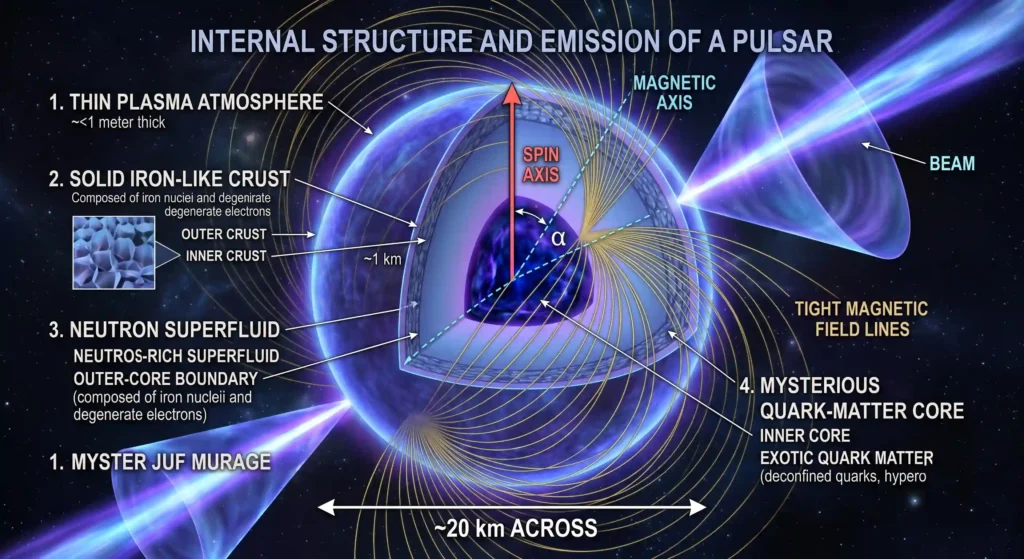
The first pulsar was discovered in 1967 by graduate student Jocelyn Bell Burnell, who picked up a signal so regular her team half-jokingly labelled it “LGM-1,” for “Little Green Men,” before realising it was a natural object. Pulsars are now prized as some of the most precise clocks in the universe.
The fastest known pulsar, PSR J1748−2446ad, rotates 716 times every second. For a 12-km-radius star, its equator moves at:
v = 2πR × f = 2π × 12,000 m × 716 ≈ 54 million m/s ≈ 0.18c — roughly a fifth of the speed of light, on the surface of a star.
Spinning that fast without flying apart takes gravity beyond anything ordinary matter could survive. Only a neutron star can hold itself together at these speeds.
Pulsar timing is so reliable that astronomers use arrays of them as a galaxy-sized detector for low-frequency gravitational waves, and the steady slowing of a pulsar’s spin reveals how it loses energy over millions of years. Their clock-like regularity has even been proposed as a natural GPS for future deep-space navigation.
Magnetars — the most magnetic objects in the universe
A small fraction of neutron stars are magnetars, and they are extreme even by neutron star standards. A magnetar’s magnetic field can reach 10¹⁴ to 10¹⁵ gauss — trillions of times stronger than Earth’s field and a thousand times stronger than an ordinary neutron star. These are the most powerful magnets known to exist.
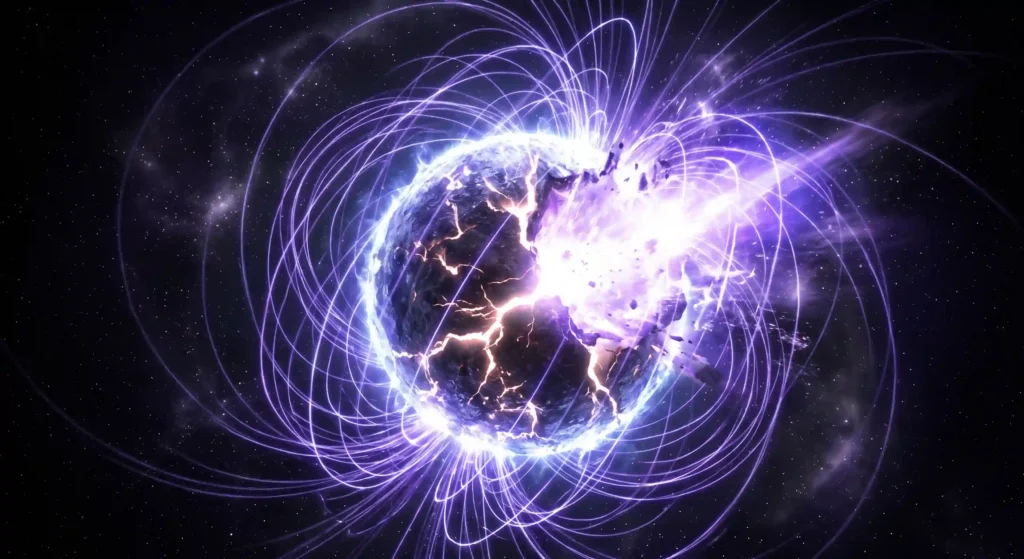
The field is so intense it would be lethal from tens of thousands of kilometres away, distorting the very atoms in your body by stretching their electron clouds into thin cylinders and shutting down the chemistry of life. Magnetars occasionally unleash giant flares as their crust cracks under magnetic stress. In 2004, a giant flare from the magnetar SGR 1806−20, about 50,000 light-years away, briefly outshone the full Moon in gamma rays and measurably disturbed Earth’s upper atmosphere — from halfway across the galaxy.
Magnetars are also now the leading suspect behind some fast radio bursts, the millisecond flashes seen from across the cosmos. That raw power is exactly why a magnetar makes such a terrifying thought experiment. We explore what one would do to our world in what if a magnetar replaced the Moon — a vivid way to feel just how violent these objects are. The flares they produce also overlap with another cosmic spectacle, the gamma-ray burst, among the most energetic explosions we know of.
The neutron star zoo: not all the same
“Neutron star” is a category, not a single type. The same basic object shows up in strikingly different guises depending on its age, magnetic field, and whether it has a companion:
- Radio pulsars — the classic lighthouses, beaming radio waves as they spin, gradually slowing over millions of years.
- Millisecond pulsars — old neutron stars “recycled” and spun up to hundreds of rotations per second by stealing gas from a companion star. They are the steadiest natural clocks known.
- Magnetars — the ultra-magnetic minority (seen as “soft gamma repeaters” and “anomalous X-ray pulsars”), powered by their monstrous magnetic fields rather than their spin.
- X-ray binaries — neutron stars actively devouring gas from a partner star, blazing in X-rays as the infalling matter is superheated.
- Isolated cooling neutron stars — old, companionless stars that simply glow faintly as they slowly radiate away their birth heat.
- RRATs — “rotating radio transients” that flash only sporadically, a puzzle still being pieced together.
All of these are the same fundamental object — a city-sized ball of neutron matter — wearing different masks. Which mask a neutron star wears comes down mostly to how strong its magnetic field is and whether it has a neighbour to feed on.
Neutron star vs black hole: the sharpest line in physics
A neutron star is what you get when collapse stops; a black hole is what you get when it doesn’t. The deciding factor is mass. Below roughly 2.2–2.3 solar masses, neutron degeneracy pressure (and the stiffness of nuclear matter) can hold gravity off. Above that limit — the Tolman–Oppenheimer–Volkoff limit — nothing can, and the core collapses through its own event horizon into a black hole.
Neutron stars live right at the edge of that cliff — the last stable form matter can take before gravity wins completely. That’s what makes them so scientifically precious: they’re a natural laboratory for physics at the absolute limit of density, and the exact location of that mass limit tells us how matter behaves under pressures no accelerator can reach. A neutron star that gains too much mass — by pulling gas from a companion, or by merging with another — can be pushed over the edge and collapse into a black hole before our instruments.
What’s really inside the core? The quark question
The outer layers of a neutron star are reasonably understood, but the core is a genuine mystery. At those pressures, the neutrons themselves may be crushed into their constituent quarks, forming states of matter that can’t exist anywhere else in the universe. Some theorists propose that the densest neutron stars are really quark stars, with cores of free-flowing quark matter.
Stranger still is the idea of “strange matter” — a hypothetical, possibly more stable form of quark matter containing strange quarks, with unsettling implications we explored in what if a single strangelet touched the Earth. Whether these exotic states exist inside neutron stars is one of the biggest open questions in nuclear physics — and neutron-star observations, especially precise measurements of their maximum mass and radius, are exactly how we’re testing it.
When neutron stars collide
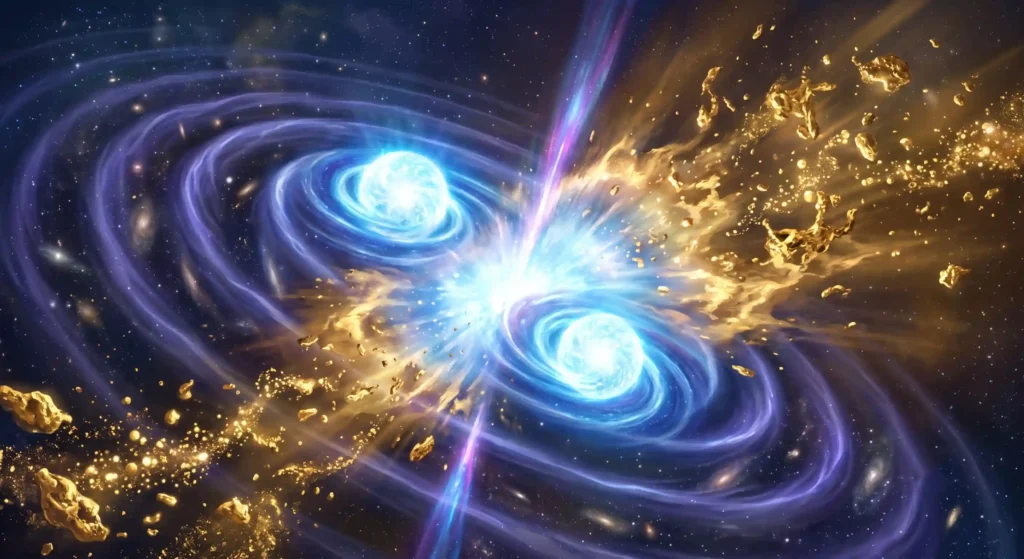
Neutron stars sometimes orbit in pairs, slowly spiralling together over millions of years as they radiate away energy in gravitational waves, and finally merging in a titanic collision. These mergers do two extraordinary things at once.
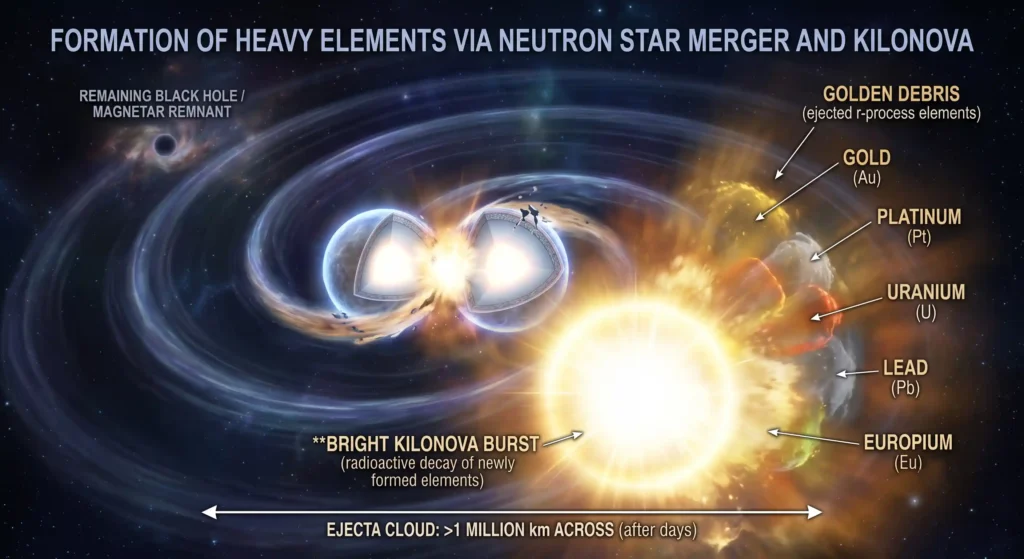
First, they ripple spacetime with gravitational waves we can now detect directly. Second, they forge heavy elements — much of the gold, platinum, and uranium in the universe (and in your jewellery) was likely cooked in neutron-star collisions and flung into space in a burst called a kilonova. Some mergers also unleash short gamma-ray bursts. In 2017, the event GW170817 tied all of this together: LIGO and Virgo caught the gravitational waves from two neutron stars merging, telescopes worldwide saw the kilonova’s glow, and the debris confirmed that such collisions are a major source of the universe’s precious metals. A single event united gravitational-wave astronomy, the origin of gold, and the physics of ultra-dense matter.
How we detect neutron stars
Despite being tiny and far away, neutron stars reveal themselves in several ways. Radio telescopes catch the rhythmic pulses of pulsars. X-ray observatories detect neutron stars pulling gas from a companion star, heating it until it glows in X-rays. NASA’s NICER instrument on the International Space Station measures the size and mass of neutron stars by precisely timing their X-ray hotspots — directly constraining that all-important equation of state. And gravitational-wave observatories catch them in their final, merging moments. Each method probes a different facet of the same impossible object.
The long, cold afterlife
A neutron star’s dramatic youth doesn’t last. It’s born blisteringly hot and spinning fast, but over millions of years it radiates its heat away and its spin gradually slows as its magnetic field drags against the surrounding space. A young pulsar flashing many times a second will, over tens of millions of years, slow until its beam sputters out and it goes radio-quiet — still there, still impossibly dense, but no longer announcing itself.
From then on, a neutron star is essentially eternal by human standards. With no fuel to burn, it simply cools, over billions to trillions of years, toward a cold, dark cinder — unless it gets a second act. If it has a companion, it can be spun back up into a millisecond pulsar, or it can accrete enough mass to finally tip over the limit and collapse into a black hole. Left alone, though, a neutron star is one of the most durable objects the universe makes: a fossil of a dead star that will outlast almost everything else in the cosmos.
What happens if you get close to one
Approaching a neutron star would be lethal long before you arrived. Far out, the intense X-ray and gamma radiation would already be deadly. Closer in, the magnetic field — especially for a magnetar — would tear apart the chemistry of your body. And the gravity is the real killer: the difference in pull between your head and your feet, the tidal force, would become so severe that you’d be stretched into a thin stream of atoms, the same “spaghettification” that awaits near a black hole.
Even the surface is hostile beyond imagination: temperatures of hundreds of thousands to millions of degrees, gravity that would flatten anything solid into an atom-thick layer, and an atmosphere only centimetres thick. There is no scenario in which a spacecraft, let alone a person, survives close contact with a neutron star.
Q&A
Yes. If a neutron star gains enough mass — by pulling gas from a companion or merging with another neutron star — and exceeds roughly 2.2 to 2.3 solar masses, neutron degeneracy pressure can no longer support it and it collapses into a black hole. The merger GW170817 is thought to have produced one.
Newly formed neutron stars can spin many times per second, and “millisecond pulsars” spin even faster after being spun up by gas from a companion. The record-holder, PSR J1748−2446ad, rotates 716 times every second — its surface moving at roughly a fifth of the speed of light.
A magnetar is a neutron star with an extreme magnetic field — up to 10¹⁵ gauss, the strongest known in the universe. Its field can crack the star’s crust and release enormous bursts of radiation, and it may be behind some fast radio bursts.
One of the closest confirmed neutron stars is RX J1856.5−3754, roughly 400 light-years away — an isolated, cooling neutron star detected mainly by its X-ray and faint optical glow rather than radio pulses.
No neutron star is anywhere near close enough to threaten us; the nearest are hundreds to thousands of light-years away. They’re only dangerous at close range, which never happens. Even the 2004 magnetar giant flare, from 50,000 light-years away, only briefly nudged our upper atmosphere.
At birth, a neutron star’s interior can exceed a trillion degrees, though it cools rapidly by emitting neutrinos. The visible surface of a young neutron star is around a million degrees Celsius — hundreds of times hotter than the Sun’s surface — and cools over millions of years.
The Bigger Question
Once you grasp how dense, fast, and magnetic a neutron star is, the natural next question is what one would do if it came anywhere near us. A magnetar — the most magnetic neutron star of all — wouldn’t need to touch Earth to wreck it; its field and radiation would do the job from a distance. That’s exactly the scenario we follow in what if a magnetar replaced the Moon, where the cosy night-light of our sky is swapped for the deadliest magnet in the cosmos. And if you push a neutron star just past its limit, you get its darker sibling — explored in full in black holes explained. Explore more cosmic extremes on the Space & Cosmos hub.
Neutron stars sit right at the boundary of what matter can endure before gravity wins entirely. They are the universe showing us its limits — and a reminder that the calm points of light in our night sky include some of the most violent objects that exist.