 By
By 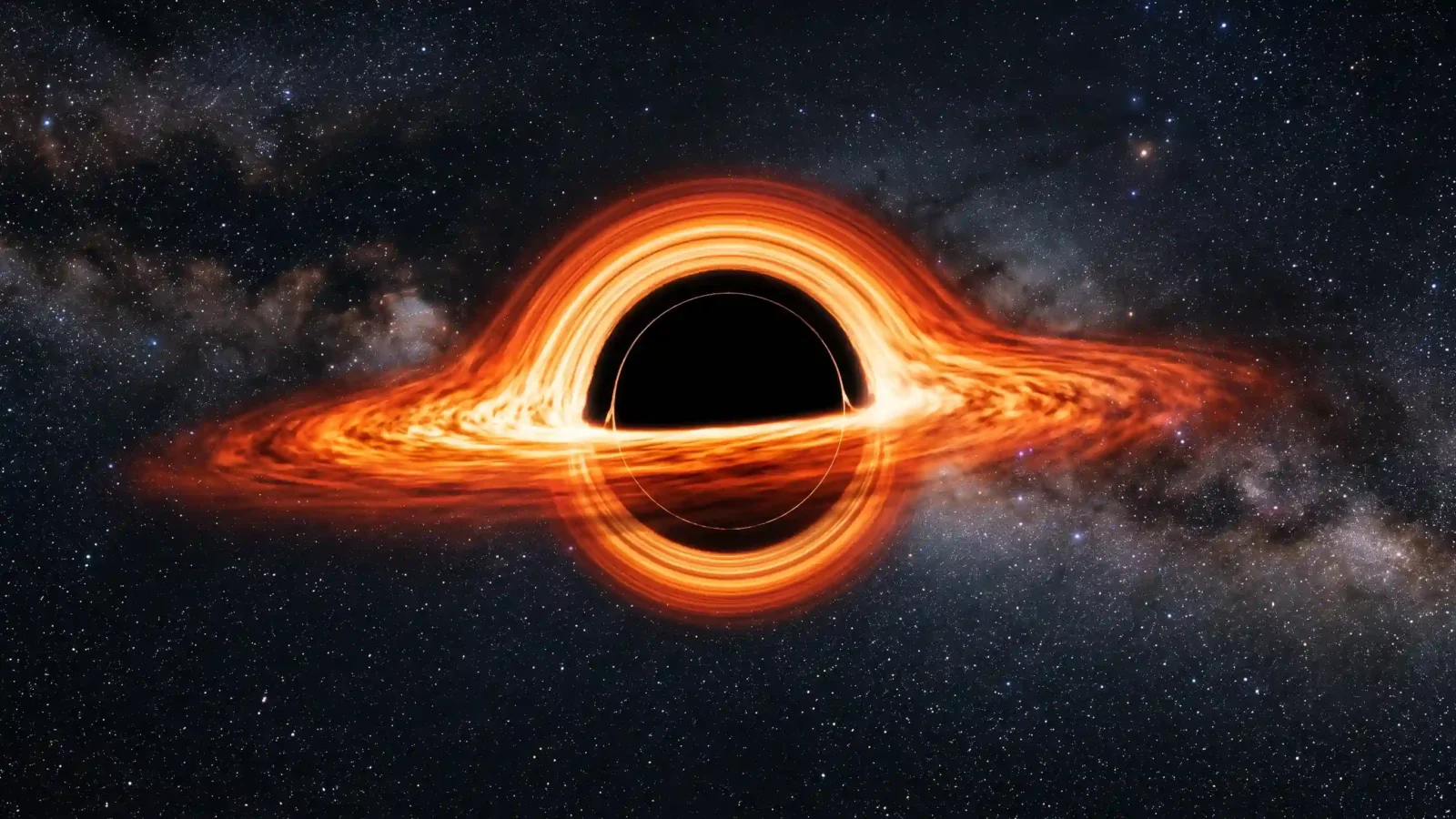
Quick Answer
A black hole is a region of space where gravity is so strong that nothing — not even light — can escape once it crosses the boundary called the event horizon. It forms when a large amount of matter is crushed into a tiny volume, warping spacetime beyond the point of return. Black holes are not cosmic vacuum cleaners; they are the densest, simplest objects gravity can build, ranging from city-sized stellar black holes to monsters billions of times the Sun’s mass at the centres of galaxies.
Few objects capture the imagination like a black hole, and few are as badly misunderstood. They are not holes, they do not roam the galaxy swallowing everything in sight, and they are not portals in the everyday sense. What they really are is stranger and more precise: a place where matter has collapsed so completely that it bends spacetime into a one-way trapdoor. This guide covers what black holes actually are, the different kinds, how they form, what happens near one, whether they can die, and how we’ve managed to photograph something from which no light escapes.
What exactly is a black hole?
Strip away the mythology and a black hole is defined by one property: an escape velocity greater than the speed of light. Escape velocity is the speed you must reach to break free of an object’s gravity — 11.2 km/s to leave Earth, about 618 km/s to leave the Sun’s surface. Pack enough mass into a small enough radius and that number climbs past 300,000 km/s, the speed of light. Because nothing can travel faster than light, nothing can leave. The boundary where escape velocity equals light speed is the event horizon, and everything about a black hole flows from it.
The event horizon is not a physical surface. There’s no wall, no shell, nothing to touch. It’s simply a distance from the centre — the radius at which the trapdoor closes. Its size depends only on the black hole’s mass, through one of the cleanest equations in all of physics.
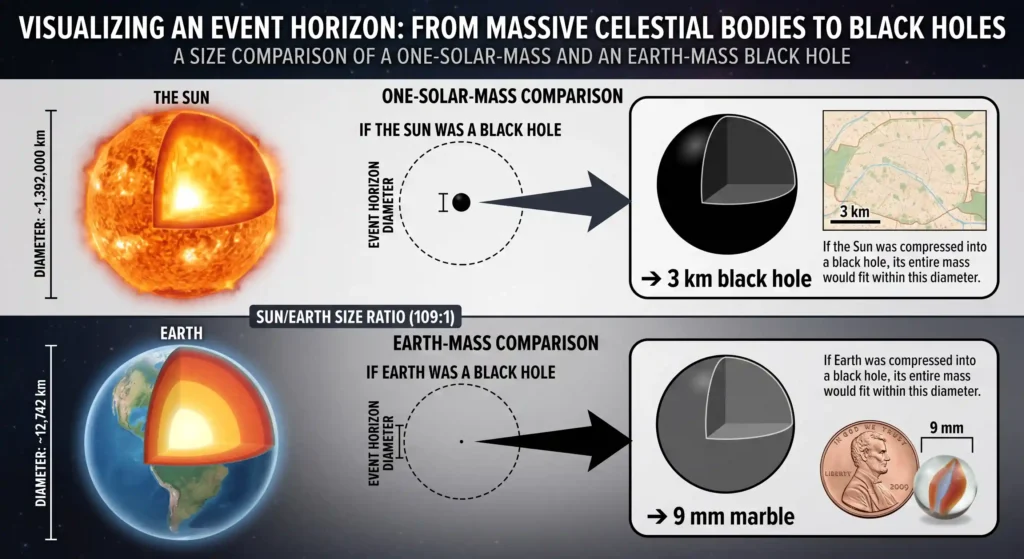
The event-horizon radius (the Schwarzschild radius) is R = 2GM / c², where G is the gravitational constant, M the mass, and c the speed of light. Run it for familiar masses:
- The Sun, if crushed to a black hole: R ≈ 3 km.
- The Earth: R ≈ 9 millimetres — a black hole with Earth’s mass would be the size of a marble.
- A 70-kg human: R ≈ 10⁻²⁵ metres — a hundred-billion-billion times smaller than a proton.
The radius grows in direct proportion to mass: double the mass, double the horizon. That single rule spans everything from city-sized black holes to horizons wider than our solar system.
A short history of an impossible idea
The concept is older than you’d think. Back in 1783, English clergyman John Michell reasoned that a star could be so massive that light itself couldn’t escape it — he called them “dark stars.” The idea faded until Einstein published general relativity, and in 1916 Karl Schwarzschild, calculating from a trench in World War I, found the exact equation for the boundary we now call the event horizon. For decades physicists — Einstein included — doubted such objects could really form; they seemed like a mathematical quirk.
The tide turned mid-century. In the 1960s, theorists including Roger Penrose proved that collapse to a singularity was not a fluke but an unavoidable consequence of the equations (work that earned him a share of the 2020 Nobel Prize). Physicist John Wheeler popularised the punchy name “black hole” in 1967, and the term stuck. Soon after, the X-ray source Cygnus X-1 became the first widely accepted stellar black hole candidate — so contested that Stephen Hawking famously bet against it being a black hole, a wager he conceded in 1990. From a clergyman’s thought experiment to a photographed shadow took just over two centuries.
The anatomy of a black hole
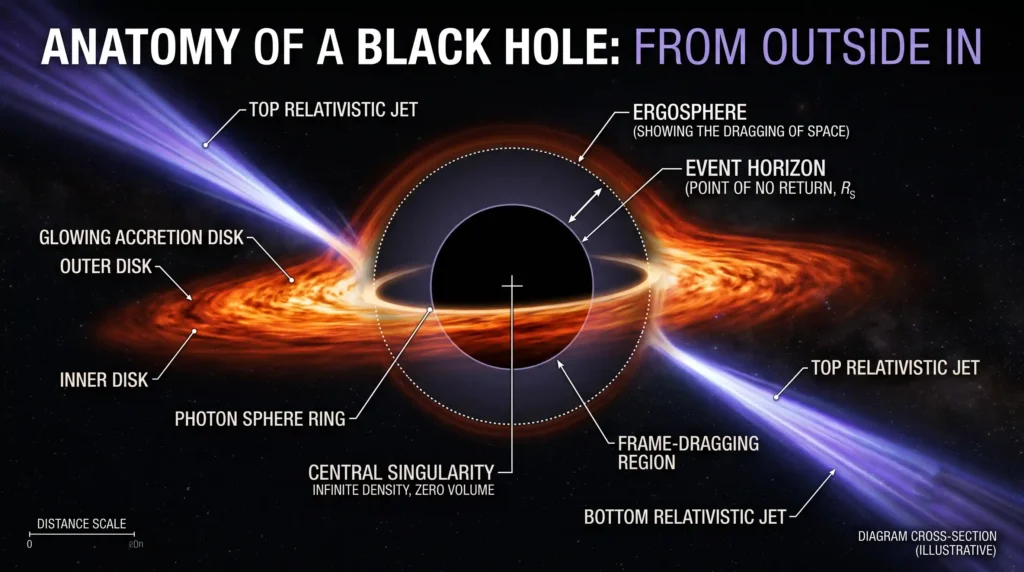
A black hole has more structure than “a dark ball” suggests. Working inward from the outside:
The accretion disk
Most black holes are surrounded by a swirling disk of gas and dust spiralling inward. Friction heats this material to millions of degrees, making it glow fiercely — often in X-rays. Paradoxically, some of the brightest objects in the universe are powered by black holes: quasars are supermassive black holes devouring matter so voraciously that their accretion disks outshine entire galaxies. The black hole itself is invisible; it’s the doomed matter around it that lights up the sky.
Relativistic jets
Many feeding black holes also launch narrow jets of particles from their poles at nearly the speed of light, blasting across thousands of light-years. Exactly how a black hole focuses these jets is still debated, but they’re among the most powerful phenomena in nature.
The photon sphere
At 1.5 times the Schwarzschild radius lies the photon sphere, where gravity is strong enough to bend light into a circle. A photon skimming this region can orbit the black hole. The glowing ring in the first black hole images traces light bent around near this radius — you are partly seeing the far side of the disk, its light wrapped over the top toward you.
The event horizon and beyond
Inside the horizon, all paths lead inward. And for a spinning black hole (which is most of them), there’s an additional region just outside the horizon called the ergosphere, where spacetime itself is dragged around so violently that nothing can stay still. Remarkably, energy can be extracted from this whirlpool — a process that may power those relativistic jets.
A black hole has only three properties
Here’s one of the most surprising facts in physics: no matter what fell in — stars, planets, encyclopedias, antimatter — a black hole can be completely described by just three numbers: its mass, its spin (angular momentum), and its electric charge. Everything else is erased. Physicists call this the “no-hair theorem,” the idea being that black holes have no distinguishing features (“hair”) beyond those three. Two black holes with the same mass, spin, and charge are utterly identical, regardless of how they formed.
This simplicity is beautiful and troubling at once. If a library falls into a black hole, where does the information in those books go? That question — whether information can truly be destroyed — is the crux of the black hole information paradox, one of the deepest unsolved problems in modern physics.
How fast do black holes spin?
Almost every black hole is spinning, and many spin astonishingly fast — some at over 99% of the theoretical maximum, their event horizons whirling at nearly the speed of light. This isn’t a minor detail. A spinning black hole (described by the “Kerr solution”) drags spacetime itself around with it, a phenomenon called frame-dragging: near the horizon, space is swept along so forcefully that nothing can remain still, even if it fires its engines at full thrust against the rotation.
Spin also changes the black hole’s structure. A rotating black hole is smaller for its mass than a non-rotating one, and it surrounds itself with that whirlpool region — the ergosphere — from which energy can, in principle, be extracted. Astronomers actually measure black-hole spin by studying how the inner edge of the accretion disk behaves, and the values they find are a clue to the black hole’s history: whether it grew by steady accretion (which tends to spin it up) or by chaotic mergers (which can spin it down).
The kinds of black hole
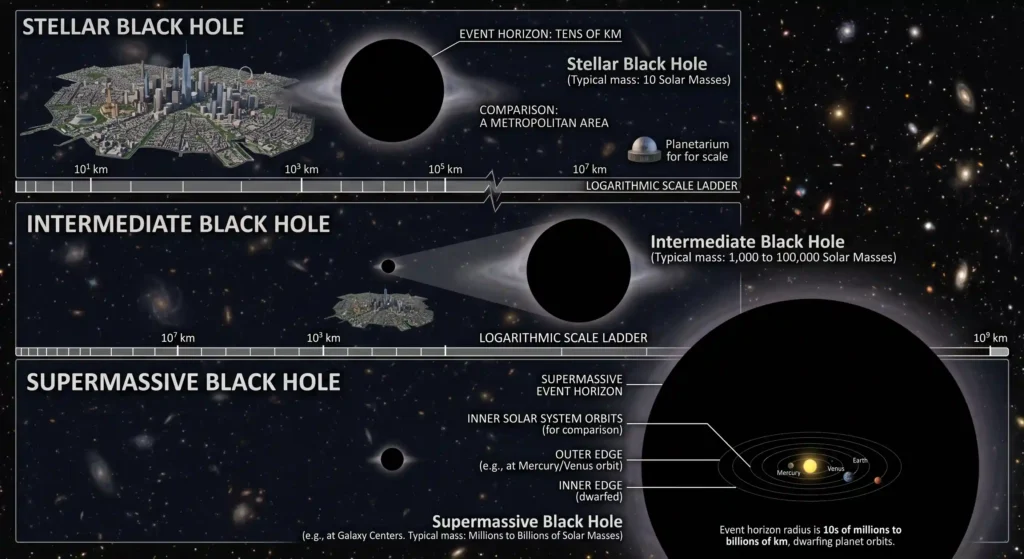
Black holes come in a small number of flavours, sorted almost entirely by mass.
Stellar black holes
Formed from the collapse of a single massive star, these run from a few to a few dozen solar masses, with horizons tens of kilometres across. They’re the most common kind, and the ones detected merging by gravitational-wave observatories. Our galaxy likely holds tens of millions of them, most of them dark and drifting, invisible unless they happen to be feeding on a companion star.
Supermassive black holes
Millions to billions of solar masses, anchoring the centres of galaxies. Our own Milky Way hosts Sagittarius A*, weighing 4.3 million Suns, imaged directly in 2022. The largest known monsters exceed tens of billions of solar masses, with event horizons far wider than our entire solar system. How they grew so massive so early in cosmic history — some were already giant less than a billion years after the Big Bang — is one of astronomy’s hottest open questions.
Intermediate-mass black holes
The long-missing middle, hundreds to tens of thousands of solar masses. For years they were theoretical, but observations are increasingly filling the gap. They may be the “seeds” that grew into supermassive black holes, and could form in the dense hearts of star clusters.
Primordial black holes
A hypothetical class that could have formed not from stars but from ultra-dense pockets in the first fraction of a second of the universe. Some could be tiny — mountain-mass or smaller. None have been confirmed, but they remain a serious candidate for part of the universe’s dark matter, and we explored what one would do if it passed through our planet in what if a microscopic black hole passed through the Earth.
The counterintuitive truth about black-hole density
Everyone “knows” black holes are incredibly dense — and stellar ones are. But scale them up and something strange happens. Because the radius grows in proportion to mass while volume grows with the cube of the radius, the average density inside the horizon falls as mass rises.
Average density inside the horizon scales as 1 / M². Work the extremes:
- A stellar black hole (a few solar masses): denser than an atomic nucleus.
- A supermassive black hole of a few hundred million solar masses: average density roughly that of water.
- The largest known black holes (tens of billions of solar masses): average density less than air.
If you could stand at the centre of the Milky Way’s supermassive black hole with average density spread out, it would be less dense than the atmosphere you’re breathing. “Black hole” does not automatically mean “unimaginably dense” — it means “escape velocity beats light.” Those are not the same thing.
How black holes form
The classic route is stellar death. A star survives by fusing lighter elements into heavier ones; the outward pressure of fusion balances the inward crush of its own gravity. When a massive star — roughly 20 or more times the Sun — exhausts its fuel, that balance collapses in less than a second.
From star to singularity
For stars in a middle mass range, the collapsing core stops at a neutron star, an object so dense a teaspoon weighs a billion tonnes. But if the core is heavier than about 2.2–2.3 solar masses, not even the pressure between neutrons can hold, and nothing known can stop the collapse. The core shrinks past its own event horizon and a black hole is born. The star’s outer layers, meanwhile, are hurled outward as a supernova — the black hole is the dark heart left behind.
Direct collapse and mergers
Some very massive stars may skip the explosion entirely and collapse straight into a black hole. Black holes also grow by merging: two black holes orbiting each other spiral together and coalesce, releasing a burst of gravitational waves — ripples in spacetime we can now detect. And they grow by accretion, steadily swallowing gas over cosmic time. The supermassive giants likely grew through some combination of all of these, though the details remain unsettled.
What’s inside? The singularity problem
Here, honesty matters more than confidence. General relativity — our best theory of gravity — predicts that at the centre of a black hole, all the mass is crushed into a singularity: a point of zero size and infinite density. But “infinite” in physics almost always signals that a theory has hit its limit, not that nature actually contains infinities. The singularity is really a warning sign that reads: here, general relativity breaks down, and we need a theory of quantum gravity we don’t yet have.
So the truthful answer to “what’s inside a black hole?” is we don’t know. The event horizon is a one-way door; no information about the interior can ever reach us. What we can say is that the smooth, predictable physics that works everywhere else stops working at the centre. Some theorists suspect the singularity is replaced by something exotic — a “Planck star,” a bounce, or new physics entirely. Testing those ideas is one of the deepest goals in physics, and it’s part of why the interior connects to speculative geometry like the wormhole and the time-reversed white hole — both of which fall out of the same equations that describe real black holes.
What happens if you fall in?
Approach a black hole and gravity’s most dramatic tricks appear.
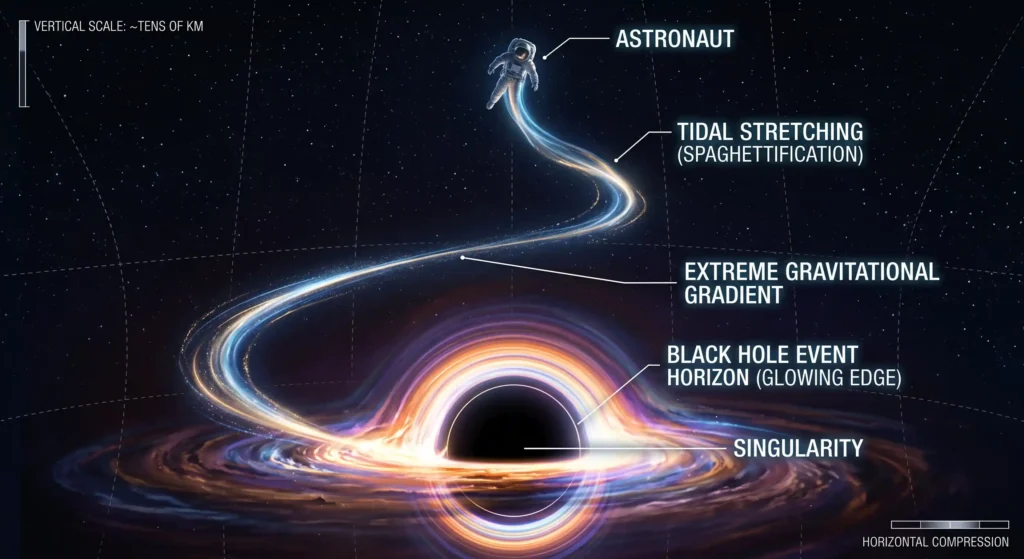
Spaghettification
Because gravity weakens with distance, your feet (nearer the black hole) are pulled far harder than your head. Near a small stellar black hole this difference is lethal long before you reach the horizon: you’d be stretched into a thin stream of atoms, an effect physicists nickname spaghettification. Near a supermassive black hole, curiously, the tidal difference at the horizon is gentle enough that you could cross it without feeling anything unusual — the horizon isn’t a place, just a line you can no longer come back past.
The strange behaviour of time
Time near a black hole runs differently for different observers. To someone watching from far away, your infalling clock appears to slow, and you seem to freeze at the horizon, your light stretching redder and dimmer until you fade from view forever. From your own perspective, nothing dramatic happens at the crossing — you sail through smoothly and reach the centre in moments. Both descriptions are correct simultaneously. This isn’t a contradiction; it’s general relativity, and reconciling the two viewpoints is at the heart of the information paradox.
Can a black hole die?
Astonishingly, yes — very, very slowly. In 1974, Stephen Hawking showed that quantum effects near the event horizon cause a black hole to emit a faint glow and gradually lose mass. This Hawking radiation means black holes are not eternal: they evaporate.
A black hole’s Hawking temperature is inversely proportional to its mass. For a Sun-mass black hole:
T ≈ 6 × 10⁻⁸ kelvin — sixty-billionths of a degree above absolute zero, far colder than deep space itself (2.7 K).
Because it’s colder than its surroundings, a stellar black hole today actually absorbs more than it radiates. Only in the far future, once the universe has cooled below its temperature, will it truly begin to shrink. The time for a Sun-mass black hole to evaporate completely is around 10⁶⁷ years — a 1 followed by 67 zeros, dwarfing the 1.4 × 10¹⁰-year age of the universe. Smaller black holes evaporate faster, ending in a final burst of radiation; the supermassive giants may be the last structures left in the cosmos, outliving the stars themselves.
How we know black holes are real
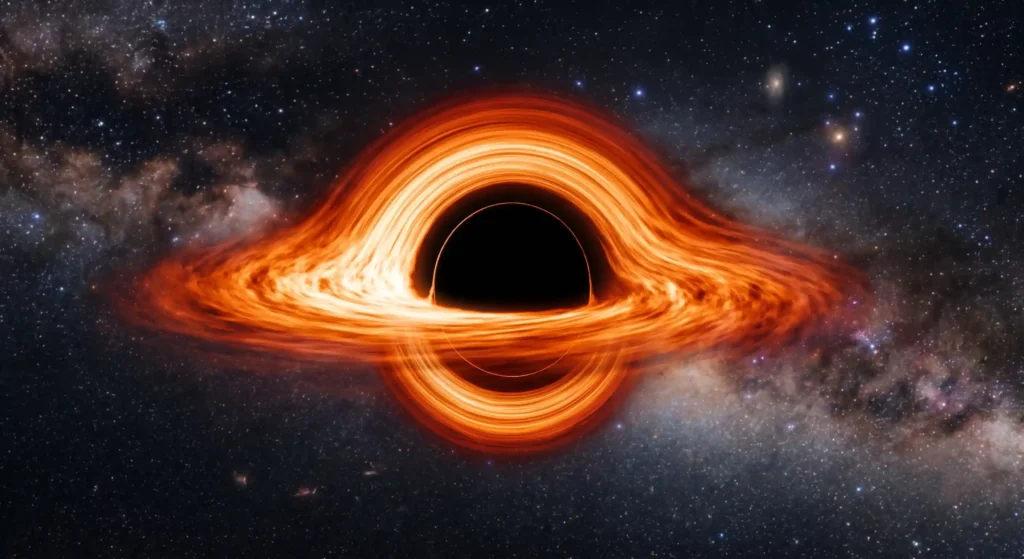
For decades black holes were a mathematical prediction. Now we observe them four independent ways:
Stars orbiting nothing
At the centre of the Milky Way, astronomers tracked stars whipping around an invisible point at thousands of kilometres per second for over two decades. The only object that could anchor those orbits is a supermassive black hole. This work earned the 2020 Nobel Prize in Physics.
Gravitational waves
In 2015, LIGO detected the ripples in spacetime from two black holes merging over a billion light-years away — the first direct detection of gravitational waves, and proof that black holes collide exactly as relativity predicts. Dozens of mergers have been caught since.
The first images
In 2019 the Event Horizon Telescope released an image of the black hole in galaxy M87, and in 2022 of our own Sagittarius A*: a dark shadow ringed by glowing, gravity-bent gas. To do it, astronomers linked radio dishes across the planet into a single Earth-sized virtual telescope.
Feeding and flares
X-ray telescopes spot black holes pulling gas from companion stars, and occasionally we catch a “tidal disruption event” — a star wandering too close and being shredded, flaring brightly as its remains spiral in. Each observation tests general relativity under the most extreme gravity in the universe, and so far, Einstein keeps passing.
Common myths, corrected
- “Black holes suck everything in.” No. A black hole’s gravity is no stronger than any object of the same mass. Replace the Sun with a black hole of identical mass and Earth’s orbit wouldn’t change — it would just get very dark and cold. You have to get close to be in danger.
- “A black hole could swallow the galaxy.” No. Even the supermassive black hole at the galactic centre governs only its immediate neighbourhood; the galaxy orbits the collective mass of all its stars and dark matter, not the black hole.
- “Particle colliders might make a deadly black hole.” No. Any micro black hole a collider could theoretically make would evaporate instantly, and cosmic rays far more energetic than any collider have bombarded Earth’s atmosphere for billions of years with no ill effect.
Could we ever harness a black hole?
It sounds absurd, but physics doesn’t forbid it — and for an advanced civilization, a black hole could be the ultimate power source. There are two routes. The first is the Penrose process: drop matter into the spinning ergosphere in just the right way, and it can come back out with more energy than it went in with, stolen from the black hole’s rotation. In principle, up to about 29% of a black hole’s mass-energy could be tapped this way.
The second is even more efficient: an accretion disk. As matter spirals in, it can convert up to 40% of its mass into energy before crossing the horizon — dwarfing nuclear fusion, which releases under 1%. A civilization that could build a structure around a black hole (a “black hole engine”) would have access to the most efficient energy generation the universe allows. This is deep-future speculation, not engineering — but it’s grounded in the same equations that describe real quasars, which are essentially natural versions of exactly this machine, already lighting up the distant universe.
Why black holes matter
Beyond spectacle, black holes are the universe’s ultimate physics laboratory. They’re where gravity is strongest, where general relativity and quantum mechanics are forced to meet — and where our two best theories openly contradict each other. Every observation, from a merger’s gravitational chirp to the shadow of an event horizon to a star torn apart, is an experiment at conditions no laboratory on Earth could ever reproduce. Understanding black holes isn’t just about exotic objects far away; it’s the most promising path toward the deeper theory that would finally unite all of physics.
Q&A
A black hole is a region where gravity is so strong that nothing, not even light, can escape once it crosses the boundary called the event horizon. It forms when enough matter is crushed into a small enough space that the escape velocity exceeds the speed of light.
Near a small black hole, tidal forces stretch you into a thin stream (“spaghettification”) before you reach the horizon. Near a supermassive one you could cross the horizon unharmed — but you could never return, and to outside observers you’d appear to freeze and fade at the edge forever.
Yes, through Hawking radiation a black hole slowly loses mass and eventually evaporates — but for a star-sized black hole this takes around 10⁶⁷ years, vastly longer than the current age of the universe.
Yes. A supermassive black hole called Sagittarius A*, about 4.3 million times the Sun’s mass, sits at the centre of our galaxy, 27,000 light-years away. It was directly imaged in 2022, and tens of millions of smaller stellar black holes are scattered through the galaxy.
Not realistically. Black holes only pull in what comes close; from a distance, a black hole with the Sun’s mass would have exactly the same gravitational pull as the Sun does now. There is no black hole anywhere near close enough to threaten Earth.
A neutron star is collapse stopped just short of forming a horizon — incredibly dense, but you can still see its surface. A black hole is collapse that never stopped. If a stellar core is heavier than about 2.2–2.3 solar masses, it becomes a black hole instead of a neutron star.
The Bigger Question
Black holes are where the rulebook of physics runs out. Cross the horizon and our equations predict a singularity they can’t actually describe; watch from outside and time itself seems to freeze. That gap — between what falls in and what we can ever know about it — is not a detail. It may be the thread that unravels the whole tapestry, revealing how gravity and quantum mechanics finally fit together. Pull on it further in how black holes slowly evaporate and the paradox that keeps physicists up at night — or step back and explore the wider universe on the Space & Cosmos hub.
For all their menace, black holes are less destroyers than teachers. They mark the exact edge of what matter and space can endure — and in showing us that edge, they point toward the physics that lies beyond it.