What space facts actually rewrite your sense of scale?
Most space facts fail at one job: conveying scale. The numbers grow so large they stop meaning anything. So start small. Light — the fastest thing that exists — crosses from the Sun to your eyes in roughly eight minutes.
From the next-nearest star, Proxima Centauri, that same light needs over four years. Almost everything in the universe is, quite literally, the empty distance between objects. That single fact reframes every other entry on this page.
How big is the universe, and what fills it?
The observable universe stretches roughly 93 billion light-years across. We can only see "observable" space because light from anything more distant has not had time to reach us since the Big Bang, around 13.8 billion years ago.
Inside that bubble sit the galaxies — vast islands of stars, gas and dust. Estimates of how many remain genuinely uncertain: a 2016 study suggested up to two trillion, while more recent spacecraft data hints the true figure may be closer to hundreds of billions. Either way, our own galaxy is one grain in an unimaginable beach.
- The solar system: light crosses it in hours.
- The Milky Way galaxy: light crosses it in about 100,000 years.
- The observable universe: light could not cross it in the entire age of the cosmos.
What are neutron stars and black holes?
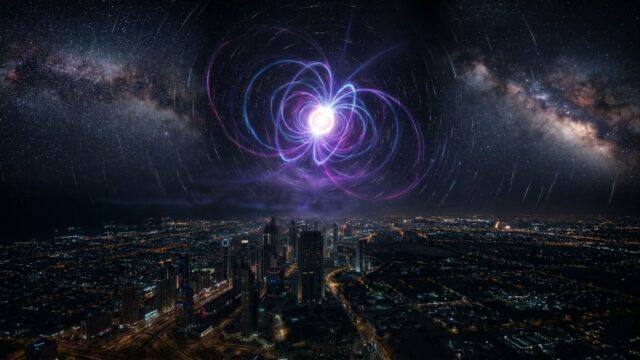
When a massive star dies, gravity crushes its core into one of nature's most extreme objects. Neutron stars are the milder outcome: a city-sized sphere so dense that a single teaspoon of its material would weigh on the order of a billion tonnes. We follow that density to its logical extreme in what would happen if a magnetar replaced the Moon.
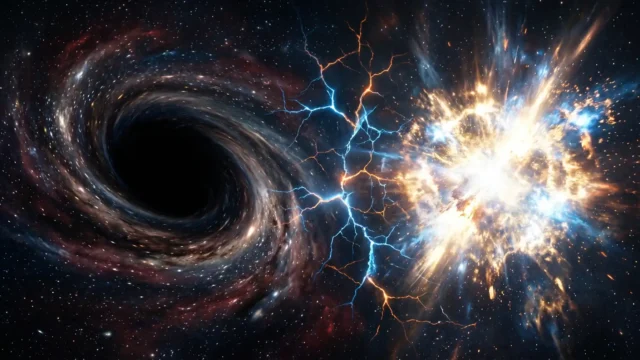
Black holes go further. Here gravity becomes so overwhelming that not even light escapes past a boundary called the event horizon. The supermassive black hole at our galaxy's centre, Sagittarius A*, holds roughly four million times the mass of the Sun — and it is far from the largest known. Even a microscopic black hole passing through the Earth would be an event no instrument could ignore — and the strangest matchup of all might be a white hole colliding with a black hole.
Where do our solar system and galaxy fit in?
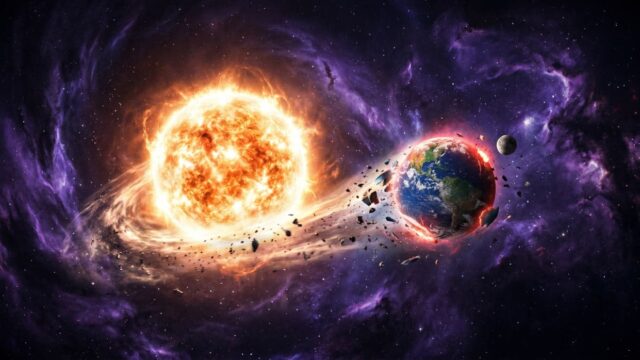
Our solar system — the Sun, eight planets and countless smaller bodies — orbits the centre of the Milky Way once every 230 million years or so. That orbit feels permanent, but it is not guaranteed: a close stellar flyby could, in principle, eject Earth from the solar system entirely.
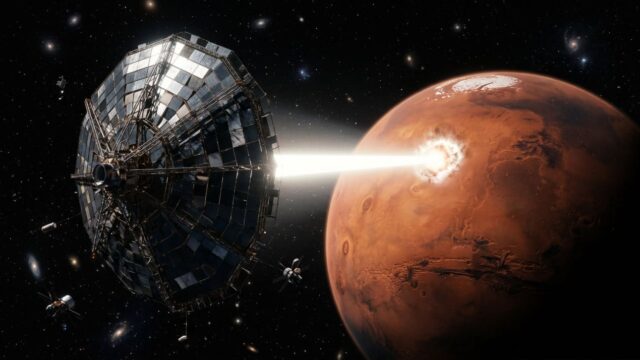
The galaxy itself contains somewhere between 100 and 400 billion stars, many likely hosting planets of their own. That ordinariness is its own astonishing astronomy fact. The chemistry that built Earth is not special to us — and some neighbouring worlds may even be candidates for planetary engineering, like melting Mars' ice caps with an orbital mirror.
What are supernovae and other cosmic phenomena?
A supernova is the explosive death of a massive star, briefly outshining its entire host galaxy. These blasts are not just spectacle — they forge and scatter the heavy elements that make up planets and people. The iron in your blood was cooked inside long-dead stars.
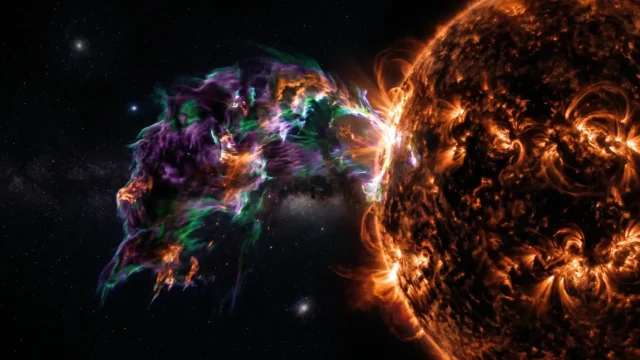
Supernovae are only one item in a catalogue of cosmic phenomena: pulsars, quasars, gravitational waves, colliding galaxies. Even our own quiet star takes part — roughly every eleven years the Sun's magnetic field flips, a routine reminder that stars are dynamic machines. Each is a natural laboratory testing physics under conditions no machine on Earth can reproduce.
Why explore deep space at all?
Studying deep space is how we stress-test our understanding of reality. Observations of distant galaxies revealed the universe is expanding; the behaviour of stars exposed dark matter; supernovae helped uncover dark energy.
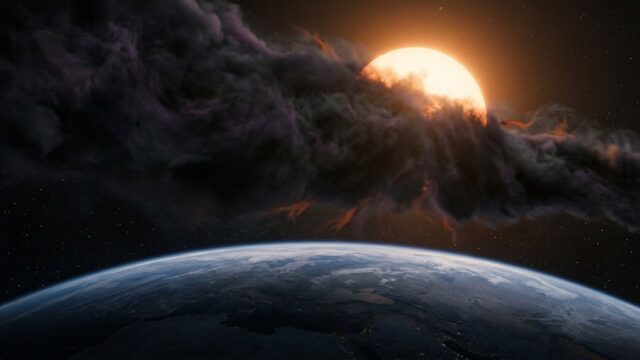
And the questions keep multiplying: could cosmic dust carry alien microbes? What changes if Earth drifts through a dense interstellar cloud? Every confirmed astronomy fact narrows the gap between what we assume and what is true. That is the quiet engine behind this hub — turning the most interesting space facts into questions worth chasing.
Space facts remain humanity's best reminder of proportion. The more carefully we map these astronomy facts — neutron stars, galaxies, supernovae and the architecture of the universe — the clearer it becomes that the most interesting space facts are also the most humbling. Explore every AstroAli what-if scenario to see where the physics leads next.
Q&A
Arguably that space is mostly emptiness. Even "crowded" galaxies are overwhelmingly vacuum, and stars almost never collide. The objects we marvel at are tiny specks separated by distances so vast that light itself takes years to cross them.
Estimates range from hundreds of billions to around two trillion, and the figure remains genuinely uncertain. Newer spacecraft data has pushed counts lower than older surveys suggested, so any precise number you see should be treated as an approximation.
Near a black hole, extreme gravity would stretch you in a process nicknamed "spaghettification." For very large black holes, the event horizon could be crossed without immediate violence — but escape, and any return of information, would be impossible.
About eight minutes and twenty seconds. Because light has a finite speed, you always see the Sun as it appeared minutes ago — and distant stars as they looked years, or even millions of years, in the past.
Black holes, by definition. A neutron star packs roughly a billion tonnes into a teaspoon, but a black hole concentrates mass so completely that escape velocity exceeds the speed of light, making it the densest phenomenon physics describes.