 By
By 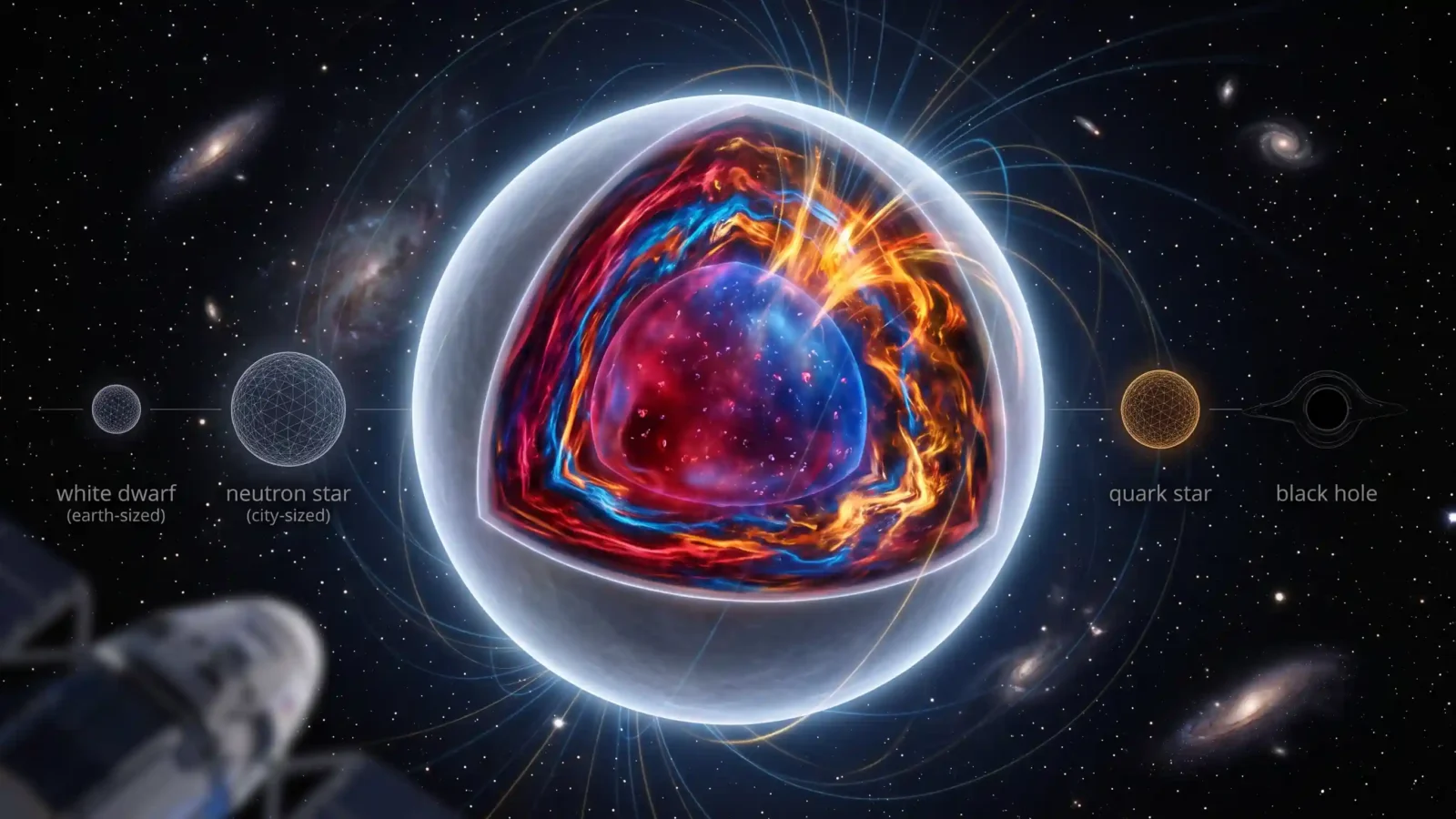
Quick Answer
A quark star is a hypothetical type of collapsed star even denser than a neutron star, in which the neutrons themselves have been crushed into a soup of their fundamental building blocks — quarks. It would sit in the narrow gap between a neutron star and a black hole: dense enough that ordinary matter has dissolved, but not quite dense enough to collapse completely. No quark star has been confirmed, but several candidate objects hint that they might be real.
If a neutron star is matter pushed to the edge, a quark star is matter pushed over it. To understand whether anything can be denser than a neutron star without becoming a black hole, physicists imagine a stage where the particles inside the star break apart entirely. This guide explains what a quark star is, how matter could get that dense, its link to the exotic idea of strange matter, and whether we have found one.
What Is a Quark Star?
A quark star is a proposed compact object made not of whole neutrons, but of the quarks that normally live locked inside them. In ordinary matter — and even inside a neutron star — quarks are bound together in groups of three to form protons and neutrons, held by the strong nuclear force. A quark star would be so dense that this confinement breaks down, releasing the quarks to roam freely as a single, continuous state of quark matter.
Such an object would be roughly the mass of a neutron star but possibly smaller and even denser, with the entire star behaving almost like one gigantic atomic nucleus made of quarks. Because nothing this dense has ever been directly confirmed, quark stars remain on the boundary between solid theory and speculation — predicted by physics, but not yet proven to exist.
How Matter Could Get Even Denser Than a Neutron Star
To picture how a quark star forms, follow what happens as you keep squeezing matter. In a neutron star, gravity has already crushed atoms so hard that electrons and protons have merged into neutrons packed at nuclear density, held up by neutron degeneracy pressure. But if a neutron star’s core is compressed even further — for example, if it gains extra mass or is born especially heavy — the pressure may become so extreme that the neutrons themselves can no longer hold their shape.
At that point, the boundaries between neutrons dissolve, and their constituent quarks are “deconfined,” forming a continuous quark matter. This could create a stable object midway between a neutron star and a black hole. If even this quark matter cannot withstand the gravity — above the maximum mass limit — then nothing can, and the object collapses into a black hole instead.
Strange Quark Matter Inside
The most intriguing version of the quark star involves strange quark matter. Ordinary matter is built from just two types of quark, called “up” and “down.” But at extreme densities, it may become energetically favourable for some of those to convert into a third, heavier type called the “strange” quark, producing matter made of up, down, and strange quarks in roughly equal numbers.
Some physicists have proposed a startling idea (known as the Bodmer–Witten hypothesis): that strange quark matter might actually be the most stable form of matter in the universe — more stable, in principle, than the ordinary atomic nuclei we are made of. If true, a quark star could be a “strange star” made entirely of this exotic substance. This raises an unsettling possibility explored in what if a single strangelet touched the Earth: that a small lump of strange matter, called a strangelet, could convert ordinary matter it touches into more strange matter. Whether strange matter is truly stable remains one of the open questions of physics.
Have We Ever Found One?
No quark star has been confirmed, but astronomers have flagged several intriguing candidates. The main clue would be a compact star that is unusually small for its mass, or that cools in an unexpected way — both signs that its interior is denser or behaves differently than a normal neutron star. A few observed compact objects have appeared smaller or cooler than standard neutron star models predict, prompting speculation that they could be quark stars.
The difficulty is that neutron stars and quark stars look very similar from a distance, so telling them apart requires extremely precise measurements of mass and radius. Instruments like NASA’s NICER are now measuring these properties more accurately than ever, gradually narrowing down what the interiors of the densest stars are made of. For now, the verdict is “possible but unproven.”
Quark Stars vs Neutron Stars vs Black Holes
- White dwarf: held up by electron degeneracy pressure; about the size of Earth.
- Neutron star: atoms crushed into neutrons; a city-sized ball held up by neutron degeneracy pressure.
- Quark star (hypothetical): neutrons dissolved into free quarks; even denser, possibly smaller.
- Black hole: gravity wins entirely; matter collapses to a point and nothing, not even light, escapes.
A quark star, if it exists, would occupy the rung just below a black hole — the densest possible matter that can still hold itself up against total collapse.
Why They Matter for Physics
Quark stars are not just exotic curiosities. They are natural laboratories for studying matter at densities no experiment on Earth can reach. The behaviour of quark matter is governed by the strong nuclear force, described by a theory called quantum chromodynamics, and the conditions inside collapsed stars probe that theory at its limits. Confirming or ruling out quark stars would teach us about how matter behaves under the most extreme pressures in the universe — and could settle whether strange quark matter is stable, which has implications far beyond astronomy.
Q&A
It is not confirmed. Quark stars are predicted by physics and there are candidate objects that hint at their existence, but no observation has definitively proven that any star is made of free quark matter. They remain a strong theoretical possibility awaiting confirmation.
The best clues are a compact star that is too small for its mass or cools unusually fast, since quark matter has different properties than neutron matter. Precise measurements of a star’s mass and radius — for example with NASA’s NICER instrument — are the main way to distinguish a quark star from a neutron star.
Yes. If a quark star gains enough mass to exceed the maximum that quark matter can support against gravity, nothing can stop further collapse and it would become a black hole. Quark stars, if they exist, occupy a narrow mass range just below that threshold.
There is no confirmed quark star, so there is no definitive “nearest” one. Some relatively nearby compact stars have been proposed as candidates because they appear unusually small, but these identifications are tentative and debated.
The Bigger Question
Quark stars push the idea of density to its absolute limit — and they raise a deeper question about the very nature of matter. If strange quark matter is truly more stable than the ordinary atoms we are built from, then a tiny seed of it could, in theory, be catastrophically contagious. That terrifying scenario is exactly what we examine in what if a single strangelet touched the Earth.
To see how physicists recreate quark matter in the lab, read our companion article on quark-gluon plasma, or explore more mind-bending physics on the Extreme Physics hub.
Watch the strangelet scenario to see what the densest matter in the universe could do to ordinary atoms.