
What is theoretical physics, and why is it so strange?
Theoretical physics uses mathematics to describe how the universe works at its deepest level — then makes predictions that experiments can test. Its strangeness is not a bug. It is what happens when you push beyond the human-scale world our intuition was built for.
At very small sizes, very high speeds, or very strong gravity, the familiar rules break down. The theoretical physics concepts that replace them are precise, repeatedly verified, and almost impossible to picture. That tension is the heart of the field.
How does quantum mechanics change the picture?
Quantum mechanics governs the behaviour of the smallest things — electrons, photons, atoms. In this realm, particles can exist in combinations of states at once, and the act of measurement appears to fix an outcome. Nothing in daily life prepares you for it.
Crucially, quantum mechanics is not loose speculation. It underpins lasers, transistors and the device you are reading this on. It is among the most rigorously tested ideas in all of modern physics.
What did relativity teach us about space and time?
Einstein's general relativity, published in 1915, recast gravity not as a force but as the bending of space and time by mass. Massive objects curve the fabric of reality, and other objects follow those curves — what we feel as gravity.
Its predictions have held up spectacularly, from light bending around the Sun to the detection of gravitational waves a century later.
- Old view: space and time are a fixed, neutral stage.
- Relativity: space and time stretch, warp and slow depending on motion and gravity.
What is particle physics looking for?
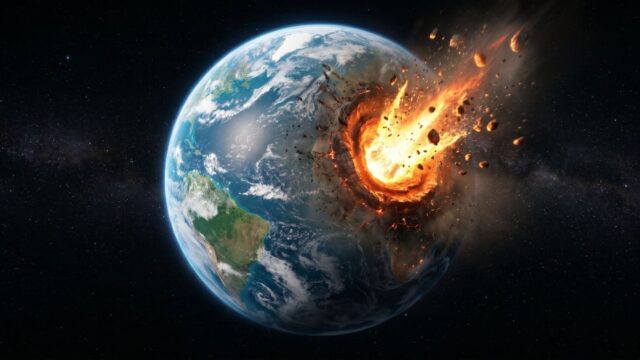
Particle physics studies the universe's most basic building blocks and the forces between them. Its crowning framework, the Standard Model, was confirmed when the Higgs boson was discovered at CERN's Large Hadron Collider in 2012. The same machines raise sharper questions — such as what follows if a single strangelet touched the Earth.
The field also probes antimatter — material identical to ordinary matter but with opposite charge. When matter and antimatter meet, they annihilate completely, releasing energy in line with Einstein's famous equation. Why the universe contains so much more matter than antimatter remains an open puzzle.
What are dark matter, string theory, and the multiverse?
Some of the boldest theoretical physics concepts address what we cannot see. Dark matter is unseen mass that bends light and holds galaxies together; ordinary matter makes up only around 5% of the cosmos, with the rest in dark matter and dark energy.
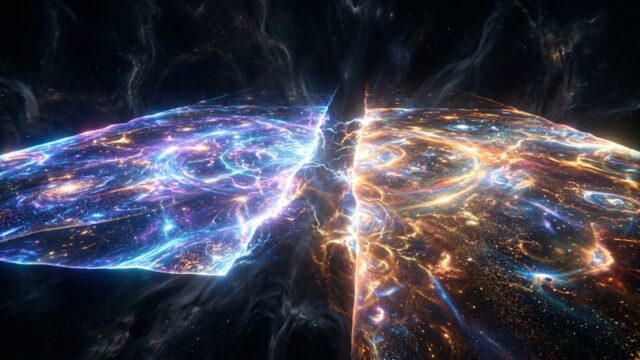
String theory attempts to unify all forces by proposing that particles are tiny vibrating strings, possibly requiring extra spatial dimensions. The multiverse — the idea that our universe is one of many — emerges from several such frameworks, including scenarios where two braneworlds collide. Both remain unconfirmed, and scientists are open about that.
Why do physicists rely on thought experiments?
When equipment cannot reach the conditions in question, physicists turn to thought experiments — carefully reasoned imaginary scenarios. Einstein imagined riding alongside a beam of light; Schrödinger imagined a cat both alive and dead.
AstroAli's documentaries work the same way — asking what happens if vacuum decay begins in a particle collider, or if the atmosphere liquefies at absolute zero — then following the equations honestly. These exercises expose hidden assumptions and have repeatedly pointed the way to real discoveries, making them a serious tool of modern physics rather than a sideshow.
Theoretical physics endures because it keeps being right about things that sound impossible. Whether through quantum mechanics, the contested edges of string theory, or the next generation of theoretical physics concepts, modern physics continues to turn the unimaginable into the carefully measured. Browse all AstroAli physics scenarios to watch those ideas pushed to their limits.
Q&A
Theoretical physics builds mathematical models to explain and predict nature, while experimental physics tests those predictions with real measurements. The two depend on each other: a theory is only accepted once experiments repeatedly confirm what it forecasts.
There is no direct evidence for a multiverse. It appears as a consequence of several theoretical frameworks, including some versions of string theory, but it remains unconfirmed and debated. Treat it as a serious hypothesis, not an established fact.
Antimatter is ordinary matter's mirror image, with opposite electric charge. When a particle meets its antiparticle, both vanish and convert entirely into energy. It is real, routinely made in tiny amounts, and central to particle physics research.
In relativity, light's speed is woven into the structure of space and time itself. Accelerating an object with mass toward that speed requires ever more energy, approaching infinity — so the speed of light acts as an unbreakable cosmic limit.
Nobody knows yet. Dark matter does not emit light, but its gravity bends starlight and holds galaxies together. Leading candidates are undiscovered particles. Identifying it is one of the biggest unsolved problems in modern physics.