What geology facts surprise people most?
The single most disorienting geology fact is that solid ground is not solid in the way it feels. Earth formed about 4.54 billion years ago, and beneath the thin crust we live on lies a churning, scorching interior in constant slow motion.
The continents themselves drift, oceans open and close, and mountains rise and erode — all on timescales so long that a human life is a blink. Most of geology is the study of that hidden, patient machinery.
What are Earth's layers, from crust to core?
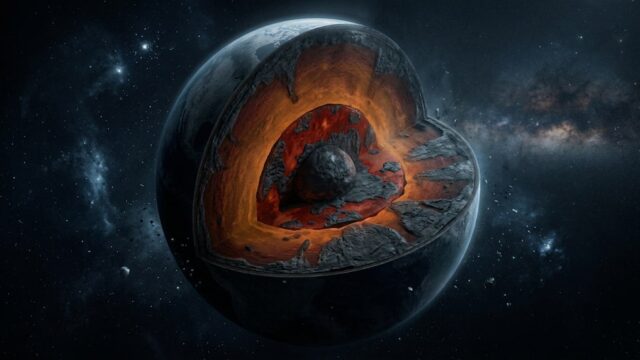
Earth is built like a series of nested shells.
- Crust: the thin, rocky outer skin we live on.
- Mantle: a thick layer of slowly flowing hot rock.
- Outer core: liquid iron and nickel that generates Earth's magnetic field.
- Inner core: a solid iron-nickel ball at the centre.
These earth's layers are not just trivia. The inner core's heat drives motion in the mantle above it, which in turn powers nearly everything that happens at the surface.
How hot is Earth's core?
Earth's core is staggeringly hot. The inner core is estimated at roughly 5,000 to 6,000°C — comparable to the surface of the Sun — though the exact figure remains uncertain because no instrument can reach it directly.
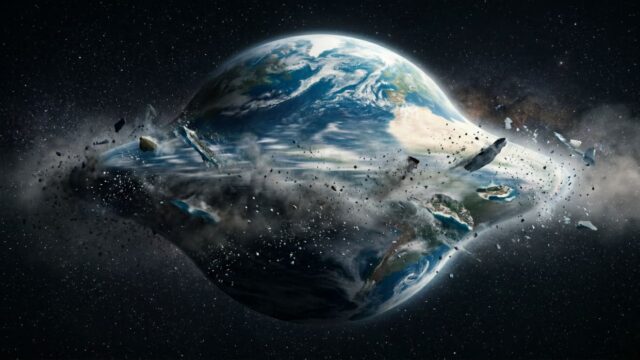
Despite that heat, immense pressure keeps the inner core solid. This is one of the more counter-intuitive earth science facts: the centre of the planet is hotter than molten rock yet does not melt, simply because it is squeezed so hard. The follow-up question gets its own documentary: what if Earth's core solidified entirely?
What is plate tectonics?
Plate tectonics is the grand unifying theory of geology. Earth's rigid outer shell is broken into roughly fifteen to twenty plates that ride on the slowly flowing mantle beneath.
Where plates pull apart, new crust forms; where they collide, mountains rise or one plate dives beneath another. This single framework explains the layout of continents and oceans, and it sets the stage for the planet's most dramatic events.
What causes earthquakes, volcanoes and tsunamis?
Most natural disasters of geological origin trace back to those moving plates. Earthquakes strike when stressed rock along a fault suddenly slips, releasing stored energy as seismic waves.
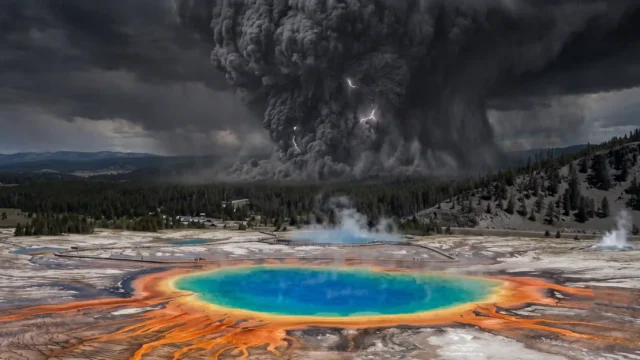
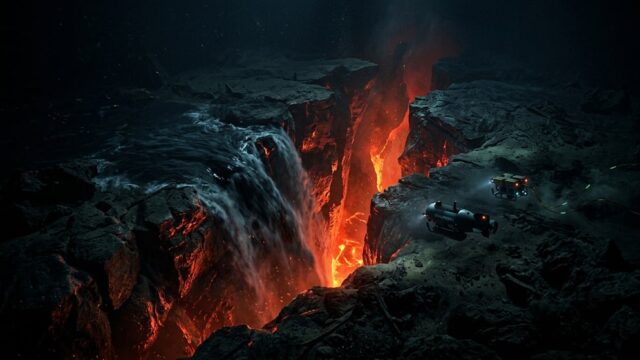
Volcanoes form where molten rock reaches the surface, often near plate boundaries. And when a large quake displaces the seafloor, it can send tsunamis racing across an ocean at jetliner speeds — the mechanism behind the deepest ocean trench cracking open. The rarest and most extreme cousins are supervolcanoes, capable of eruptions thousands of times larger than ordinary ones; we follow that scenario in what if Yellowstone erupted tomorrow.
Why do these earth science facts matter?
Geology is not only about the deep past. Understanding plate tectonics lets us map where earthquakes and volcanoes are likely, informing building codes and warning systems that save lives.
The same knowledge locates water, energy and minerals, and helps us read the climate record stored in rock. Turning interesting geology facts into practical foresight is the quiet payoff of the entire science.
Geology facts reward attention because the ground is anything but inert. From earth's core to shifting plates, from volcanoes to tsunamis, these earth science facts reveal a living planet — and the more interesting geology facts we uncover, the better we predict the natural disasters that shape human life. Explore all AstroAli geology scenarios to see those forces unleashed.
Q&A
Arguably that continents move. Plate tectonics shows landmasses drift a few centimetres a year — about as fast as fingernails grow. Over millions of years that slow creep rearranges entire oceans and builds the world's mountain ranges.
Earth's inner core is estimated at roughly 5,000 to 6,000°C, about as hot as the Sun's surface. The figure is uncertain because the core cannot be measured directly; it is inferred from seismic data and laboratory experiments on iron.
Earthquakes occur when stress built up along a fault overcomes friction, and rock suddenly slips. That release sends seismic waves through the ground. Most large earthquakes happen near the boundaries of Earth's moving tectonic plates.
Supervolcanoes like Yellowstone are real but extremely rare. A major eruption could disrupt climate and agriculture globally, yet such events occur on timescales of hundreds of thousands of years, and there is no sign one is imminent.
Pressure. At Earth's centre, the crushing weight of everything above forces iron atoms together so tightly that they cannot break into a liquid, even at temperatures that would easily melt the same metal at the surface.