 By
By 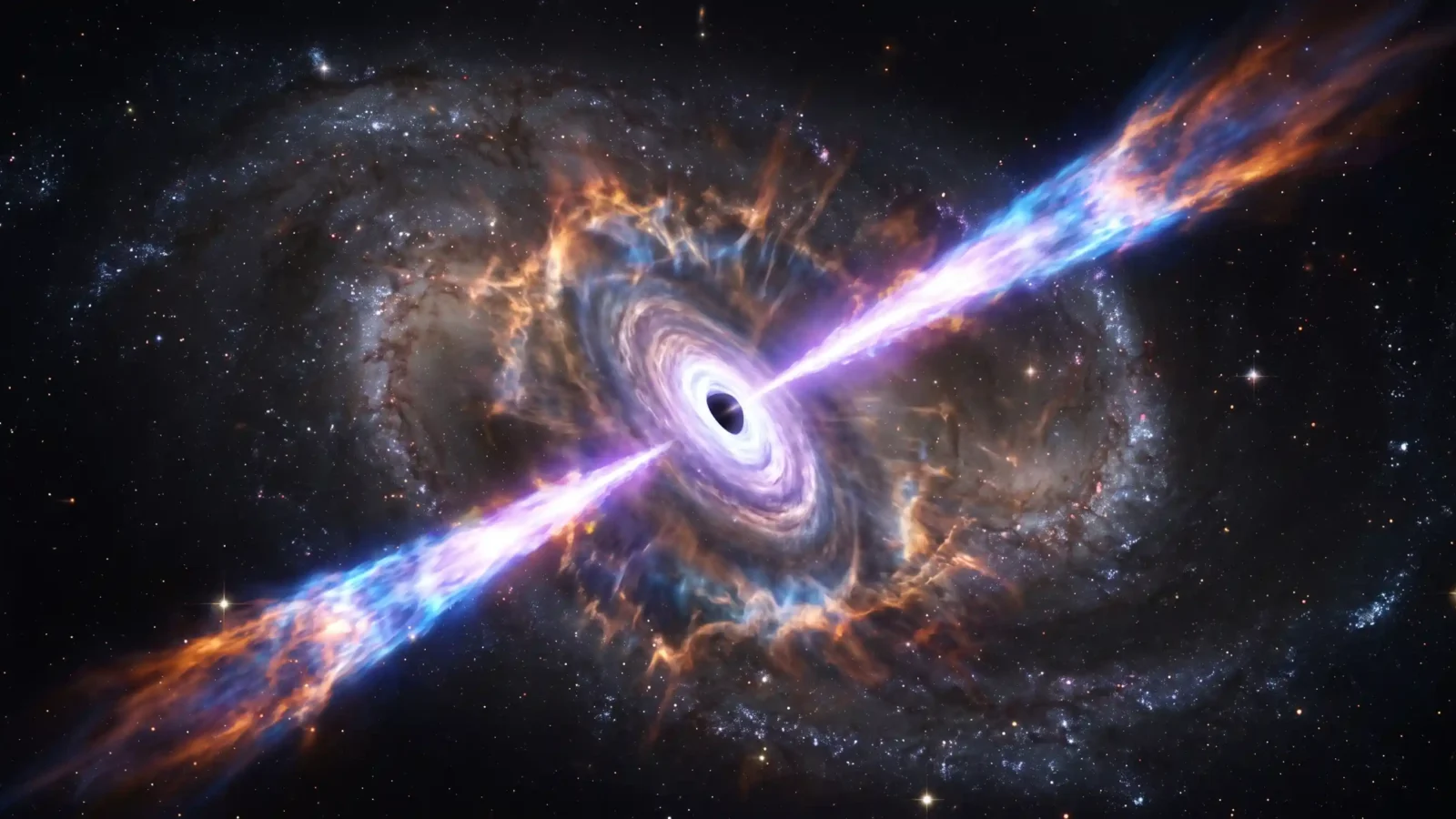
Quick Answer
A gamma-ray burst (GRB) is the most violent explosion in the universe — a flash of high-energy gamma rays that can release more energy in a few seconds than the Sun will emit over its entire ten-billion-year lifetime. GRBs come in two types, born either from the collapse of a giant dying star or from the collision of two neutron stars, and we detect roughly one somewhere in the sky every day from across billions of light-years.
For a few seconds, a single gamma-ray burst can briefly outshine all the other gamma-ray sources in the universe combined. They are so luminous we can see them from the edge of the observable cosmos, billions of light-years away. This guide explains what gamma-ray bursts are, the two very different ways they form, how they connect to magnetars, and the real (and reassuringly small) odds that one could ever threaten Earth.
What Is a Gamma-Ray Burst?
A gamma-ray burst is an intense, narrowly beamed jet of gamma radiation — the most energetic form of light — released during the catastrophic death of a star or the merger of dense stellar remnants. The burst itself lasts anywhere from a fraction of a second to a few minutes, followed by a fading “afterglow” in X-rays, visible light, and radio waves that can linger for days or weeks.
GRBs were discovered by accident in the late 1960s by U.S. Vela satellites built to detect clandestine nuclear weapons tests. Instead of bomb signatures, they kept catching mysterious flashes of gamma rays coming from deep space. For decades their distance was unknown. Only in the 1990s did astronomers confirm that GRBs occur in distant galaxies, which meant their true energy output was almost unimaginably large.
Because the energy is funnelled into tight jets rather than radiated in all directions, the apparent (“isotropic-equivalent”) energy of a bright GRB can reach 1047 joules — comparable to converting the mass of a planet, or even a fraction of the Sun, entirely into light.
Long vs Short Bursts (two different origins)
Astronomers sort gamma-ray bursts into two broad families based on how long they last, and the divide reflects two genuinely different cosmic catastrophes.
Long bursts — collapsing massive stars
Bursts lasting more than about two seconds are called long GRBs, and they account for most of what we detect. They are produced when an extremely massive, rapidly spinning star runs out of fuel and its core collapses directly into a black hole — a scenario known as a collapsar. As matter spirals into the new black hole, it launches twin jets that punch out through the star’s poles at more than 99.99% of the speed of light. Long GRBs are often accompanied by a particularly energetic supernova (a Type Ic), confirming their link to dying giant stars.
Short bursts — neutron star mergers
Bursts lasting less than about two seconds are short GRBs. These come from the merger of two ultra-dense objects — typically two neutron stars, or a neutron star and a black hole — that have spiralled together over millions of years. This connection was spectacularly confirmed in 2017, when the gravitational-wave event GW170817 (two merging neutron stars) was accompanied by a short gamma-ray burst, GRB 170817A, detected just 1.7 seconds later. It was the first time a single cosmic event was “seen” in both gravitational waves and light.
Magnetar Flares and Soft Gamma Repeaters
Not every flash of gamma rays is a true cosmological gamma-ray burst. Some come from magnetars — neutron stars with the most powerful magnetic fields in the universe — within our own galaxy and nearby ones. When a magnetar’s crust cracks under magnetic stress, it can release a giant flare: a burst of gamma rays so intense that the most powerful ones, seen in other galaxies, can masquerade as short GRBs.
The most famous example occurred in 2004, when the magnetar SGR 1806−20 unleashed a giant flare that, despite being roughly 50,000 light-years away, briefly disturbed Earth’s ionosphere. Objects that flare repeatedly in this way are called soft gamma repeaters. The link is direct: to understand how a magnetar could threaten our planet, see what if a magnetar replaced the Moon, and to understand the objects themselves, our explainer on neutron stars lays out the foundations.
How Powerful Are They, Really?
The energy scales are difficult to overstate. A typical long GRB releases, in its narrow jets, an amount of energy that would take the Sun many billions of years to match. Because we usually only detect bursts whose jets happen to point toward us, every one we see is a near-direct hit by a beam of the universe’s most energetic radiation.
- Speed: the jets travel at over 99.99% of the speed of light.
- Beaming: energy is focused into narrow cones a few degrees wide, not spread in all directions.
- Luminosity: for seconds, a single burst can outshine everything else in the gamma-ray sky.
- Reach: the brightest can be detected from over 13 billion light-years away.
In October 2022, astronomers recorded GRB 221009A, nicknamed the “BOAT” — the Brightest Of All Time. It was so luminous that it disturbed Earth’s upper atmosphere despite originating roughly two billion light-years away, and it is statistically the kind of event expected only once in many thousands of years.
Could a Gamma-Ray Burst Hit Earth?
This is the question most people really want answered, and the honest reply is: it is possible in principle but extremely unlikely in practice. For a GRB to harm Earth, it would need to be relatively close — within a few thousand light-years — and its jet would have to be pointed almost exactly at us, which is a rare alignment.
The Ordovician extinction hypothesis
One intriguing but unproven idea is that a nearby gamma-ray burst contributed to the Late Ordovician mass extinction about 445 million years ago, which wiped out a large fraction of marine life. The proposed mechanism is that a GRB’s radiation would strip away Earth’s ozone layer for years, letting harmful ultraviolet light from the Sun reach the surface and damaging the base of the food chain. It remains a hypothesis — there is no direct geological “smoking gun” — but it illustrates how a burst could do damage without ever physically touching the planet.
What the odds actually are
Estimates suggest a dangerously close, well-aimed GRB might strike Earth only once every few hundred million years or so. Our galaxy also has relatively few of the right kind of massive, low-metal stars near us that produce long GRBs. In short, while the consequences would be severe, the probability in any human lifetime — or even over recorded history — is vanishingly small.
How Astronomers Detect and Study GRBs
Because gamma rays are absorbed by our atmosphere, GRBs are caught by space telescopes. NASA’s Swift Observatory detects a burst, pinpoints its location within seconds, and automatically swivels to catch the fading X-ray and visible-light afterglow. The Fermi Gamma-ray Space Telescope monitors the whole sky and measures the burst’s high-energy spectrum. Ground-based telescopes then race to image the afterglow and identify the host galaxy, which reveals the distance.
Today, GRB science is part of “multi-messenger astronomy,” combining gamma rays, visible light, gravitational waves, and even neutrinos to reconstruct what happened. That is how the 2017 neutron star merger was decoded so completely — and why each new burst is a chance to study physics at energies no laboratory on Earth could ever reach.
Q&A
No known star close enough is both capable of producing a long GRB and aligned to fire its jet at us. The candidates sometimes mentioned, such as the Wolf-Rayet system WR 104, are debated, and even there the jet orientation is uncertain. There is no identified imminent threat.
In principle, a close, well-aimed burst could destroy much of the ozone layer for years, increasing harmful ultraviolet radiation at the surface. Some scientists have proposed this as a possible contributor to the Late Ordovician extinction, but it remains an unproven hypothesis.
Across the entire observable universe, satellites detect roughly one gamma-ray burst per day. In any single galaxy like the Milky Way, however, a GRB is thought to occur only once every few hundred thousand to a few million years.
The gamma rays themselves are invisible and blocked by the atmosphere. However, the visible-light afterglow of one burst, GRB 080319B, briefly reached a brightness that would have been faintly visible to the unaided eye — despite being about 7.5 billion light-years away.
Almost certainly not a dangerous one. Betelgeuse will eventually explode as a supernova, but it is not the rapidly spinning, low-metal type of star thought to make long GRBs, and its rotation axis is not pointed at Earth. Its supernova would be a dazzling sight, not a threat.
The Bigger Question
Gamma-ray bursts show that the universe can concentrate almost inconceivable energy into a single point and fling it across the cosmos. The magnetar flares that mimic the smallest bursts are produced by the same family of objects that inspire one of our most extreme thought experiments: what if a magnetar replaced the Moon? If a flash from 50,000 light-years away can rattle our atmosphere, the idea of one of these objects in our own backyard is genuinely sobering.
Explore more cosmic extremes on our Space & Cosmos hub, and see how a magnetar — the engine behind some of these flares — would reshape life on Earth.
Watch the magnetar scenario to see what the universe’s most powerful magnet would do from point-blank range.