What is existential risk, exactly?
Existential risk refers to threats that could permanently end humanity's potential — either by causing extinction or by collapsing civilisation beyond recovery. It is the most severe tier of a broader category called global catastrophic risk.
The distinction matters. A disaster might kill millions yet leave civilisation intact; an existential risk to humanity threatens the entire future. Researchers study these scenarios not to frighten, but because preventing the worst outcomes requires understanding them clearly.
Has Earth faced catastrophes before?
Yes — repeatedly. The fossil record documents five mass extinction events. The most severe, the end-Permian "Great Dying" around 252 million years ago, wiped out the overwhelming majority of species on the planet.
The most famous, roughly 66 million years ago, ended the age of the dinosaurs and was likely triggered by a massive asteroid impact. These events prove that life on Earth has no guarantee of continuity — a sobering baseline for any honest discussion of risk.
Which threats are natural versus human-made?
Risks fall broadly into two groups.
- Natural: asteroid impact, supervolcanic eruption, naturally emerging pandemics.
- Human-made: nuclear war, engineered pathogens, runaway climate change, and risks from powerful new technologies.
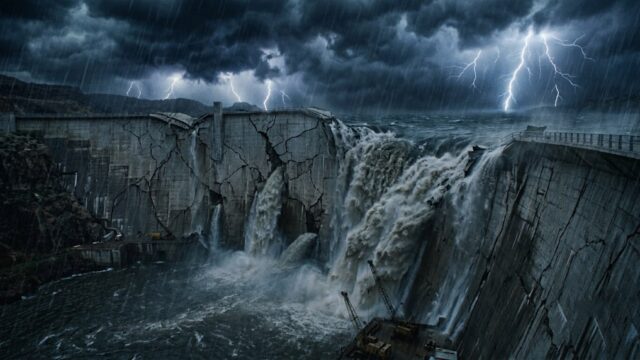
Many researchers argue the human-made category now dominates. Unlike a stray asteroid, these are hazards we create — which also means they are hazards we can choose to reduce. History already offers previews: the 1975 Banqiao dam disaster shows how a single infrastructure failure cascades into mass catastrophe, and even planetary mechanics can be interrogated — what if Earth's rotation spun twice as fast?
How dangerous are pandemics and nuclear war?
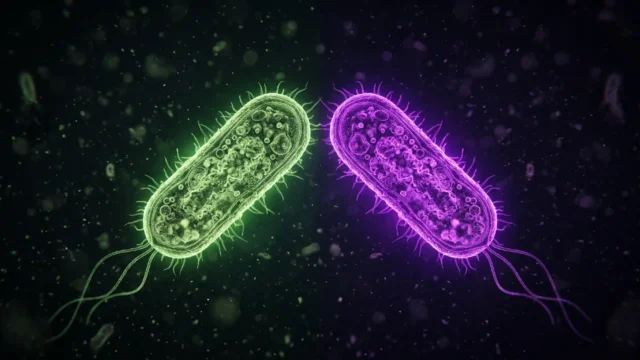
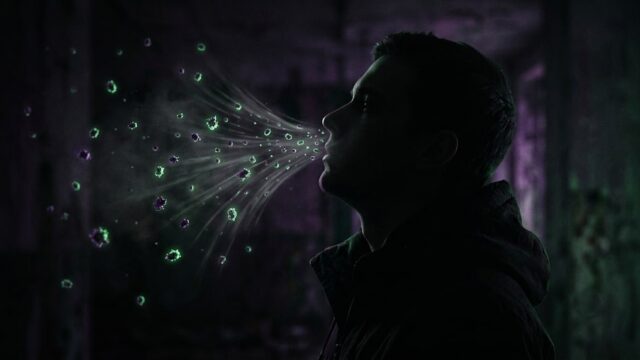
Pandemics have shaped history for millennia, and modern travel lets a new pathogen circle the globe in days. A naturally occurring outbreak is a serious global catastrophic risk; a deliberately engineered one could be far worse — the scenario we trace in what happens if an engineered super-virus becomes airborne. A newer cousin of that fear is synthetic mirror life escaping into the wild.
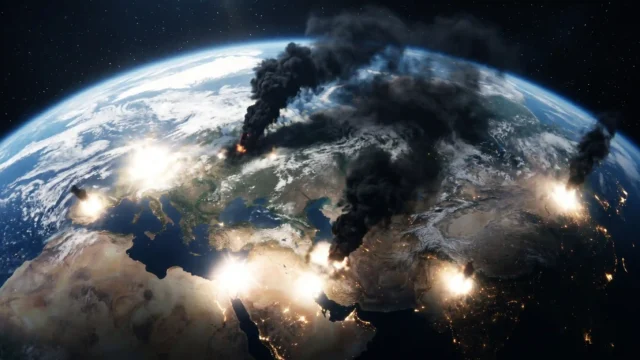
Nuclear war poses a more immediate path to civilisation collapse. Beyond the direct destruction, large-scale exchanges could loft soot into the atmosphere, cooling the planet and crippling food production — a scenario known as nuclear winter. We model the extreme end of that ledger in what if all nuclear weapons detonated at once. The danger lies in cascading effects, not just the initial blast.
Will climate change end civilisation?
Climate change is unlikely to cause human extinction on its own, but it is a powerful "threat multiplier." Global temperatures have already risen more than 1°C above pre-industrial levels, intensifying droughts, floods and food insecurity.
Its real danger is how it amplifies other pressures — straining resources, displacing populations and raising the odds of conflict. In risk terms, climate change rarely ends the story alone, but it makes many doomsday scenarios more likely to unfold.
So, what are humanity's actual odds?
Honest researchers resist single numbers, because the data is thin and the uncertainty is large. What they broadly agree on is that human survival is not automatic — and that several risks are larger today than at any point in history.
The encouraging half is that most leading risks are partly within our control. Early-warning systems, pandemic preparedness, arms reduction and emissions cuts all measurably shift the odds. Studying existential risk is ultimately a hopeful act: you cannot defend against a danger you refuse to name.
Existential risk is not a prophecy of doom but a planning discipline. By taking global catastrophic risk seriously — from mass extinction-scale impacts to engineered pandemics — we turn vague dread into concrete action, and give the long project of human survival its best possible chance against existential risk to humanity. See every AstroAli survival scenario to watch each threat followed to its conclusion.
Q&A
Researchers most often point to risks from advanced technologies — including nuclear war, engineered pandemics and powerful new tools — rather than natural disasters. Estimates vary widely and remain uncertain, but human-made hazards are generally judged larger than natural ones today.
Very unlikely in any given century. Large, civilisation-threatening asteroid impacts occur on timescales of hundreds of thousands to millions of years, and most large near-Earth objects are now tracked. Smaller, regionally destructive impacts are more frequent but survivable.
A natural pandemic causing human extinction is considered unlikely, since some populations almost always survive. The greater concern is a deliberately engineered pathogen, which could combine high lethality and high transmissibility in ways nature rarely produces.
On its own, climate change is unlikely to cause extinction, but it is a serious global catastrophic risk and a "threat multiplier." It worsens food insecurity, displacement and conflict, raising the probability of other catastrophic outcomes rather than ending civilisation directly.
Catastrophic risk covers disasters that kill huge numbers of people but leave civilisation able to recover. Existential risk is the narrower, more severe case where humanity's long-term future is permanently destroyed — through extinction or unrecoverable collapse.