 By
By 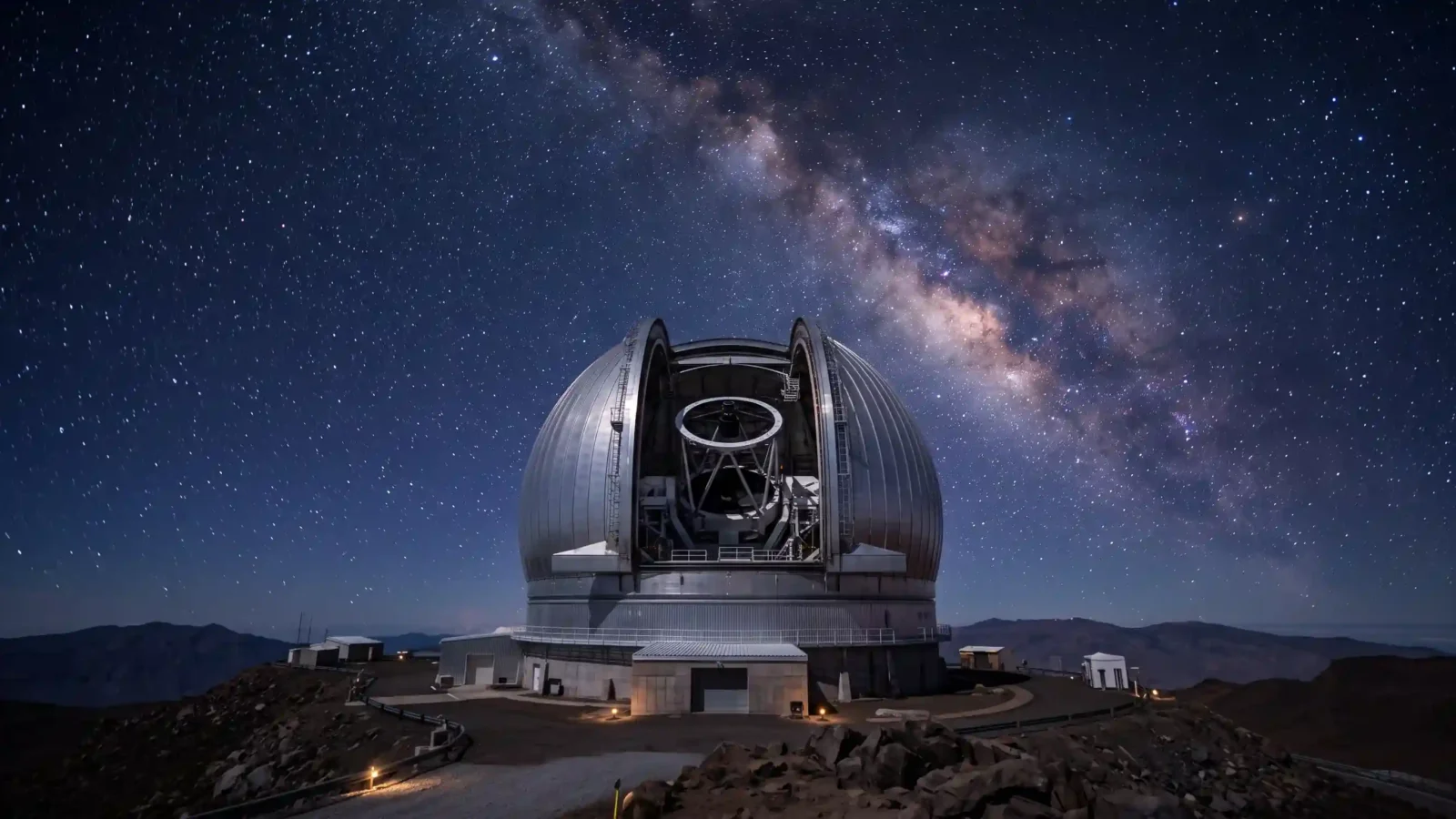
For a decade, a possible ninth planet — five to ten times Earth’s mass, hidden hundreds of times farther out than Earth — has been inferred but never seen. The case rests on a strange fact: the most distant icy bodies in the solar system have orbits that cluster together, tilted and aligned as if something massive is herding them. Now the Vera C. Rubin Observatory is scanning the sky, and within roughly 18 months of full survey it should either photograph Planet Nine or rule out most of the places it could hide.
This is the rare cosmic question with a real deadline. Rubin images the entire southern sky every few nights, going deep enough, often enough, to catch a faint dot that creeps against the stars. Planet Nine is exactly that kind of target — if it’s real.
Why it’s been invisible: the brutal 1/d⁴ law
A distant planet shines only by reflected sunlight, and that light gets punished twice. Sunlight spreads out as it travels to the planet (weakening as 1/distance²), and the reflected light spreads out again on its way back to us (another 1/distance²). The two effects multiply.
Reflected brightness falls off as roughly 1 / d⁴, where d is the distance in astronomical units (1 AU = Earth–Sun distance). Put Planet Nine at a plausible 600 AU:
d⁴ = 600⁴ = 130,000,000,000 (1.3 × 10¹¹).
An identical object at Earth’s distance would be about 100 billion times brighter than the same object at 600 AU. That factor is why decades of searching missed it — it sits near apparent magnitude 22–25, fainter than Pluto by a wide margin, buried in the noise of ordinary telescopes. Rubin, stacking repeat images, reaches past magnitude 24 and deeper. Planet Nine, if it exists near the expected size and distance, lands right inside that reach.
How you spot a planet you can’t resolve
Rubin won’t see a disc — just a point of light. The trick is motion. Stars are effectively fixed; a body at 600 AU drifts by a tiny but measurable amount over weeks. Rubin’s software flags anything that moves against the background, then links those detections into an orbit. A super-Earth at the solar system’s edge would reveal itself not as an image but as a slow, lonely track no star can fake.
What “settling it” really means
There are two ways to win. One: Rubin finds the dot, and a ten-year mystery ends with a new planet. Two: Rubin scans the predicted regions deeply enough that a planet of the expected mass can’t be hiding there — and the clustering of distant objects has to be explained some other way, maybe by a ring of unseen debris or a statistical fluke. Either outcome is a genuine result. Non-detection is not failure; it’s information.
The company Planet Nine would keep
Whatever Rubin finds, it’s surveying the least-mapped real estate in the solar system — the frozen frontier beyond Neptune where comets are born and the Sun is just the brightest star. That whole region traces back to one enormous reservoir of icy bodies: the Oort Cloud, explained.
What we know, and what we don’t
What’s solid: the orbital clustering is real and hard to explain by chance, and Rubin has the depth and cadence to test the hypothesis directly. What’s genuinely uncertain: whether the clustering points to a planet at all, and if so, exactly how big and how far. That’s the honest state of play — which is what makes the next year and a half worth watching. For once, we’re not waiting on a theory. We’re waiting on a telescope that’s already looking.
Somewhere past 600 AU there is either a planet or a very good reason there isn’t one. In the history of astronomy, that question has rarely had an expiration date. This time it does.