 By
By Inside the Magma Chamber That Could Erupt Tomorrow
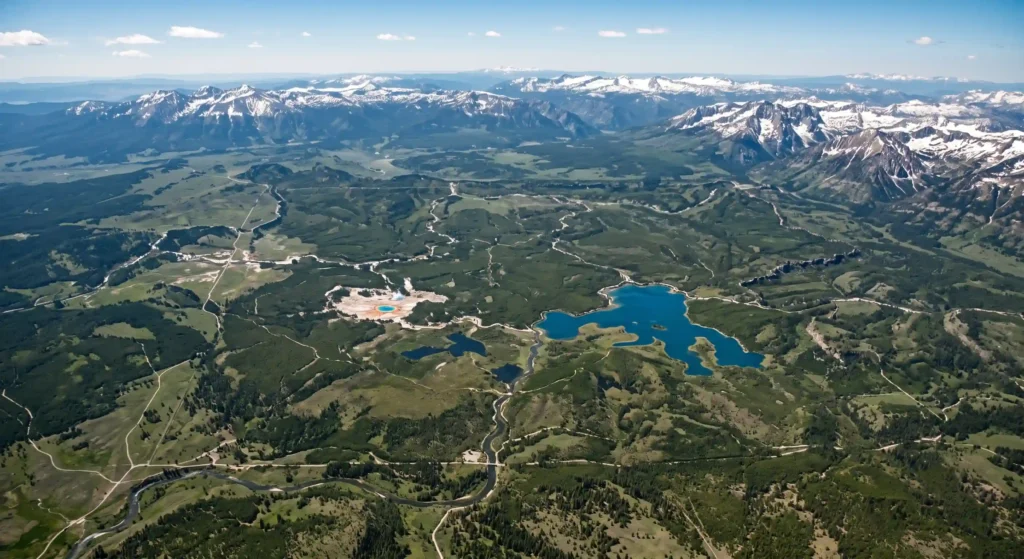
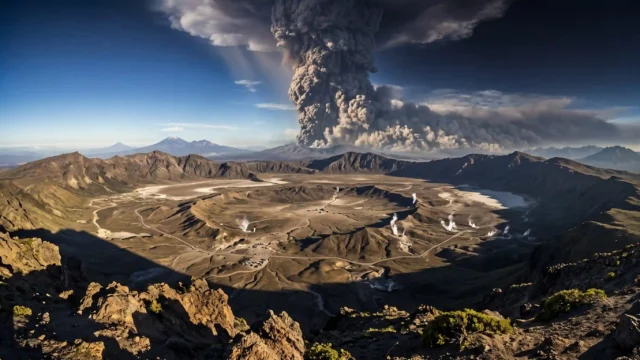
Yellowstone is not a mountain with a crater — it is a caldera: the collapsed depression left after a catastrophically large eruption empties a magma chamber. The Yellowstone caldera spans 55 × 72 kilometres in northwestern Wyoming, formed by a supereruption 640,000 years ago that ejected roughly 1,000 km³ of material — the Lava Creek Tuff eruption, a VEI 8 event on the Volcanic Explosivity Index.
The Yellowstone hotspot has produced three such supereruptions: 2.1 million years ago (Huckleberry Ridge Tuff, ~2,500 km³), 1.3 million years ago (Mesa Falls Tuff, ~280 km³), and 640,000 years ago (Lava Creek Tuff, ~1,000 km³). The recurrence interval is irregular — not a regular “640,000-year clock” as sometimes claimed. Current USGS monitoring shows the Yellowstone magma chamber is roughly 5–15% molten, well below the threshold (~50% melt fraction) considered necessary for a supereruption.
Would There Be Any Warning?
Almost certainly yes — and this is the single most important qualifier on everything that follows. A caldera-forming eruption is not a switch that flips. It requires a mostly-solid magma reservoir to remelt and mobilise on a scale of hundreds of cubic kilometres, and that process cannot happen silently beneath one of the most densely instrumented pieces of ground on Earth.
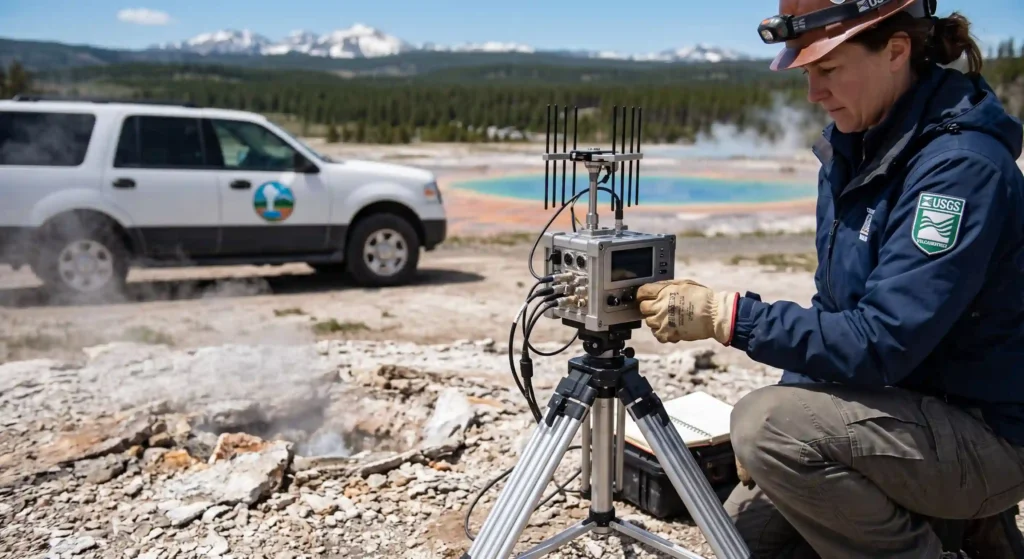
The Yellowstone Volcano Observatory runs a permanent network of seismometers, GPS stations, satellite radar, gas sensors, and stream gauges across the park. A genuine run-up to a supereruption would light up every one of them, in a recognisable escalating sequence:
- Years to decades out: a sustained change in the caldera’s long-term behaviour — uplift that keeps accelerating instead of cycling, and a rising rate of deep, long-period earthquakes indicating fluid movement at depth.
- Months to years out: intense, migrating earthquake swarms tracking upward through the crust; ground deformation of tens of centimetres concentrated over one part of the caldera; a shift in gas chemistry toward a higher sulfur-to-carbon ratio, signalling fresh magma rising.
- Weeks to months out: harmonic tremor — continuous rhythmic shaking caused by magma forcing its way through rock — plus dramatic changes across the hydrothermal system as geysers and hot springs respond to the heat below.
- Days to hours out: shallow seismicity, rapid deformation, opening of fissures, and phreatic (steam-driven) blasts as groundwater flashes against the rising magma.
The hard problem is not detection but interpretation. Calderas produce false alarms routinely — unrest that builds impressively and then fades without any eruption. Long Valley in California did exactly that in the 1980s; Campi Flegrei in Italy has been doing it for two decades. Deciding when unrest has crossed from restlessness into commitment, and ordering a mass evacuation of three states on that call, would be one of the hardest decisions in the history of emergency management. But the signal would be there. Nothing about this scenario begins without notice.
When Will Yellowstone Erupt?
USGS scientists consistently state that Yellowstone is not overdue for a supereruption and that the current level of activity is normal for an active volcanic system. The statistical probability of a Yellowstone supervolcano eruption in any given year is approximately 1 in 730,000. By comparison, an individual’s lifetime risk of dying in a car accident in the US is about 1 in 100. The most realistic eruption scenario for Yellowstone in the near geological term is a hydrothermal explosion (like the 1989 Pork Chop Geyser explosion) or a smaller effusive lava flow, not a supereruption.
That said, the physics of a full VEI 8 supereruption is well-understood from the geological record and from smaller supereruptions like Mount Tambora (VEI 7, 1815), whose 60 Tg of SO₂ injection caused the “Year Without a Summer” in 1816 — crop failures across Europe and North America and an estimated 90,000 deaths. Yellowstone at full scale would be roughly 8–10 times larger than Tambora.
The First 24 Hours
Assume the extraordinarily unlikely has happened: the warning signs escalated past the point of doubt, and the caldera roof fails. Here is how the first day would unfold, based on the physics of caldera collapse and the deposits left by past supereruptions.
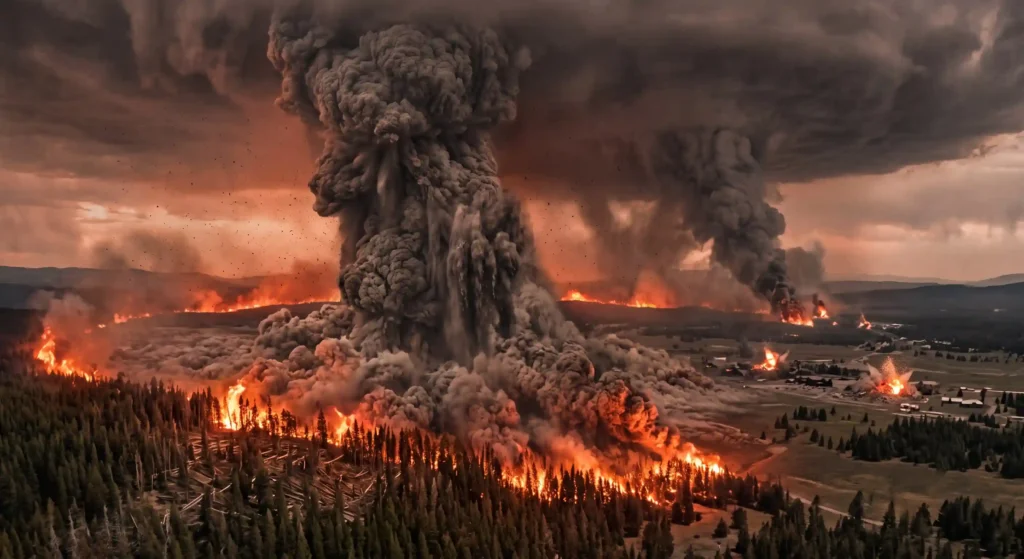
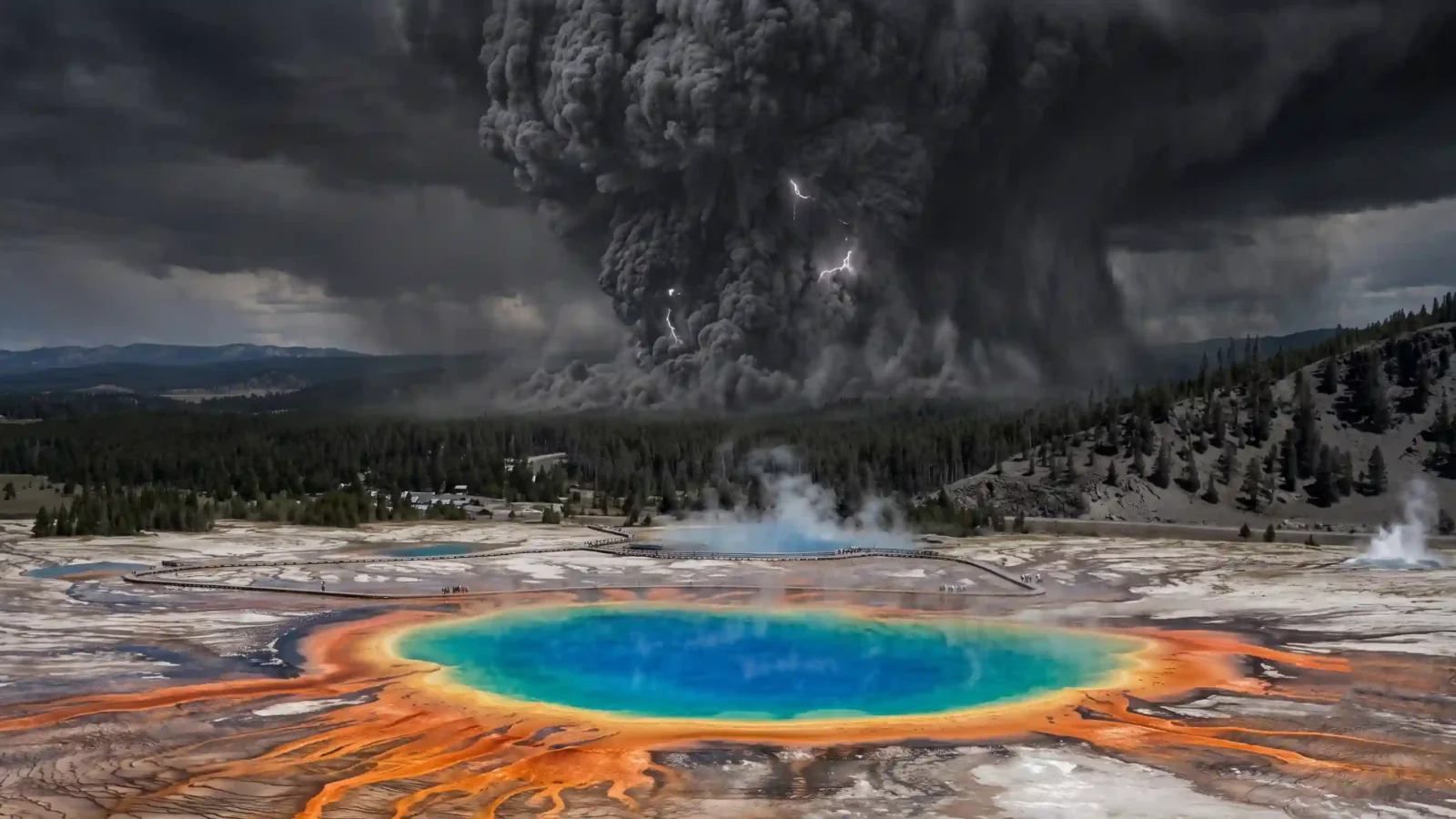
- T+0 to 10 minutes — the ring fracture opens. The eruption does not begin at a single vent. Magma finds the ring faults encircling the caldera and erupts along a curved fissure tens of kilometres long. A column of ash and gas punches into the stratosphere within minutes, reaching 25–40 km altitude. The seismic signal registers worldwide.
- T+10 minutes to 1 hour — column collapse. The eruption column becomes too dense to stay aloft and collapses under its own weight. This is the moment that generates pyroclastic flows: avalanches of gas, ash and rock at 100–700 km/h and 100–900 °C, radiating outward in every direction from the ring fracture. Everything within roughly 100 km of the caldera is destroyed.
- T+1 to 6 hours — the umbrella cloud. The sustained plume spreads sideways at the top of the stratosphere into an umbrella cloud that expands in all directions, largely independent of wind at first. Modelling published by USGS researchers shows this umbrella dynamic is why ash would reach both coasts, not just downwind states. Darkness falls across the northern Rockies at midday.
- T+6 to 12 hours — regional ashfall begins. Ash starts settling across Montana, Idaho, Wyoming, Utah and the Dakotas. Air travel across the western United States halts. Cell networks and power distribution begin failing as ash — electrically conductive when damp — shorts out insulators and transformers.
- T+12 to 24 hours — continental spread. The ash cloud reaches the Midwest and begins crossing into the eastern United States and southern Canada. Roofs in the heavy-fall zone start to fail, especially anywhere rain has fallen and doubled the ash’s weight. The caldera floor, meanwhile, has been collapsing throughout — dropping hundreds of metres and enlarging the crater.
One correction to the disaster-film version: the eruption would not be over in a day. Past supereruptions deposited their material over days to weeks of sustained, pulsing activity, not a single instantaneous blast. The first 24 hours would set the pattern, not finish the event.
What Would the Ashfall Look Like?
The 1980 Mount St. Helens eruption (VEI 5) deposited ash across Washington, Idaho, and Montana. A VEI 8 Yellowstone supereruption would be roughly 10,000 times more energetic. Modelling by USGS and university researchers shows:
- Within 500 km (roughly Kansas City): 1–3 metres of ashfall — collapses roofs, clogs water supplies, makes vehicle travel impossible for weeks
- Within 1,000 km (roughly Chicago, Denver): 10–30 cm of ash — agricultural devastation, infrastructure paralysis
- Beyond 1,500 km: 1–10 cm of ash over most of the continental US — agricultural disruption, aviation shutdown across North America
Volcanic ash is not soft like snow — it is ground glass, highly abrasive, electrically conductive when wet, and toxic to lungs. Fine ash particles (less than 10 micrometres) pose the greatest respiratory hazard and can remain suspended in the troposphere for weeks.
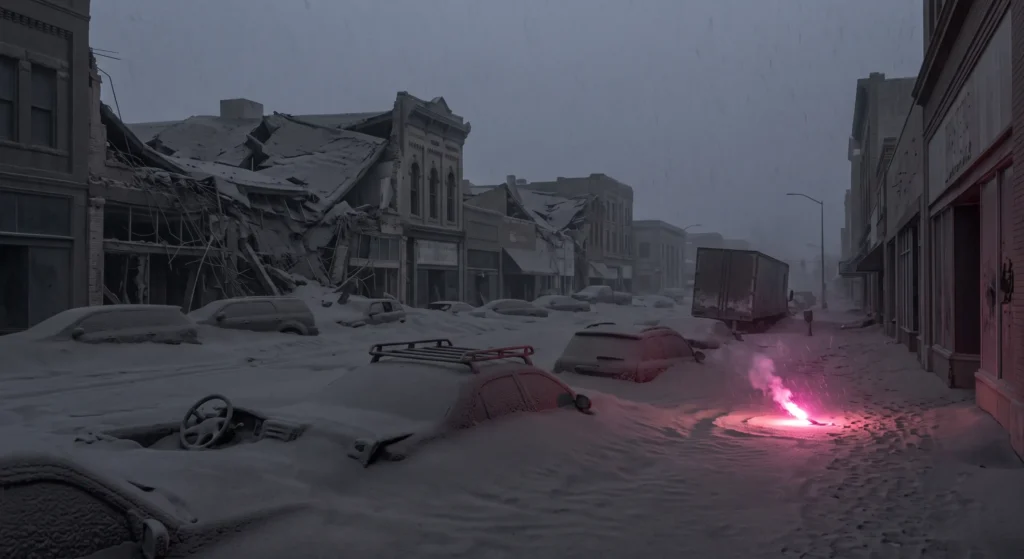
To translate those bands into specific places: cities in the immediate downwind corridor such as Billings, Montana could receive on the order of a metre or more — figures around 40 to 70 inches appear in published ashfall modelling. Salt Lake City and Denver would face tens of centimetres. Chicago and Minneapolis would see a measurable, disruptive layer. And because of the umbrella-cloud effect, even New York, Washington and Los Angeles would receive a few millimetres — not life-threatening on its own, but more than enough to close every airport in the country.
What Ash Actually Does to a Modern Country
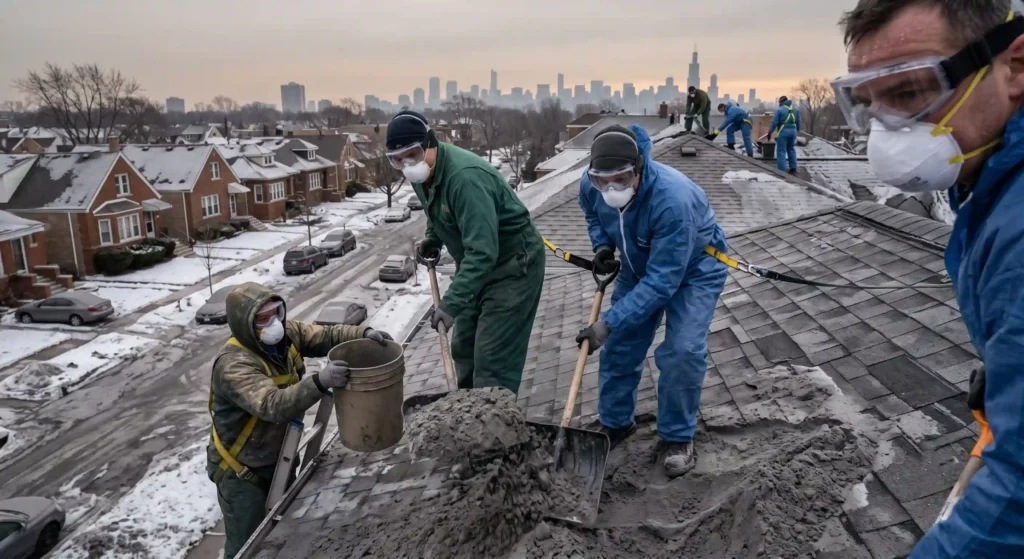
The single most underrated fact about volcanic ash is its weight. Dry ash is roughly 1,000 kg per cubic metre — comparable to rubble, not snow. Wet it with rain and it can approach 1,500 kg/m³. A typical residential roof is rated for a snow load that a mere 10 centimetres of wet ash can exceed. This is why roof collapse, not asphyxiation, is historically the leading cause of death in heavy ashfall zones.
Beyond the structural load, ash attacks a modern society through several independent systems simultaneously:
- Electrical grid. Ash is non-conductive when dry but conductive when damp. It coats high-voltage insulators and causes flashover — arcing that trips substations. Cascading outages across the ashfall region would be immediate and repeated, and crews cannot restore lines while ash is still falling.
- Water supply. Ash clogs intakes and overwhelms filtration plants. It also adds fluoride, sulfate and heavy metals to surface water. Treatment capacity, not source water, becomes the bottleneck.
- Engines and machinery. Ash is essentially powdered glass, harder than steel. It destroys air filters within minutes, scores cylinder walls, and ruins bearings. Vehicles, generators, pumps and HVAC systems all fail — including, critically, the backup generators hospitals depend on.
- Human health. Particles under 10 micrometres reach deep into the lungs. Short-term effects are respiratory irritation and severe aggravation of asthma and existing lung disease. The long-term concern is silicosis for anyone with prolonged unprotected exposure — cleanup crews above all. Ordinary cloth or surgical masks are inadequate; effective protection requires a fitted P2/N95 respirator or better.
- Roads and rail. Ash reduces traction and visibility, and buries markings. Rail signalling and points fail. Once ash is compacted by traffic, it becomes extremely difficult to remove.
- Cleanup itself. Ash cannot be flushed into storm drains — it sets like concrete and destroys the drainage system. It has to be physically collected, trucked, and landfilled. Removing metres of ash from a metropolitan area is a multi-year civil engineering programme, not a cleanup.
The Day Aviation Stops
There is a useful precedent for this specific consequence, and it is far smaller than Yellowstone. In April 2010, the Eyjafjallajökull eruption in Iceland — a modest VEI 4 — closed most of European airspace for roughly a week, cancelling over 100,000 flights, stranding some ten million passengers, and causing the largest air-traffic shutdown since the Second World War.
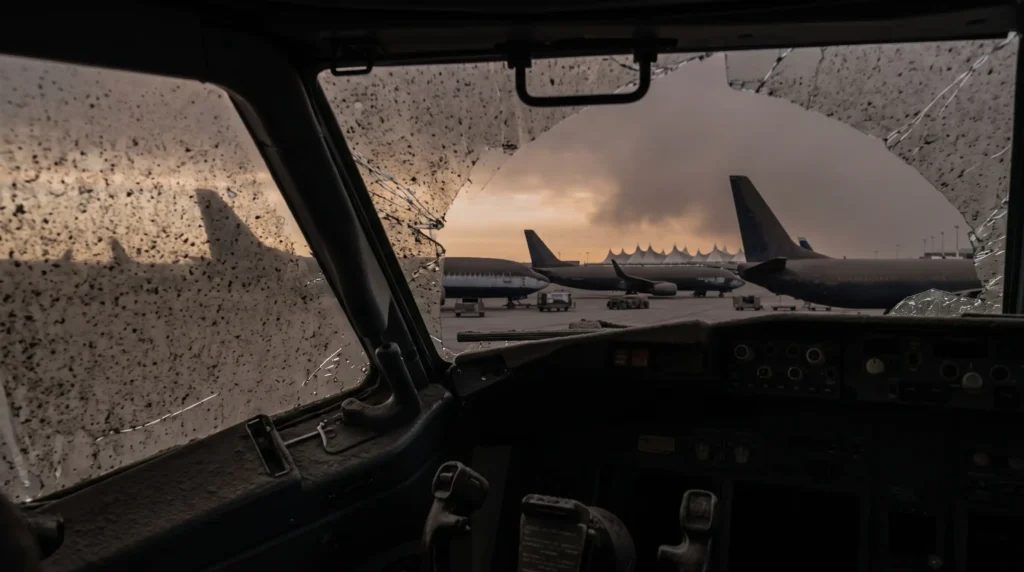
The reason is that volcanic ash and jet engines are catastrophically incompatible. Ash melts at the operating temperature inside a turbine, then re-solidifies on the cooler turbine blades, choking airflow and causing flameout. In 1982 a British Airways 747 lost all four engines flying through an ash cloud from Mount Galunggung and descended for sixteen minutes before restarting them. Ash also sandblasts windscreens opaque and blocks pitot tubes, destroying airspeed data.
Scale Eyjafjallajökull up by four VEI steps and move it into the middle of North America. Airspace over the continental United States would close essentially in its entirety, for weeks at minimum and likely months while ash remains in circulation and continues to be resuspended by wind from the ground. Because North American airspace is the hub of a large fraction of global aviation, the effect would propagate worldwide — grounding not just passengers but air freight, which carries a disproportionate share of high-value and time-critical cargo including pharmaceuticals and electronics components.
How Many People Would Die?
This deserves a direct answer, because the number circulating in headlines — “five billion dead” — is not a scientific estimate and has no basis in any published study.
Published assessments of the immediate zone put deaths on the order of tens of thousands: an often-cited figure is around 70,000 fatalities among people in the vicinity of the caldera who could not or did not evacuate. That number is a function of population density — the region is sparsely populated — and, crucially, it assumes the eruption is preceded by warning and evacuation. Without warning, in peak tourist season, it would be substantially higher.
The larger toll would arrive slowly and indirectly, and it is much harder to bound: roof collapses across the heavy ashfall zone, respiratory deaths among vulnerable populations, deaths from the failure of power-dependent medical care, and — over the following years — malnutrition and famine driven by the global harvest shortfall. Those secondary numbers depend far more on political decisions about food distribution than on volcanology.
What the science does say clearly is what would not happen. The USGS has stated plainly that a Yellowstone eruption would not end humanity, and would not end the United States as a nation. It would be among the worst disasters in recorded history and a severe strain on global civilisation. It would not be an extinction event, and framing it as one is not supported by any evidence.
What Is Volcanic Winter and How Long Would It Last?
The longer-term threat from a Yellowstone supervolcano eruption is the volcanic winter — the global cooling caused by sulphur dioxide (SO₂) injected into the stratosphere. SO₂ reacts with water to form sulfate aerosols that reflect sunlight. A Yellowstone eruption could inject 100–300 million tonnes (100–300 Tg) of SO₂ into the stratosphere. For comparison, the 1991 Pinatubo eruption injected ~20 Tg and reduced global temperatures by ~0.5°C for 2 years. Yellowstone at VEI 8 would produce a volcanic winter reducing global temperatures by 5–10°C for 5–10 years — effectively ending agriculture across the Northern Hemisphere for a decade.
That upper bound deserves a caveat, because it represents the severe end of the published range. The cooling does not scale linearly with sulfur: at very high concentrations, aerosol droplets collide and grow larger, which makes them less efficient at scattering sunlight per unit of mass and causes them to fall out of the stratosphere faster. This saturation effect means tripling the sulfur does not triple the chill. The USGS explicitly cautions that Yellowstone’s specific climate impact is difficult to predict and may be milder than the most dramatic scenarios. A cooling of a few degrees over several years — devastating, but short of the worst case — is the more conservative expectation.
Years Two Through Five: The Food Shock
By the second year, the ash has stopped falling and the immediate emergency has passed. This is when the actually dangerous phase begins.
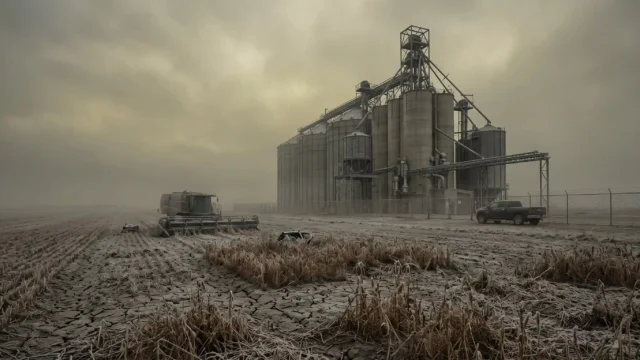
The eruption would have delivered a double blow to agriculture: physical burial of North American farmland under ash, and a simultaneous global cooling that shortens growing seasons everywhere else. Losing the American Midwest alone removes a substantial share of the world’s corn and soybean supply. Adding a two-to-four-degree global cooling on top of that cuts yields across the Black Sea grain belt, Chinese and Indian rice production, and the South American soy corridor at the same time.
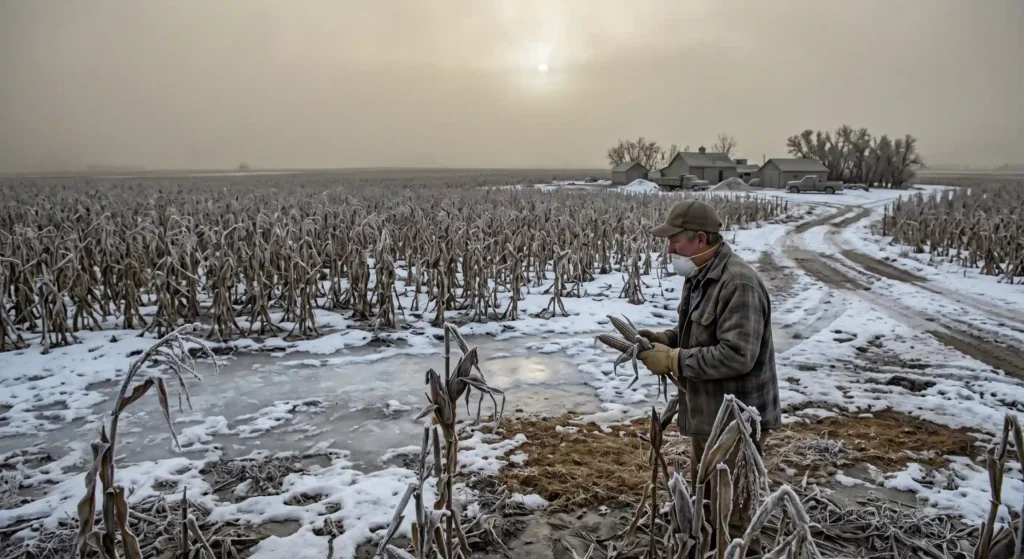
The world’s food system carries only a few months of grain reserves. It is optimised for efficiency, not resilience. Historically, the mechanism that converts a production shortfall into a famine is not the shortfall itself but the response: exporting nations impose bans to protect domestic supply, and importing nations — often the poorest — face shortages far deeper than the actual global deficit. This happened in miniature during the 2008 and 2010 price spikes, on production shortfalls a fraction the size.
The levers that exist are real but politically demanding: releasing strategic reserves, redirecting grain from livestock feed to human consumption (which alone represents an enormous latent supply), switching to cold-tolerant and fast-maturing cultivars, and expanding controlled-environment agriculture. Every one of them requires international coordination at exactly the moment governments face maximum pressure to hoard. The mechanism behind the cooling itself is explored in full in our companion article on volcanic winter.
Could You Survive a Yellowstone Eruption?
Survival depends almost entirely on one variable: distance from the caldera.
- Inside ~100 km — the pyroclastic zone. There is no shelter, no structure, and no procedure that helps. A pyroclastic flow moving at highway speed at several hundred degrees cannot be outrun or hidden from. The only survival strategy is to not be there, which is why the warning period matters more than any other single factor in this scenario.
- 100–1,500 km — the heavy ashfall zone. Survivable, and the actions that matter are unglamorous. Get indoors and stay there while ash is falling. Clear ash from the roof before it accumulates past roughly 10 cm, and before any rain arrives — roof collapse is the primary killer here. Seal windows, doors and vents. Wear a fitted N95 or P2 respirator and eye protection outdoors. Do not drive; ash destroys engines and visibility. Store water in advance, because treatment plants will fail.
- Beyond 1,500 km — the thin ashfall zone. Physically survivable with minimal precautions. The threat here is not the ash but the collapse of systems: no flights, disrupted freight, power interruptions, and — over the following years — food prices and availability.
- The rest of the world. No ash at all. The entire risk is economic and agricultural, arriving on a timescale of years rather than hours.
The counterintuitive summary: the overwhelming majority of people affected by a Yellowstone supereruption would never see a single flake of ash. The blast is regional. The famine risk is planetary. Preparing for the second is a matter of grain reserves and international cooperation, not bunkers.
What Would Be Left of Yellowstone Itself
The park as it exists would be gone. The caldera floor would drop hundreds of metres along its ring faults, and the geysers, hot springs and mudpots — including Old Faithful — would be destroyed outright, buried under welded ash and reshaped by the collapse.
What would take their place, over the following centuries, is a new hydrothermal system. The thick sheet of hot volcanic deposits would take decades to millennia to cool, driving vigorous new steam activity as groundwater returns. The caldera would likely fill with a lake, as Toba’s did and as Yellowstone’s own caldera partly did after the Lava Creek eruption. Rhyolite lava domes would slowly push up through the floor, exactly as they did in the 640,000 years following the last collapse. Ecologically, the region would recolonise from the edges over centuries — ash is nutrient-rich once weathered, and volcanic soils eventually become some of the most fertile on Earth.
In geological terms, none of this would be the end of Yellowstone. It would be the beginning of the next cycle — the fourth caldera in a sequence the hotspot has been running for two million years.
Why This Scenario Almost Certainly Will Not Happen
Everything above is a thought experiment built on solid physics and a very low probability. It is worth closing the loop honestly.
The reservoir beneath the caldera is roughly 5–15% molten — hot, crystal-rich mush, not a lake of liquid rock. A supereruption requires a far larger molten fraction, and there is no evidence that mobilisation is underway. The annual probability of a caldera-forming eruption is about 1 in 730,000. And a supereruption is not even the default outcome if Yellowstone does reawaken: of roughly 80 eruptions since the last caldera collapse, nearly all were lava flows. The most likely hazardous event at Yellowstone in any human lifetime is a hydrothermal explosion — a steam blast that carves a crater a few metres to a few hundred metres wide, dangerous to anyone standing nearby and irrelevant to everyone else.
The “overdue” claim that drives most of the fear is a statistical error. Three eruptions produce two intervals, and two intervals are not a schedule. Volcanoes have no mechanism for keeping time; waiting longer does not make an eruption more likely. For the full picture — what genuinely lies beneath the park, how the hotspot works, what the monitoring data actually show, and where each popular myth comes from — see our complete guide to the Yellowstone supervolcano.
Q&A
No. USGS volcanologists consistently state that Yellowstone is not on a regular eruption schedule and is not “overdue.” The three supereruptions occurred at 2.1 Mya, 1.3 Mya, and 640 Kya — irregular intervals, not a clock. Current monitoring shows the magma chamber is 5–15% molten, far below the ~50% threshold considered necessary for a supereruption.
A supervolcano is a volcanic system capable of producing a VEI 8 eruption — ejecting more than 1,000 km³ of material. They typically form calderas rather than classic cone-shaped mountains. Known supervolcanoes include Yellowstone, Toba (Indonesia), Taupo (New Zealand), and Campi Flegrei (Italy). Toba’s eruption ~74,000 years ago may have reduced the human population to as few as 10,000 individuals.
USGS modelling shows a full Yellowstone supereruption would deposit 1–3 metres of ash within ~500 km, 10–30 cm within ~1,000 km (covering the entire Midwest and parts of Canada), and 1–10 cm across most of the continental US. The ash cloud would circle the globe within weeks, depositing trace amounts globally.
The Year Without a Summer in 1816 was caused by the April 1815 eruption of Mount Tambora in Indonesia — the largest eruption in recorded history (VEI 7). The eruption injected approximately 60 Tg of sulphur dioxide into the stratosphere. The resulting sulfate aerosols reduced global temperatures by ~0.5°C, causing crop failures across Europe, North America, and Asia and contributing to widespread famine.
A pyroclastic flow is a fast-moving current of hot gas, ash, and volcanic rock fragments (collectively “tephra”) that travels along the ground at speeds of 100–700 km/h at temperatures of 100–900°C. Pyroclastic flows are the most deadly volcanic hazard — they cannot be outrun and cause death by incineration, suffocation, and blunt trauma simultaneously. In a Yellowstone supereruption, pyroclastic flows would devastate an area roughly the size of Florida.
Very likely a great deal — weeks and months at minimum, and plausibly years. A caldera-forming eruption requires hundreds of cubic kilometres of magma to mobilise, which produces unmistakable escalating signals: migrating earthquake swarms, rapid ground deformation, harmonic tremor, and shifts in gas chemistry. The Yellowstone Volcano Observatory monitors all of these continuously. A sudden, unwarned supereruption is not how the system would behave.
Published estimates put immediate deaths in the vicinity of the caldera at roughly 70,000 — a figure that reflects the region’s low population density and assumes some evacuation. Secondary deaths from roof collapse, respiratory illness, infrastructure failure and multi-year food shortages would be higher and are much harder to bound. The widely circulated “five billion” figure is not a scientific estimate. The USGS is explicit that a Yellowstone eruption would not be a human extinction event.
No. Volcanic ash melts inside jet engines and re-solidifies on turbine blades, causing flameout — the reason the far smaller 2010 Eyjafjallajökull eruption closed European airspace for a week and cancelled over 100,000 flights. A Yellowstone supereruption would close continental US airspace essentially entirely for weeks to months, with knock-on disruption to global aviation and air freight.
Stay indoors while ash is falling, seal windows, doors and vents, and store water in advance because treatment plants clog. The most important action is clearing ash from your roof before it exceeds roughly 10 cm and before rain arrives — wet ash can weigh 1,500 kg per cubic metre and roof collapse is the leading cause of ashfall deaths. Outdoors, wear a fitted N95 or P2 respirator and eye protection; cloth masks are not adequate. Do not drive, as ash destroys engines and visibility.
A hydrothermal explosion or a lava flow — not a supereruption. Steam-driven hydrothermal blasts are the most frequent hazard, occurring in the park every few years on a small scale, and are the event most likely to actually affect visitors. Of roughly 80 eruptions since the last caldera collapse 640,000 years ago, nearly all were slow-moving rhyolite lava flows with no global consequences whatsoever.
Internal links: geology facts | What If Earth’s Core Solidified? | What If the Ocean Floor Cracked Open?