 By
By How Fast Does the Earth Spin?
Earth’s rotation speed at the equator is approximately 1,037 mph (1,670 km/h) — the rate at which a point on the equatorial surface moves through space as the planet completes one full rotation in about 23 hours 56 minutes (a sidereal day; the 24-hour solar day includes Earth’s orbital motion around the Sun). At the poles, rotational speed is zero — you spin in place. At latitude 45°N or 45°S, it’s about 735 mph.
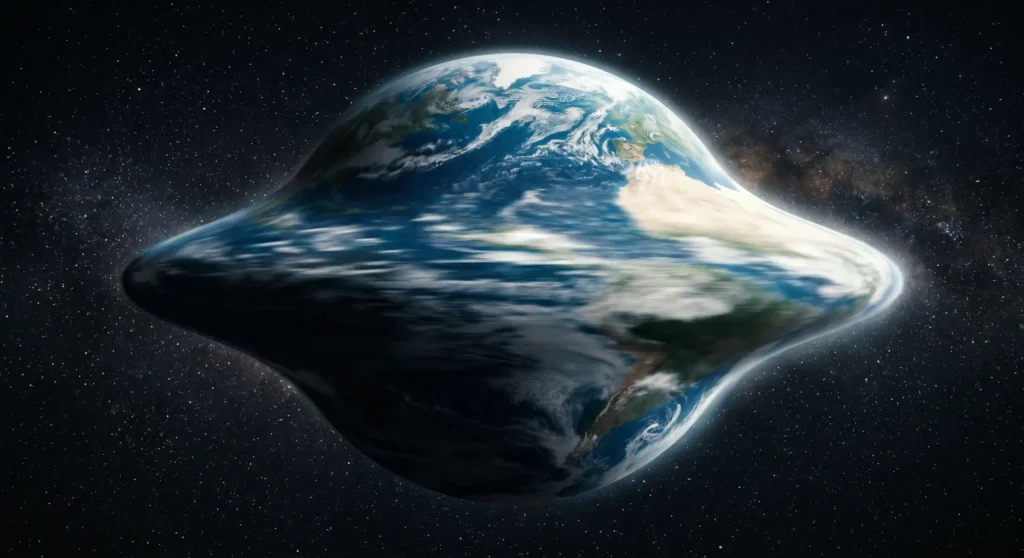
How fast does the earth spin in mph matters because that rotational velocity is what creates the equatorial bulge (Earth is 43 km wider at the equator than at the poles), drives the Coriolis effect that steers winds and ocean currents, and contributes to the length of a day. Earth’s angular momentum — the conserved quantity in planetary rotation — is approximately 7.1 × 1033 kg·m²/s. The Moon’s tidal drag is very slowly reducing this: Earth’s day is lengthening by about 1.4 milliseconds per century.
What Would Happen to Earth’s Shape at Double Rotation?
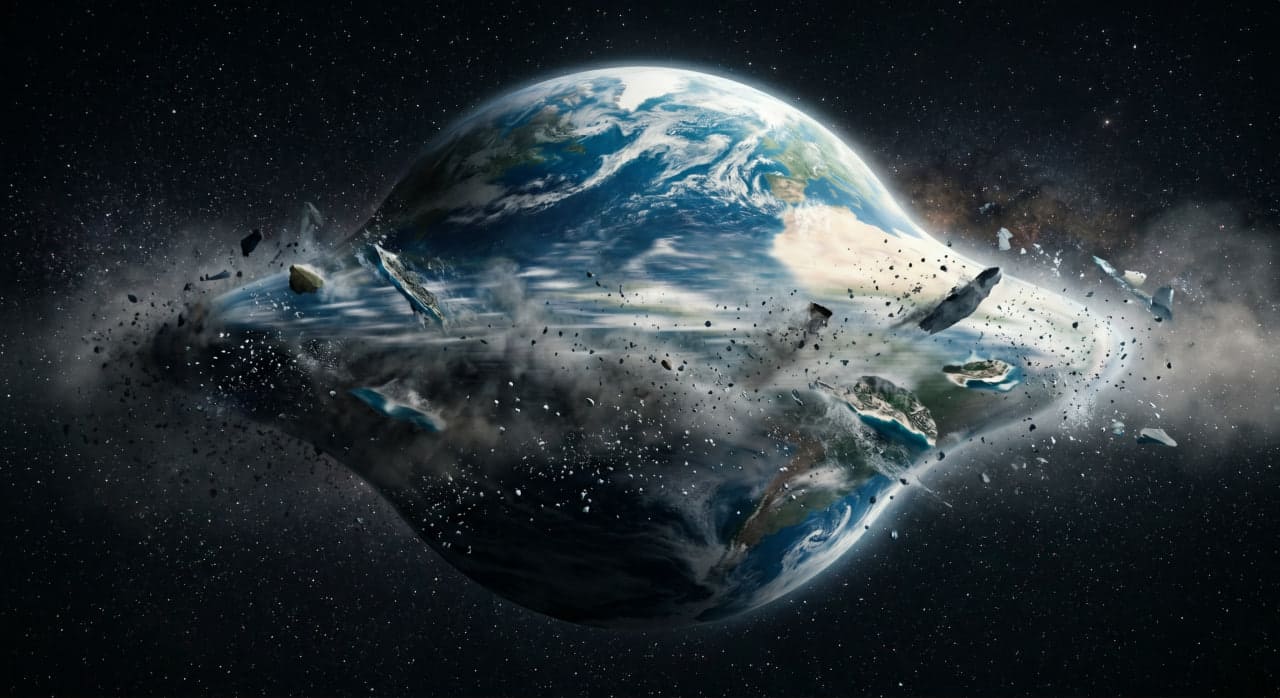
If Earth’s rotation speed doubled — one complete rotation per 12 hours — the centrifugal force at the equator would quadruple. The equatorial bulge would increase substantially. Geophysical models suggest that at double rotation speed, the equatorial radius would expand by an additional 10–20 km, while the polar radius would decrease correspondingly. Sea levels at the equator would rise by approximately 100 metres as ocean water redistributed toward the equatorial region; sea levels near the poles would fall by a similar amount.
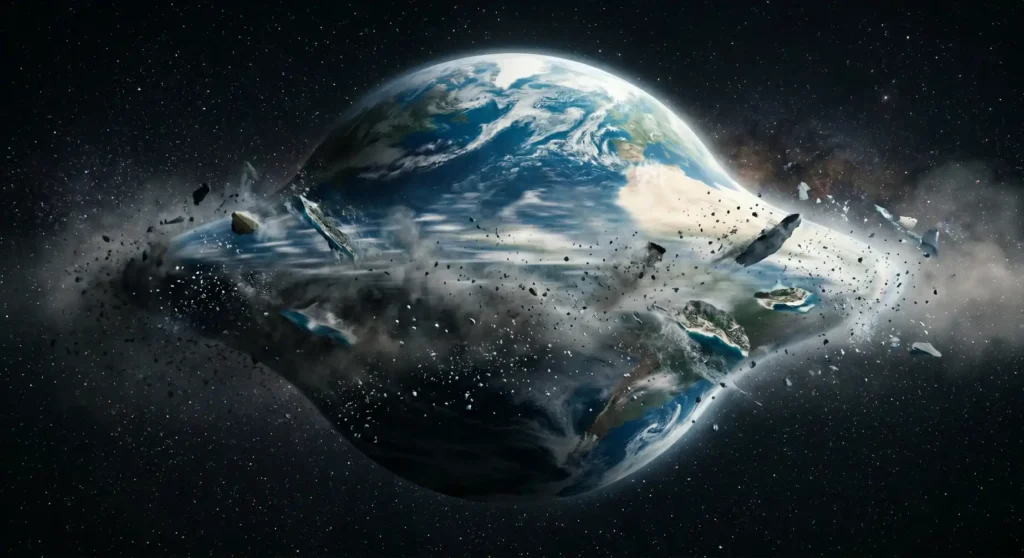
To picture the scale of the changes at 2× Earth’s rotation speed:
- Equatorial circumference increase: ~60–120 km (from redistribution of ocean and crustal material)
- Sea level rise at equator: ~100 metres (flooding most major port cities: Shanghai, Miami, Mumbai, Jakarta)
- Sea level fall at poles: ~100 metres (exposing continental shelves around the Arctic)
- Day length: reduced from 24 to 12 hours
- Surface gravity at equator: reduced by ~0.5% due to increased centrifugal effect (you’d weigh ~0.5% less)
What Happens to Weather and the Atmosphere?
The Coriolis effect — the deflection of moving air and water due to Earth’s rotation — would double in strength. The Coriolis effect is what organises the jet streams, trade winds, polar vortex, and the rotation direction of cyclones and anticyclones. With double rotation speed, the jet streams would become faster and more stable, the tropical Hadley circulation cells would compress to narrower latitudinal bands, and the temperature gradient between equator and poles would sharpen dramatically.
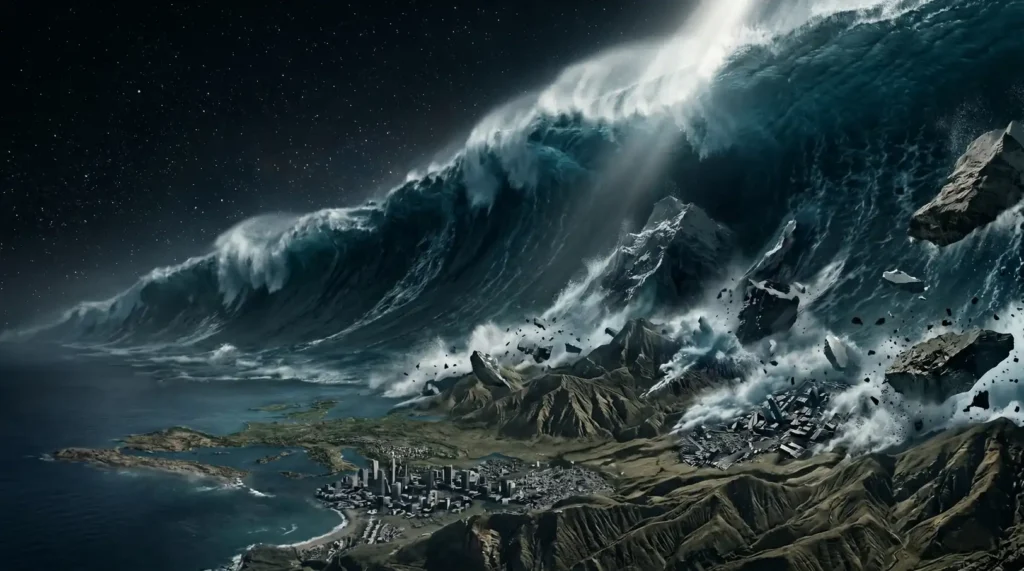
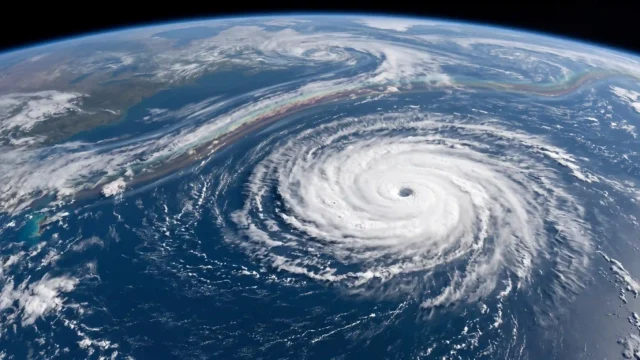
The enhanced Coriolis effect would organise persistent, rotating superstorm systems in the mid-latitudes — permanent cyclonic structures analogous to Jupiter’s Great Red Spot. Some climate modellers have suggested that at sufficiently fast rotation speeds, Earth might develop banded atmospheric structures like gas giants: stable latitudinal bands of alternating wind directions with no mechanism to mix heat from equator to poles efficiently. The tropics would become hotter and drier; the poles would become colder and more isolated.
What About the Geological and Tectonic Effects?
The redistribution of mass toward the equator would alter the planet’s moment of inertia, which by conservation of angular momentum would require the outer liquid core to rotate differently relative to the mantle. This could disrupt the geodynamo that generates Earth’s magnetic field — though the timescale for such disruption is uncertain (the geodynamo operates over thousands of years, not days).
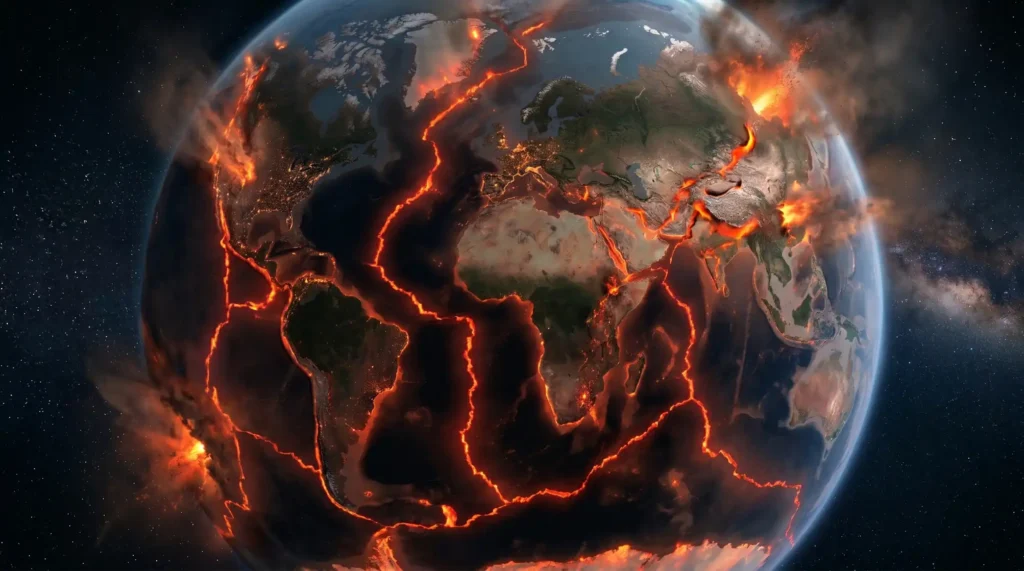
Tectonic plate stresses would be modified by the changed distribution of centrifugal loading on the crust, potentially increasing volcanic activity and seismicity along equatorial plate boundaries.
Q&A
Earth spins at approximately 1,037 mph (1,670 km/h) at the equator, completing one rotation in 23 hours 56 minutes (a sidereal day). This speed decreases with latitude — at the poles, rotational speed is zero. Earth’s rotation also generates the equatorial bulge, the Coriolis effect steering winds and currents, and the 24-hour day cycle.
Doubling Earth’s rotation speed would quadruple centrifugal forces at the equator, raising sea levels there by ~100 m while lowering polar sea levels, strengthening the Coriolis effect to produce permanent superstorm systems, compressing the length of a day to 12 hours, and potentially altering the geodynamo that generates Earth’s magnetic field.
The Coriolis effect is the apparent deflection of moving objects (air, water, projectiles) due to Earth’s rotation. In the Northern Hemisphere, deflection is to the right; in the Southern Hemisphere, to the left. It organises the rotation direction of cyclones (counterclockwise in the north), steers jet streams, drives ocean gyres, and determines the direction of trade winds.
Earth’s equatorial bulge is the additional ~21 km of radius at the equator compared to the poles, caused by centrifugal force from Earth’s rotation. Earth is not a perfect sphere — it is an oblate spheroid. The equatorial circumference is about 40,075 km vs the polar circumference of ~40,007 km. A faster-spinning Earth would have a more pronounced bulge.
Yes, very slowly. Tidal interactions between Earth and the Moon transfer angular momentum to the Moon, causing Earth’s rotation to slow by about 1.4 milliseconds per century. 620 million years ago, an Earth day was about 21.9 hours. Ultimately, if Earth and Moon remain bound, Earth’s rotation will slow until Earth is tidally locked to the Moon, showing the same face to it permanently — a process taking billions of years.
Internal links: existential risk | What If Earth’s Core Solidified? | What If Yellowstone Erupted Tomorrow?