 By
By 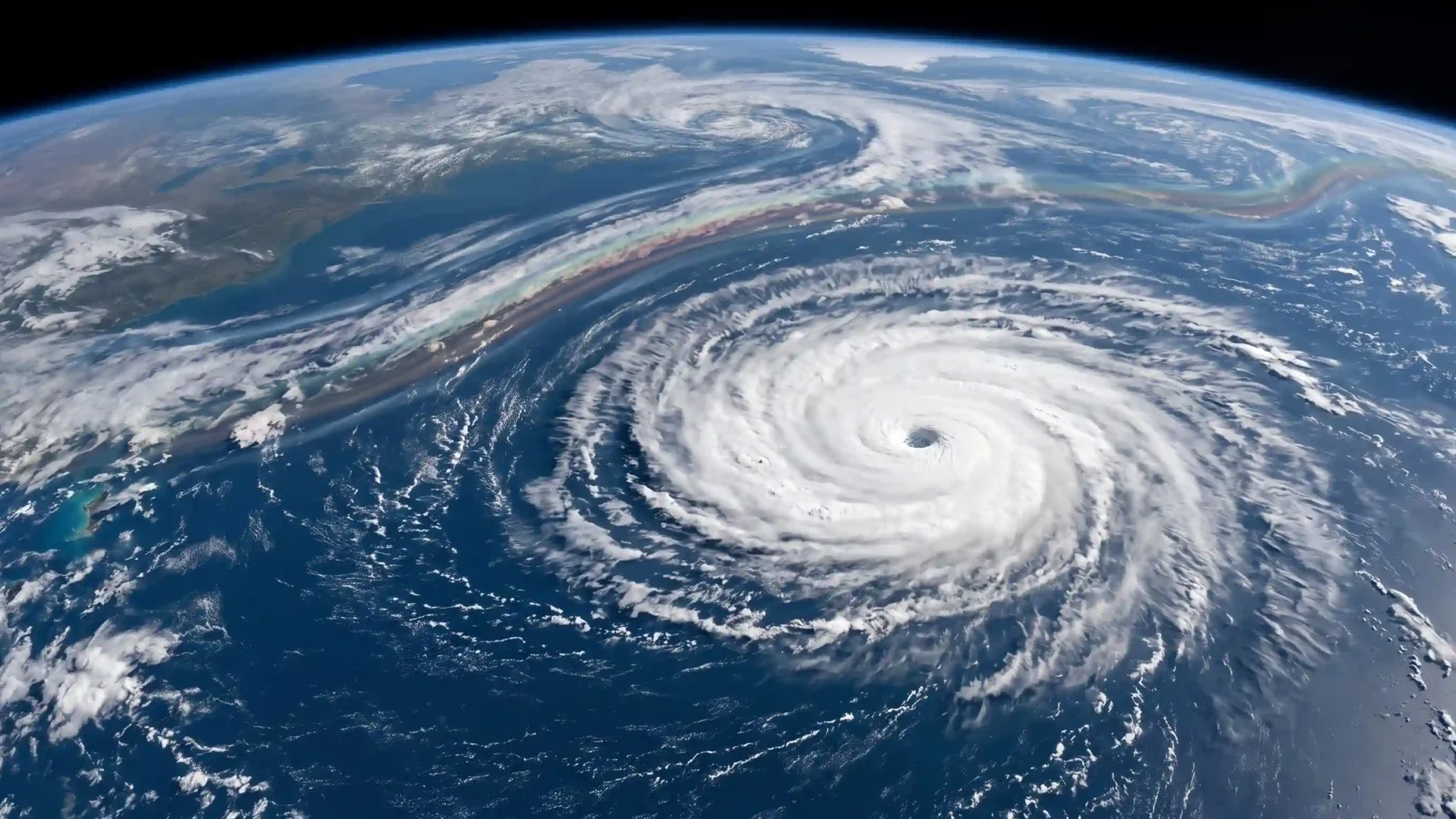
Quick Answer
The Coriolis effect is the apparent deflection of moving objects — like air and ocean water — caused by Earth’s rotation. Because the planet spins beneath them, freely moving things curve to the right in the Northern Hemisphere and to the left in the Southern Hemisphere. This invisible force shapes our weather: it is why hurricanes spin in opposite directions in the two hemispheres and why global winds and ocean currents follow their characteristic curved paths.
The Coriolis effect is one of those forces you never see directly, yet it governs the large-scale movement of the entire atmosphere and oceans. It is also the subject of a famous myth about draining water. This guide explains what the Coriolis effect is, why a spinning planet produces it, how it steers storms and currents, the truth about the toilet myth, and what would happen if Earth spun faster.
What Is the Coriolis Effect?
The Coriolis effect is the tendency of objects moving across the surface of a rotating planet to follow a curved path rather than a straight one, as seen from the ground. It is not a true physical force pushing on the object — it is an apparent deflection that arises because we are observing from a spinning frame of reference. For that reason it is sometimes called the “Coriolis force,” but more precisely it is an effect of Earth’s rotation.
The rule of thumb is simple: in the Northern Hemisphere, moving objects appear to veer to the right of their direction of travel; in the Southern Hemisphere, they veer to the left. The effect is strongest near the poles and vanishes at the equator. Critically, it only becomes significant for objects moving over long distances or long times — which is why it dominates weather systems and ocean currents but is irrelevant to everyday motion.
Why It Happens (a spinning frame of reference)
The Coriolis effect happens because Earth is a rotating sphere, and different latitudes move at different speeds. At the equator, the surface is racing eastward at about 1,670 kilometres per hour as the planet spins, while closer to the poles the surface moves much more slowly, because it traces a smaller circle each day.
Now imagine a parcel of air moving from the equator toward the north. It carries the fast eastward speed of the equator with it, but the ground beneath it is moving eastward more slowly the farther north it goes. As a result, the air outruns the ground and appears to curve to the east — to the right. The reverse happens for air moving toward the equator. From the rotating Earth’s point of view, every freely moving object seems to be gently pushed sideways, even though it is really just the ground turning underneath it.
How It Steers Hurricanes and Ocean Currents
The Coriolis effect is the architect of global weather and ocean circulation. As air flows toward a low-pressure centre, the Coriolis deflection prevents it from rushing straight in; instead, the air spirals. This is why large storm systems rotate — counterclockwise in the Northern Hemisphere and clockwise in the Southern Hemisphere. Hurricanes, typhoons, and cyclones all owe their characteristic spin to this effect.
The same force shapes the planet’s prevailing winds, deflecting them into the trade winds and the westerlies, and it sets the great ocean currents turning in vast circular patterns called gyres. It even guides the high-altitude jet streams that steer weather across continents. Without the Coriolis effect, global wind and ocean patterns — and the climate they create — would look completely different.
The Toilet-Swirl Myth, Debunked
One of the most persistent myths is that the Coriolis effect determines which way water swirls down a toilet or sink — clockwise in one hemisphere, counterclockwise in the other. This is false.
The Coriolis effect is far too weak to control something as small and fast-draining as a sink or toilet. Over the tiny distance and short time involved, its influence is utterly negligible — overwhelmed by other factors like the shape of the basin, how the water was poured in, jets from the bowl, and any residual motion in the water. A toilet flushes the way it does because of its design, not the hemisphere it is in. You can easily get water to swirl either direction in either hemisphere. The Coriolis effect is real and powerful, but only at the grand scale of weather systems and oceans — not in your bathroom.
What Would Happen If Earth Spun Faster
Since the Coriolis effect is driven by Earth’s rotation, a faster-spinning planet would have a dramatically stronger Coriolis effect. Winds and storms would be deflected more sharply, and weather systems would become tighter, more intense, and more numerous. Hurricanes might spin up faster and behave very differently, and the whole pattern of global circulation would shift.
A faster spin would also shorten the day, change the shape of the planet, and alter sea levels and gravity at the equator. Exactly how extreme these changes would be is the focus of the scenario what if the Earth’s rotation spun twice as fast. The opposite trend — Earth’s rotation gradually slowing over time — is explored in our companion article on whether Earth’s rotation is slowing down.
Q&A
It has a measurable influence on long-distance flights, which is accounted for in navigation, but it does not “steer” aircraft in any dramatic way. Pilots and flight computers simply correct for it as one of many factors. For short flights, its effect is negligible.
Large storm systems spin counterclockwise in the Northern Hemisphere and clockwise in the Southern Hemisphere, due to the Coriolis effect. This applies to hurricanes, typhoons, and other cyclones, whose rotation direction is determined by which hemisphere they form in.
The Coriolis effect is zero exactly at the equator and strongest near the poles. This is one reason hurricanes do not form right at the equator — without the Coriolis deflection, the spiralling rotation that organises a storm cannot get started.
The Coriolis effect is absolutely real and measurable — it governs the rotation of weather systems, the direction of winds, and the flow of ocean currents. The myth is only that it controls the direction water drains from sinks and toilets, which it does not, because the effect is far too weak at that small scale.
The Bigger Question
The Coriolis effect is the spinning planet’s fingerprint on the weather — and it depends entirely on how fast Earth turns. So what would happen to our winds, storms, days, and even our oceans if the planet suddenly rotated twice as fast? The Coriolis effect would intensify, and that is just the beginning of the upheaval explored in what if the Earth’s rotation spun twice as fast.
For the real, gradual change happening to Earth’s spin, read is Earth’s rotation slowing down, and discover more about our restless planet on the Geology hub.
Watch the faster-rotation scenario to see how a quicker spin would transform our world.