 By
By 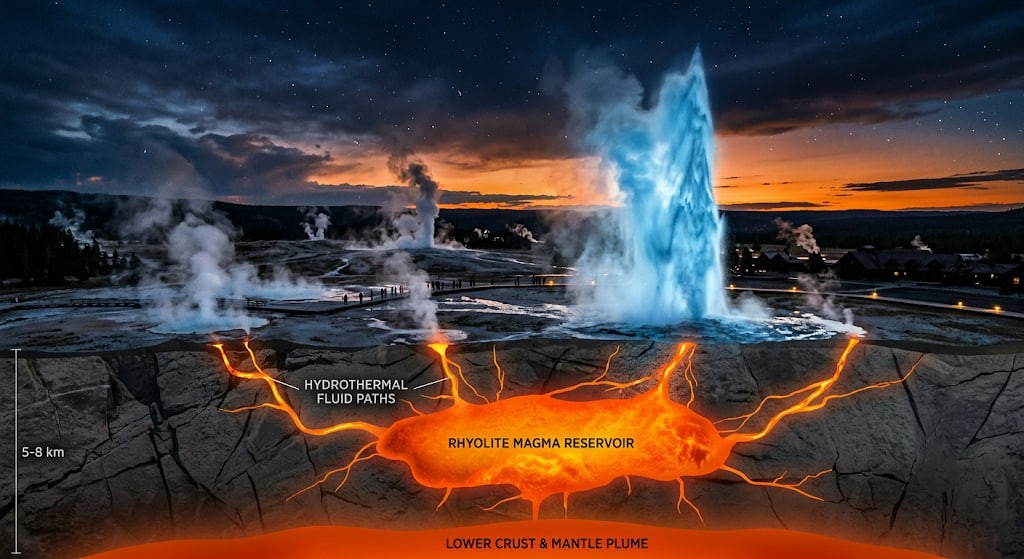
Quick Answer
The Yellowstone supervolcano is the giant volcanic system beneath Yellowstone National Park, capable of rare, colossal eruptions thousands of times larger than an ordinary volcano. It has produced three super-eruptions in the past 2.1 million years, the most recent 640,000 years ago, each of which collapsed the ground into a vast crater called a caldera.
Despite its fearsome reputation, Yellowstone is not “overdue”: the U.S. Geological Survey puts the odds of a caldera-forming eruption at roughly 1 in 730,000 in any given year, and monitoring shows no sign that one is coming. The far likelier future event is a lava flow or a small steam-driven blast, not a global catastrophe.
Few places on Earth carry a reputation quite like Yellowstone’s. Beneath its geysers and hot springs sits one of the planet’s largest active volcanic systems — a “supervolcano” that has, three times in the deep past, erupted with a violence almost impossible to picture. That history has made Yellowstone a fixture of doomsday headlines and disaster films.
The real science is more interesting, and far less apocalyptic, than the myths. This guide explains what the Yellowstone supervolcano actually is, the hotspot that powers it, the three giant eruptions in its past, what genuinely lies beneath the park today, why scientists are confident it is not about to blow, and what would truly happen across the hours, years, and decades if it ever did.
What Is the Yellowstone Supervolcano?
The Yellowstone supervolcano is the large, active volcanic system underlying Yellowstone National Park in the western United States — a system capable of producing a “super-eruption” that ejects more than 1,000 cubic kilometres of material in a single event. That scale puts its biggest eruptions at the very top of the Volcanic Explosivity Index, the magnitude scale geologists use for eruptions (for the general definition and the VEI scale, see what is a supervolcano).
What makes Yellowstone unusual is that it barely looks like a volcano at all. There is no towering cone. Instead, its largest eruptions have left behind a caldera — a giant basin formed when the roof of an emptied magma reservoir collapses inward. The Yellowstone Caldera measures roughly 70 by 45 kilometres, so large that for decades geologists did not realise the whole valley was the crater of a supervolcano. The reason the question of an eruption fascinates and frightens so many people is explored hour by hour in our scenario, what if Yellowstone erupted tomorrow.
It is worth being precise about language. “Yellowstone supervolcano” refers to this specific system spanning parts of Wyoming, Montana, and Idaho. The word “supervolcano” on its own is a general category, and Yellowstone is only one of several such systems around the world. Here, the focus is squarely on the Yellowstone system: its origins, its record, and its real risk.
The Yellowstone Hotspot: A Volcano That Stays Put
Yellowstone’s power comes from a hotspot — a plume of hot rock rising from deep within the Earth, independent of the shifting tectonic plates above it. Unlike volcanoes that sit along plate boundaries, a hotspot stays roughly fixed in place while the continent slides over it, like a blowtorch held under a moving sheet of metal.
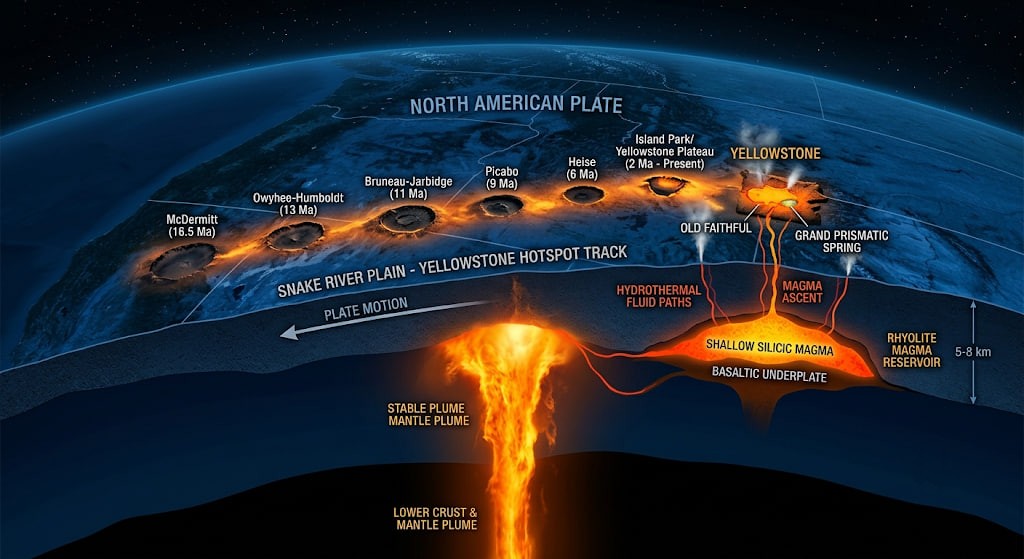
You can read this motion directly in the landscape. The North American plate drifts southwest over the Yellowstone hotspot at about 4.6 centimetres a year — roughly the rate your fingernails grow. Over millions of years, that slow march has left a trail of older, extinct calderas stretching back across the Snake River Plain of southern Idaho. Each was the site of Yellowstone-style activity in its day before the plate carried it away from the heat. Yellowstone is simply where the hotspot sits now; in the deep future, the volcanic centre will appear to migrate further into Montana.
Exactly how deep the plume reaches is still debated. Some studies trace it hundreds of kilometres down toward the deep mantle, while others argue for a shallower origin; the imaging is genuinely difficult. What is not in doubt is that the heat is real and present, and that it does double duty. The same energy that could one day drive an eruption is, right now, simply warming groundwater to create the geysers, hot springs, and mudpots that draw millions of visitors. Old Faithful is, in a sense, the supervolcano breathing quietly.
Yellowstone’s Three Super-Eruptions
Yellowstone has produced three confirmed super-eruptions over the past 2.1 million years. They were not evenly spaced, and they varied enormously in size — a crucial point that undercuts any notion of a regular “cycle.” Each blasted out vast volumes of rhyolite, a silica-rich, gas-charged magma that erupts explosively rather than flowing gently.
- Huckleberry Ridge (~2.1 million years ago): the largest, ejecting around 2,500 km³ of ash and rock — well over 2,000 times the bulk volume of the 1980 Mount St. Helens eruption.
- Mesa Falls (~1.3 million years ago): the smallest of the three, around 280 km³ — still vastly larger than any eruption in human history.
- Lava Creek (~640,000 years ago): about 1,000 km³, the eruption that formed the caldera we see in the park today.
To anchor those numbers: Mount St. Helens in 1980, which devastated hundreds of square kilometres and dominated headlines, ejected about 1 cubic kilometre of material. Huckleberry Ridge produced roughly 2,500 times more by bulk volume, spreading ash across much of what is now the United States. (Measured by erupted magma alone, the USGS puts Huckleberry Ridge at around 6,000 times the size of Mount St. Helens — either way, a difference of staggering proportions.) These rank among the largest eruptions anywhere on Earth in the last few million years.
We know all this because each eruption left a thick sheet of welded ash called a tuff — the Huckleberry Ridge Tuff, the Mesa Falls Tuff, and the Lava Creek Tuff — that geologists can map, date, and measure today. Yet the record is still being refined. Researchers continue to find ancient ash layers hinting at additional, smaller eruptions in Yellowstone’s past, and the precise volumes are periodically revised as dating methods improve. The well-established three above are the headline events, but the deep history remains an active field of study, not a closed book.
Yellowstone in Context: How It Ranks
Yellowstone is famous, but it is not alone. Several supervolcanoes are scattered around the world, and placing Yellowstone among them helps calibrate the real risk. Its largest eruption, Huckleberry Ridge, ranks among the biggest known anywhere on Earth in the past few million years — broadly comparable to the colossal Toba eruption in Indonesia around 74,000 years ago, which was the most recent super-eruption on the planet and which some researchers have controversially linked to a sharp, temporary global cooling.
Other members of the club include Taupō in New Zealand, responsible for the most recent very large eruption roughly 26,500 years ago; Long Valley Caldera in California; and Campi Flegrei near Naples, Italy, which sits alarmingly close to a major city and is watched intensely. What unites them is not a shared schedule but a shared scale — each is capable, given the right deep conditions, of an eruption far beyond anything in recorded history. For how geologists define and rank these giants in general, see what is a supervolcano. The takeaway for Yellowstone specifically is that it is one sleeping giant among a handful worldwide, none of which is currently showing signs of an imminent super-eruption.
In fact, in terms of near-term restlessness, systems like Campi Flegrei — which has seen repeated ground uplift and earthquake swarms close to a dense urban population — preoccupy volcanologists more on a human timescale than Yellowstone does, even though Yellowstone is the one that dominates popular fear.
What Lies Beneath Yellowstone Today
Here is where popular imagination diverges most sharply from reality. The cartoon image is of a vast underground lake of molten rock, sloshing and straining toward the surface.
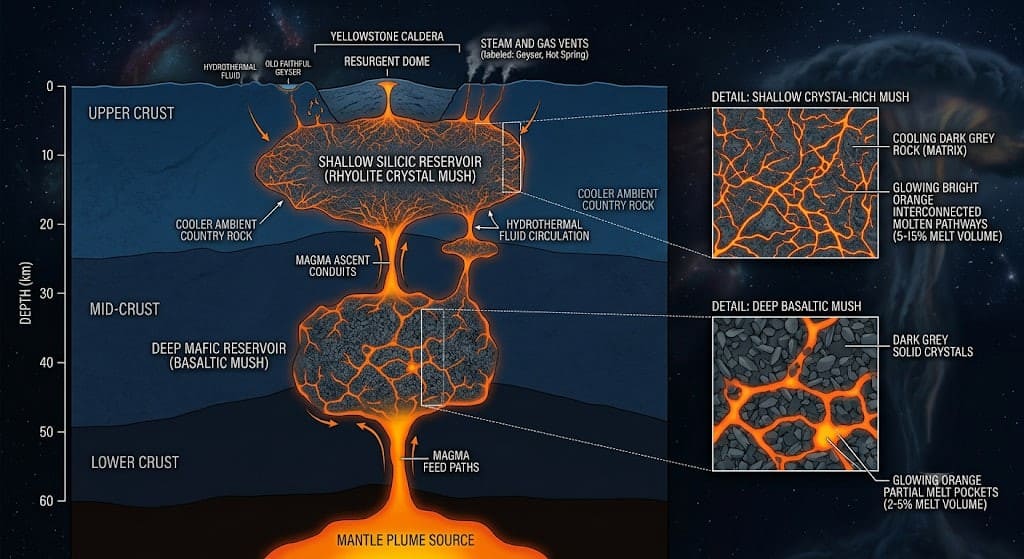
The truth, revealed by decades of seismic imaging, is far less dramatic.
A Mostly-Solid Magma Reservoir
Beneath the caldera sits a large magma reservoir, but it is mostly solid rock. Studies estimate it is only around 5 to 15 percent molten at any given time — hot, crystal-rich mush rather than a free-flowing pool. To feed a super-eruption, a far greater fraction would need to melt and mobilise, and there is no evidence that process is underway. The system is simply not “charged” for a giant eruption right now. Deeper still lies a second, much larger reservoir of hotter basaltic magma that supplies heat to the shallower chamber, but it too is overwhelmingly solid.
The Hydrothermal Engine
Above the magma, groundwater seeps down, is heated, and rises again, powering Yellowstone’s roughly 10,000 thermal features — more than half of all the geysers on Earth. This hydrothermal system is the part of Yellowstone most likely to produce a hazardous event — not a super-eruption, but a steam-driven explosion, which we will come to shortly. It is also the most active and visible sign that heat is still present below.
Yellowstone’s Restless Ground
Yellowstone is far from silent. It is one of the most seismically active regions of the interior United States, and its ground is constantly, gently moving. Reading these signals correctly — distinguishing normal restlessness from genuine warning — is the heart of monitoring the system.
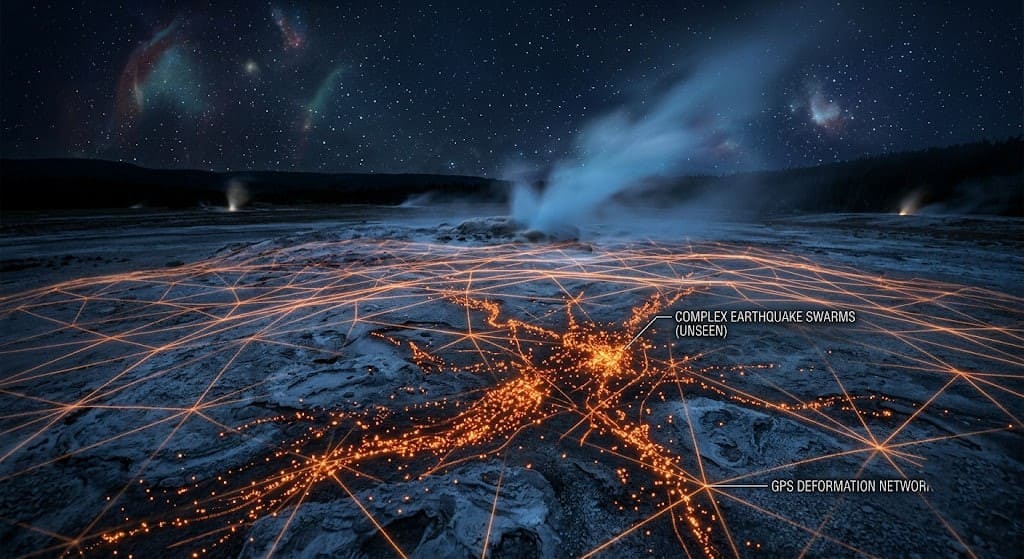
Earthquakes are routine. The region typically experiences between roughly 1,500 and 2,500 small quakes a year, the vast majority too faint to feel. They often arrive in “swarms,” clusters of many small tremors over days or weeks, usually caused by shifting underground fluids and faults rather than rising magma. The largest historical event was the magnitude 7.3 Hebgen Lake earthquake of 17 August 1959, just west of the park, which triggered a massive landslide that buried a campground, killed 28 people, and dammed a river to create what is now Quake Lake. It also shocked the park’s plumbing: within a day, hundreds of springs erupted as geysers, some for the first time on record.
The caldera floor also “breathes,” rising and falling by tens of centimetres over years to decades — a total swing of roughly half a metre across recorded history. This deformation is driven by the movement of underground water, gas, and magma, and it is normal behaviour for a restless caldera, not a countdown to eruption. The park’s geysers shift too: Steamboat Geyser, the tallest active geyser on Earth, reawakened in 2018 after years of quiet and produced a flurry of record-setting eruptions, yet careful study found no link to magmatic unrest. The lesson running through all of it is the same — Yellowstone is alive and restless, but restlessness is its baseline state, not a sign of impending catastrophe.
Is Yellowstone Going to Erupt?
Not anytime soon, and almost certainly not in any of our lifetimes. This is the single most important and most misunderstood fact about Yellowstone. The U.S. Geological Survey estimates the annual probability of another caldera-forming eruption at about 1 in 730,000 — roughly 0.00014 percent in any given year. To put that in perspective, the eruption is far less likely in a given year than many everyday risks people never think twice about.
The persistent claim that Yellowstone is “overdue” is simply false, and it rests on a basic misunderstanding of statistics. The intervals between the three past super-eruptions — about 800,000 years, then about 660,000 years — are not a schedule. Two gaps do not make a clock, volcanoes do not erupt on a timer, and there is no countdown ticking toward a due date. The most recent volcanic activity of any kind was a lava flow about 70,000 years ago, and the current quiet period could easily continue for many thousands of years more.
Crucially, a super-eruption is not the default outcome even if Yellowstone does become active again. Of the approximately 80 eruptions since the last caldera collapse, nearly all were lava flows — not catastrophic explosions. The odds strongly favour a modest event over an apocalyptic one.
What Would Actually Erupt Next?
If Yellowstone stirs in the foreseeable future, the science points to two realistic possibilities, neither of which is a global disaster.
The first is a lava flow. The most recent eruptions at Yellowstone, including the activity around 70,000 years ago, were thick, slow-moving flows of rhyolite lava — some of the largest such flows on Earth. A future flow would be locally destructive and a serious hazard within the park, but it would advance slowly enough for people to move out of the way, and it would have essentially no global impact.
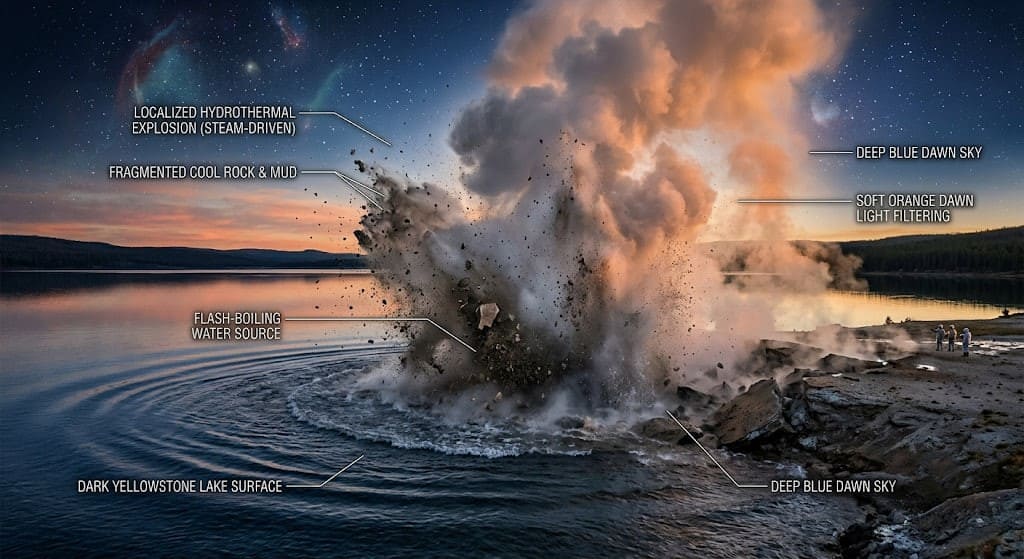
The second, and most likely to affect people, is a hydrothermal explosion — a sudden burst of superheated water and steam that flings rock and mud, blasting out a crater. Small ones happen in the park every few years and form pits a few metres across. Larger ones, capable of forming craters hundreds of metres wide, occur every few thousand years; Yellowstone’s Mary Bay, on the shore of Yellowstone Lake, is the scar of one such ancient blast. Because they can strike with little warning and Yellowstone draws millions of visitors, hydrothermal explosions are arguably the geological hazard most likely to actually harm people at Yellowstone — a world away from the supervolcano of popular fear.
What If a Super-Eruption Actually Happened?
Suppose the extraordinarily unlikely occurred and Yellowstone produced a full caldera-forming super-eruption. The consequences would unfold in widening rings, from regional devastation to a global chill. It is worth walking through them honestly — neither minimising nor inflating.
The Regional Zone: Pyroclastic Flows
Closest to the eruption, across parts of Wyoming, Montana, and Idaho, the danger would be pyroclastic flows — avalanches of superheated gas, ash, and rock moving at hurricane speeds. Within roughly a hundred kilometres, this zone would be utterly destroyed. There is no surviving a pyroclastic flow; the only protection is distance, which is why advance warning and evacuation matter so much.
The Continental Zone: Ashfall
Far more widespread would be the ashfall. A super-eruption would loft enormous volumes of fine volcanic ash into the sky, and prevailing winds would spread it across much of North America. The historic eruptions deposited ash well past present-day Kansas City; a modern event could dust large parts of the United States, southern Canada, and northern Mexico, with the layer thinning steadily with distance. Even a few centimetres of ash is heavy and abrasive: it collapses roofs, shorts out electrical grids and transformers, contaminates water supplies, clogs engines and machinery, and grounds all air travel. The economic blow to a modern, interconnected nation would be severe and long-lasting.
The Agricultural Blow
One of the gravest impacts would land on farming. A thick blanket of ash across the agricultural heart of North America could wipe out a season’s harvest of staples like corn and soybeans and could degrade productive farmland for years. Because the world’s food system is deeply interconnected and runs on thin reserves, the loss of a major breadbasket would ripple far beyond the affected region, driving up prices and shortages globally.
The Global Chill: Volcanic Winter
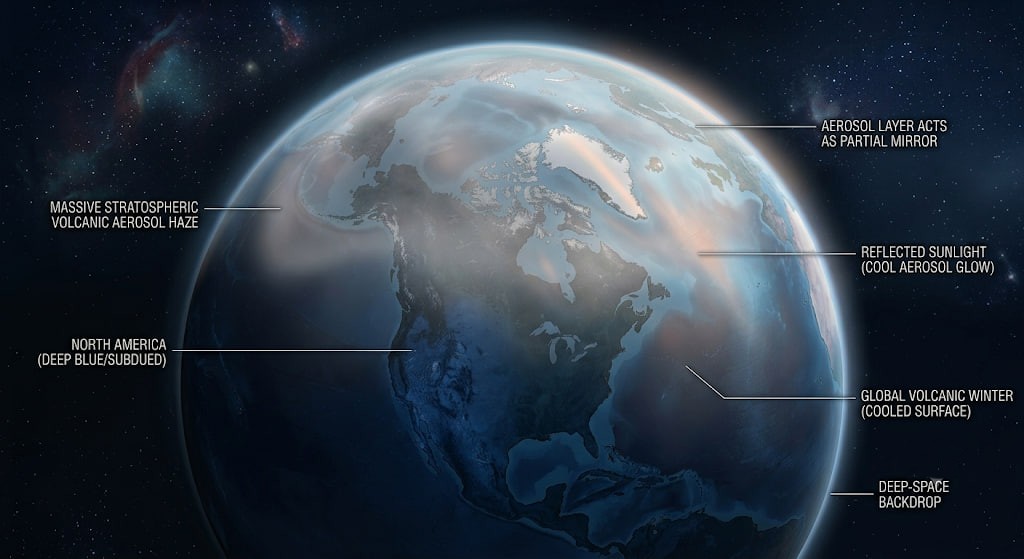
The farthest-reaching effect would be climatic. A super-eruption would inject millions of tonnes of sulfur dioxide into the stratosphere, where it forms a fine haze of droplets that reflects sunlight back to space. The result is a volcanic winter: a multi-year drop in global temperatures that disrupts growing seasons worldwide, explored in detail in our companion article on volcanic winter. Estimates of the cooling vary widely and remain genuinely uncertain — some models suggest global average temperatures could fall by several degrees Celsius for years, while the USGS cautions that Yellowstone’s specific climate impact is hard to predict and may be milder than the most extreme scenarios. What is clear is that the threat to global food supplies, more than the blast itself, is what makes a super-eruption a planetary concern.
A vital piece of perspective: even in this worst case, the USGS has stated plainly that a Yellowstone eruption would not wipe out humanity. It would be a civilisation-straining catastrophe, not an extinction event. Treating it as the literal end of the world is not supported by the science.
Could Humanity Prepare?
Because a super-eruption would announce itself well in advance, the realistic response is preparation rather than prevention. The regions inside the pyroclastic-flow zone would need to be evacuated entirely — the one unambiguous, life-saving step. Further out, the priorities would be protecting people from ash inhalation, clearing and reinforcing roofs before the weight collapses them, safeguarding water supplies, and keeping power and transport running as long as possible. The deeper challenge would be the multi-year food shock: cushioning it would demand drawing on global grain reserves, rapid shifts to hardier and faster-growing crops, and international cooperation on a scale rarely achieved.
None of this would be easy, but none of it is hopeless — and crucially, the warning time the system would provide is what makes meaningful preparation possible rather than futile.
Can We Predict or Prevent an Eruption?
Prediction, within limits, is realistic. A super-eruption could not sneak up on us: it would be preceded by unmistakable, escalating warning signs — intense earthquake swarms, dramatic ground deformation, and surging gas emissions — likely over weeks, months, or far longer. The challenge is less about detecting the signals than about interpreting them correctly and acting in time.
Prevention is another matter entirely. The most discussed idea is a NASA proposal to cool the system by drilling deep into its flanks and pumping water down under high pressure to draw heat out, with the bonus of generating geothermal electricity — at an estimated baseline cost of around 3.5 billion dollars. The concept is genuinely speculative, and experts urge caution.
The USGS warns that meddling with a magma system could backfire and even make an eruption more likely, that the timescales involved stretch across thousands of years, and that large-scale heat extraction would lower pressure on the geysers and hot springs, likely killing the very features that make Yellowstone unique. For now, prevention is not a realistic option. Monitoring, scientific understanding, and emergency preparedness — not engineering the volcano — are our genuine tools.
How Yellowstone Is Watched
Yellowstone is among the most closely monitored volcanic systems on Earth. The Yellowstone Volcano Observatory (YVO), a partnership led by the USGS, keeps constant watch using a dense network of seismometers that detect earthquakes and magma movement, GPS stations and satellite radar that measure millimetre-scale ground swelling or sinking, stream-gauges, and sensors that track gas emissions and the temperature of thermal features. The data flow in continuously and are reviewed and published in regular public updates.
As of 2026, the system remains firmly at background levels: routine small earthquakes, no significant uplift or subsidence of the caldera, and no indication of an impending eruption of any kind. That steady, transparent watch is the real reason scientists can speak with such confidence — not because Yellowstone is harmless, but because, were it ever to wake, we would almost certainly see it coming.
Yellowstone Myths, Debunked
Few natural features attract as much misinformation as Yellowstone, and separating fact from fiction is part of understanding it honestly. A handful of myths resurface again and again.
- “Yellowstone is overdue.” False — eruptions follow no schedule, and the past intervals were unequal, so there is no due date to miss.
- “There’s a giant lake of magma about to burst.” Misleading — the reservoir is mostly solid, only an estimated 5 to 15 percent molten, and is not pressurising toward an eruption.
- “Animals are fleeing, so an eruption is coming.” Untrue — a 2014 viral video of bison running through the park sparked this claim, but the animals were simply moving along a road, and wildlife behaviour does not forecast eruptions.
- “It will wipe out humanity.” Not supported — even a worst-case super-eruption would be a severe global disaster, but the USGS is clear it would not cause human extinction.
- “Scientists are hiding signs of an imminent eruption.” No — the Yellowstone Volcano Observatory publishes its monitoring data openly, with routine public updates anyone can read.
The thread connecting these myths is a hunger for a dramatic, imminent catastrophe. The real Yellowstone is more reassuring and, arguably, more fascinating: a colossal, restless, but quietly sleeping system whose behaviour we can actually watch, measure, and understand.
Q&A
No — this is a myth. Volcanoes do not erupt on a fixed schedule, and the gaps between Yellowstone’s three past super-eruptions were not equal, so there is no “due date” to be late for. The USGS is explicit that the math does not support the idea of being overdue, and monitoring shows no sign an eruption is near.
No one can name a date, but the annual odds of a caldera-forming eruption are about 1 in 730,000, and scientists do not expect one anytime soon. The current dormant period has already lasted around 70,000 years and could continue for thousands more. A small lava flow or hydrothermal explosion is far more likely than a super-eruption.
No. Even a full super-eruption would not be a human extinction event — the USGS has said so directly. It would cause catastrophic regional destruction, continent-wide ashfall, and a global volcanic winter that strains food supplies, but humanity as a whole would survive. The “end of the world” framing is not supported by the evidence.
Likely a great deal. A major eruption would be preceded by clear, escalating signals — swarms of earthquakes, significant ground deformation, and rising gas emissions — probably over weeks to months or longer. The Yellowstone Volcano Observatory monitors all of these continuously, so a sudden, unwarned super-eruption is not how the system would behave.
There is no evidence of that. The reservoir beneath Yellowstone is mostly solid rock, estimated at only about 5 to 15 percent molten. A super-eruption would require a far larger molten fraction to accumulate, and monitoring shows no such build-up. Normal small fluctuations in ground level reflect the shifting of water and gas, not magma surging toward the surface.
It was a magnitude 7.3 earthquake just west of Yellowstone on 17 August 1959 — the largest in the region’s recorded history. It triggered a huge landslide that killed 28 people and formed Quake Lake, and it dramatically altered the park’s geysers and hot springs. It was a tectonic earthquake, not a sign of volcanic eruption, and the region remains seismically active today.
Not with any proven method. A widely discussed NASA concept would drill deep and pump water to draw heat from the magma, but the USGS cautions it could be ineffective or even risky — potentially triggering instability and destroying the park’s geysers. For now, prevention is not feasible, and the realistic response is monitoring and preparedness rather than engineering the volcano.
A lava flow or a hydrothermal (steam) explosion — not a super-eruption. Nearly all of Yellowstone’s approximately 80 eruptions since the last caldera collapse were lava flows. Steam-driven hydrothermal blasts are smaller but more frequent and are the hazard most likely to actually affect park visitors.
The Bigger Question
The Yellowstone supervolcano is real, immense, and worth understanding clearly — which means resisting both complacency and panic. The evidence says it is quietly dormant, not winding up to erupt, and that its likeliest future stirrings are modest. But the rare worst case is dramatic enough to be worth imagining in full. What would the first hours, the ashfall, and the long volcanic winter actually look like if it let go at full force? That scenario plays out in what if Yellowstone erupted tomorrow.
To understand the wider category these giants belong to and the scale geologists use to rank them, read what is a supervolcano, and to explore the global cooling that makes any giant eruption a planetary concern, see volcanic winter. Discover more of the forces shaping our planet on the Geology hub.
Watch the Yellowstone scenario to see what a real super-eruption would unleash, minute by minute.