 By
By 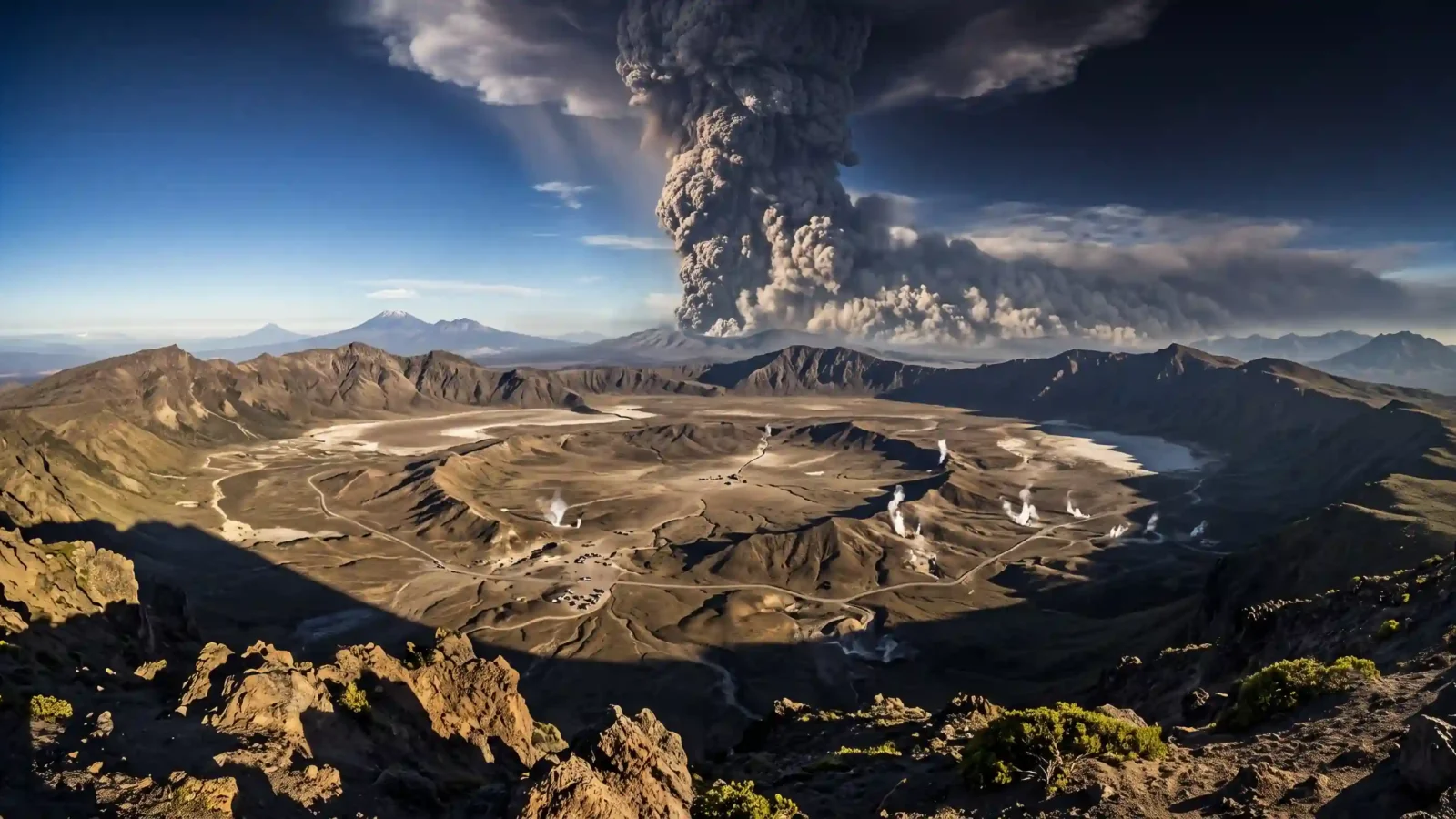
Quick Answer
A supervolcano is a volcano capable of an eruption thousands of times larger than a normal one — ejecting more than 1,000 cubic kilometres of material in a single event. These rare, catastrophic eruptions rank as a maximum 8 on the Volcanic Explosivity Index (VEI), the scale geologists use to measure eruption size. Known supervolcanoes include Yellowstone, Toba, and Taupō, and a super-eruption could disrupt the global climate — though such events occur only every tens of thousands of years.
The word “supervolcano” conjures apocalyptic images, and for once the reality lives up to the name. These are the most powerful volcanic systems on Earth, capable of reshaping landscapes and cooling the entire planet. This guide explains what makes a volcano “super,” how the Volcanic Explosivity Index works, where the world’s supervolcanoes are, what a super-eruption actually does, and whether we could predict or prevent one.
What Makes a Volcano a “Super” Volcano?
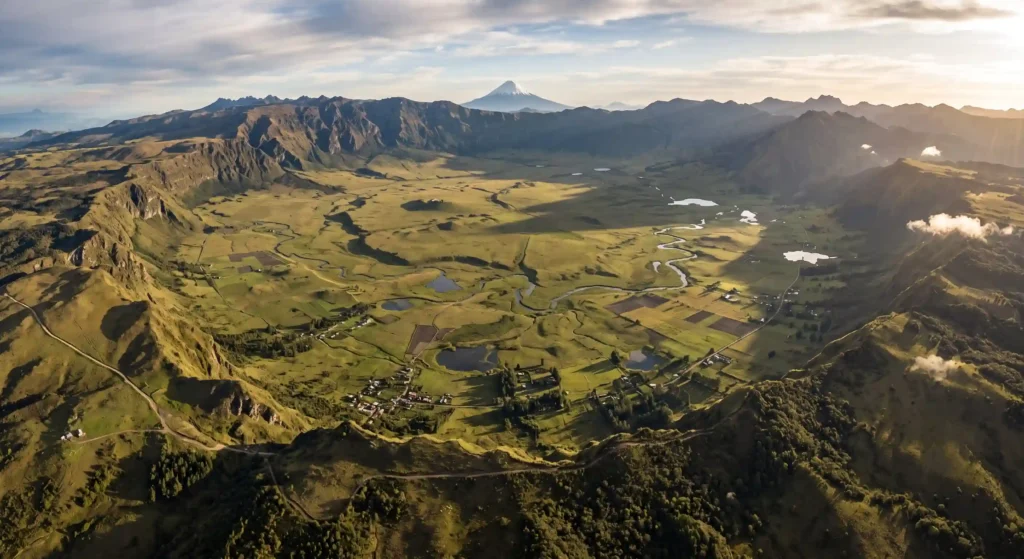
A supervolcano is defined not by its shape but by the sheer scale of its largest eruptions. Specifically, a supervolcano is one that has produced, or is capable of producing, an eruption that ejects more than 1,000 cubic kilometres of material — the top category on the eruption scale. By comparison, the famous 1980 eruption of Mount St. Helens ejected about 1 cubic kilometre, so a super-eruption is on the order of a thousand times larger.
Many supervolcanoes do not even look like volcanoes. Instead of a towering cone, they often appear as vast, low depressions called calderas — giant craters formed when the ground collapses into the emptied magma chamber after an eruption. The Yellowstone caldera, for instance, is so large (tens of kilometres across) that for years no one realised the whole valley was the crater of a supervolcano.
How a Supervolcano Forms
Ordinary volcanoes build cones because magma reaches the surface fairly regularly, in modest batches. Supervolcanoes do the opposite: they store magma for an extraordinarily long time before releasing any of it. That storage is the whole story.
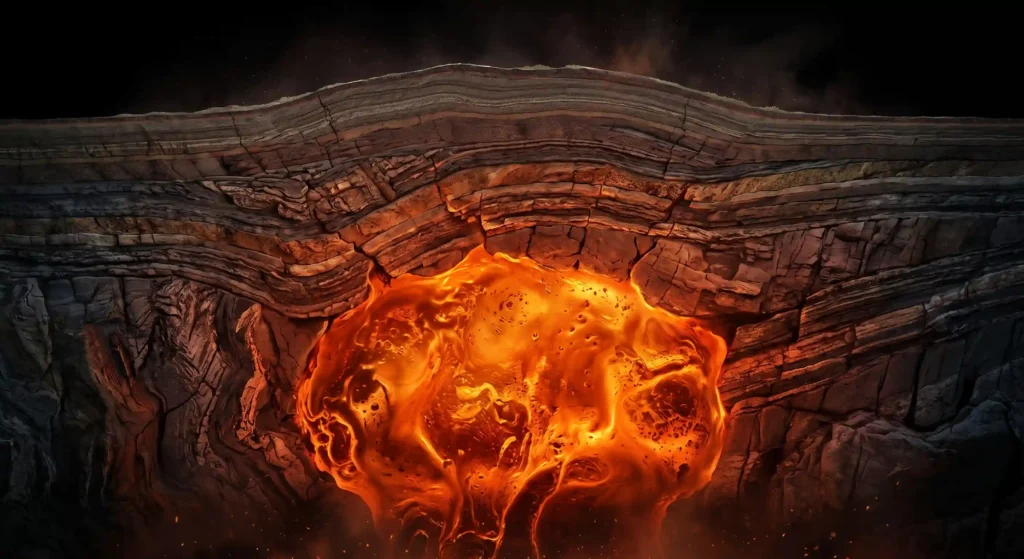
The magma involved is usually rhyolite — a silica-rich melt that is thick, sticky, and loaded with dissolved gas. Because it is so viscous, gas cannot escape gently the way it does from runny Hawaiian basalt. Instead the melt accumulates in a shallow reservoir over tens or hundreds of thousands of years, slowly cooking the crust above it, until the pressure exceeds the strength of the rock roof.
When the roof finally fails, the eruption is self-accelerating. Depressurising the reservoir causes dissolved gas to come out of solution all at once — the same physics as opening a shaken bottle, scaled to a magma body the size of a mountain range. As the chamber empties, the ground above has nothing left to rest on and collapses inward along ring faults, dropping hundreds of metres in a matter of hours. That collapse is what carves a caldera.
- Hotspot systems: a plume of hot rock rises from deep in the mantle and sits beneath a continental plate, melting crust above it. Yellowstone is the classic example — the plate slides over the fixed heat source, leaving a trail of dead calderas behind it.
- Subduction systems: one tectonic plate dives beneath another, releasing water that lowers the melting point of the overlying mantle. Toba, Taupō, and Campi Flegrei all sit above subduction zones.
Both routes converge on the same outcome: a huge volume of gas-rich, crystal-laden magma parked in the upper crust with nowhere to go. Crucially, the reservoir spends the overwhelming majority of its life as mostly-solid mush. It only becomes eruptible in the geologically brief window when enough of it remelts and mobilises — which is why “there is magma under there” and “an eruption is coming” are two completely different statements.
The Volcanic Explosivity Index (VEI) Explained
Geologists rank eruptions on the Volcanic Explosivity Index, a scale from 0 to 8 based mainly on the volume of material erupted and the height of the eruption plume. Like the Richter scale for earthquakes, it is roughly logarithmic — each step up represents about a tenfold increase in size.
- VEI 0–1: gentle, effusive eruptions (like much of Hawaii’s activity).
- VEI 3–4: moderate to large explosive eruptions (Mount St. Helens, 1980, was a VEI 5).
- VEI 6: very large eruptions (Krakatoa, 1883; Pinatubo, 1991).
- VEI 7: colossal eruptions (Tambora, 1815 — the largest in recorded history).
- VEI 8: super-eruptions, ejecting over 1,000 km³ — only supervolcanoes reach this level.
Only a VEI 8 eruption qualifies as a true super-eruption. No such event has occurred in recorded human history, so everything we know about them comes from the geological record.
The Full VEI Scale, Step by Step
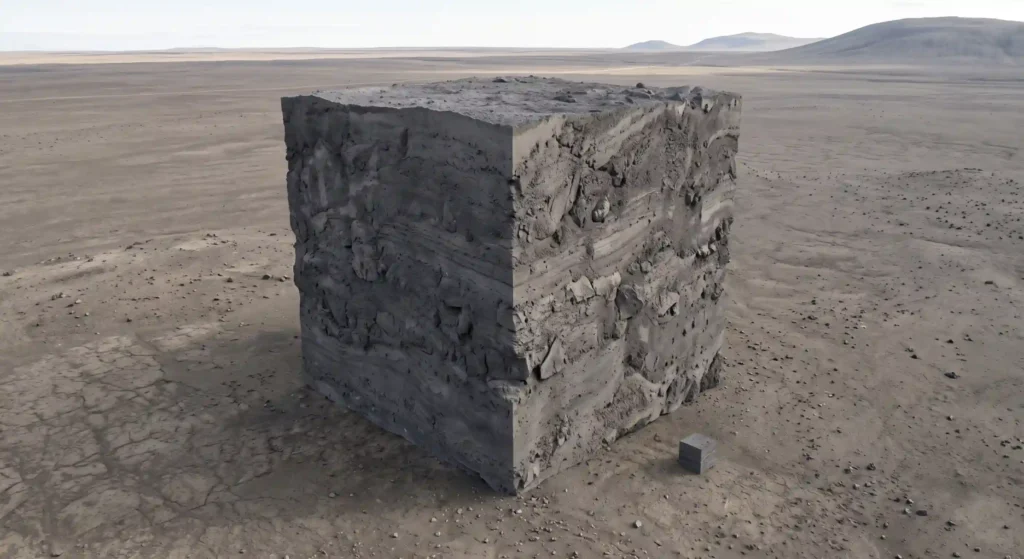
The summary above covers the headline categories, but it is worth seeing every rung of the ladder — including how often each one actually happens. That frequency column is the part most people never see, and it does more to put supervolcanoes in perspective than any description of the blast.
- VEI 0 — Effusive. Less than 10,000 m³ erupted, plume under 100 m. Continuous somewhere on Earth. Example: everyday Kīlauea lava flows.
- VEI 1 — Gentle. Over 10,000 m³, plume 100 m–1 km. Roughly daily. Example: Stromboli’s routine spattering.
- VEI 2 — Explosive. Over 1,000,000 m³, plume 1–5 km. Roughly every two weeks. Example: Galeras, 1993.
- VEI 3 — Severe. Over 0.01 km³, plume 3–15 km. Every few months. Example: Nevado del Ruiz, 1985.
- VEI 4 — Cataclysmic. Over 0.1 km³, plume 10–25 km. Roughly yearly. Example: Eyjafjallajökull, 2010 — small, but it closed European airspace.
- VEI 5 — Paroxysmic. Over 1 km³, plume above 25 km. Roughly every decade. Example: Mount St. Helens, 1980; Vesuvius, AD 79.
- VEI 6 — Colossal. Over 10 km³. Roughly every 50–100 years. Example: Krakatoa, 1883; Pinatubo, 1991.
- VEI 7 — Super-colossal. Over 100 km³. Roughly every 500–1,000 years. Example: Tambora, 1815; Minoan eruption of Santorini.
- VEI 8 — Mega-colossal. Over 1,000 km³. Very roughly every 50,000–100,000 years globally. Example: Toba, Yellowstone’s Lava Creek, Taupō’s Oruanui.
Two things jump out. First, the gap between VEI 5 and VEI 8 is not a difference of degree but of category — a thousandfold jump in erupted volume. Second, humanity has direct experience only up to VEI 7. Every VEI 8 event lies outside written history, which is precisely why they are so easy to mythologise.
Geologists have identified at least 60 confirmed VEI 8 eruptions in the geological record, spread across every continent and hundreds of millions of years. Only three of those systems — Yellowstone, Toba, and Taupō — are considered geologically active today.
What the VEI Does Not Measure
The VEI is a useful shorthand, but it has real blind spots, and understanding them is the difference between reading a headline and reading the science.
It measures bulk volume, not magma. Erupted material is full of gas bubbles and void space, so a cubic kilometre of ash deposit contains far less actual rock than a cubic kilometre of magma. Scientists correct for this using dense-rock equivalent (DRE), which strips out the froth. The same eruption can therefore be quoted with two very different-sounding numbers depending on which measure is used — one reason published eruption volumes seem to disagree.
It ignores non-explosive eruptions almost entirely. The VEI is built around explosivity, so enormous but quiet eruptions score badly. The 1783–84 Laki fissure eruption in Iceland rates only a VEI 6, yet it released so much sulfur into the lower atmosphere that it killed roughly a quarter of Iceland’s population and is linked to tens of thousands of excess deaths across Europe. Flood basalt provinces like the Deccan Traps and Siberian Traps — implicated in mass extinctions — barely register on the index at all.
It says nothing about sulfur. The single most important factor in whether an eruption changes global climate is how much sulfur dioxide it delivers to the stratosphere, and the VEI does not track this. A modest, sulfur-rich, tropical eruption can cool the planet more than a larger, sulfur-poor one at high latitude — the mechanism explored in our companion article on volcanic winter.
For these reasons many volcanologists prefer the magnitude (M) scale, which is based purely on erupted mass and behaves more like the moment magnitude scale used for earthquakes. On that scale, a super-eruption is M8 or greater. You will see both systems used in the literature, often side by side.
The World’s Known Supervolcanoes (incl. Yellowstone)
Several supervolcanoes are scattered around the globe, mostly dormant but carefully monitored. The most famous is Yellowstone in the United States, which has had several super-eruptions over the past two million years and is the subject of endless fascination and worry — explored in what if Yellowstone erupted tomorrow.
Others include Toba in Sumatra, Indonesia, whose eruption around 74,000 years ago was one of the largest of the last few million years; Taupō in New Zealand, responsible for the most recent super-eruption roughly 26,500 years ago; Long Valley Caldera in California; and Campi Flegrei near Naples, Italy. Each is a sleeping giant, and geologists keep close watch on them for any sign of unrest.
Of these, Yellowstone attracts by far the most public attention — and by far the most misinformation. Its three-eruption record, the size of its caldera, and the fact that it sits under a national park visited by millions have made it the default image people reach for when they hear “supervolcano.” What actually lies beneath the park, how molten it really is, and why scientists are confident it is not winding up to erupt are covered in full in our guide to the Yellowstone supervolcano.
Which Supervolcanoes Are Restless Right Now?
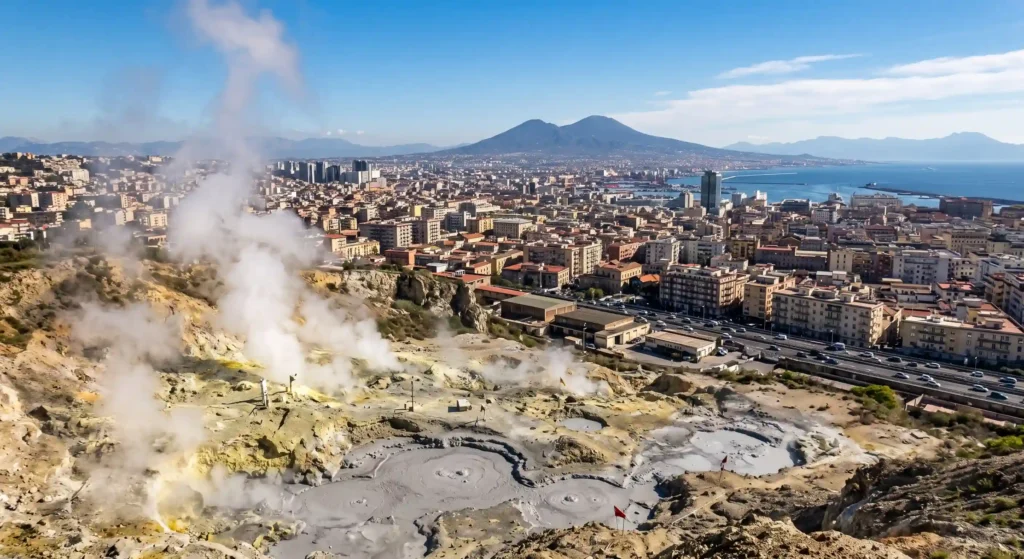
“Restless” is a technical term, not an alarm. Large calderas breathe constantly — the ground rises and falls, earthquake swarms come and go, gas output fluctuates. The question volcanologists ask is not whether a caldera is moving, but whether the pattern of movement is changing in a way that suggests magma, rather than water and gas, is on the move.
- Campi Flegrei, Italy — the most restless of the group by a wide margin. The caldera has been uplifting since 2005, accumulating well over a metre and a half of ground rise, with frequent earthquake swarms beneath a densely populated area near Naples. Italy’s INGV describes the system as in a phase of accelerating unrest. Even so, the agency stresses that unrest is not the same as an imminent eruption, and that any eruption would most likely be small — not a super-eruption.
- Long Valley Caldera, California — episodic uplift and earthquake swarms since the late 1970s, studied intensively. Recent research suggests the system is cooling and releasing stored fluid rather than recharging with fresh magma.
- Yellowstone, USA — thousands of small earthquakes a year and decades-long cycles of caldera inflation and deflation, all of it within the system’s normal range. No indication of magma ascent.
- Toba, Indonesia — now largely occupied by Lake Toba. Quiet, with no significant unrest reported.
- Taupō, New Zealand — produced a minor unrest episode with earthquakes and small ground deformation in 2022, which subsided. The caldera lies beneath a lake and is continuously monitored.
The important pattern here is that the calderas causing volcanologists the most professional concern are not the ones causing the public the most fear. Campi Flegrei, sitting under half a million people, is a far more pressing civil-defence problem on a human timescale than Yellowstone — and the realistic scenario there is a modest eruption, not a planet-altering one.
The Biggest Eruptions in Earth’s History
Once you go past Tambora, the record leaves written history behind entirely and is read instead from ash layers, welded tuffs, and radiometric dates. Here are the benchmarks geologists use.
- Fish Canyon Tuff, La Garita Caldera (Colorado, ~28 million years ago) — roughly 5,000 km³, among the largest explosive eruptions ever identified anywhere on Earth.
- Huckleberry Ridge Tuff (Yellowstone, ~2.1 million years ago) — around 2,450–2,500 km³, the largest of Yellowstone’s three.
- Youngest Toba Tuff (Sumatra, ~74,000 years ago) — roughly 2,800 km³, the largest eruption of the last two million years and the subject of the contested “Toba catastrophe” hypothesis.
- Lava Creek Tuff (Yellowstone, ~640,000 years ago) — around 1,000 km³; this is the eruption that formed the caldera visible in the park today.
- Oruanui eruption (Taupō, ~25,600 years ago) — roughly 1,170 km³, the most recent VEI 8 eruption on Earth.
- Tambora (Indonesia, 1815) — around 150 km³, a VEI 7. Not a super-eruption, but the largest in recorded history and the reference point for everything we actually observed.
Note the gap at the end of that list. The most recent true super-eruption predates agriculture, writing, cities, and every institution modern civilisation depends on. Everything humanity has ever built has been built during a quiet stretch.
What a Super-Eruption Actually Does
A super-eruption is among the most destructive natural events possible. The immediate effects would be regional devastation: the collapse of the ground into a new caldera, vast pyroclastic flows of superheated gas and rock, and a blanket of volcanic ash spreading across an entire continent, burying landscapes and collapsing roofs hundreds of kilometres away.
But the most far-reaching consequence is climatic. A super-eruption injects enormous quantities of sulfur dioxide and ash high into the atmosphere, where the sulfur forms a haze of tiny droplets that reflect sunlight back into space. This can cause a volcanic winter — a sharp, multi-year drop in global temperatures that disrupts agriculture worldwide, as detailed in our companion article on volcanic winter. It is this global cooling, far more than the local blast, that makes super-eruptions a planetary concern.
How Far the Damage Reaches
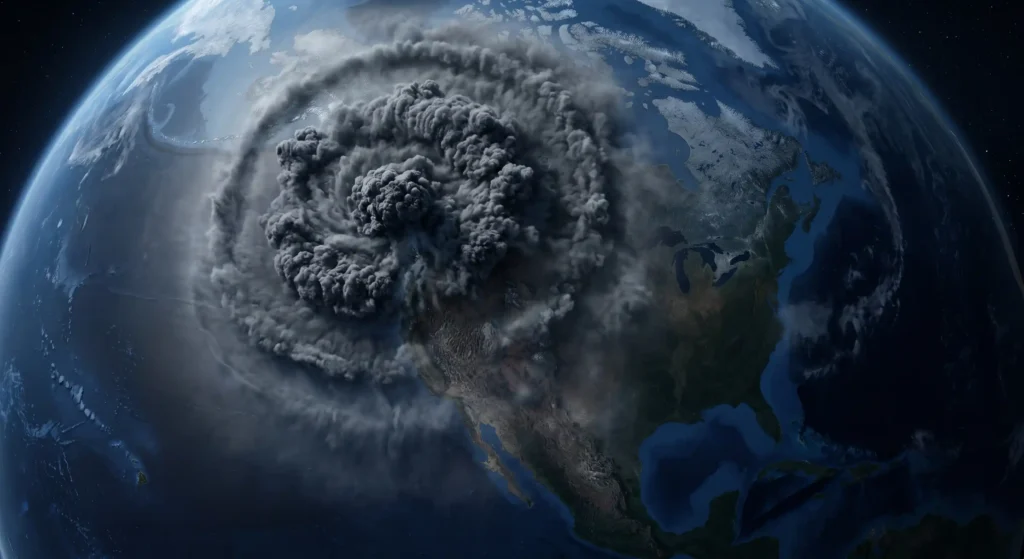
It helps to think of a super-eruption as four concentric zones, each governed by different physics and each requiring a completely different response.
- 0–100 km — the pyroclastic zone. Ground-hugging currents of gas, ash and rock at 100–700 km/h and 100–900 °C. Total destruction. Survival depends entirely on not being there; evacuation is the only defence.
- 100–1,500 km — the heavy ashfall zone. Centimetres to metres of abrasive volcanic glass. Roofs collapse under the load, especially if rain wets the ash and doubles its weight. Power grids short out, water supplies clog, engines seize.
- Continental scale — the thin ashfall zone. Millimetres of ash across most of a continent. Not directly lethal, but enough to ground aviation, contaminate reservoirs, and damage crops.
- Global — the climate zone. No ash at all, just a stratospheric sulfate haze. This is where the majority of human impact would land: shortened growing seasons, failed harvests, and pressure on a food system that keeps only a few months of reserves.
The counterintuitive conclusion is that the people most affected by a super-eruption would be those who never see a single flake of ash. The blast is regional; the famine risk is planetary.
How Often Do They Erupt?
The reassuring news is that super-eruptions are extraordinarily rare. VEI 8 events occur, very roughly, on the order of once every 50,000 to 100,000 years globally, though the timing is irregular and not on a fixed schedule. The most recent super-eruption — Taupō’s Oruanui eruption — was about 26,500 years ago, and the famous Toba eruption was around 74,000 years ago.
It is important to dispel a common myth here: a supervolcano like Yellowstone is not “overdue.” Volcanoes do not erupt on a predictable timetable, and the average interval between past eruptions does not mean the next one is imminent. Current monitoring shows no signs that any supervolcano is heading toward an eruption in the foreseeable future.
Why “Overdue” Is a Statistical Mistake
The “overdue” claim is worth dismantling properly, because it is repeated so confidently and so often.
An average interval is a description of the past, not a schedule for the future. If three eruptions happened 800,000 and 660,000 years apart, that tells you the system is capable of long gaps — it does not create an obligation for a fourth. Volcanoes have no memory of when they last erupted and no mechanism for keeping time.
Statisticians call this a memoryless process: the probability of an eruption in the next year is essentially the same whether the last one was 10,000 or 600,000 years ago. Waiting longer does not make an event more likely; it only means you have waited longer. Buses run on timetables. Magma does not.
There is also a sampling problem. With only three data points at Yellowstone, and only about 60 identified VEI 8 events worldwide across all of geological time, any “average recurrence interval” carries enormous uncertainty. Treating a number derived from three intervals as a countdown clock is not a small error — it is a misuse of the arithmetic.
Can We Predict or Prevent One?
Scientists monitor supervolcanoes intensively using networks of seismometers (to detect magma movement), GPS and satellite measurements (to detect ground swelling), and gas sensors. A super-eruption would almost certainly be preceded by clear warning signs — intense earthquake swarms, significant ground deformation, and changes in gas emissions — likely over weeks, months, or longer, giving some time for evacuation.
Preventing one is a different matter. There is currently no proven way to stop a super-eruption. Speculative ideas, such as drilling into the magma chamber to relieve pressure or extract heat, are debated, but some scientists warn such interventions could be risky or even trigger the very eruption they aim to prevent. For now, monitoring and preparedness — not prevention — are our realistic tools.
The Warning Signs Volcanologists Actually Watch
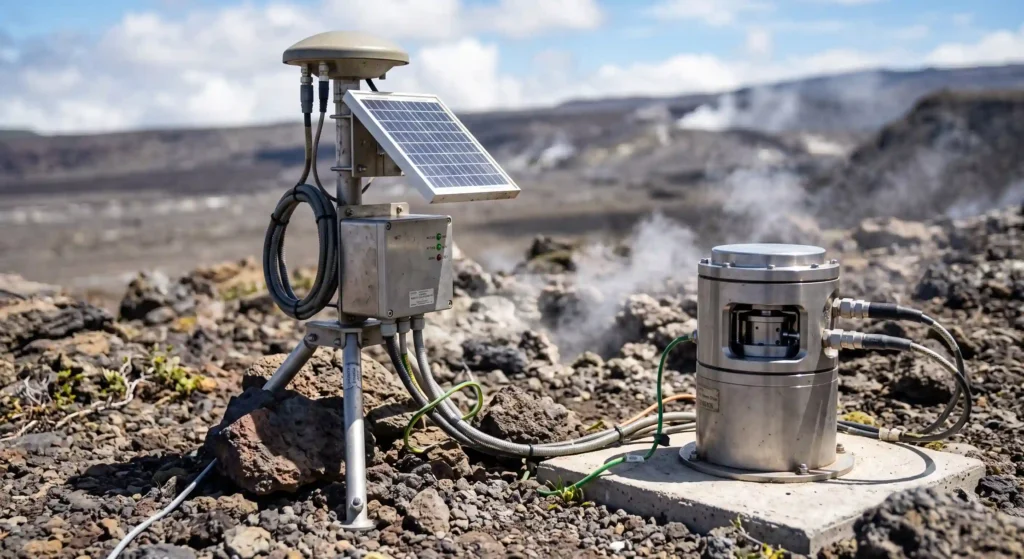
Monitoring a caldera is not a matter of waiting for one dramatic alarm. It is the continuous cross-referencing of several independent data streams, because any one of them alone can mislead.
- Seismicity. Not just how many earthquakes, but what kind. Sharp, brittle “volcano-tectonic” quakes mean rock is cracking. Rhythmic, sustained “harmonic tremor” means fluid is moving — a far more significant signal.
- Ground deformation. GPS stations and satellite radar (InSAR) detect surface movement down to millimetres. The key is the pattern: steady breathing over decades is normal; sudden acceleration localised over one part of the caldera is not.
- Gas chemistry. A rising ratio of sulfur dioxide to carbon dioxide can indicate that fresh magma is ascending, because different gases come out of solution at different depths.
- Thermal and hydrothermal output. Changes in the temperature and behaviour of hot springs, geysers, and fumaroles, tracked by ground sensors and satellite thermal imaging.
The genuine difficulty is not detection but interpretation. Calderas produce false alarms routinely — unrest episodes that build, plateau, and fade away without any eruption at all. The 1982–84 Long Valley crisis and the ongoing Campi Flegrei uplift are both examples of serious, sustained unrest that has not led to an eruption. Distinguishing a system that is genuinely mobilising from one that is merely shifting hot water is the central unsolved problem in caldera science, and it is why volcanologists talk in probabilities rather than predictions.
Q&A
Among the largest known is the La Garita Caldera’s Fish Canyon eruption in Colorado around 28 million years ago, which ejected roughly 5,000 cubic kilometres of material. In recorded human history, the largest was Tambora in 1815, a VEI 7 that caused the “Year Without a Summer.”
No — this is a myth. Volcanoes do not erupt on a fixed schedule, so the concept of being “overdue” does not apply. Yellowstone’s past eruptions were not evenly spaced, and there is currently no scientific evidence that a super-eruption is imminent.
There is no proven method to prevent a super-eruption. Speculative proposals like drilling to release pressure or heat exist, but experts caution they could be ineffective or even dangerous, potentially triggering instability. Realistically, we rely on monitoring and emergency preparedness rather than prevention.
The most far-reaching danger is the global cooling, or volcanic winter, caused by sulfur and ash blocking sunlight. This could disrupt agriculture worldwide for years and threaten food supplies far beyond the eruption zone — a greater risk to humanity than the local blast and ash fall.
Geologists have identified at least 60 VEI 8 eruptions in the geological record, but most of those systems are long extinct. Only a handful of large calderas are considered active and capable of a super-eruption today — Yellowstone, Toba, Taupō, Long Valley, and Campi Flegrei are the ones most commonly listed and most closely monitored.
Roughly a factor of ten in erupted volume. A VEI 7 eruption ejects more than 100 km³ — Tambora in 1815 is the benchmark, and it caused the Year Without a Summer. A VEI 8 exceeds 1,000 km³ and qualifies as a super-eruption. Humanity has direct historical experience of VEI 7 events but none at all of VEI 8.
The Oruanui eruption of Taupō in New Zealand, around 25,600–26,500 years ago, is the most recent confirmed VEI 8 event on Earth. Before that, Toba erupted around 74,000 years ago. No super-eruption has occurred within recorded human history.
By current unrest levels, Campi Flegrei in Italy is the most restless — it has been uplifting since 2005 with frequent earthquake swarms, and Italian authorities classify it as in accelerating unrest. Importantly, even there the expected scenario is a small to moderate eruption, not a super-eruption. No supervolcano anywhere is showing signs of an imminent VEI 8 event.
Similar in spirit but not identical. Both are roughly logarithmic, with each step representing about a tenfold increase. However, the VEI is based on erupted volume and plume height rather than energy released, it is capped at 8, and it does not capture non-explosive eruptions or sulfur output. Many volcanologists prefer the magnitude (M) scale, which is based on erupted mass and behaves more like earthquake magnitude.
Almost certainly not. A super-eruption would be a civilisation-straining catastrophe — regional destruction, continental ashfall, and years of disrupted harvests — but scientific agencies including the USGS are explicit that it would not wipe out humanity. Humans survived the Toba eruption roughly 74,000 years ago with far fewer resources than we have now.
The Bigger Question
Supervolcanoes are the planet’s most powerful eruptive systems, and the most closely watched is Yellowstone — a caldera sitting atop a vast reservoir of magma. What would actually happen, hour by hour and year by year, if it erupted at full force tomorrow? From the initial blast to the global volcanic winter, that scenario is laid out in what if Yellowstone erupted tomorrow.
The climatic aftermath of any giant eruption is explored in volcanic winter. Discover more about Earth’s geological forces on the Geology hub.
Watch the Yellowstone scenario to see what a real super-eruption would unleash.