 By
By What Is the Mariana Trench and What’s at Its Bottom?
The Mariana Trench is a crescent-shaped oceanic trench in the western Pacific Ocean, formed where the Pacific Plate subducts beneath the Mariana Plate — a process called a subduction zone. At its deepest point, Challenger Deep, the ocean floor lies at approximately 10,935 metres (35,876 feet) below sea level — nearly 11 km down, deep enough to submerge Mount Everest with over 2 km to spare.
At the bottom of the Mariana Trench, pressure reaches approximately 1,086 atmospheres (about 1.1 × 10⁸ Pa). Despite these extreme conditions, life exists: single-celled foraminifera, shrimp-like amphipods, snailfish (the deepest-known fish, recorded at 8,336 m), and microbial communities metabolising organic material that drifts down from the sunlit surface waters over the course of decades. The abyssal zone is not lifeless — it is populated by adapted organisms found nowhere else.
How Does a Subduction Zone Work?
The Pacific Plate is one of Earth’s largest tectonic plates, moving west-northwest at approximately 7 cm/year. Where it collides with the smaller Mariana Plate, the denser oceanic crust of the Pacific Plate bends downward and dives beneath the lighter Mariana Plate in a process called subduction. As the Pacific Plate descends, it creates the Mariana Trench at the surface and carries water-bearing minerals into the mantle, where the water reduces the melting point of rock and generates magma that rises to form the arc of volcanic islands (the Mariana Islands) parallel to the trench.
The interface between the two plates — the megathrust fault — is where the world’s largest earthquakes occur. The 2011 Tōhoku earthquake (M9.1) ruptured a 500 km section of the Japan Trench subduction zone. The 1960 Valdivia earthquake (M9.5) — the largest recorded — ruptured ~1,000 km of the South American subduction zone. The Mariana subduction zone extends ~2,550 km.
What Would a Full Mariana Trench Rupture Look Like?
A simultaneous rupture of the entire 2,550 km Mariana subduction zone — a hypothetical “maximum credible earthquake” — would likely exceed magnitude 10.5. The 2011 Tōhoku M9.1 quake caused the ocean floor to rise by up to 7 metres over a 500 km segment. A full 2,550 km Mariana rupture with comparable seafloor displacement would displace far more water:
- Rupture length: ~2,550 km (vs 500 km for Tōhoku)
- Seafloor displacement: potentially 10–20 metres vertically over thousands of square kilometres
- Initial tsunami wave height at generation zone: 20–50 metres
- Pacific-wide tsunami propagation: 16 hours to reach the US west coast; 20 hours to reach South America
- Tsunami run-up on exposed coastlines: potentially 50–100 metres in funnel-topography coastlines like bays and river valleys
What Hydrothermal Activity Would a Major Rupture Release?
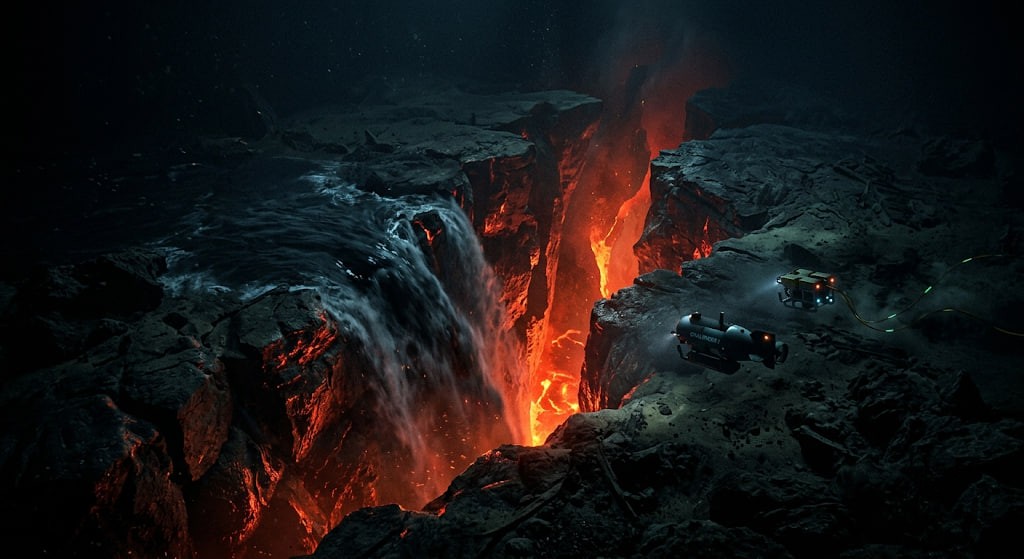
Hydrothermal vents are found along the entire Mariana arc, driven by the volcanic activity associated with subduction. A major rupture event that fractured the oceanic crust along the trench might temporarily increase permeability in the overlying crust, releasing superheated vent fluids over a larger area. This has been observed on smaller scales following large earthquakes: the 2011 Tōhoku earthquake measurably changed the hydrothermal vent activity along the Japan Trench by altering crustal permeability. The most dramatic ocean exploration in this zone — the 2012 James Cameron solo dive to Challenger Deep — found the trench floor to be a flat, featureless sediment plain; the real geological action is along the trench walls where the active fault zones lie.
Q&A
The Mariana Trench is a crescent-shaped oceanic trench in the western Pacific, formed by the subduction of the Pacific Plate beneath the Mariana Plate. At its deepest point — Challenger Deep — the ocean floor lies at approximately 10,935 metres below sea level, making it the deepest part of the ocean on Earth.
At the bottom of the Mariana Trench, pressure exceeds 1,000 atmospheres, yet life exists: amphipod crustaceans, snailfish (recorded to 8,336 m), single-celled foraminifera, and microbial communities. The floor is a flat sediment plain of fine-grained material that has settled from above over millions of years. Hydrothermal vents occur along the trench walls.
A subduction zone is a tectonic plate boundary where one plate dives beneath another into the Earth’s mantle. The subducting plate creates a deep ocean trench at the surface and generates volcanic arcs and earthquakes as it descends. The world’s deepest trenches (Mariana, Tonga, Philippine) and most powerful earthquakes (Cascadia, Japan, Chile) occur at subduction zones.
Challenger Deep, the deepest surveyed point in the Mariana Trench (and on Earth), has a confirmed depth of approximately 10,935 metres (35,876 feet), based on multibeam sonar surveys. The measurement was most precisely confirmed by the Five Deeps Expedition in 2019. It is located in the southern end of the Mariana Trench, southwest of Guam.
The deepest part of the ocean is Challenger Deep in the Mariana Trench, at approximately 10,935 metres below sea level. The second deepest is the Tonga Trench in the Pacific (Horizon Deep, ~10,820 m), followed by the Philippine Trench (~10,540 m). All three are subduction zone trenches in the western Pacific Ocean.
Internal links: geology facts | What If Yellowstone Erupted Tomorrow? | What If the Banqiao Dam Collapsed Today?