 By
By 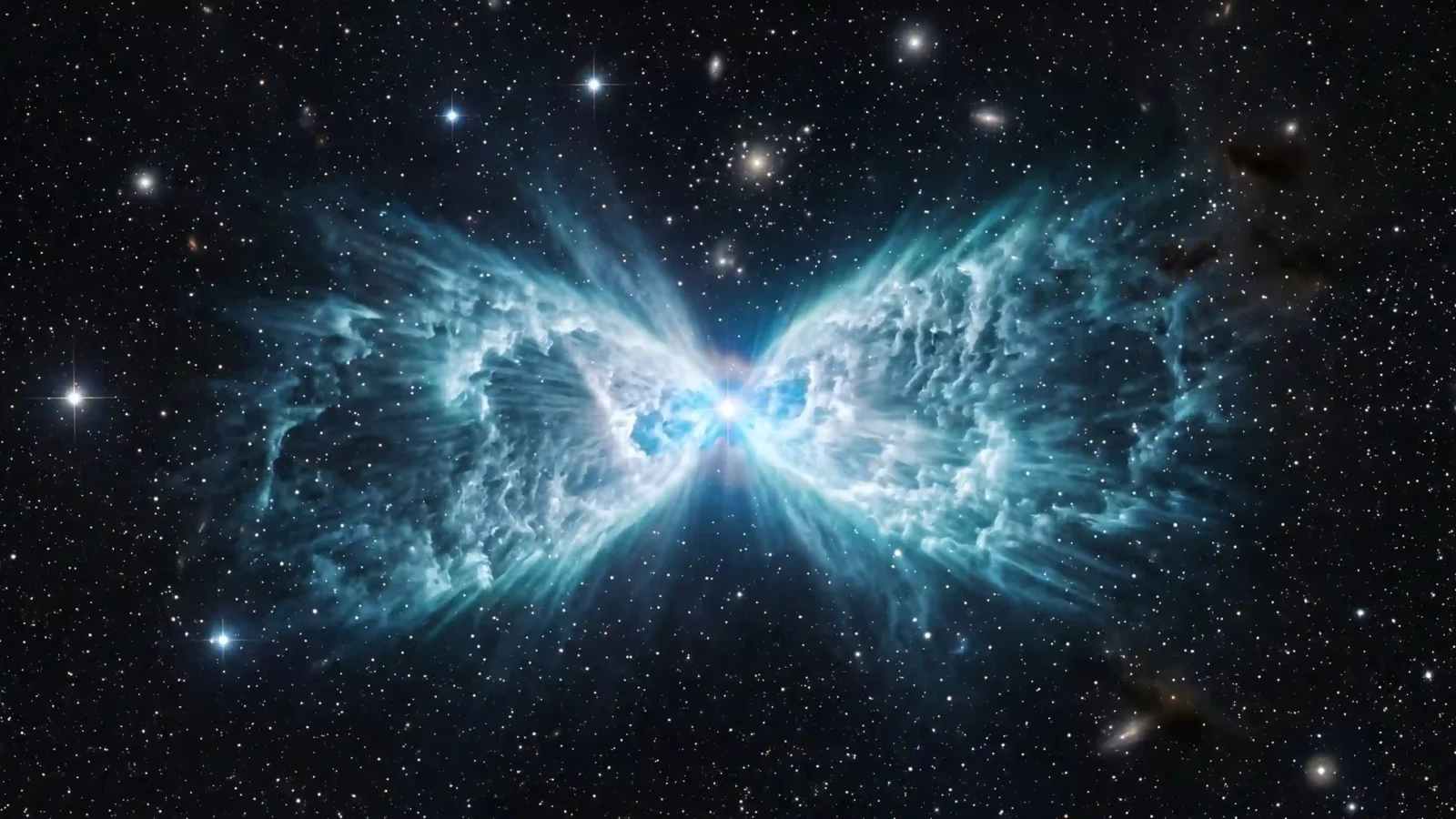
Quick Answer
The coldest known place in the universe is the Boomerang Nebula, about 5,000 light-years from Earth, where temperatures drop to roughly 1 kelvin (−272°C) — colder even than the natural background of space itself. Most of space sits at about 2.7 K, the leftover warmth of the Big Bang, but the rapidly expanding gas of the Boomerang Nebula chills itself below that. The very coldest temperatures of all, however, are made by humans in laboratories.
It is natural to assume that deep space is the coldest thing there is. But “cold” has a baseline even in the vacuum, and one remarkable object manages to beat it. This guide explains how cold the universe normally is, why the Boomerang Nebula is colder than its surroundings, the astonishing temperatures achieved in labs, and what the ultimate cold — absolute zero — really means.
How Cold Is the Universe Normally? (the CMB at 2.7 K)
Empty space is not at absolute zero. It is bathed in the cosmic microwave background (CMB) — the faint afterglow of the Big Bang, radiation that has been cooling for nearly 14 billion years as the universe expanded. Today it fills all of space with a temperature of about 2.725 kelvin, which is roughly −270°C.
This means that anything floating in deep space, far from any star, will naturally settle toward that temperature of about 2.7 K, warmed ever so slightly by this universal background glow. For a long time, this seemed to set the floor for how cold any natural place could be — until astronomers found somewhere colder.
Why the Background Has a Temperature at All
That 2.725 K figure is not an arbitrary measurement. It is a direct readout of the universe’s age, and it is one of the strongest pieces of evidence that the Big Bang happened.
For its first 380,000 years the universe was hot enough that atoms could not hold together. Electrons roamed free, and free electrons scatter light relentlessly, so the cosmos was an opaque glowing fog at thousands of degrees. When expansion cooled it to roughly 3,000 K, electrons and nuclei combined into neutral atoms and the fog cleared. The light released at that moment has been travelling ever since.
It has not cooled by losing energy to anything. It cooled because space itself expanded, stretching every wavelength by a factor of about 1,100 and dropping the effective temperature from around 3,000 K to 2.725 K. The photons arriving now left when the universe was 380,000 years old, and they set the temperature floor everywhere.
Two consequences follow, and both are worth holding onto:
- The background is not permanent. Expansion continues, so the CMB keeps cooling. In a few tens of billions of years it will be a fraction of a kelvin, and in the far future essentially zero. The temperature floor of the universe is falling, which is why black hole evaporation cannot begin in earnest for another 1017 years.
- It arrives from every direction. There is no shadow, no shelter, no way to get below it passively. Anything sitting still in deep space absorbs CMB photons continuously and settles at 2.725 K. To go colder, an object must actively do something — which is precisely what makes the Boomerang Nebula remarkable.
The Boomerang Nebula — Colder Than Space Itself
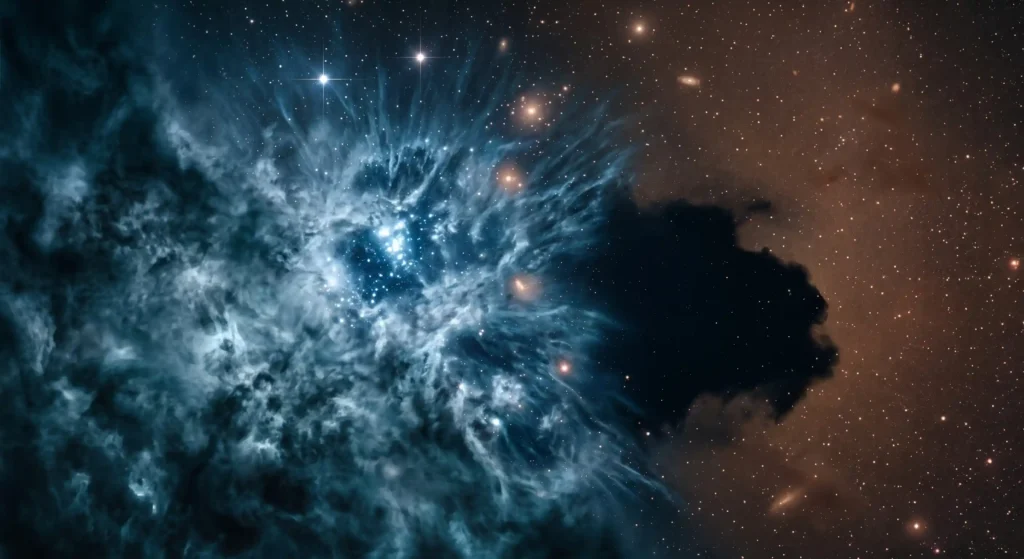
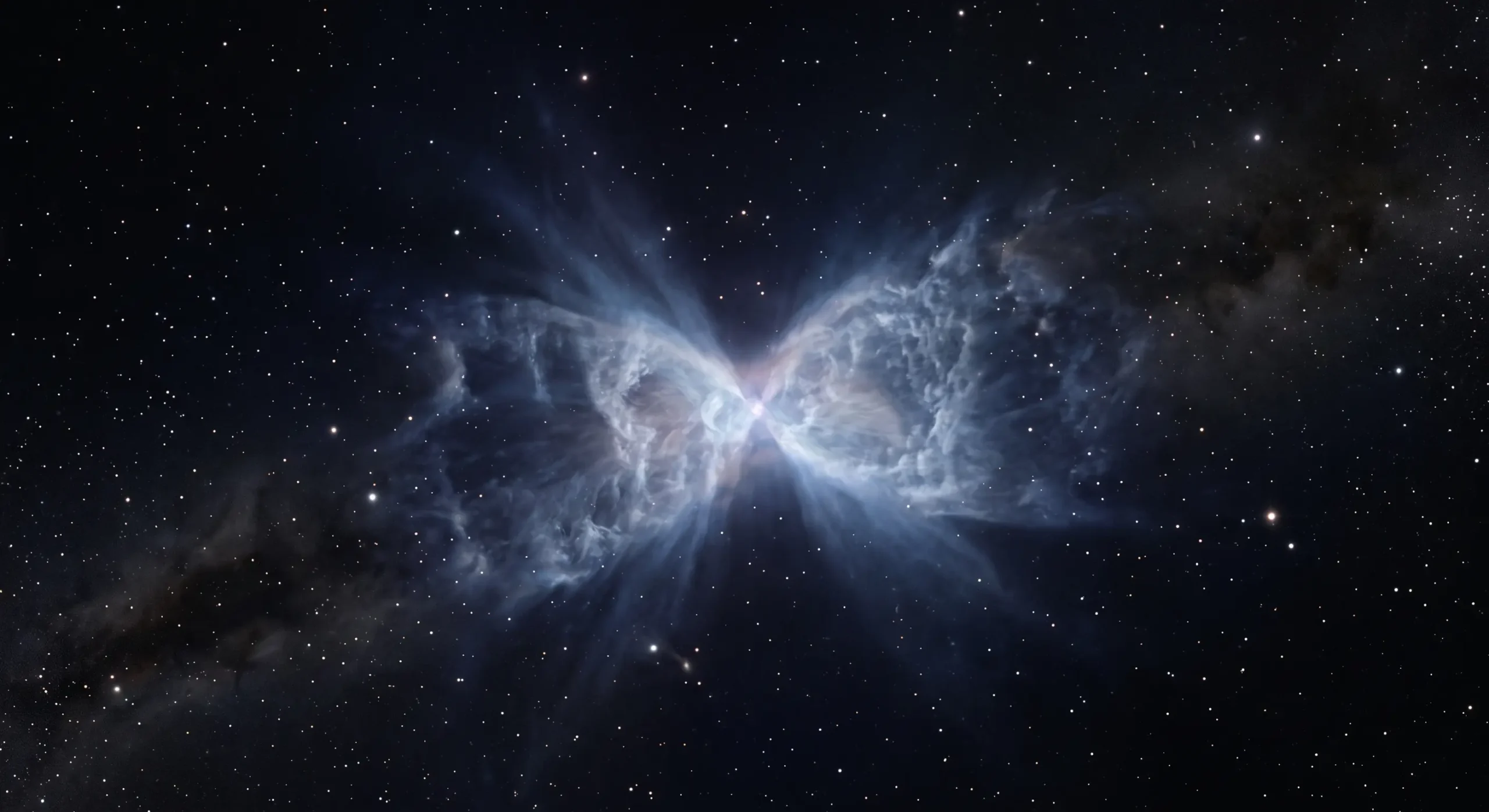
The Boomerang Nebula, located about 5,000 light-years away in the constellation Centaurus, holds the record for the coldest known natural place in the universe. Measurements put its temperature at around 1 kelvin — about −272°C — which is actually below the 2.7 K temperature of the cosmic background radiation. It is, as far as we know, the only known natural object colder than the Big Bang’s afterglow.
How a nebula gets colder than its surroundings
How can anything be colder than the background of space that surrounds it? The answer is the same principle that makes an aerosol can feel cold as it sprays. The Boomerang Nebula is formed by a dying central star flinging out gas at enormous speed — around 150 kilometres per second. As that gas rushes outward, it expands rapidly, and expanding gas cools (a process called adiabatic expansion). The gas is being flung out and expanding so quickly that it chills below the surrounding background faster than it can reabsorb heat from it. Astronomers measured this by watching how the cold gas absorbs the cosmic microwave background passing through it — the nebula casts a “cold shadow” against the warmer background.
The Star That Is Killing Itself Too Fast
The nebula is strange even by the standards of dying stars, and the anomaly is the reason it holds the record.
A star of roughly the Sun’s mass ends its life by shedding its outer layers over tens of thousands of years, producing a planetary nebula. The Boomerang is doing the same thing at an extraordinary rate — losing mass roughly a hundred times faster than an ordinary dying star, and about ten thousand times faster than our Sun currently loses material through the solar wind. At that rate the entire outflow has been running for only about 1,500 years, making it an infant by astronomical standards.
That extreme outflow is what makes the cooling possible. Adiabatic expansion cools any expanding gas, but the effect only wins if the gas expands faster than it can reabsorb heat from the cosmic background. Ordinary planetary nebulae do not manage it. The Boomerang does, by a wide margin.
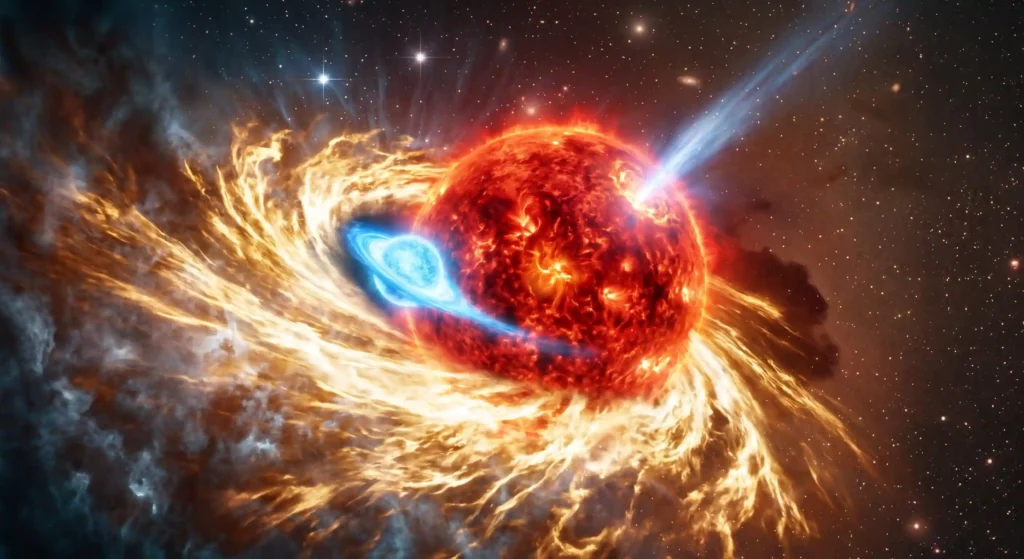
Why the star is losing mass so fast is not settled. The leading explanation is a binary companion: a smaller star spiralling into the outer envelope of the dying giant, transferring orbital energy and flinging material outward far more violently than the star could manage alone. The nebula’s distinctive double-lobed hourglass shape — clearly resolved by Hubble, and quite unlike the “boomerang” that early ground-based images suggested — supports this, since such bipolar structures generally require something to break the star’s spherical symmetry.
There is also a time limit, and it is the reason the record is unlikely to be beaten by anything similar. The cold phase depends on the outflow continuing at this violent rate. As the star exhausts its envelope over the coming millennia, expansion will slow, the gas will warm back toward the cosmic background, and the Boomerang will become an ordinary planetary nebula. We are observing a transient state that lasts a geological instant.
The Coldest Place Made by Humans (labs near absolute zero)
As cold as the Boomerang Nebula is, humans have done far better. In physics laboratories, scientists routinely chill matter to temperatures thousands of times colder than anything found in nature, using techniques like laser cooling and magnetic evaporative cooling to slow atoms almost to a standstill.
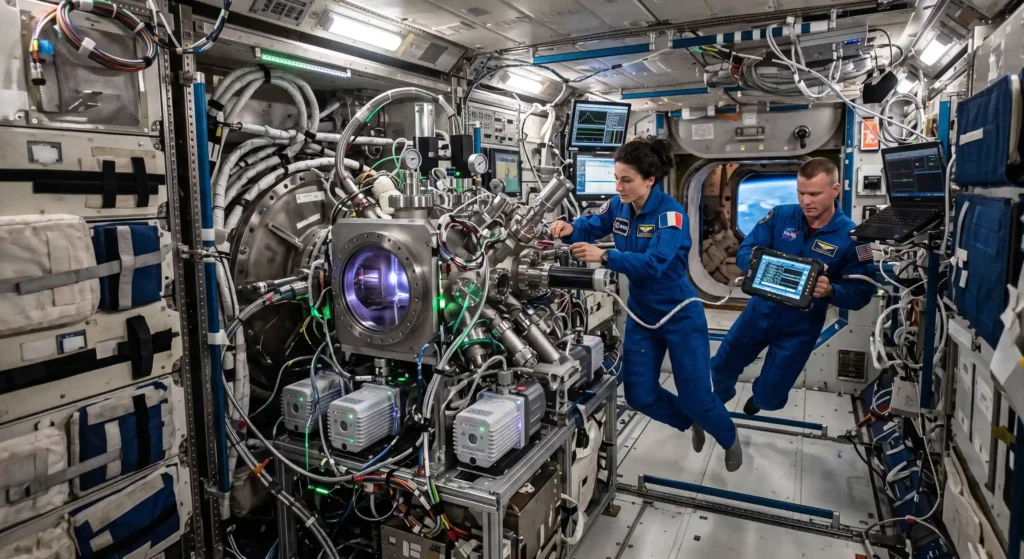
These experiments reach into the nanokelvin range — billionths of a degree above absolute zero — and some have pushed even lower, into trillionths of a degree. NASA’s Cold Atom Laboratory aboard the International Space Station creates some of the coldest known spots, exploiting weightlessness to chill clouds of atoms into exotic states of matter called Bose–Einstein condensates. So the coldest places in the known universe are not in deep space at all — they are inside human-built apparatus on and above the Earth.
How You Cool Something With Light
“Laser cooling” sounds like a contradiction — lasers are used to cut steel — and the mechanism behind it is one of the more elegant tricks in experimental physics.
The first stage exploits the Doppler effect. Tune a laser slightly below the frequency an atom absorbs. An atom sitting still will mostly ignore it. But an atom moving toward the beam sees the light Doppler-shifted upward into resonance, absorbs a photon, and receives a tiny kick in the direction opposite its motion. It then re-emits the photon in a random direction, so the emissions average out while the absorptions consistently oppose the atom’s velocity. Surround a cloud of atoms with six such beams, one from each direction, and every atom is slowed regardless of which way it moves. Physicists call this optical molasses, and it reaches the microkelvin range — millionths of a degree.
The second stage is evaporative cooling, and it works exactly like a cup of coffee. Trap the cold atoms magnetically, then progressively lower the walls of the trap so the fastest atoms escape. The survivors re-thermalise at a lower average temperature. Repeat, discarding most of the atoms to make the remainder colder. This takes the cloud into nanokelvin territory — billionths of a degree.
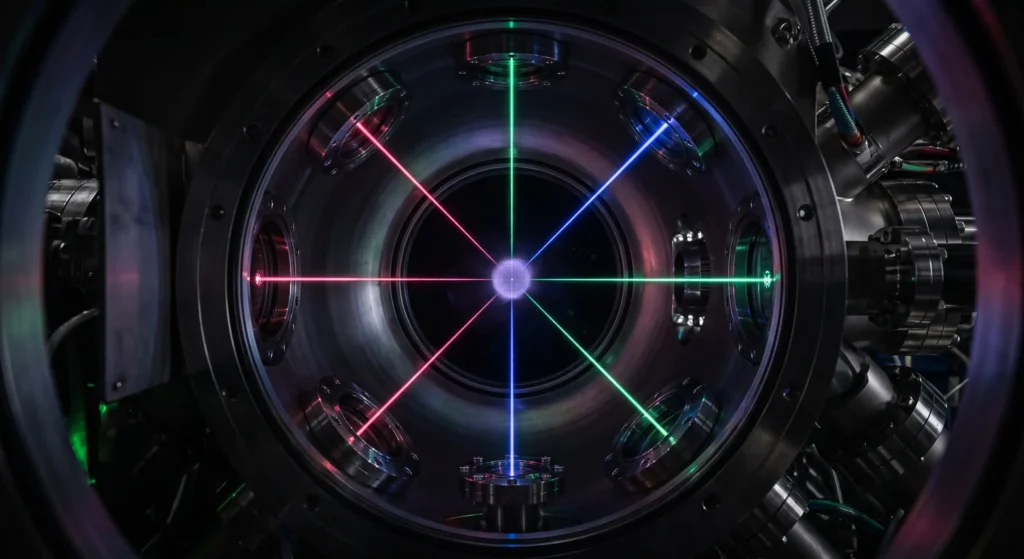
At those temperatures something extraordinary happens. Atoms are quantum objects with a wavelength that grows as they slow down, and eventually the wavelengths of neighbouring atoms overlap. The individual atoms stop being distinguishable and collapse into a single quantum entity — a Bose–Einstein condensate, predicted in 1925 and first created in 1995, a feat that earned the 2001 Nobel Prize in Physics.
NASA’s Cold Atom Laboratory on the International Space Station exists because gravity is the limiting factor. On Earth, a released condensate falls, and you have milliseconds to observe it before it hits something. In free fall it simply hangs there, allowing observation for seconds instead — and permitting weaker traps, which means colder atoms. It has reached the picokelvin range, trillionths of a degree above absolute zero.
Which produces a genuinely strange fact: the coldest place in the known universe is a small aluminium box in low Earth orbit, roughly a billion times colder than the Boomerang Nebula and a hundred billion times colder than deep space.
What Absolute Zero Actually Means
All of these temperatures are measured against the same ultimate reference point: absolute zero, which is 0 kelvin, or −273.15°C. Temperature is fundamentally a measure of how much atoms and molecules jiggle and move. The hotter something is, the more its particles move; the colder it is, the less. Absolute zero is the theoretical point at which this thermal motion reaches its absolute minimum.
This is the floor of the temperature scale — you cannot get any colder, because there is no “less than no motion.” It is also why the kelvin scale starts there. What would happen to ordinary matter, like the air around us, if it were brought near this ultimate cold is exactly the scenario we explore in what if the atmosphere liquefied at absolute zero.
The Temperature Ladder, Top to Bottom
Numbers like “one kelvin” and “a trillionth of a degree” lose meaning without something to compare them against. Here is the full range, from the hottest thing ever measured to the coldest.
- 1032 K — the Planck temperature. The theoretical maximum, where known physics stops working. The universe may have been this hot in its first instant.
- ~5.5 × 10¹² K — quark-gluon plasma. Produced in heavy-ion collisions at the Large Hadron Collider; the hottest matter humans have ever created, and the state the entire universe was in for its first microseconds.
- ~1.5 × 10⁷ K — the Sun’s core. Hot enough for hydrogen fusion.
- 5,778 K — the Sun’s surface. Considerably cooler than its core, which is why it glows yellow rather than emitting only X-rays.
- 288 K (15 °C) — Earth’s average surface. The narrow band in which liquid water and chemistry work.
- 184 K (−89 °C) — Vostok Station, Antarctica. The coldest air temperature reliably recorded on Earth’s surface.
- ~90 K — the Moon’s night side, and Neptune’s cloud tops around 55 K.
- 2.725 K — the cosmic microwave background. The natural floor throughout the universe.
- ~1 K — the Boomerang Nebula. The only known natural place below the background.
- Nanokelvin — laboratory Bose–Einstein condensates. A billion times colder than deep space.
- Picokelvin — NASA’s Cold Atom Laboratory. Trillionths of a degree; the coldest known place anywhere.
- 0 K — absolute zero. Unreachable in principle, for reasons below.
The asymmetry in that list is worth noticing. The hot end spans 32 orders of magnitude and has a theoretical ceiling nobody can approach. The cold end has a hard floor at zero that we have approached to within a trillionth of a degree. It is far easier to remove almost all the heat from something than to add very much.
Why Nothing Can Reach Exactly 0 K
Here is a deep truth of physics: nothing can ever actually reach absolute zero. This is a consequence of the third law of thermodynamics, which implies that removing the last bit of heat from a system would take an infinite number of steps. No matter how clever the cooling method, you can always get closer but never quite arrive.
There is also a quantum reason. Even at absolute zero, particles would retain a tiny irreducible motion called zero-point energy — a consequence of quantum uncertainty, which forbids a particle from having both a perfectly defined position and zero momentum. So absolute zero is best understood as a limit that matter forever approaches but can never truly touch — the asymptote at the bottom of the temperature scale.
Why Anyone Bothers Going This Cold
Chasing the last billionth of a degree sounds like record-keeping. It is not — extreme cold is a research tool, and several technologies you use depend on it.
- Atomic clocks. Cold atoms move slowly, so they can be measured for longer and with less Doppler blurring. The resulting clocks lose less than a second over the age of the universe — and GPS, which works by comparing signal arrival times to nanosecond precision, exists because of them.
- Quantum computing. Superconducting qubits operate at around 10 to 20 millikelvin, colder than deep space, because thermal noise at any higher temperature destroys the fragile quantum states they encode. Every dilution refrigerator in every quantum computing lab is a cold-physics machine.
- Superconductivity and superfluidity. Below critical temperatures, electrical resistance vanishes entirely and liquid helium flows with zero viscosity, climbing the walls of its container. Superconducting magnets built on this are what steer particle beams at the LHC and generate the fields in every MRI scanner.
- Testing fundamental physics. Ultracold atoms are used as exquisitely sensitive probes for measuring gravity, searching for a permanent electric dipole moment of the electron, and testing whether fundamental constants drift over time.
- Simulating the unreachable. Cold atom lattices can be tuned to mimic the behaviour of electrons in exotic materials, or the physics of neutron star interiors, allowing experiments on systems that cannot otherwise be accessed.
The pattern is consistent: cooling something removes the thermal noise that hides delicate effects. At room temperature, atoms move at hundreds of metres per second and everything interesting is smeared out. Near absolute zero they are nearly still, and quantum behaviour that normally averages away becomes directly observable — and usable.
Q&A
The coldest temperatures ever achieved are in laboratories, where scientists have cooled atoms to within a few trillionths of a degree (picokelvin) of absolute zero. These are far colder than any natural place, including the Boomerang Nebula, which sits at about 1 kelvin.
Yes. The natural background of space is about 2.7 kelvin, but the Boomerang Nebula is colder, at roughly 1 kelvin, because its rapidly expanding gas chills below the background. Human laboratories are colder still, reaching billionths and trillionths of a degree above absolute zero.
At absolute zero, the thermal motion of particles would reach its theoretical minimum. Matter can enter exotic quantum states, such as Bose–Einstein condensates, where atoms behave as a single quantum entity. However, true absolute zero cannot actually be reached, and a small quantum zero-point motion always remains.
The coldest natural air temperature reliably recorded on Earth’s surface was about −89°C at Vostok Station in Antarctica, with satellite data suggesting pockets of the Antarctic Plateau may reach near −98°C. That is frigid, but still vastly warmer than space or laboratory temperatures.
Because it is filled with the cosmic microwave background — light released 380,000 years after the Big Bang, when the universe cooled enough for atoms to form and became transparent. That light has not lost energy to anything; it has been stretched by the expansion of space by a factor of about 1,100, dropping its effective temperature from around 3,000 K to 2.725 K. It arrives from every direction, so nothing sitting passively in space can be colder.
By tuning a laser slightly below an atom’s absorption frequency. An atom moving toward the beam sees the light Doppler-shifted into resonance, absorbs a photon and receives a kick opposing its motion, then re-emits in a random direction so the emissions cancel out. Six beams from six directions slow atoms regardless of which way they move, reaching microkelvin temperatures. Evaporative cooling — letting the fastest atoms escape a magnetic trap — then takes it to nanokelvin.
Because its central star is shedding mass roughly a hundred times faster than an ordinary dying star, flinging gas outward at around 150 km/s. Rapidly expanding gas cools — the same effect that chills an aerosol can — and here the expansion outpaces the rate at which the gas can reabsorb heat from the cosmic background. The extreme mass loss is probably driven by a companion star spiralling into the dying giant’s envelope.
No. The cold depends entirely on the violent outflow continuing, and the whole structure is only about 1,500 years old. As the star exhausts its envelope over coming millennia, the expansion will slow, the gas will warm back toward the 2.7 K background, and it will become an ordinary planetary nebula. We are observing a transient state that lasts an astronomical instant.
A state of matter that forms when atoms are cooled to billionths of a degree above absolute zero. As atoms slow, their quantum wavelengths grow until neighbouring atoms overlap and become indistinguishable, collapsing into a single quantum entity that behaves as one object. Predicted in 1925 and first created in 1995, the achievement won the 2001 Nobel Prize in Physics.
Because cooling removes the thermal noise that hides delicate quantum effects. The applications are substantial: atomic clocks accurate to less than a second over the age of the universe, which make GPS possible; superconducting qubits that require 10–20 millikelvin because warmer temperatures destroy quantum states; superconducting magnets for MRI scanners and particle accelerators; and ultracold atoms used to simulate systems from exotic materials to neutron star interiors.
The Bigger Question
Understanding extreme cold leads to a fascinating thought experiment: what would happen to the very air we breathe if it were chilled toward absolute zero? At those temperatures, the gases of the atmosphere would condense into liquids and then freeze solid. We follow that scenario step by step in what if the atmosphere liquefied at absolute zero.
For a real, everyday taste of extreme cold, see our companion article on liquid nitrogen, and explore more temperature extremes on the Extreme Physics hub.
Watch the absolute zero scenario to see what the ultimate cold would do to our world.