 By
By 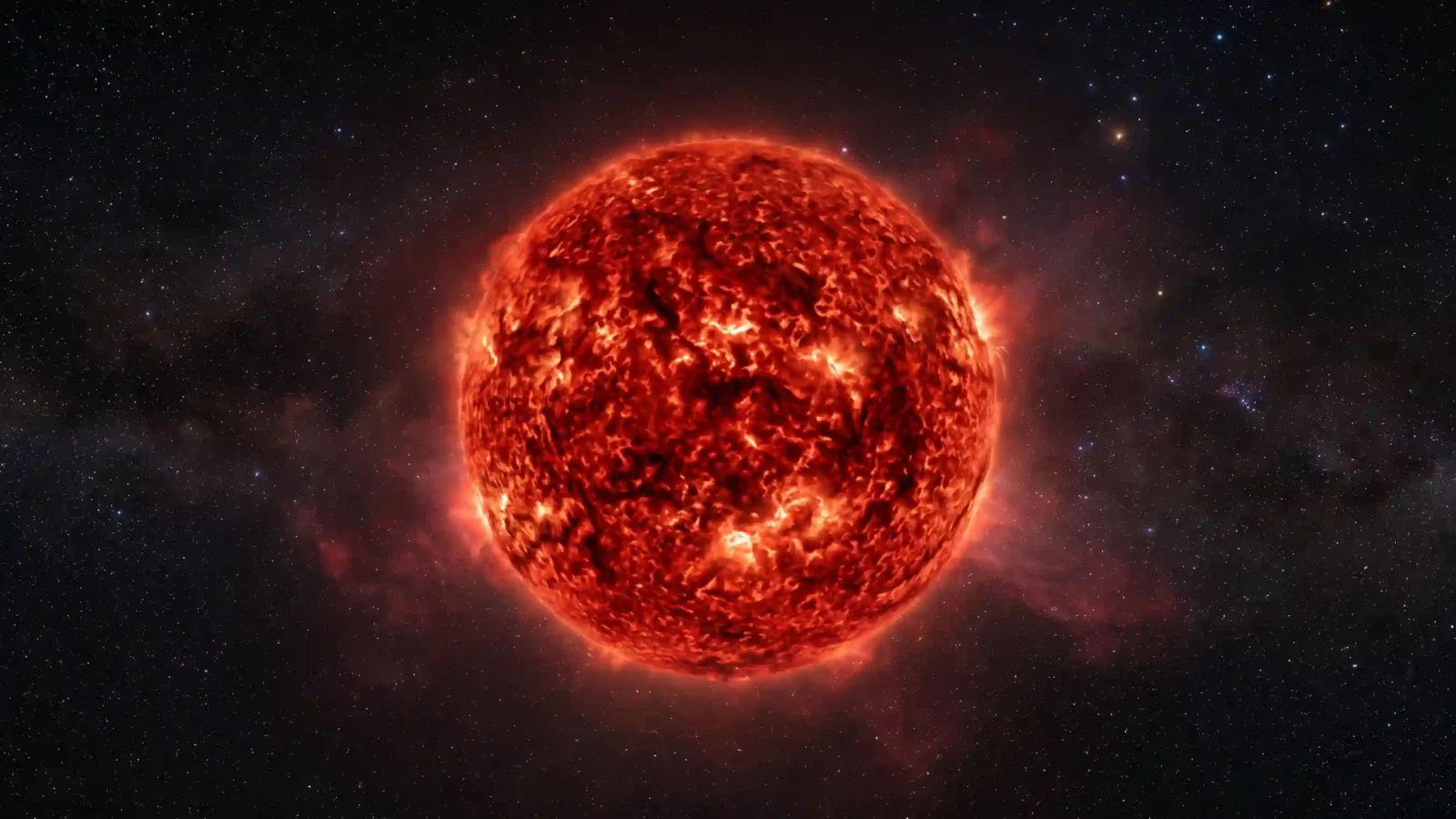
Betelgeuse — the red shoulder of Orion — is a dying star roughly 600 light-years away, and it will explode as a supernova. When it does, Earth gets a front-row seat to one of the sky’s rarest shows: a star bright enough to cast shadows at night and be seen in broad daylight for weeks. And it cannot harm us in the slightest. Both of those facts come straight from distance and the inverse-square law.
First, the honest caveat: “soon” in stellar terms means anytime in the next ~100,000 years. The dramatic Great Dimming of 2019–2020 was not a countdown — it was a cloud of dust the star coughed out, temporarily blocking its own light. Betelgeuse is unpredictable, not imminent. But when its core finally collapses, here’s the view.
First, appreciate the beast. Betelgeuse is already a monster — about 700 times the Sun’s radius. Drop it where the Sun sits, and its glowing surface would swallow Mercury, Venus, Earth and Mars whole and reach out into the asteroid belt. That grotesque bloating is exactly the sign of a star in its death throes: as the core contracts and heats, the outer layers puff up enormously. What looks like a calm red dot in Orion is a dying giant the size of a solar system.
Bright enough to read by
At peak, a Betelgeuse supernova would reach roughly apparent magnitude −11 — comparable to a half-to-quarter moon compressed into a single point of light. It would outshine every star and planet, remain visible in daytime for weeks, and only slowly fade over months. Orion would look broken for the rest of your life, its brightest corner burned out. No human in recorded history has seen a supernova this close.
Why it’s completely safe
Supernovae are dangerous only up close. To strip Earth’s ozone layer with radiation, a supernova has to detonate within about 50 light-years. Betelgeuse sits twelve times farther out.
Radiation intensity falls off as 1 / distance². Compare Betelgeuse’s 600 light-years to the ~50-light-year damage threshold:
(50 ÷ 600)² = (1/12)² = 1/144.
Betelgeuse’s blast would reach Earth at roughly 1/144 of the dose needed to damage the ozone layer — and that’s using a generous danger radius. There is no scenario in which it threatens life on Earth. It is spectacle without consequence: a nearby star tearing itself apart at a safe remove, delivering light and nothing lethal.
What’s left behind
The explosion is the funeral, not the end. Betelgeuse’s core — too heavy to stop collapsing but not heavy enough to become a black hole — will crush into a neutron star: a city-sized ball so dense a sugar-cube’s worth outweighs a mountain. The outer layers, blasted into space at thousands of kilometres a second, will seed the galaxy with the oxygen, silicon and iron that later worlds are built from. What we call an ending is a factory. The physics of that leftover core is here: neutron stars, explained.
Light on a 600-year delay
One eerie detail: because Betelgeuse is 600 light-years away, its light takes 600 years to reach us. So the star could already have exploded — the flash simply hasn’t arrived yet. If you watch Orion tonight and see Betelgeuse glowing red, you’re seeing it as it was around the year 1426. The supernova, whenever it “happens” for us, is really an old event finally catching up.
What we know, and what we’re guessing
Certain: Betelgeuse is in the final ~1% of its life, it will explode, and at 600 light-years it’s harmless. Uncertain: when — the error bars are tens of thousands of years wide, and its brightness swings make short-term prediction almost impossible. Anyone claiming a firm date is guessing. But the moment it goes, everyone alive will know within a single night. It will be the brightest new star any living person has ever seen.
A dying giant, a harmless distance, and light on a six-century delay. When Orion’s shoulder finally lets go, the whole planet looks up at once.