 By
By 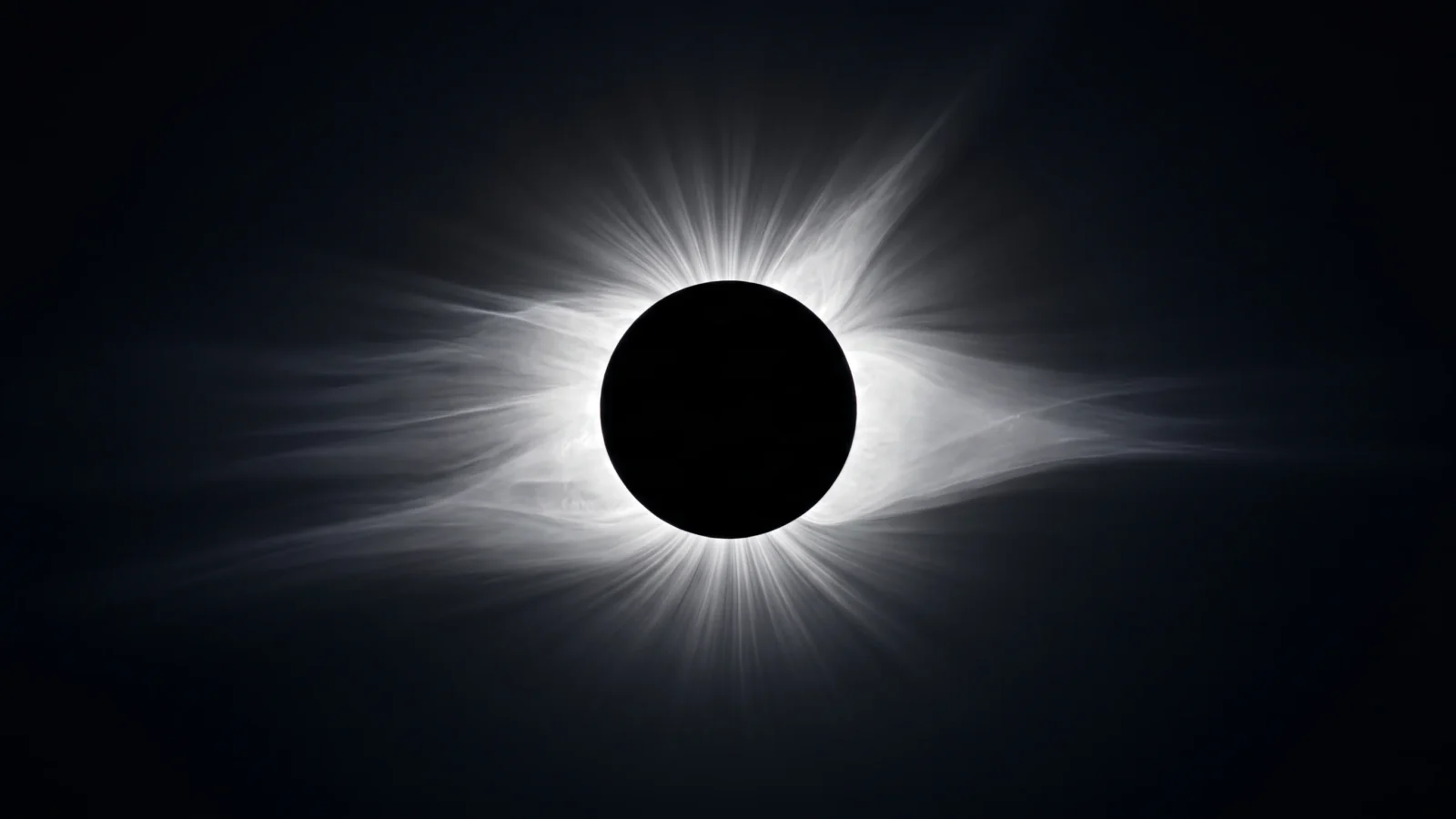
For a few minutes on August 12, the Moon did something no instrument does easily: it blocked the Sun’s blinding disc and exposed the corona, the faint million-degree crown of plasma around it. And the corona’s shape is not decoration — it’s a live diagram of the Sun’s magnetic field, and therefore a readout of exactly where the solar cycle is right now.
The rule is simple enough to check with your own eclipse photos. A round, symmetric corona means the Sun is near the peak of its 11-year cycle, its magnetic field tangled and active. A lopsided corona — long streamers stretched out along the equator, short tufts at the poles — means the Sun is quieting down toward minimum. In 2026, on the downslope from the Cycle 25 maximum, expect the second kind.
The corona is a magnetic field made visible
Coronal plasma is charged, so it can’t cross magnetic field lines — it’s forced to flow along them. That means the glowing streamers you photograph trace the actual shape of the Sun’s field lines reaching into space. Near solar maximum the field is a knotted mess and the corona looks round; near minimum it settles into a clean dipole, like iron filings around a bar magnet, and the corona elongates. You are, quite literally, photographing magnetism.
And it’s faint magnetism. The corona is only about one-millionth as bright as the Sun’s blazing disc — roughly the brightness of the full Moon. That’s the whole reason you can’t see it on any ordinary day: the disc’s glare drowns it out a million to one. A total eclipse is the one moment the Moon hides the disc perfectly, letting a crown that was there all along finally show itself.
The corona’s faint green glow comes from a specific emission line at 530.3 nm, produced by iron atoms stripped of 13 of their electrons (Fe XIV). Stripping that many electrons off iron takes enormous energy — it only happens in a gas hotter than about 2 million kelvin.
Compare that to the Sun’s visible surface at 5,800 K:
2,000,000 K ÷ 5,800 K ≈ 350× hotter.
The corona is roughly 350 times hotter than the surface it sits on — even though it’s farther from the Sun’s core, the heat source. Heat flowing to a place hotter than its source is exactly backwards, and no one has fully explained it. It’s the unsolved “coronal heating problem,” and every eclipse is a chance to measure the mystery directly.
Why 2026 is a useful data point
Solar Cycle 25 reached its maximum around 2024–2025 — a stronger peak than forecasters expected. By August 2026 the Sun is winding down, and the corona’s growing asymmetry is one of the cleanest visual confirmations that the decline is underway. Every eclipse in this phase is a snapshot in a slow-motion movie of the field reorganizing itself toward the eventual flip that will begin Cycle 26.
Why the field’s mood matters to you
This isn’t just aesthetics. The same magnetic field that shapes the corona also stores the energy behind flares and coronal mass ejections — the eruptions that drive auroras, disturb satellites, and occasionally threaten power grids. A tangled, active corona means more of them; a calm dipole means fewer. Reading the corona is reading next year’s space weather forecast. The full mechanism is here: how solar flares and CMEs work.
What’s certain, and what we’re still guessing
The geometry is certain: the corona’s shape tracks the cycle, and 2026 sits on the downslope. What remains genuinely open is why the corona is so hot in the first place — whether it’s heated by countless tiny magnetic “nanoflares” or by waves rippling up the field lines. Both ideas are alive, and eclipse observations still feed the debate.
A total eclipse is the only time you get to see the Sun’s magnetic weather with your own eyes. In 2026 it’s telling you the storm season is fading — for now.