 By
By 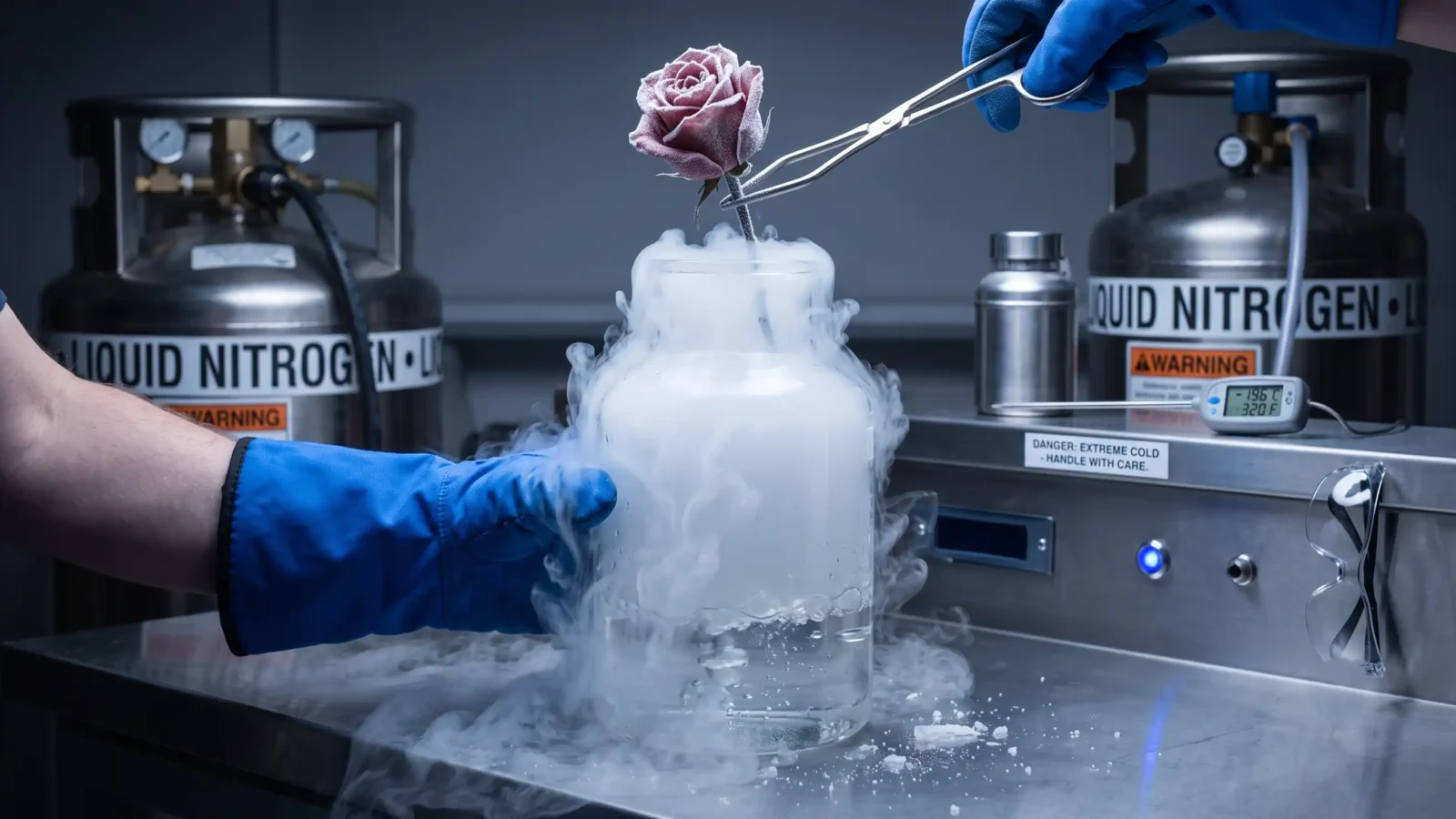
Quick Answer
Liquid nitrogen is ordinary nitrogen gas — the same gas that makes up most of the air — cooled until it becomes a liquid at a frigid −196°C (77 kelvin). It is colourless, odourless, and so cold that it instantly freezes almost anything it touches. Made by chilling and distilling air, liquid nitrogen is cheap, widely used in medicine, food, and industry, and a dramatic everyday example of just how cold matter can get.
The air around you is mostly nitrogen, and with enough cooling, that invisible gas turns into a boiling, smoking liquid cold enough to shatter a rose. This guide explains what liquid nitrogen is, how we pull it out of thin air, why it is so cold, what it is used for — and why, despite being so common, it can be dangerous if mishandled.
What Is Liquid Nitrogen?
Liquid nitrogen is nitrogen in its liquid state. Nitrogen is normally a gas — it makes up about 78% of the air we breathe — but like any gas, it can be turned into a liquid if you cool it down enough. For nitrogen, that happens at −196°C at normal atmospheric pressure, the temperature at which it boils (or condenses). Below that, it is a clear, mobile liquid that looks a little like boiling water, constantly steaming as it evaporates back into gas.
Because it is chemically inert (nitrogen does not easily react with other substances) and extremely cold, liquid nitrogen is prized as a convenient, inexpensive coolant. The “smoke” you see pouring off it is not the nitrogen itself but water vapour from the air condensing in the intense cold.
How Air Becomes Liquid (fractional distillation)
Liquid nitrogen is manufactured directly from air through a process called fractional distillation. First, air is filtered and compressed, then cooled to extremely low temperatures until it turns into a liquid — liquefied air. This liquid air is a mixture, mostly nitrogen and oxygen with a little argon and other gases. The trick is to separate them.
The boiling points of nitrogen vs oxygen
Separation works because each gas has a different boiling point. As the liquefied air is warmed slowly in a distillation column, the components boil off one at a time:
- Nitrogen: boils at −196°C — the lowest, so it boils off first.
- Argon: boils at about −186°C.
- Oxygen: boils at −183°C — it clings on as a liquid longest.
By carefully controlling the temperature, the column separates nitrogen from oxygen and argon, allowing each to be collected in pure form. This is the same industrial process that supplies liquid oxygen for hospitals and rockets, and it is remarkably efficient — turning the air around us into useful, bottled cryogenic liquids.
Why It’s So Cold and What It Does to Matter
At −196°C, liquid nitrogen is cold enough to dramatically alter the things it touches. Flowers, fruit, and rubber become brittle and shatter like glass. Biological tissue freezes solid in moments. When poured onto a warm surface, the liquid skitters and dances on a cushion of its own vapour — a phenomenon called the Leidenfrost effect, the same reason water droplets dance on a very hot pan.
Its extreme cold is also why a small amount of liquid nitrogen produces so much gas: as it warms and boils, it expands to roughly 700 times its liquid volume. That property is useful in industry but also the source of real hazards, as we will see.
Everyday and Industrial Uses
Liquid nitrogen is one of the most versatile coolants in the world, used across science, medicine, and food.
- Medicine: preserving biological samples such as cells, blood, and reproductive tissue (cryopreservation), and freezing off warts and skin lesions (cryosurgery).
- Food: flash-freezing food to lock in freshness, making ultra-smooth ice cream, and creating dramatic effects in molecular gastronomy.
- Industry: shrinking metal parts for precise fitting, cooling superconducting magnets in MRI machines, and freezing materials for clean cutting or grinding.
- Science: cooling detectors and experiments, and as a stepping stone toward even colder temperatures.
What Would Happen If the Whole Atmosphere Liquefied
Liquid nitrogen gives us a tangible glimpse of a far more extreme idea: what if the entire atmosphere got cold enough to turn liquid? Since the air is mostly nitrogen, and nitrogen liquefies at −196°C, chilling the whole planet’s atmosphere toward those temperatures would cause the air itself to condense into liquid and then freeze solid onto the ground. The sky would, in effect, fall as a cryogenic rain.
That is exactly the scenario we follow in what if the atmosphere liquefied at absolute zero — a planetary-scale version of what happens in a flask of liquid nitrogen. The Boomerang Nebula, discussed in our piece on the coldest place in the universe, shows that such temperatures genuinely exist out in the cosmos.
Safety: Why It Can Be Dangerous
Despite being common and widely available, liquid nitrogen demands respect. Direct, prolonged contact causes severe frostbite and cold burns, instantly damaging skin and tissue. In enclosed spaces, the rapidly expanding nitrogen gas can displace oxygen and cause asphyxiation without any warning, because nitrogen is odourless. And sealing liquid nitrogen in an airtight container is extremely dangerous: as it warms and expands 700-fold, the pressure can cause a violent explosion. It should only be handled with proper protective equipment, ventilation, and training.
Q&A
A brief splash may skitter off your skin harmlessly thanks to the Leidenfrost effect, where a layer of vapour momentarily protects you. But any sustained contact — or liquid that becomes trapped against skin or clothing — causes severe frostbite almost instantly. It should never be touched deliberately.
Absolutely not. Swallowing liquid nitrogen causes catastrophic internal injuries as it boils and expands violently inside the body. There have been serious injuries from novelty drinks and snacks served with leftover liquid nitrogen still present; it must fully evaporate before any food or drink is safe to consume.
It would freeze and kill a living person rapidly and is not a viable way to preserve someone alive. The cryonics industry freezes bodies after legal death in the unproven hope of future revival, but there is no scientific evidence that a person frozen this way can ever be brought back.
Liquid nitrogen boils at −196°C, which is 77 kelvin, at normal atmospheric pressure. That is its warmest liquid temperature; under reduced pressure it can be made slightly colder before it freezes solid at around −210°C.
The Bigger Question
A flask of liquid nitrogen is a small, controllable demonstration of what extreme cold does to matter. But scale that idea up to an entire planet, and you get one of the eeriest thought experiments in physics: an atmosphere chilled until the very air turns to liquid and snows down as frozen oxygen and nitrogen. That is the world we explore in what if the atmosphere liquefied at absolute zero.
To see where such temperatures occur naturally, read about the coldest place in the universe, and find more on the physics of cold on the Extreme Physics hub.
Watch the absolute zero scenario to see what would happen if the sky itself turned to liquid.