 By
By What Is a White Hole in Space?
A white hole is a region of spacetime predicted by the same equations of general relativity that describe black holes — specifically, it is the time-reverse of a black hole solution. Where a black hole has an event horizon that nothing can exit, a white hole has an event horizon that nothing can enter. Matter and energy are continuously ejected from a white hole but cannot fall back in.
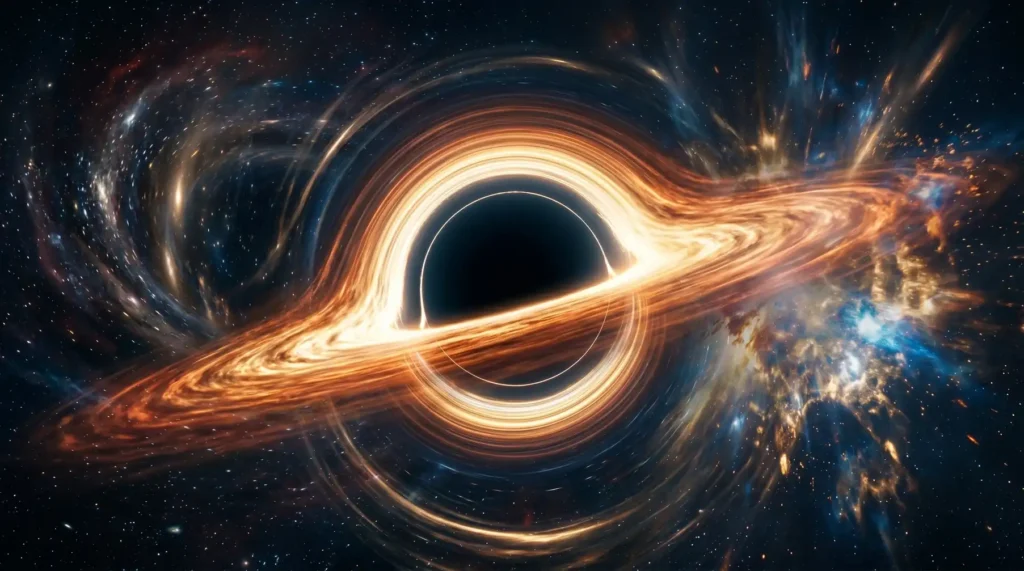
White holes appear in the maximally extended Schwarzschild solution — a mathematical description of the geometry of curved spacetime around a non-rotating mass. The full Kruskal–Szekeres diagram of a Schwarzschild black hole contains four regions: the external universe, the black hole interior, a parallel universe, and the white hole region. In practice, white holes are thermodynamically unstable: any matter encountering the white hole’s exterior event horizon would pile up and eventually convert the white hole into a black hole. Most physicists believe white holes don’t exist in the universe today, though the question isn’t formally closed.
White Hole vs Black Hole: What Makes Them Opposite?
The contrast between white hole and black hole is precise in general relativity:
- Black hole: Event horizon is a one-way membrane — matter and light can cross inward but not outward. Time inside runs toward the singularity.
- White hole: Event horizon is also a one-way membrane, but reversed — matter and light exit but cannot enter. Time inside runs away from the singularity.
- Entropy: Black holes have maximum entropy (Bekenstein-Hawking entropy proportional to horizon area). White holes would have minimum entropy — a highly ordered state — which contradicts the Second Law of Thermodynamics for any naturally occurring object.
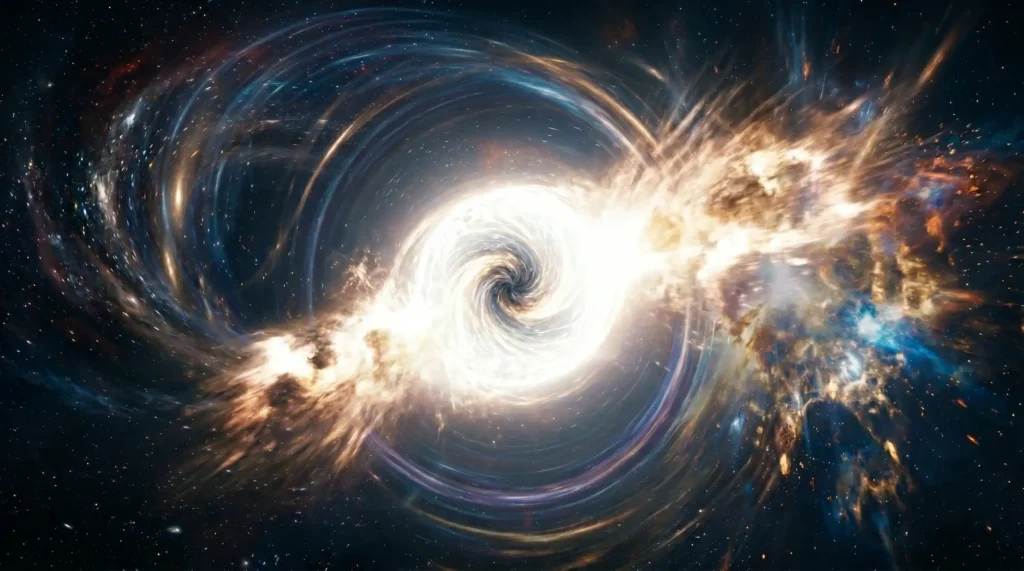
This thermodynamic argument is the strongest reason most physicists doubt white holes can naturally form or persist. A white hole is a low-entropy state that, in our universe, would require extremely special initial conditions to create.
What Would Happen if a White Hole Collided with a Black Hole?
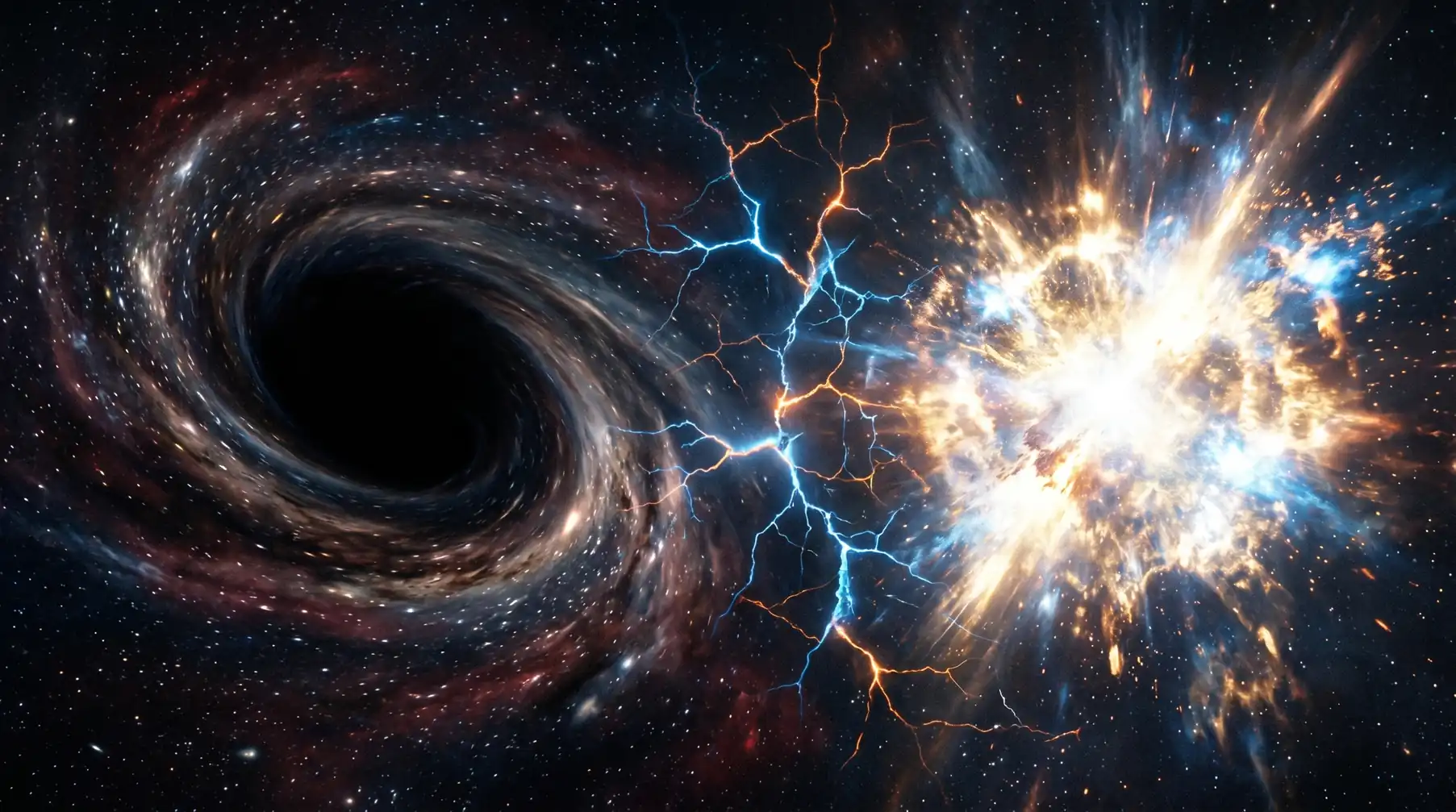
Theoretically, two scenarios emerge. In the first, the white hole is converted to a black hole before contact — the infalling matter piled up outside the white hole’s event horizon accumulates into a black hole shell, and the collision becomes a merger of two black holes (which LIGO detects routinely as gravitational wave bursts). The gravitational wave signature of a black hole merger scales with total mass and spin; two 10-solar-mass black holes merging produce a ringdown signal lasting fractions of a second.
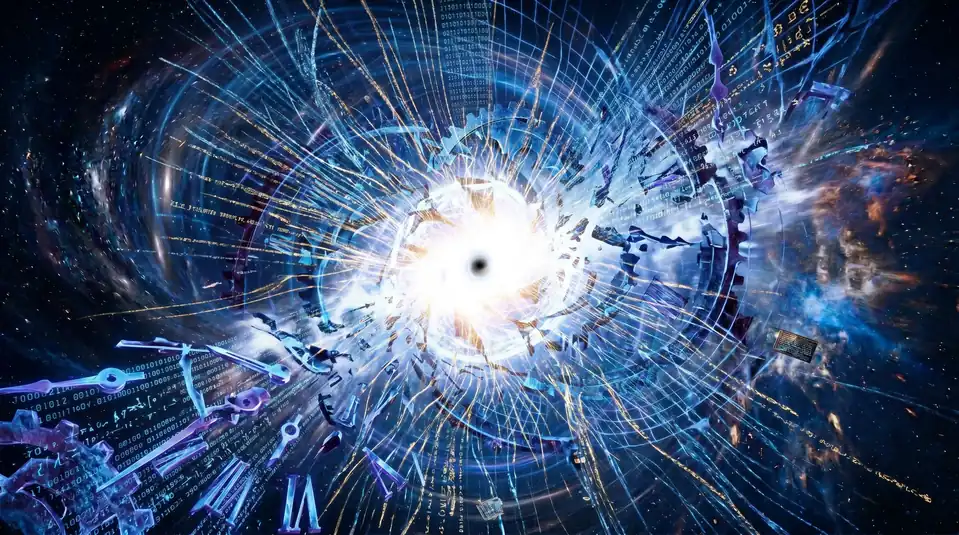
In the second scenario — if the white hole’s expulsion is active enough to prevent conversion — the encounter involves a region simultaneously ejecting matter at relativistic speeds into a region that absorbs matter. The interaction would produce an extreme radiation outburst and a gravitational wave signature with a non-standard chirp profile that doesn’t match known merger templates. Current LIGO/Virgo analysis pipelines specifically look for non-standard signals for this reason.
Loop quantum cosmology — a specific approach to quantum gravity — proposes that the Big Bounce (a hypothetical quantum transition before the Big Bang) could produce white holes as the time-reversal of black holes that formed and evaporated in a previous cosmic era. In this scenario, certain unexplained short gamma-ray bursts might be white hole evaporation events, though this remains speculative.
Has a White Hole Ever Been Observed?
No confirmed white hole observation exists. A 2006 gamma-ray burst (GRB 060614) was unusual enough in duration and spectral properties that some physicists tentatively proposed white hole evaporation as a possible explanation, but the mainstream explanation is a compact object merger. The most honest assessment is that white holes are solutions to equations — beautiful, internally consistent, and probably not physical objects that exist in our universe. They require initial conditions (low entropy singularities) that our universe’s history seems not to have provided.
Q&A
A white hole is the time-reverse of a black hole in general relativity — a region of spacetime that can only eject matter and light, never absorb them. It appears in the mathematical extension of black hole solutions but is thermodynamically unstable and almost certainly cannot exist as a persistent natural object in our universe.
A black hole traps matter and light inside its event horizon; nothing inside can escape. A white hole is the opposite: its event horizon prevents anything from entering, while matter and light continuously pour outward. In thermodynamic terms, black holes have maximum entropy and white holes minimum entropy.
Yes, in the mathematical formulation. The maximally extended Schwarzschild solution contains both a black hole and a white hole connected by an Einstein-Rosen bridge (a wormhole). However, this wormhole is non-traversable — it pinches off faster than light could cross it, and it connects to a separate, parallel universe region rather than to two points in our observable universe.
Hawking radiation is the theoretical thermal radiation predicted by Stephen Hawking (1974) to be emitted by black holes due to quantum effects near the event horizon. Virtual particle pairs form near the horizon; one falls in, the other escapes as radiation. Over enormous timescales, this causes black holes to slowly evaporate. Hawking radiation has not yet been directly detected.
Almost certainly not through any known natural process. The thermodynamic argument — that white holes require an extraordinarily low-entropy initial state — means they cannot arise from gravitational collapse, which always produces high-entropy black holes. Some quantum gravity proposals suggest white holes might be the final stage of black hole evaporation, but this remains highly speculative.
Internal links: space facts | What If a Magnetar Replaced the Moon? | What If a Micro Black Hole Passed Through Earth?