 By
By 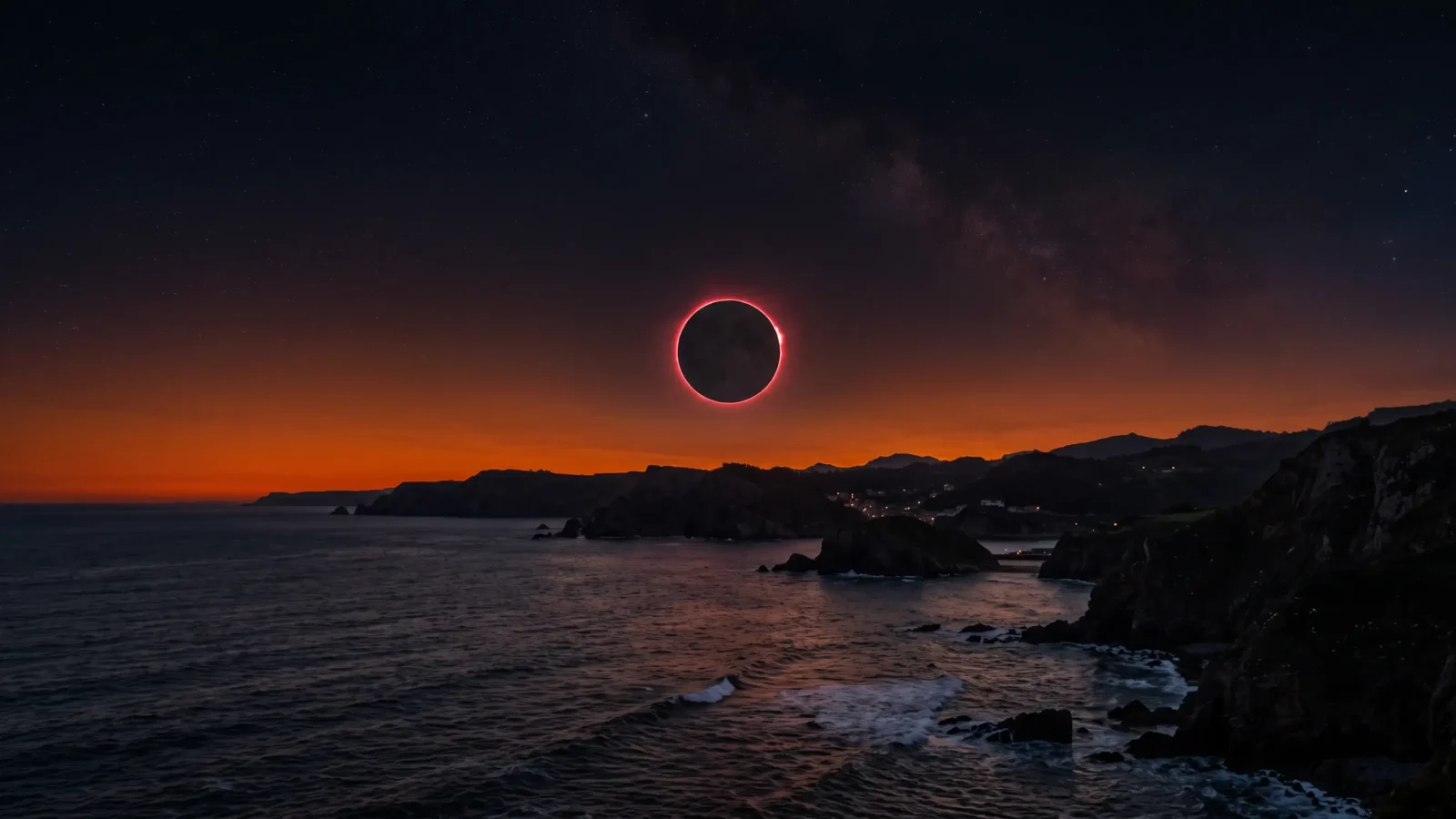
On August 12, 2026, mainland Europe gets its first total solar eclipse since 1999 — but the strange part isn’t the date. It’s the geometry. From northern Spain, totality arrives with the Sun only about 3 to 8 degrees above the horizon, minutes before sunset. That low angle changes everything you’ll see, and it comes down to one number: how much air the sunlight has to cross.
When the Sun is overhead, its light passes through one “air mass” — the thickness of the atmosphere straight up. Near the horizon, the light takes a long, grazing path through the same atmosphere, and the amount of air it crosses climbs steeply. At 3° altitude, that path is roughly 15 times longer than straight up. Everything odd about this eclipse follows from that factor of 15.
Why totality will look red, not white
During a normal total eclipse, the Sun’s corona appears pearly white. On August 12 from Spain, expect it to look deeper — orange to ruby — for the same reason sunsets are red. The long slant path scatters away blue and green light (Rayleigh scattering, which hits short wavelengths hardest), leaving the reddened remainder. The corona you’ll photograph is the corona filtered through fifteen atmospheres of haze.
Air mass is roughly 1 / sin(altitude). Straight up (90°) it equals 1. At 3° the simple formula gives ~19, but it overestimates near the horizon, where Earth’s curvature matters. The standard Kasten–Young correction gives a truer value:
Air mass at 3° ≈ 15, versus ≈ 1.15 at 60°.
Now push sunlight through it. Rayleigh scattering removes green-blue light with an optical depth of about τ ≈ 0.1 straight up. Transmission = e−τ × air mass:
- At 60° up: e−0.1 × 1.15 = 0.89 — 89% of the blue-green gets through.
- At 3° up: e−0.1 × 15 = 0.22 — only 22% survives.
Four-fifths of the short-wavelength light is stripped out before it reaches the coast. That’s not a filter effect — that’s why the eclipsed Sun and its corona will glow orange instead of white.
A shadow that lands as a long ellipse
The Moon’s umbral shadow is a roughly circular tube in space. When it hits the ground at a steep angle it prints a near-circle; when it grazes in at a shallow angle — as it will over Spain — it smears into a long ellipse. A shadow cross-section that would cover, say, 100 km head-on can stretch to several hundred kilometres of ground track width when it strikes at a low angle. More towns fall inside the path, but totality at each also races by faster along the ground.
How long does it actually last?
Maximum totality for this eclipse is about 2 minutes 18 seconds, and it falls out over the Atlantic near Iceland — not on land. By the time the shadow reaches Spain, totality drops below two minutes, and observers trade duration for something rarer: a blackened Sun sitting on the sea. There is essentially no photography of a total eclipse at this geometry from mainland Europe in living memory, because the last mainland-Spain totality (1999) sat much higher in the sky.
What we actually know — and what depends on the weather
The orbital mechanics are locked: the date, the path, and the altitude are known to the second. What isn’t guaranteed is whether you’ll see any of it. At 3° elevation you’re looking through the haziest, most cloud-prone slice of sky there is, and a single low bank of cloud on the western horizon erases the whole event. This is the one eclipse where site selection is less about the centerline and more about a clean sea horizon.
If you want the physics of what the corona is actually made of — the magnetic loops, the million-degree plasma, and the storms it throws at Earth — that’s its own rabbit hole: how solar flares and CMEs work.
The real prize is a year away
August 12, 2026 is a warm-up. On August 2, 2027, a much bigger eclipse crosses southern Spain, North Africa and Egypt with over six minutes of totality — one of the longest of the century — and the Sun high in the sky. The 2026 event is the appetizer that teaches Europe how to chase a shadow; 2027 is the feast. Both are worth planning for now, because clear-sky sites book out fast.
The universe rarely lines up a blackened Sun on the ocean at sunset. When it does, the whole show is written in one number — the length of the path through the air.