 By
By What Was the Banqiao Dam Disaster?
The Banqiao dam disaster of August 1975 remains the deadliest dam failure in recorded history. Banqiao, a concrete arch dam on the Ru River in Henan Province, China, was designed to withstand a 1-in-1,000-year flood — a rainfall of 300 mm in 24 hours. On 5–8 August 1975, Typhoon Nina stalled over the region and delivered an unprecedented 1-in-2,000-year rainfall: 1,060 mm in 24 hours at the peak, including 189.5 mm in a single hour.
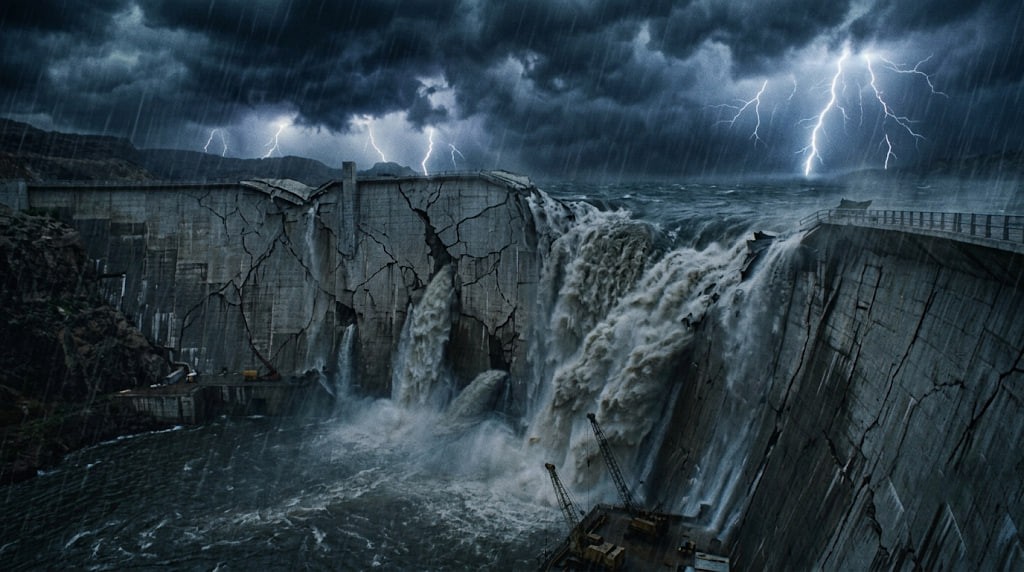
At 1:00 AM on 8 August, Banqiao dam overtopped and failed, releasing approximately 600 million cubic metres of water — a wall of water 3–7 metres high travelling at 50 km/h. The initial flood wave killed approximately 86,000 people; the subsequent crop failure and disruption of food supply in the flooding’s aftermath killed an additional 85,000–145,000 people. The total death toll is estimated at 171,000 with some estimates reaching 230,000. The disaster was classified secret by the Chinese government and was not publicly acknowledged until 2005.
What Is the Three Gorges Dam and What Does It Hold?
The Three Gorges Dam, completed in 2003 on the Yangtze River, is the world’s largest hydroelectric dam by installed capacity (22.5 GW) and the largest dam structure by concrete volume. Its reservoir (the Three Gorges Reservoir) holds approximately 39.3 cubic kilometres (39.3 km³) of water — 65 times more than Banqiao’s 600 million cubic metres.
To picture the scale:
- Three Gorges reservoir volume: 39.3 km³ (39.3 trillion litres)
- Banqiao 1975 release: 0.6 km³
- Cities protected downstream: Wuhan (~11 million), Nanjing (~8 million), Shanghai (~26 million)
- Total downstream population within flood risk zone: ~400 million people
What Would Happen if the Three Gorges Dam Failed Today?
A catastrophic Three Gorges Dam failure — releasing the full 39.3 km³ reservoir — would generate a flood wave unlike anything in recorded history. Hydraulic engineers have modelled dam break scenarios; estimates for a full Three Gorges failure suggest:
The initial flood wave would travel the 1,500 km from the dam to Shanghai in approximately 30 hours, arriving as a wall of water 10–30 metres high depending on the downstream channel geometry. Wuhan, 450 km downstream, would receive the wave in about 7 hours — too little time for meaningful evacuation of its 11 million residents. The combined flood plain of the Yangtze River delta — home to roughly 400 million people — would be inundated by floodwaters that would take weeks to months to recede.
The direct death toll is unquantifiable but catastrophic. The indirect effects — destruction of China’s most economically productive region, disruption of global supply chains, agricultural collapse across eastern China — would constitute the largest man-made disaster in human history by any metric.
Is the Three Gorges Dam Safe?
Chinese engineers and the dam operator (China Three Gorges Corporation) maintain the dam is designed to withstand a 1-in-10,000-year flood. Concerns raised by external observers include the dam’s behaviour during the 2020 Yangtze floods (when reservoir levels reached 167.5 m, within metres of the dam’s crest), the discovery of visible deformation cracks in satellite imagery, and the geological complexity of the region (the reservoir has been linked to thousands of small earthquakes — “reservoir-induced seismicity”). Official Chinese government assessments characterise the dam as safe; independent verification is difficult given restricted access.
Q&A
The Banqiao dam disaster occurred on 8 August 1975 in Henan Province, China, when Typhoon Nina delivered 1,060 mm of rainfall in 24 hours — more than 3 times the dam’s design capacity. The resulting dam failure released 600 million cubic metres of water, killing approximately 171,000 people from direct flooding and subsequent famine. It remains the deadliest dam failure in history.
Approximately 171,000 people died in the 1975 Banqiao dam failure, though some estimates range up to 230,000. Roughly half died from direct flooding; the rest from disease and famine in the aftermath. The disaster was kept secret by the Chinese government for nearly 30 years, only being formally acknowledged in 2005.
By installed hydroelectric capacity, the Three Gorges Dam (22.5 GW) on China’s Yangtze River is the world’s largest, completed in 2003. By reservoir volume, the Kariba Dam on the Zambia-Zimbabwe border holds slightly more water (~180 km³). By concrete volume and structural size, Three Gorges is among the largest man-made structures on Earth.
Reservoir-induced seismicity is earthquake activity triggered by the filling or operation of a large reservoir. The weight of stored water increases pore pressure in underlying rock formations, lubricating existing fault planes and potentially triggering earthquakes. The Three Gorges reservoir has been linked to thousands of small earthquakes since filling began in 2003, including a magnitude 4.6 event in 2008.
The worst dam disasters by death toll include: (1) Banqiao/Shimantan, China, 1975 — ~171,000 deaths; (2) Vajont Dam, Italy, 1963 — ~2,000 deaths from a landslide-triggered wave; (3) Malpasset, France, 1959 — ~423 deaths; (4) St. Francis Dam, USA, 1928 — ~600 deaths; (5) Machhu Dam, India, 1979 — estimated 1,000–25,000 deaths.
Internal links: existential risk | What If the Ocean Floor Cracked Open? | What If Yellowstone Erupted Tomorrow?