 By
By How Many Nuclear Weapons Exist, and What Is Their Total Yield?
As of 2024, the Bulletin of the Atomic Scientists and the Federation of American Scientists estimate approximately 12,500 nuclear warheads in the world’s combined arsenals, of which about 9,600 are in military stockpiles (the rest are retired but intact). The nine nuclear-armed states are the US (~5,550 warheads), Russia (~6,257), China (~500), France (~290), UK (~225), Pakistan (~170), India (~164), Israel (~90), and North Korea (~50).
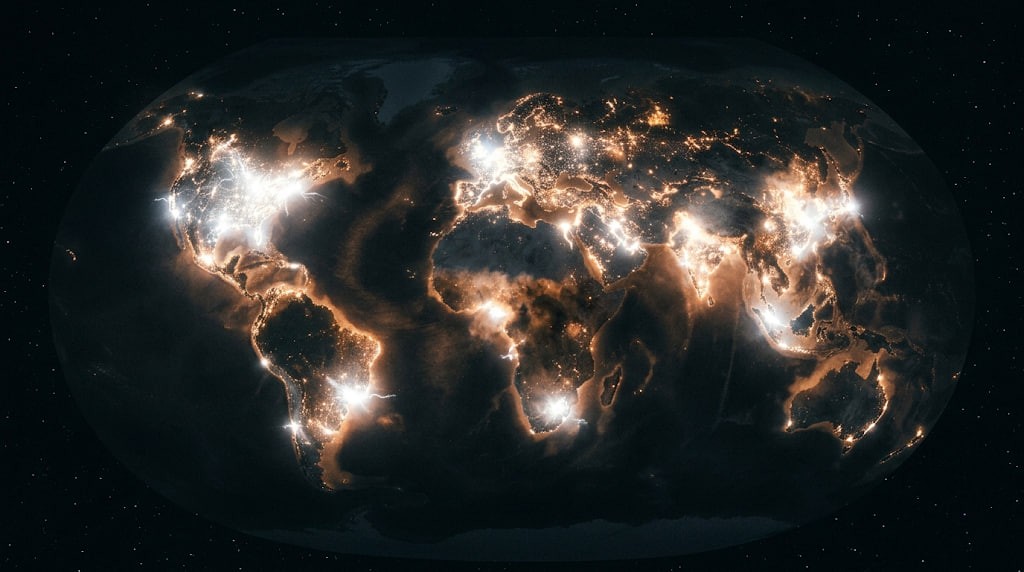
Average warhead yield varies widely. The US W76 submarine warhead (the most numerous deployed type) has a yield of ~100 kilotons. Russia’s RS-28 Sarmat carries warheads estimated at 500 kilotons to several megatons. The largest nuclear weapon ever detonated — the Soviet Tsar Bomba tested in 1961 — had a yield of 50 megatons, roughly 3,300 times the bomb that destroyed Hiroshima (15 kilotons). If all ~12,500 warheads detonated simultaneously at an average yield of 200 kilotons, total yield would be approximately 2,500 megatons — 2.5 gigatons of TNT equivalent.
The Arsenal in 2026: Updated Numbers
The global count has shifted since the figures above were compiled, and the direction of travel matters as much as the totals. The Federation of American Scientists puts the world inventory at roughly 12,187 warheads at the start of 2026, of which about 9,745 sit in military stockpiles available for use. The headline number is drifting down as retired warheads are dismantled — but the number of usable warheads is no longer falling, and in several arsenals it is rising.
- United States and Russia: together roughly 86% of the total global inventory and 83% of stockpiled warheads. The US stockpile stands at approximately 3,700 warheads, with around 1,770 deployed — roughly 400 on land-based ICBMs, 970 on submarine-launched missiles, 300 at domestic bomber bases, and about 100 tactical bombs at European bases.
- China: the fastest-growing arsenal, up from roughly 350 warheads in 2020 to around 600 — a near-doubling in six years.
- India: approximately 180 warheads, sixth globally, and slowly expanding alongside Pakistan.
- The rest: France, the UK, Pakistan, Israel and North Korea hold the remainder, with North Korea the only arsenal growing from a very low base.
For the purposes of this scenario, the change is not material — 12,187 versus 12,500 warheads shifts nothing about the physics. What has changed is the strategic context: several arms-control treaties have lapsed or are lapsing, and the number of nuclear-armed states with expanding rather than shrinking arsenals is now the majority. The total yield estimate of roughly 2.5 gigatons remains the right order of magnitude.
Why “Simultaneous” Is Physically Impossible
Before going further, the premise deserves an honest audit, because the answer changes depending on how seriously you take the word “simultaneously.”
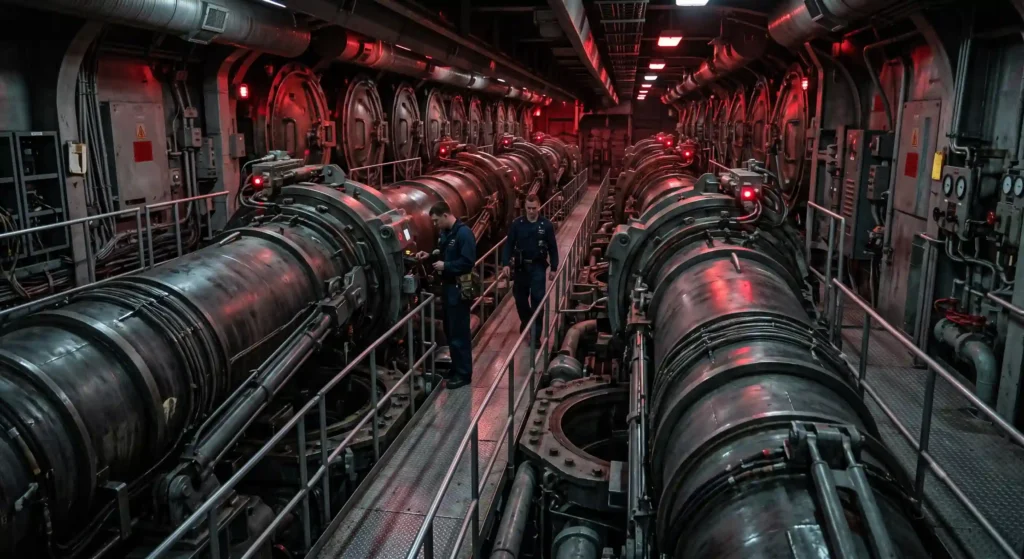
The weapons are not in one place, and cannot be. At any moment a large fraction of the deployed arsenal sits inside ballistic missile submarines dispersed across ocean basins, precisely so they cannot be destroyed or triggered together. Others are in hardened silos, at bomber bases, or in storage bunkers. There is no mechanism — technical, political or accidental — by which all of them fire at the same instant.
Nuclear weapons destroy each other. This is called fratricide. A detonating warhead produces neutron flux, X-rays, overpressure and dust that can disable or pre-detonate another warhead arriving nearby seconds later. Real targeting plans have to be sequenced specifically to avoid this. In a genuinely simultaneous detonation, a meaningful fraction of the arsenal would simply be destroyed before completing its own reaction — producing a fizzle rather than a full-yield explosion.
Warheads are not bombs until they are armed. Modern weapons use permissive action links, environmental sensing devices, and multi-stage arming sequences that require the weapon to experience a specific flight profile — acceleration, altitude, re-entry deceleration — before it will detonate. A warhead sitting in a bunker cannot be made to go off by an adjacent explosion. It gets crushed and scattered, not triggered.
Detonation location changes everything. The scenario’s outcome depends far more on where than on how many. Warheads detonated over open ocean or empty desert would produce enormous energy release and essentially no soot, because there is nothing to burn — and soot, not yield, drives the global catastrophe. The same 2.5 gigatons distributed over cities versus over the Pacific are two completely different events.
So this is a physics thought experiment, not a military scenario — the same category as asking what would happen if every volcano erupted at once. It is worth working through because the physics is calculable and the intermediate cases (a regional exchange, a superpower exchange) are unfortunately not hypothetical at all.
What Is Nuclear Winter?
Nuclear winter is the severe and prolonged global cooling that would follow a large-scale nuclear exchange, caused not primarily by the blast or radiation effects but by the fires. A nuclear weapon detonating over a city ignites firestorms consuming millions of tonnes of combustible material. The fires loft enormous quantities of black carbon soot high into the upper troposphere and stratosphere, where it can persist for months to years and absorb incoming solar radiation.
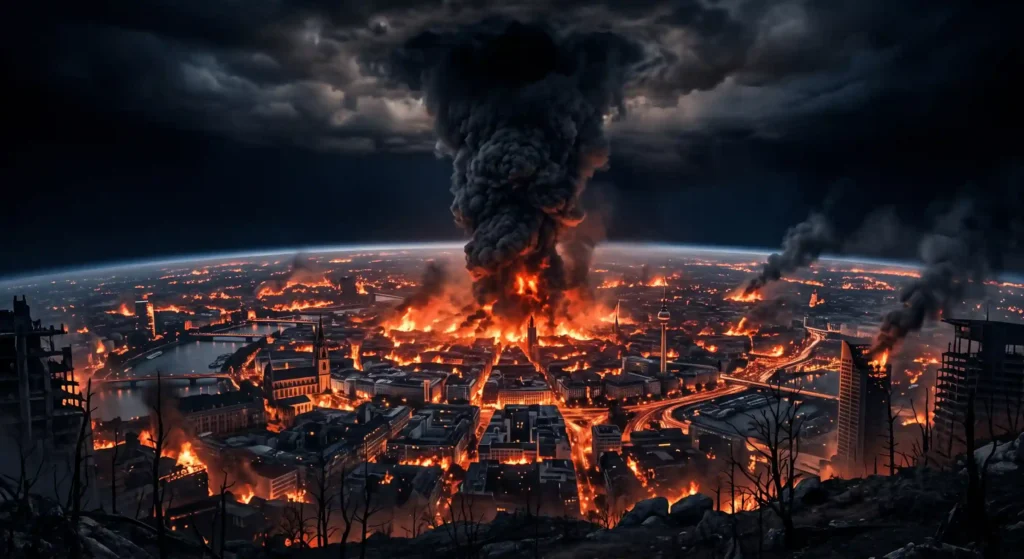
To picture the scale of a full nuclear exchange:
- Total soot injection from all 12,500 warheads: estimated 150 teragrams (Tg) = 150 billion kg
- Stratospheric residence time: 5–10 years (soot at 20–40 km altitude is above rainfall washout)
- Global temperature reduction: 8–10°C average; 20–30°C in continental interiors in summer
- Agricultural collapse: growing seasons shortened or eliminated across the Northern Hemisphere for 2–5 years
- Famine deaths estimated: 5 billion people within two years (Robock et al., 2007; updated 2022)
The Soot Number Is the Whole Ballgame
Every figure in the list above descends from a single input: 150 teragrams. Change that number and everything downstream changes with it. It is worth understanding why it is the most contested quantity in the entire field.
Soot is not a property of the warhead. It is a property of the target. To generate 150 Tg of black carbon you need a specific chain to complete: the weapon must detonate at an altitude that maximises fire ignition rather than cratering; the target must contain enough combustible material per square kilometre; the individual fires must merge into a true firestorm rather than burning separately; the firestorm’s convection column must punch through the tropopause; and the soot must then self-loft rather than rain out. Break any link and the number collapses.
- The Robock–Toon position. Modern three-dimensional climate models — the same class used for global warming research — consistently find that the soot self-lofts as it absorbs sunlight, climbing higher into the stratosphere and extending its lifetime to years. This group’s simulations produce the severe outcomes above and have been reproduced across multiple independent modelling centres.
- The Los Alamos critique. A team led by Jon Reisner used high-resolution fire models and argued that firestorms would inject dramatically less soot than assumed — potentially by an order of magnitude — because much of the smoke would be scavenged by the fire’s own moisture and never reach the stratosphere. Under those assumptions, a nuclear war produces regional catastrophe and a modest global chill rather than a decade-long winter.
- The rebuttal. Robock and Toon responded that the Los Alamos fire simulations modelled a single fire rather than a mass fire in a dense urban environment, and did not reproduce the observed behaviour of real firestorms or of large wildfires whose smoke has been directly observed reaching the stratosphere.
The 2017 British Columbia and 2019–20 Australian megafires provided partial real-world calibration: both injected smoke into the stratosphere, where satellites tracked it self-lofting and persisting for months — exactly the mechanism nuclear winter requires, though at a small fraction of the scale. That observation strengthened the basic physics considerably without settling the magnitude question. The honest summary is that a full exchange would very likely produce serious global cooling and agricultural disruption; whether “serious” means catastrophic or merely severe still turns on a soot figure nobody can know in advance. That entire debate, including its Cold War origins, is traced in our guide to nuclear winter.
What Would the First 24 Hours Look Like?
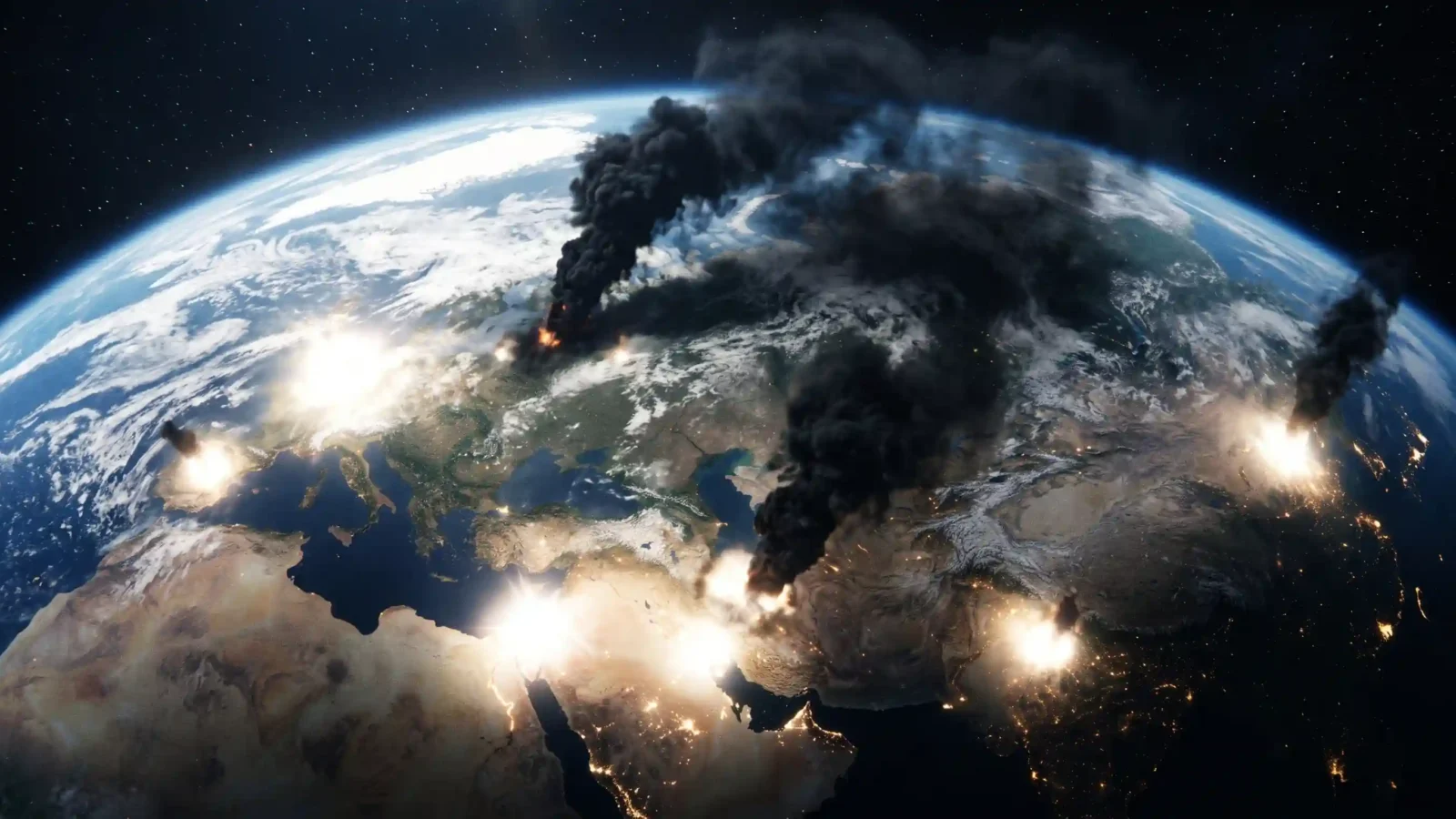
A simultaneous detonation scenario — all warheads fired at once — is a thought experiment rather than a military scenario (launch-on-warning procedures and physical dispersion of submarines would prevent simultaneous detonation). But the physics is calculable. The simultaneous detonation of 12,500 weapons targeted primarily on cities (their primary strategic purpose) would kill approximately 500 million people in direct blast, heat, and prompt radiation effects within the first hour. The blast radius of a 100-kiloton weapon extends to ~7 km for complete destruction; a 500-kiloton weapon to ~15 km.
Within 24 hours, 50–100 nuclear firestorms in major cities would be burning uncontrolled. Fallout radiation — the radioactive material carried aloft by the fireball and deposited downwind — would contaminate hundreds of thousands of square kilometres downwind of detonation sites. Within 72 hours, the soot cloud would begin spreading through the stratosphere via the Brewer-Dobson circulation, reaching global coverage within 1–2 weeks.
The Blast Rings, Measured
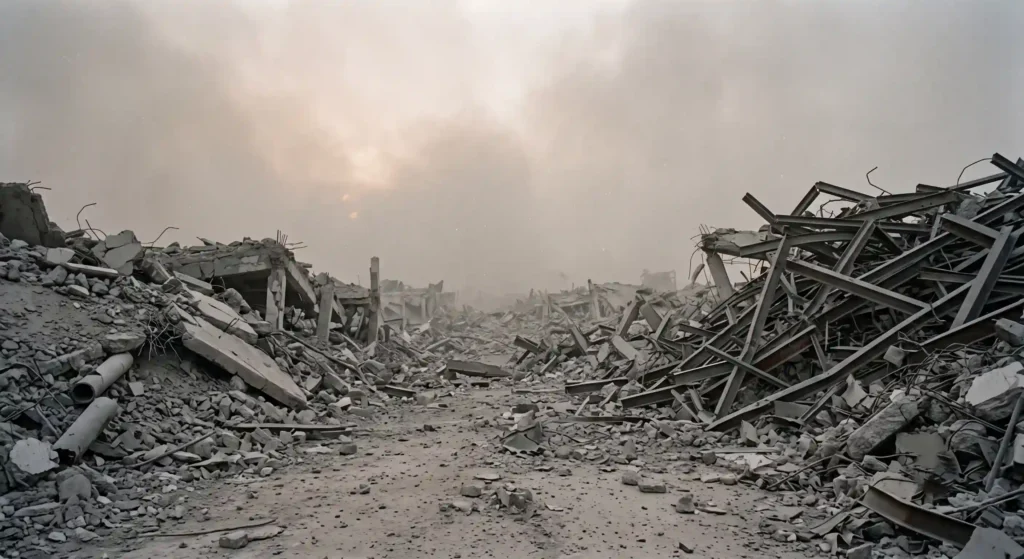
The phrase “blast radius” flattens a set of effects that behave very differently and reach very different distances. For a single 100-kiloton airburst — the most common deployed yield — the concentric zones look roughly like this, and it is the outermost ring that produces most of the casualties.
- Fireball (~0.5 km radius): temperatures comparable to the surface of the Sun. Everything within is vaporised. Nothing survives and nothing identifiable remains.
- Heavy blast, ~20 psi overpressure (~1.5 km): reinforced concrete structures collapse. Fatality rate near 100%.
- Moderate blast, ~5 psi (~5–7 km): residential buildings destroyed, widespread fires, most injuries fatal without medical care that will not exist. This is the “complete destruction” radius quoted above.
- Thermal radiation, third-degree burns (~8–11 km): and here is the counterintuitive part — the burn radius exceeds the blast radius. Third-degree burns destroy nerve endings, so they are painless, and they require immediate specialist care. A single major city strike would produce more severe burn casualties than the entire burn-bed capacity of the country.
- Light blast, ~1 psi (~12–15 km): windows shatter. Flying glass injures enormous numbers of people over a very wide area, overwhelming any surviving medical infrastructure.
Scale to a 500-kiloton warhead and these rings roughly double. Multiply by thousands of weapons across every significant urban centre on Earth, and the immediate death toll of around 500 million is not the striking number — the striking number is that it represents well under 10% of the eventual total.
The Electromagnetic Pulse
One consequence operates on a completely different scale from all the others: a single warhead detonated at high altitude produces no blast, no fire and no direct casualties on the ground, yet can disable electronics across an entire continent.
When a nuclear weapon detonates above roughly 30 kilometres, gamma rays from the explosion strip electrons from atoms in the upper atmosphere. Those electrons are deflected by Earth’s magnetic field into a coherent, extraordinarily fast electromagnetic pulse — the E1 component — that induces damaging voltage spikes in any conductor below. The pulse arrives in nanoseconds, faster than any surge protector designed for lightning can respond.
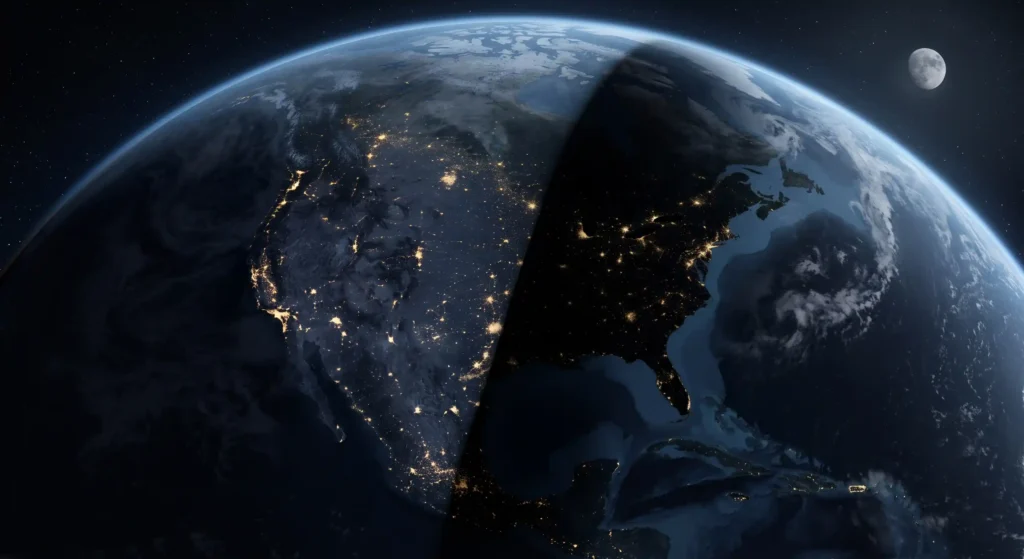
A single detonation at around 400 km altitude over the central United States would produce a line-of-sight footprint covering essentially the entire country. The 1962 Starfish Prime test, a 1.4-megaton burst 400 km above the Pacific, knocked out streetlights and telephone systems in Hawaii roughly 1,400 kilometres away — with 1962 electronics, which were vastly more robust than modern semiconductors.
In a full exchange, EMP effects would compound everything else: high-voltage transformers damaged, and those are custom-built items with lead times measured in months to years under normal conditions. Water treatment and distribution, which depends on electric pumping. Refrigeration for food and medicine. Communications and emergency coordination. In practical terms, a society would lose the industrial base needed to repair the damage at the same moment it lost the infrastructure.
Fallout: Where It Goes and How Fast It Fades
Fallout is the most feared effect and the most misunderstood, largely because films depict it as permanent. It is not. Radioactive decay is exponential, and the isotopes that make early fallout so lethal are lethal precisely because they decay fast.
The rule of thumb is the 7:10 rule: for every sevenfold increase in time after detonation, the radiation dose rate drops by a factor of ten. If the dose rate is 1,000 units one hour after the blast, it is 100 units at seven hours, 10 units at roughly two days, and 1 unit at about two weeks. Sheltering for 48 to 72 hours eliminates the large majority of the total dose a person would otherwise receive.
Two other factors determine severity:
- Burst height. An airburst — used against cities to maximise blast coverage — draws relatively little soil into the fireball and produces comparatively modest local fallout. A groundburst, used against hardened silos, sucks vast quantities of pulverised earth into the fireball where it is neutron-activated, then deposits it downwind. Counterforce targeting of missile fields produces far more fallout than city targeting does.
- Weather. Fallout follows wind, and rain concentrates it into intense localised hotspots. This is why fallout maps are plumes rather than circles, and why predicting exposure for a specific location is essentially impossible in advance.
The takeaway is not that fallout is harmless — it would contaminate hundreds of thousands of square kilometres and cause enormous casualties. It is that fallout is geographically bounded and temporally limited, while the soot in the stratosphere is neither. Hiroshima and Nagasaki are ordinary functioning cities today, eighty years on. That fact is the clearest available evidence that radiation is not the mechanism by which a nuclear war would end civilisation.
Could Any Civilisation Survive?
Some. The nuclear winter modelling by Robock, Toon, and colleagues consistently finds that the southern hemisphere experiences less cooling than the northern hemisphere (where most warheads would detonate and where most cities and forests are located). Southern hemisphere agricultural systems — Brazil, Argentina, Australia, South Africa — are modelled to continue producing some food during the worst nuclear winter years. Populations in tropical regions may survive at higher rates than northern midlatitude populations.
The fundamental challenge for survivors would not be radiation — the direct blast and fallout effects, while catastrophic, are geographically bounded — but food. Nuclear winter’s agricultural collapse would affect the same breadbasket regions that feed most of humanity. The global food system has roughly 90 days of reserve stocks. After that, the 5 billion estimated deaths are primarily from famine, not radiation.
Why the Southern Hemisphere Fares Better
The asymmetry is not a matter of luck. Three separate physical factors converge on it.
- Ocean thermal mass. The Southern Hemisphere is overwhelmingly ocean. Water has an enormous heat capacity and releases stored warmth slowly, buffering the temperature drop. Continental interiors — the Eurasian steppe, the North American plains — have no such buffer and cool fastest and furthest, which is exactly where the 20–30°C summer anomalies appear in the models.
- Slow interhemispheric mixing. Stratospheric air does not cross the equator freely. Soot injected in the north spreads across the Southern Hemisphere over months rather than weeks, and at lower concentrations, so the southern optical depth peaks lower and later.
- Marine protein. Fisheries do not depend on soil temperature or growing season in the same way crops do. Southern fisheries would be damaged by reduced plankton productivity under dimmed light, but they would not fail as abruptly as a wheat harvest.
New Zealand, Australia, southern South America and southern Africa consistently emerge from these simulations as the regions most likely to sustain functioning agriculture. This is a relative statement, not a comfortable one: those societies would face collapsed global trade, refugee pressure, absent imports of fuel, fertiliser, machinery and pharmaceuticals, and years of degraded harvests of their own.
What Would Actually Kill People, in Order
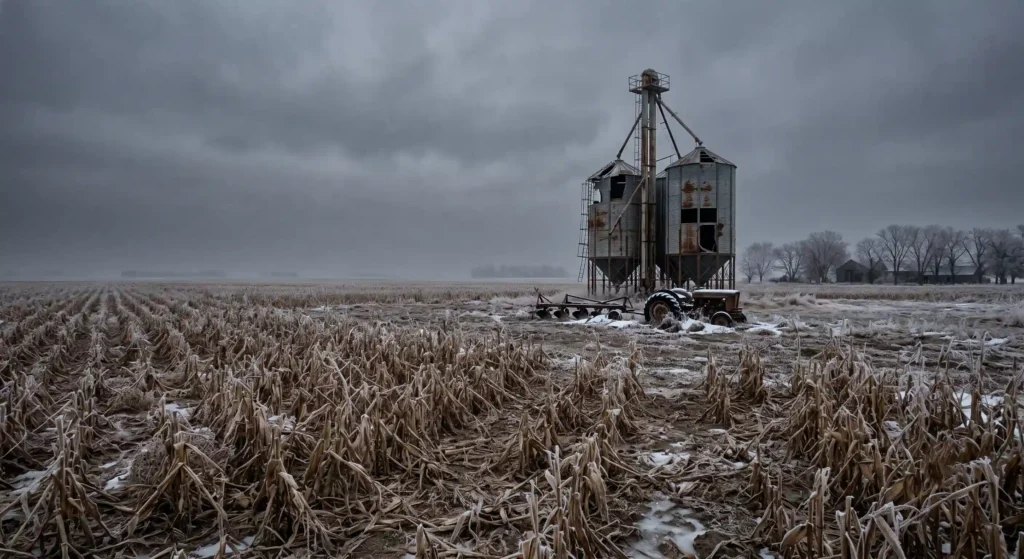
Ranking the causes by eventual death toll inverts almost every intuition the subject usually produces.
- 1. Famine — billions. Overwhelmingly the largest cause, arriving one to five years after the detonations, and falling mostly on populations in countries that were never targeted and never fired a weapon.
- 2. Blast, heat and firestorm — several hundred million. Concentrated entirely in the first hours, in the immediate vicinity of targets.
- 3. Collapse of medical, water and power infrastructure — tens to hundreds of millions. Untreated injuries, waterborne disease, loss of insulin and dialysis and antibiotics, and exposure. This category is largely invisible in casualty estimates and is probably underestimated.
- 4. Acute radiation and fallout — tens of millions. Devastating locally, but geographically bounded and decaying fast.
- 5. Long-term cancers and UV exposure — millions, spread over decades. Including the ozone-depletion effect described below.
The single most important structural fact in that list is that the top cause of death has nothing to do with being near a nuclear weapon. It is why nuclear winter reframed the entire strategic debate in the 1980s: it made a first strike potentially suicidal for the attacker even in the absence of retaliation.
The Ozone Layer, and Why the Recovery Is Not the End
There is a delayed effect that arrives just as the sky begins to clear. Soot in the stratosphere absorbs sunlight and heats the surrounding air — and stratospheric ozone chemistry is strongly temperature-dependent. Modelling of a 150 Tg injection has produced global ozone losses reaching a substantial majority of the layer within a few years, far beyond anything caused by CFCs at their peak.
The cruel timing is this: while the soot veil is thick, the reduced sunlight partly masks the damage. As the soot finally settles out after several years, full-strength sunlight returns through a badly depleted ozone layer. UV indices would climb to levels never experienced in human history, producing sunburn in minutes, damaging crops and phytoplankton, and raising cataract and skin cancer rates — precisely at the moment survivors most need to be outdoors farming.
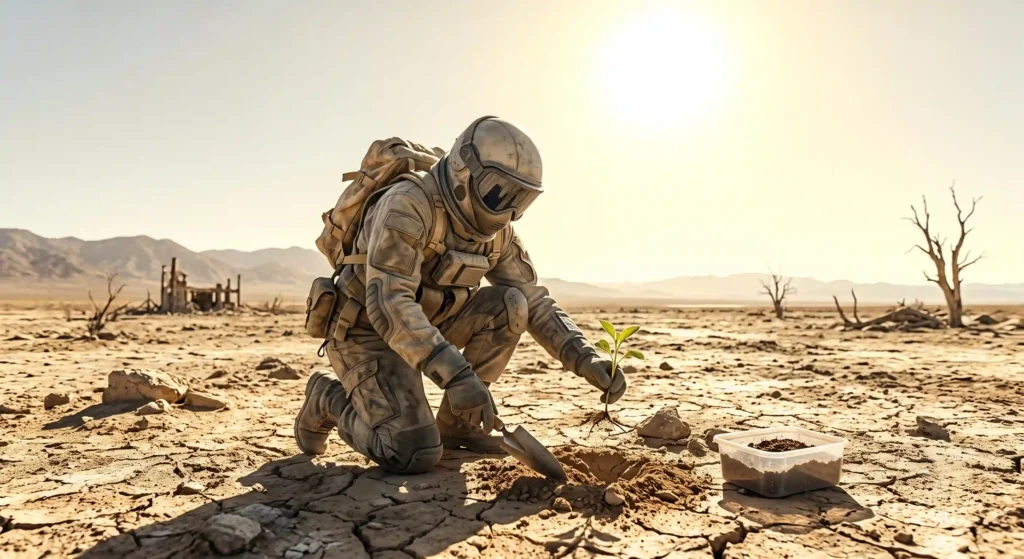
Recovery of the ozone layer would take a decade or more after the soot cleared. So the timeline of a full exchange is not detonation, winter, recovery. It is detonation, winter, and then a second, different environmental emergency layered on top of a population already reduced and a food system already broken.
A Thought Experiment, Not a Forecast
Everything above should be read with its assumptions visible. The 500 million immediate deaths assume city targeting. The 150 Tg assume every major urban area burns as a full firestorm. The 5 billion famine deaths assume no effective international food redistribution and no deployment of resilient food production. Each assumption is defensible and each is contestable, and the confidence intervals on this subject are genuinely wide.
What is not contestable is the direction. Every serious model, across every research group and every set of assumptions, agrees that a large nuclear exchange would cool the planet, shorten growing seasons worldwide, and kill far more people through starvation in uninvolved countries than through blast in targeted ones. The argument is about how much, not whether.
It is also worth stating what the science does not support. A full exchange would not sterilise the Earth, would not render the planet permanently uninhabitable, and would not push the planet out of orbit or crack the crust. Humanity would very likely survive, at a cost that defies comprehension. The mechanism behind all of it is the firestorms, the self-lofting soot, and a soot figure nobody can pin down in advance — which is why the intermediate scenarios, not this one, are what the research community actually spends its time on.
Q&A
Nuclear winter is the severe global cooling predicted to follow a large-scale nuclear exchange. Black carbon soot from nuclear-ignited urban fires would be lofted into the stratosphere, blocking 20–70% of sunlight reaching Earth’s surface for years. The resulting temperature drop and crop failures would likely cause more deaths than the direct nuclear blasts.
Approximately 12,500 nuclear warheads exist globally as of 2024, held by nine countries: the US (~5,550), Russia (~6,257), China (~500), France (~290), UK (~225), Pakistan (~170), India (~164), Israel (~90 estimated), and North Korea (~50). About 9,600 are in active military stockpiles; the rest are retired but intact.
The Tsar Bomba was the largest nuclear weapon ever detonated — a Soviet thermonuclear bomb tested on 30 October 1961 over Novaya Zemlya archipelago. Its yield was approximately 50 megatons, roughly 3,300 times the atomic bomb that destroyed Hiroshima. The fireball was 8 km wide; the blast wave circled the Earth three times. The test was a deliberate demonstration of capability, not a military operational weapon.
Fallout radiation is the radioactive material — fission products, activated soil, and weapon debris — carried aloft by a nuclear explosion and subsequently deposited on the ground downwind. The most dangerous early fallout (arriving within 24 hours) contains short-lived radioisotopes like iodine-131 and strontium-90. Lethal doses occur within tens to hundreds of kilometres downwind of a surface burst; airbursts produce less immediate fallout.
The Doomsday Clock is a symbolic measure maintained by the Bulletin of the Atomic Scientists, representing the likelihood of human-caused global catastrophe relative to midnight (civilisational collapse). As of January 2023, it stands at 90 seconds to midnight — the closest it has ever been to midnight since its creation in 1947, reflecting concerns about nuclear risk, climate change, and disruptive technologies.
The Federation of American Scientists estimates roughly 12,187 warheads worldwide at the start of 2026, of which about 9,745 are in military stockpiles available for use. The United States and Russia together hold approximately 86% of the global inventory. China’s arsenal has grown fastest, rising from around 350 warheads in 2020 to roughly 600.
No. Warheads are dispersed across submarines, silos, bomber bases and storage bunkers by design, and modern weapons require a specific arming sequence — including flight profile and altitude data — before they will detonate. A nearby explosion destroys a warhead rather than triggering it. Detonating weapons also disable each other, an effect called fratricide. A truly simultaneous global detonation is a physics thought experiment, not a possible event.
No. Fallout radiation decays exponentially — the 7:10 rule means dose rates drop by a factor of ten for every sevenfold increase in time, so most of the danger passes within days to weeks. Hiroshima and Nagasaki are ordinary functioning cities today. The long-term threat is the multi-year soot veil and the resulting famine, not permanent contamination.
An electromagnetic pulse is a burst of electromagnetic energy produced when gamma rays from a high-altitude nuclear detonation strip electrons from the upper atmosphere. A single warhead detonated around 400 km up could affect electronics across an entire continent. The 1962 Starfish Prime test disrupted streetlights and phone systems in Hawaii roughly 1,400 km from the burst — with far more robust 1960s electronics.
Modelling consistently favours the Southern Hemisphere — New Zealand, Australia, southern South America and southern Africa. Three factors drive this: the hemisphere is mostly ocean, which buffers the temperature drop; stratospheric soot from northern detonations crosses the equator slowly and at lower concentration; and fisheries provide protein that does not depend on growing seasons. Even so, these countries would face collapsed trade, absent imports, and years of degraded harvests.
Because the soot veil is global while the blast is local. Cooling and dimmed sunlight would cut harvests across every major agricultural region simultaneously, and the world food system holds only about 90 days of reserves. Once those are exhausted with no harvest to replace them, famine follows — and the modelled majority of deaths occur in countries that never fired or received a single weapon.
Internal links: existential risk | What If an Engineered Super-Virus Became Airborne? | What If Yellowstone Erupted Tomorrow?