 By
By 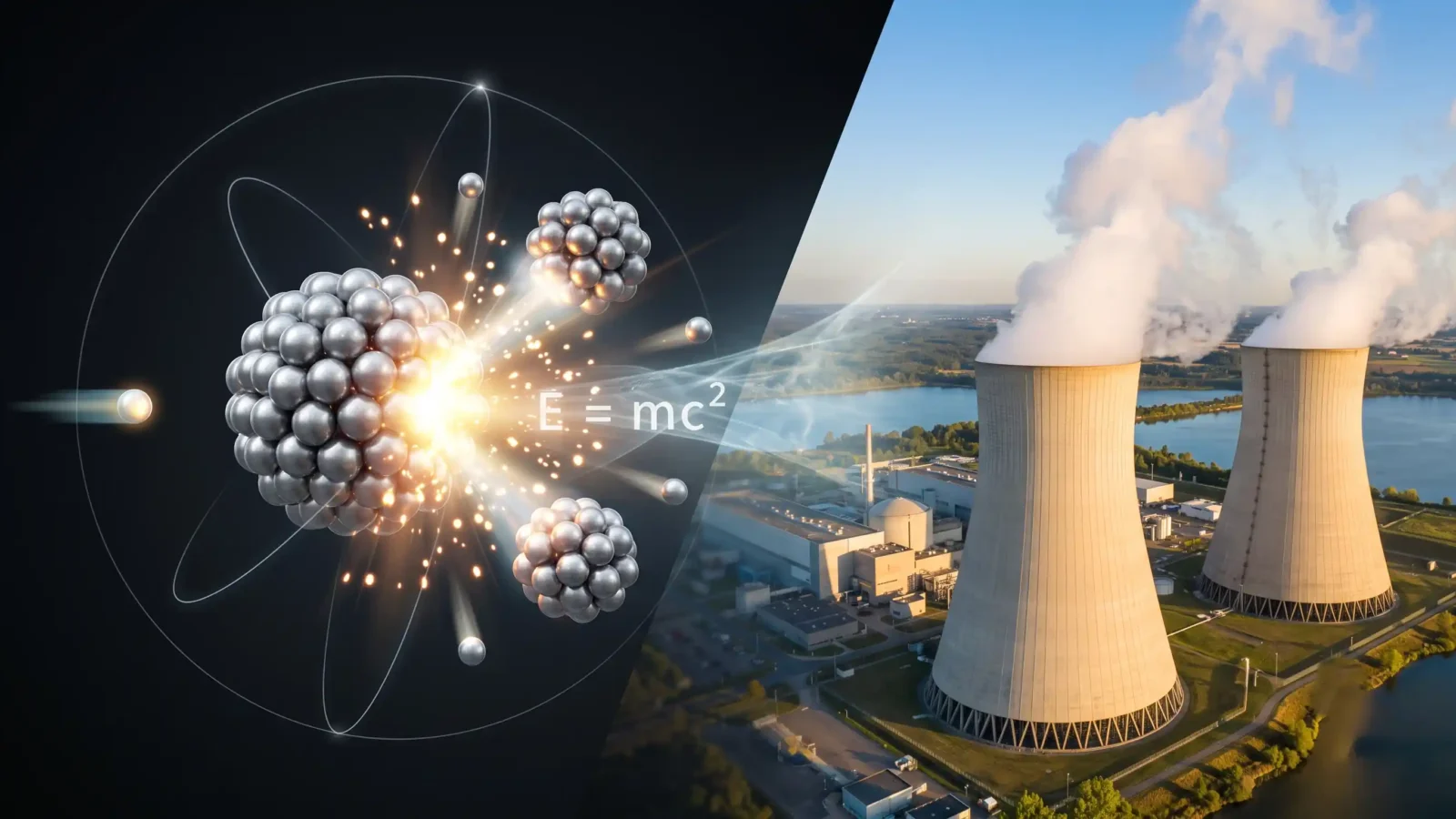
Quick Answer
Nuclear fission is the process of splitting the nucleus of a heavy atom — such as uranium — into smaller pieces, releasing a large amount of energy. When a nucleus splits, it also releases neutrons that can split more nuclei, creating a self-sustaining chain reaction. Controlled fission powers nuclear reactors that generate electricity; an uncontrolled chain reaction is what makes a nuclear weapon so destructive. The energy comes from converting a tiny amount of mass into energy, following Einstein’s E = mc².
The splitting of the atom is one of the defining scientific discoveries of the 20th century — a source of both clean electricity and humanity’s most fearsome weapons. This guide explains the science of nuclear fission: what it is, how a chain reaction works, the difference between reactors and bombs, and how it compares to its counterpart, nuclear fusion.
What Is Nuclear Fission?
Nuclear fission is a reaction in which the nucleus of a heavy atom splits into two (or more) lighter nuclei. It typically happens when a heavy, unstable nucleus — most commonly uranium-235 or plutonium-239 — absorbs a neutron, becomes unstable, and breaks apart. The split produces lighter “daughter” nuclei, a few free neutrons, and a burst of energy.
The energy comes from a remarkable fact: the combined mass of the fragments is slightly less than the mass of the original nucleus. That missing mass has been converted into energy according to Einstein’s famous equation, E = mc². Because the speed of light squared (c²) is such an enormous number, even a tiny amount of lost mass releases a tremendous amount of energy. A single fission event releases millions of times more energy than a chemical reaction like burning, which is why nuclear fuel is so extraordinarily energy-dense.
The Discovery: Berlin, December 1938
Fission was found by accident, by chemists, and it was explained by a physicist who had been forced to flee the country.
In Berlin, Otto Hahn and Fritz Strassmann were bombarding uranium with neutrons, expecting to create heavier elements. Instead, their chemical analysis kept finding barium — an element roughly half the mass of uranium. It made no sense. Nuclei were understood to chip small fragments off, not split down the middle. Hahn wrote to his long-time collaborator Lise Meitner, who had fled Nazi Germany for Sweden months earlier, describing the result and asking whether she could explain it.
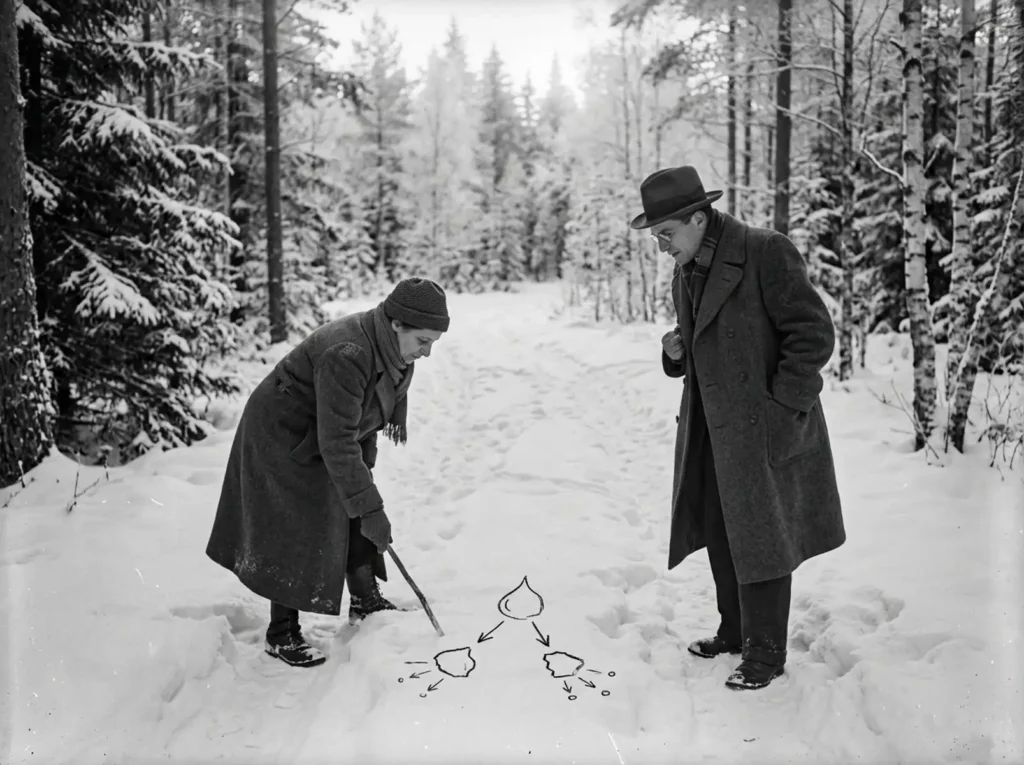
Over Christmas 1938, Meitner worked through the problem with her nephew Otto Frisch during a walk in the snow near Kungälv. Using the liquid-drop model of the nucleus, they realised that a uranium nucleus absorbing a neutron could elongate and pinch in two like a dividing droplet — and then they did the arithmetic. The mass of the fragments was less than the original. Applying E = mc², the missing mass corresponded to about 200 million electron-volts released per event. Frisch borrowed the term fission from biology, where it describes a cell dividing.
The implications were understood almost immediately. Within months, physicists including Leó Szilárd recognised that if each fission released additional neutrons, a chain reaction was possible — and within six years both a working reactor and a working bomb existed. Hahn received the 1944 Nobel Prize in Chemistry alone; Meitner’s exclusion is now widely regarded as one of the clearest injustices in the history of the prize.
The Chain Reaction Explained
The key to harnessing fission is the chain reaction. When a uranium nucleus splits, it releases two or three neutrons. Each of those neutrons can strike another uranium nucleus and cause it to split, releasing yet more neutrons, which split still more nuclei. If, on average, at least one neutron from each fission goes on to cause another fission, the reaction sustains itself.
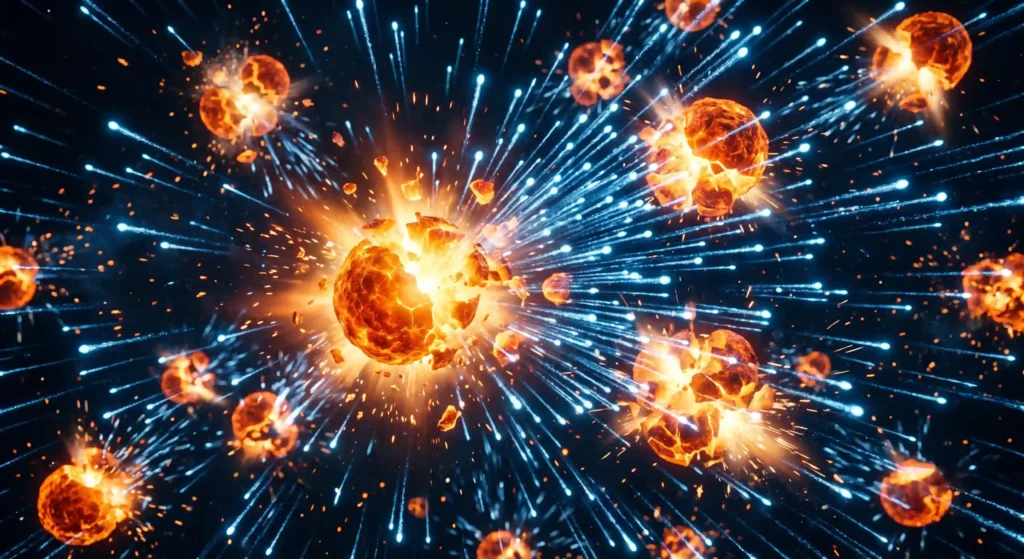
This depends on having enough fissile material packed closely enough together — a quantity known as the critical mass. Below the critical mass, too many neutrons escape without causing further fissions and the reaction fizzles out. At critical mass, the reaction becomes self-sustaining. Whether that self-sustaining reaction is gentle and steady or explosive and runaway is the crucial distinction between a power plant and a weapon.
Criticality, and the Number That Runs Everything
Everything about reactor and weapon behaviour reduces to a single quantity: k, the multiplication factor. It is the average number of neutrons from one fission that go on to cause another fission.
- k < 1 — subcritical. Each generation is smaller than the last. The reaction dies out. All fissile material in storage and transport is kept in this state by geometry and spacing.
- k = 1 — critical. Each generation exactly replaces the last. Power is steady. This is the normal operating state of every nuclear reactor in the world — “going critical” is not an emergency, it is the goal.
- k > 1 — supercritical. Each generation is larger than the last and power rises exponentially. Reactors go briefly and slightly supercritical to increase power. A weapon is designed to be violently supercritical.
Critical mass is not a fixed number, which surprises people. It depends on geometry, density, and surroundings. A sphere is the most efficient shape because it minimises surface area, so fewer neutrons escape. Compressing the material increases density and lowers the critical mass — the principle behind implosion weapon design. Surrounding the material with a neutron reflector such as beryllium bounces escaping neutrons back in, lowering the critical mass again. For uranium-235 the bare-sphere critical mass is roughly 52 kg; with a good reflector it falls to a fraction of that.
Here is the fact that makes controlled nuclear power possible at all. Roughly 99.35% of fission neutrons are released instantly — prompt neutrons, emitted within a fraction of a microsecond. If reactors depended only on those, the reaction would respond faster than any mechanical control system could possibly follow, and steady operation would be impossible. But about 0.65% of neutrons are delayed, emitted seconds to minutes later as certain fission products decay. Reactors are deliberately operated in a regime where they are subcritical on prompt neutrons alone and depend on that small delayed fraction to reach k = 1. This stretches the reactor’s response time from microseconds to seconds, which is exactly what makes it controllable by human operators and mechanical rods. A weapon, by contrast, is designed to go prompt supercritical — supercritical on prompt neutrons alone — so the entire reaction completes in under a microsecond.
Where the Energy Actually Goes
A single fission of uranium-235 releases roughly 200 million electron-volts. That energy does not appear as light or heat directly — it appears almost entirely as motion, and it is worth seeing the breakdown because one line in it explains the worst nuclear accidents in history.
- ~168 MeV — kinetic energy of the two fragments. The daughter nuclei fly apart at enormous speed, driven by mutual electrical repulsion, and slam to a halt within microns. That deceleration is what heats the fuel. This is where essentially all usable reactor power comes from.
- ~7 MeV — prompt gamma rays. Released at the instant of the split.
- ~5 MeV — kinetic energy of the released neutrons. The part that sustains the chain reaction.
- ~13 MeV — decay of the fission products. Beta particles and gamma rays emitted over the following seconds, hours and years as the unstable fragments decay toward stability.
- ~10 MeV — antineutrinos. These pass straight through the reactor, the building, and the Earth. This energy is permanently unrecoverable.
That fourth line is the critical one. The fission products keep releasing energy after the chain reaction stops — this is decay heat, and it cannot be switched off. Immediately after a reactor shuts down, decay heat still amounts to roughly 6–7% of full thermal power, falling to about 1% after an hour and continuing at diminishing levels for years. For a large reactor, 6% of full power is still tens of megawatts of heat with nowhere to go.
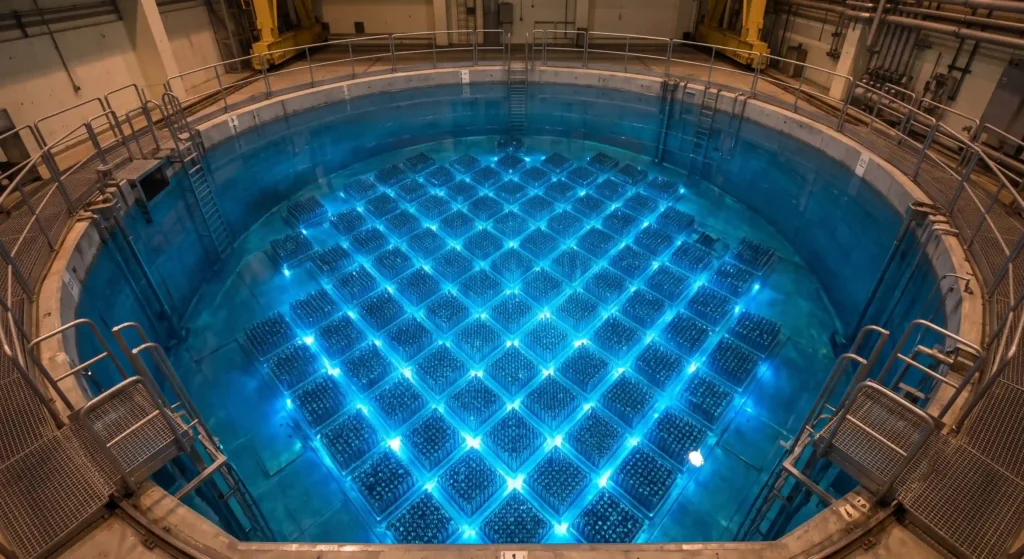
This is why every reactor requires cooling long after shutdown, and why the defining question in a nuclear accident is never “did the chain reaction stop” but “is cooling still working.” At Fukushima in 2011, the reactors shut down correctly within seconds of the earthquake. The meltdowns happened because the tsunami destroyed the backup generators that powered the pumps removing decay heat.
Fission in Power Plants vs Weapons
The same underlying physics powers both nuclear reactors and nuclear weapons, but they are engineered to do opposite things with the chain reaction.
Controlled vs uncontrolled reactions
In a nuclear power plant, the chain reaction is carefully controlled so that it proceeds at a slow, steady rate, releasing heat gradually. Operators use control rods, which absorb excess neutrons, to keep the reaction balanced — speeding it up or slowing it down as needed. A moderator (often water) slows the neutrons to make the reaction efficient, and the heat produced boils water into steam that turns turbines to generate electricity. Reactor fuel uses uranium enriched to only a few percent — far too low to ever explode like a bomb.
A nuclear weapon does the opposite: it is designed to make the chain reaction uncontrolled, so that an enormous number of fissions occur in a tiny fraction of a second, releasing all the energy at once in an explosion. This requires highly concentrated fissile material and a very different design. The fundamental safety point is that the low-enriched fuel in a power reactor physically cannot produce a nuclear explosion — the two applications are deliberately and profoundly different.
Enrichment: The Line Between Power and Weapons
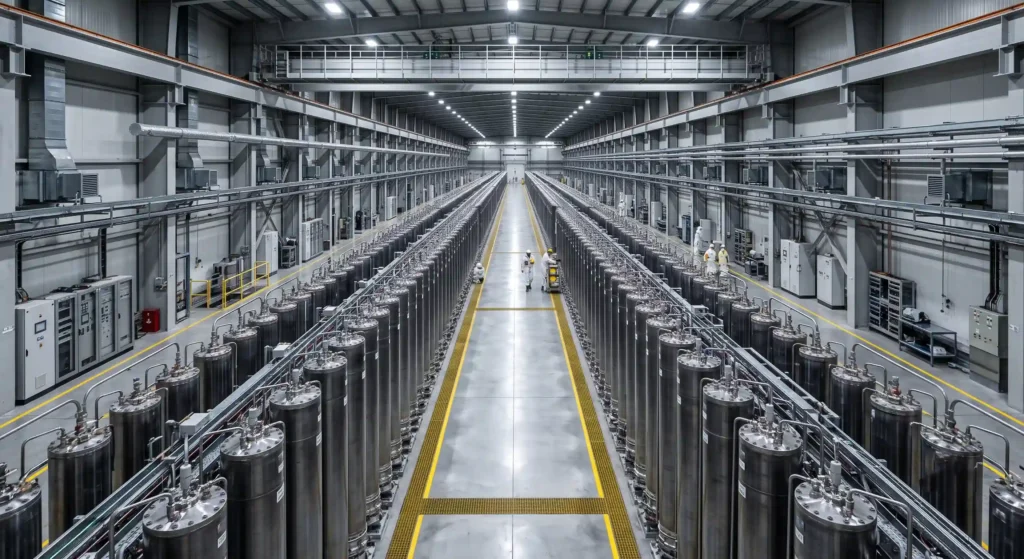
Natural uranium dug out of the ground is 99.27% uranium-238, which does not readily fission, and only about 0.72% uranium-235, which does. Enrichment is the process of raising that fraction, and where a country’s enrichment level sits is the single most important technical fact in nuclear non-proliferation.
- 0.72% — natural uranium. Usable directly only in reactor designs with very efficient moderators, such as Canadian CANDU heavy-water reactors.
- 3–5% — low-enriched uranium (LEU). Standard fuel for the world’s commercial power reactors. Physically incapable of a nuclear explosion at any density or geometry.
- Up to 20% — the LEU ceiling. Used in research reactors, naval propulsion in some countries, and newer advanced reactor designs. Twenty percent is the internationally agreed line above which material is considered directly weapons-usable.
- Above 20% — highly enriched uranium (HEU). Weapons become physically possible, though inefficient at the lower end of this range.
- ~90% — weapons-grade. The standard for a practical, compact fission weapon.
The counterintuitive and strategically decisive fact is that this ladder is wildly non-linear. Enrichment work is measured in separative work units, and because you are progressively discarding more and more material at each stage, the effort is front-loaded. Getting from 0.72% to 5% consumes roughly two-thirds to three-quarters of the total separative work needed to reach 90%. In other words, a country with an established civil enrichment programme producing reactor fuel has already done most of the hard work toward weapons-grade material.
This is precisely why enrichment capability, rather than reactors themselves, is the focus of international safeguards and inspection regimes — and why negotiations over nuclear programmes almost always centre on centrifuge counts and enrichment percentages rather than on power plants.
Reactor Designs Around the World
Almost all commercial reactors do the same fundamental thing — use fission heat to boil water and turn a turbine — but the engineering choices differ meaningfully, and those choices determine how each design fails.
- Pressurised water reactor (PWR). The most common design worldwide. Water under high pressure acts as both coolant and moderator, and transfers heat to a separate steam loop. Because the water is both coolant and moderator, losing coolant also stops the chain reaction — an inherently stabilising feature.
- Boiling water reactor (BWR). Water boils directly in the core and the steam drives the turbine. Simpler, but the steam circuit is mildly radioactive. The Fukushima Daiichi reactors were BWRs.
- Heavy water reactor (CANDU). Uses deuterium oxide as moderator, which is efficient enough to run on unenriched natural uranium, and can be refuelled while operating.
- Graphite-moderated (RBMK). The Soviet design used at Chernobyl. Because graphite rather than water was the moderator, losing coolant did not stop the reaction — under certain conditions it accelerated it. This positive void coefficient was central to the 1986 accident, and remaining reactors of this type have since been modified.
- Advanced and small modular designs. Molten salt, high-temperature gas-cooled, and small modular reactors are in various stages of development, generally designed around passive safety — shutting down and cooling by physics alone, without pumps, power or operator action.
What Actually Goes Wrong
Three accidents define public understanding of nuclear power, and comparing them is more instructive than considering any one alone — because the same physical villain appears in all three.
Three Mile Island, 1979. A stuck valve and misleading instrumentation led operators to reduce cooling when they should have increased it. Roughly half the core melted. The containment building held, and radiation release to the public was negligible with no detectable health effects. It was a severe financial and institutional disaster, and a demonstration that containment works.
Chernobyl, 1986. The worst nuclear accident in history, and the only one with a large confirmed radiation death toll. An unstable low-power test, a reactor design with a positive void coefficient, control rods with a flawed graphite tip, and the absence of a Western-style containment structure combined catastrophically. A power excursion and steam explosion blew the reactor open and the graphite moderator burned for days, lofting fission products across Europe. Chernobyl was a design and procedural failure, not an inherent property of fission.
Fukushima Daiichi, 2011. The reactors shut down correctly when the earthquake struck. The tsunami then flooded the backup diesel generators — sited too low — eliminating the power needed to circulate cooling water. Decay heat did the rest over the following days, causing three meltdowns and hydrogen explosions. The confirmed direct radiation death toll is extremely low; the far larger human cost came from the evacuation itself and its social consequences.
The common thread is decay heat. In none of the three cases did a runaway chain reaction cause the damage — in every case the reaction had stopped. What failed was the ability to remove the heat that keeps coming afterward. Modern designs address this directly through passive cooling systems that function without electricity, pumps, or human intervention.
Nuclear Waste, Honestly
Waste is the strongest argument against fission power, and it deserves to be stated accurately rather than either dismissed or exaggerated.
The volume is genuinely small. Because fission is millions of times more energy-dense than combustion, a large reactor produces on the order of tens of tonnes of spent fuel per year, compared with millions of tonnes of CO₂ from an equivalent coal plant. All the high-level waste ever produced by the entire US commercial nuclear industry would fit on a single football field stacked a few metres deep.
The duration is genuinely long. Spent fuel contains a mix of isotopes with very different lifetimes: iodine-131 with a half-life of 8 days, caesium-137 and strontium-90 at around 30 years each — these dominate the intense radioactivity of the first few centuries — and plutonium-239 at 24,100 years alongside technetium-99 at 211,000 years, which dominate the long tail. Spent fuel needs isolation on timescales that exceed all of recorded human history.
- Cooling pools, then dry casks. Spent fuel spends several years underwater, then moves to sealed concrete-and-steel casks. This is where most of the world’s spent fuel sits today — safe, monitored, and explicitly interim.
- Deep geological disposal. The scientific consensus solution. Finland’s Onkalo repository at Olkiluoto is the first in the world to be built, tunnelling into bedrock roughly 400 metres down with a design intent of isolating waste for 100,000 years. Sweden and France have programmes at various stages.
- Reprocessing. France and a few other countries chemically separate usable plutonium and uranium from spent fuel and recycle it, substantially reducing waste volume. The drawback is that reprocessing separates plutonium, which raises proliferation concerns — the reason the United States largely abandoned the practice.
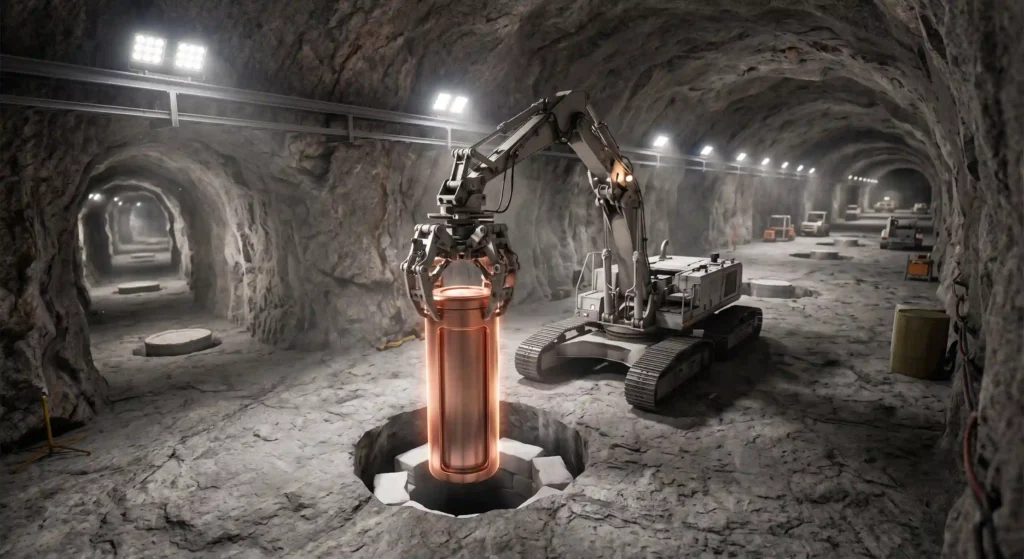
The honest summary is that the technical problem is essentially solved and the political problem is not. Deep geological disposal is broadly accepted by the scientific community as workable, but almost no country has succeeded in siting a repository, because the required consent operates on political timescales of a few years and the waste operates on timescales of a hundred millennia.
Fission vs Fusion
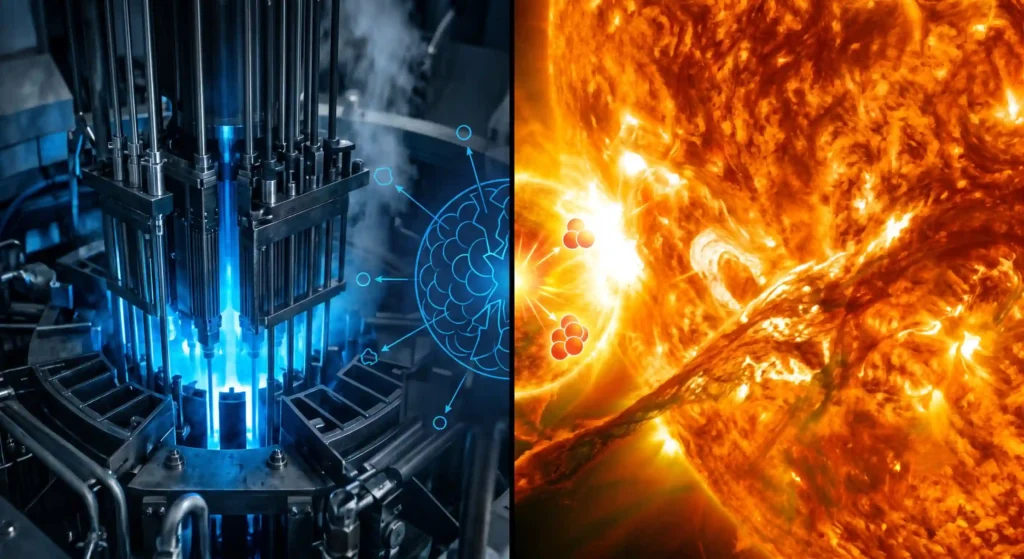
Fission has a counterpart called nuclear fusion, and the two are opposites. Fission splits heavy nuclei apart, while fusion joins light nuclei together — for example, fusing hydrogen into helium. Fusion is what powers the Sun and the stars.
- Fission: splits heavy atoms (uranium, plutonium); used in today’s nuclear power plants.
- Fusion: combines light atoms (hydrogen isotopes); powers stars and is being developed for future clean energy.
- Energy: fusion releases even more energy per unit of mass than fission.
- Difficulty: fusion requires extreme temperatures and pressures, making controlled fusion power very hard to achieve on Earth.
Fusion produces less long-lived radioactive waste and uses abundant fuel, which is why it is seen as a promising future energy source — but harnessing it for practical power has proven enormously challenging.
Why Both Appear in the Same Weapon
There is a detail worth adding here, because it explains why modern warheads are so much more powerful than the bombs of 1945. Thermonuclear weapons — hydrogen bombs — use both processes in sequence.
A fission device serves as the primary stage. Its explosion produces the extraordinary temperatures and pressures needed to force fusion in a secondary stage of hydrogen isotopes. The fusion reaction in turn floods the assembly with high-energy neutrons, which trigger additional fission in a surrounding uranium casing. In most large thermonuclear weapons, the majority of the total yield actually comes from that final fission stage rather than from the fusion itself.
This staging is why yields jumped from the 15 kilotons of Hiroshima to the 50 megatons of the Tsar Bomba within sixteen years — a factor of more than three thousand. Fission alone has a practical yield ceiling of a few hundred kilotons, because assembling a much larger supercritical mass fast enough is impractical. Fusion staging removed that ceiling entirely.
How a Fission Bomb Releases Its Energy
From a scientific standpoint, a fission weapon works by forcing an extremely rapid, uncontrolled chain reaction. The principle is to bring fissile material into a supercritical state so quickly that an immense number of fissions cascade through it before it blows itself apart, converting a small amount of mass into a devastating release of energy, heat, and radiation in an instant.
The result is the catastrophic blast, thermal flash, and radiation associated with nuclear weapons — and, on a global scale, the potential for long-lasting climate effects if many were used. The full planetary consequences of such an event are explored in what if all nuclear weapons detonated at once. The ongoing risk these weapons pose to civilisation is tracked symbolically by the Doomsday Clock.
Those climate effects are worth being specific about, because they are the reason fission weapons are considered a threat to civilisation rather than merely to their targets. The mechanism is not radiation and not the explosion itself but smoke: firestorms in burning cities loft black soot into the stratosphere, where it absorbs sunlight, lifts itself higher, and lingers for years, cooling the entire planet and collapsing harvests in countries that were never attacked. That chain of consequences — its physics, its Cold War origins in the 1983 TTAPS study, and the four decades of scientific argument over how severe it would really be — is set out in full in our guide to nuclear winter.
Is Nuclear Power Safe and Low-Carbon?
This is where the physics meets a genuinely contested policy debate, and it is worth separating the parts that are empirical from the parts that are value judgements.
On lifecycle carbon emissions, the evidence is not seriously disputed: fission is comparable to wind and lower than solar photovoltaics, at a small fraction of natural gas and a very small fraction of coal. The emissions come almost entirely from mining, enrichment and construction, not from operation.
On mortality, comparisons per unit of electricity generated consistently place nuclear among the safest sources ever used — on a similar order to wind and solar, and orders of magnitude below coal, oil and biomass, whose air pollution kills continuously rather than in visible discrete events. This holds even when the Chernobyl and Fukushima death tolls are included, because fossil fuel mortality is enormous and constant while nuclear mortality is rare and concentrated.
The genuine counterarguments are not about these numbers. They are about capital cost and construction time, which have proven very difficult to control in Western projects; about the unresolved politics of long-term waste siting; about the link between civil enrichment capability and weapons potential; and about the fact that catastrophic-but-rare risks are weighed differently by the public than continuous-but-diffuse ones — a difference that is a legitimate values question, not simply an error in reasoning. Reasonable people reach different conclusions from the same data, and the debate is better served by naming which part is being disputed.
Q&A
An enormous amount relative to its fuel. A single fission of a uranium-235 nucleus releases about 200 million electron-volts — millions of times more than a typical chemical reaction. Because of E = mc², the complete fission of about one kilogram of uranium could release energy comparable to thousands of tonnes of conventional explosive.
Modern nuclear power plants are designed with multiple safety systems, and nuclear energy has a strong overall safety record as a low-carbon power source. The main challenges are preventing accidents and safely managing long-lived radioactive waste. Reactor fuel cannot produce a nuclear explosion because it is only lightly enriched.
The most common fissile fuels are uranium-235 and plutonium-239. Natural uranium is mostly uranium-238, which is not easily fissile, so it is enriched to increase the proportion of uranium-235 for use in reactors. These heavy, unstable nuclei split readily when they absorb a neutron.
Fission splits heavy atomic nuclei apart, while fusion fuses light nuclei together. Fission powers today’s nuclear reactors; fusion powers the stars and is being developed as a future energy source. Fusion releases more energy per unit mass but is far harder to control on Earth.
Otto Hahn and Fritz Strassmann produced the experimental result in Berlin in December 1938, detecting barium after bombarding uranium with neutrons. Lise Meitner and Otto Frisch supplied the theoretical explanation weeks later and named the process “fission.” Hahn alone received the 1944 Nobel Prize in Chemistry; Meitner’s exclusion is widely regarded as a serious injustice.
No — it is physically impossible. Reactor fuel is enriched to only 3–5% uranium-235, while a weapon requires around 90%. At low enrichment no arrangement of geometry or density can produce a nuclear explosion. Reactor accidents involve steam explosions, hydrogen explosions and fuel melting, which are serious but fundamentally different events.
The minimum amount of fissile material needed to sustain a chain reaction. It is not a fixed number — it depends on shape, density and surroundings. A sphere requires less than an irregular shape because fewer neutrons escape, compression lowers it further, and a neutron reflector lowers it again. For uranium-235 the bare-sphere critical mass is roughly 52 kg, and considerably less with a reflector.
Decay heat is the energy released by radioactive fission products after the chain reaction has stopped. It cannot be switched off. Immediately after shutdown it amounts to roughly 6–7% of full reactor power, falling to about 1% after an hour. This is why reactors need cooling long after shutdown, and it is the direct cause of the Fukushima meltdowns — the reactors shut down correctly, but the tsunami destroyed the power supply to the cooling pumps.
It depends on the isotope. Iodine-131 has a half-life of 8 days, while caesium-137 and strontium-90 are around 30 years each and dominate the intense radioactivity of the first few centuries. Plutonium-239 at 24,100 years and technetium-99 at 211,000 years form the long tail, which is why deep geological repositories such as Finland’s Onkalo are designed to isolate waste for 100,000 years.
Because the process is heavily front-loaded. Natural uranium is 0.72% uranium-235; reactor fuel needs 3–5%; weapons need around 90%. But going from 0.72% to 5% consumes roughly two-thirds to three-quarters of the total separative work needed to reach weapons-grade. A country with a working civil enrichment programme has already completed most of the technical path to weapons material, which is why safeguards focus on centrifuges rather than reactors.
The Bigger Question
Nuclear fission shows how the splitting of a single atom can unleash energy out of all proportion to its size — energy that lights cities, but that can also be weaponised. What would happen if the entire global arsenal of fission and fusion weapons were unleashed at once, not just in immediate destruction but in the lasting effect on the planet’s climate? That is the grave scenario examined in what if all nuclear weapons detonated at once.
The threat these weapons pose is symbolically measured by the Doomsday Clock. Explore more about the forces that could reshape civilisation on the Earth & Humanity Survival hub.
Watch the nuclear scenario to understand the global stakes of the energy locked inside the atom.