 By
By What Is the Earth’s Core Made Of?
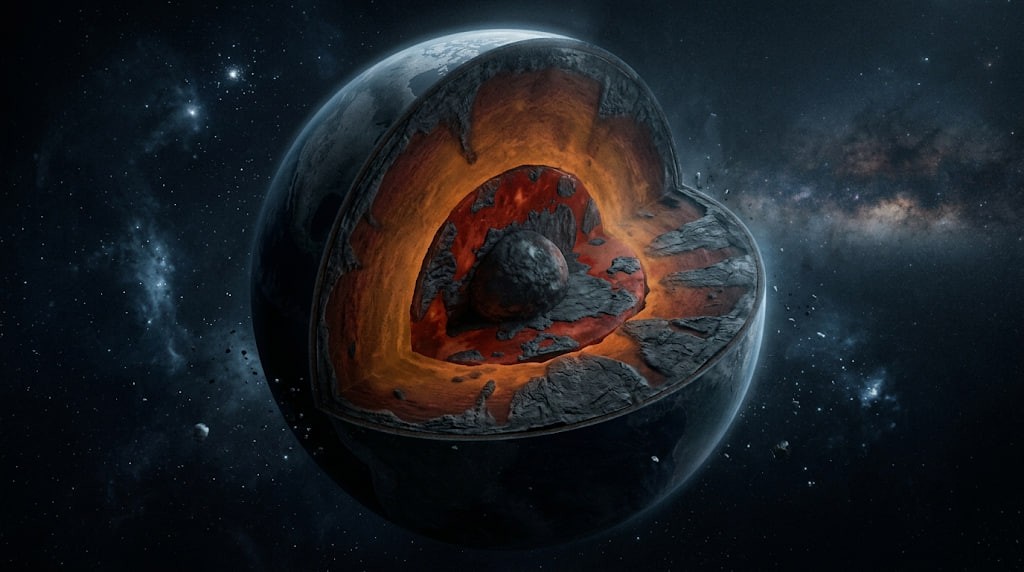
Earth’s core consists of two distinct regions. The inner core — a solid sphere about 1,220 km in radius at the planet’s centre — is composed primarily of iron with approximately 5–6% nickel and trace amounts of lighter elements (possibly silicon, sulphur, or oxygen). Despite temperatures of approximately 5,400°C (comparable to the surface of the Sun), the inner core remains solid due to the immense pressure at depth: roughly 3.6 million atmospheres.
The outer core surrounds the inner core and extends from 1,220 km to 3,480 km radius. It is liquid iron-nickel alloy at temperatures of 4,000–5,400°C. It is this liquid outer core that generates Earth’s magnetic field via the geodynamo: convection currents in the conducting fluid, driven by the heat difference between the inner core boundary and the core-mantle boundary, plus the rotational Coriolis effect, create electrical currents that produce the global magnetic field. The inner core is actually growing — solidifying onto its outer surface at approximately 0.5 mm per year — extracting latent heat that helps drive the outer core convection.
What Would Happen if the Outer Core Solidified?
If the liquid outer core suddenly solidified, the geodynamo would cease operating. The mechanism requires a conducting fluid in motion; solid iron, while still electrically conductive, would not convect in the way needed to sustain field generation. Earth’s surface magnetic field — which averages about 25–65 microtesla — would decay on a timescale of roughly 10,000–100,000 years as residual currents dissipated. This is actually the relevant timescale for natural geomagnetic reversals, where the field weakens significantly before recovering in a new polarity orientation.
During a geomagnetic reversal — which has happened hundreds of times in Earth’s history, most recently 780,000 years ago — the field drops to about 10% of its normal strength for a period of roughly 1,000–10,000 years. During these periods, cosmic ray flux at Earth’s surface increases significantly, ozone depletion increases UV radiation reaching the surface, and satellite electronics and power grids are more vulnerable. But life has survived every geomagnetic reversal in the geological record; no mass extinction is definitively linked to one.
How Would the Magnetosphere Collapse Affect Life?
Mars is the relevant model. Mars lost its global magnetic field approximately 4 billion years ago when its smaller core cooled and the geodynamo stopped. Subsequently, the solar wind — the constant stream of charged particles from the Sun — eroded Mars’ ancient thick atmosphere at a rate of ~100 grams per second. Over 4 billion years, this erosion removed most of Mars’ early CO₂-rich atmosphere, transitioning the planet from a potentially habitable warm-wet environment to the cold, thin-atmosphere desert it is today.
Earth’s fate without a magnetosphere would follow the same trajectory, but the timescale is long:
- 0–10,000 years after geodynamo stop: Gradual field decay; cosmic ray exposure increases; aurora disappears
- 10,000–100,000 years: Ozone depletion accelerates; UV radiation at surface rises 1.5–2×; increased cancer rates in surface organisms
- 1 million years: Atmospheric loss rate increases to measurable levels; ionosphere and upper atmosphere eroded more quickly
- 100 million–1 billion years: Significant atmospheric loss; Earth’s climate begins to shift toward Martian conditions
How Hot Is Earth’s Core and Why Hasn’t It Cooled Already?
Earth’s core has been cooling since the planet formed 4.5 billion years ago, but the rate is extremely slow. The mantle surrounding the core acts as a superb insulator — rock has very low thermal conductivity compared to metal. Core temperature has decreased by perhaps 300–500°C over the past 4 billion years. The inner core began solidifying roughly 1–1.5 billion years ago. At the current cooling rate, the outer core will remain liquid for billions of years into the future — well past the Sun’s transition to a red giant in approximately 5 billion years, which will render the question moot by incinerating Earth’s surface regardless.
Q&A
Earth’s inner core is a solid sphere of mainly iron with ~5–6% nickel, at about 5,400°C but solid due to extreme pressure (3.6 million atm). The outer core is liquid iron-nickel alloy at 4,000–5,400°C. It’s the convecting liquid outer core that generates Earth’s magnetic field through the geodynamo process.
The geodynamo is the mechanism by which Earth generates its global magnetic field. Convection in the liquid outer core — driven by heat from the inner core boundary and compositional buoyancy — combined with Earth’s rotation (Coriolis effect) creates organised electrical currents in the conducting iron fluid, which generate the geomagnetic field we observe at the surface.
Earth’s magnetic field is the magnetosphere — a magnetic bubble extending ~65,000 km above the surface that deflects the solar wind (charged particles from the Sun) around the planet. Without it, the solar wind would erode the upper atmosphere, strip away lighter gases over millions of years, increase cosmic ray and UV radiation at the surface, and gradually transition Earth toward the airless conditions of Mars.
Not completely, but it has weakened dramatically during geomagnetic reversals. Earth’s magnetic poles have reversed hundreds of times in geological history, most recently 780,000 years ago (the Brunhes-Matuyama reversal). During reversals, the field drops to ~10% of normal strength for 1,000–10,000 years. Life has survived every reversal; no confirmed mass extinction is causally linked to one.
The inner core boundary temperature is approximately 5,400°C — comparable to the surface of the Sun. The outer core ranges from ~4,000°C at the core-mantle boundary to ~5,400°C at the inner core surface. These temperatures are estimated from seismological data, mineral physics experiments, and ab initio calculations; no drill has ever reached the core.
Internal links: geology facts | What If Yellowstone Erupted Tomorrow? | What If Earth Spun Twice as Fast?