 By
By What Is a Rogue Planet, and How Are They Made?
A rogue planet — also called a free-floating planet — is a planetary-mass object that travels through interstellar space unbound to any star. Astronomers estimate that the Milky Way contains more rogue planets than stars: a 2021 microlensing survey suggested there could be as many as 50 billion Jupiter-mass free-floating objects in our galaxy alone. Most were ejected during the chaotic early period of their star systems’ formation, flung outward by gravitational interactions with larger gas giants.
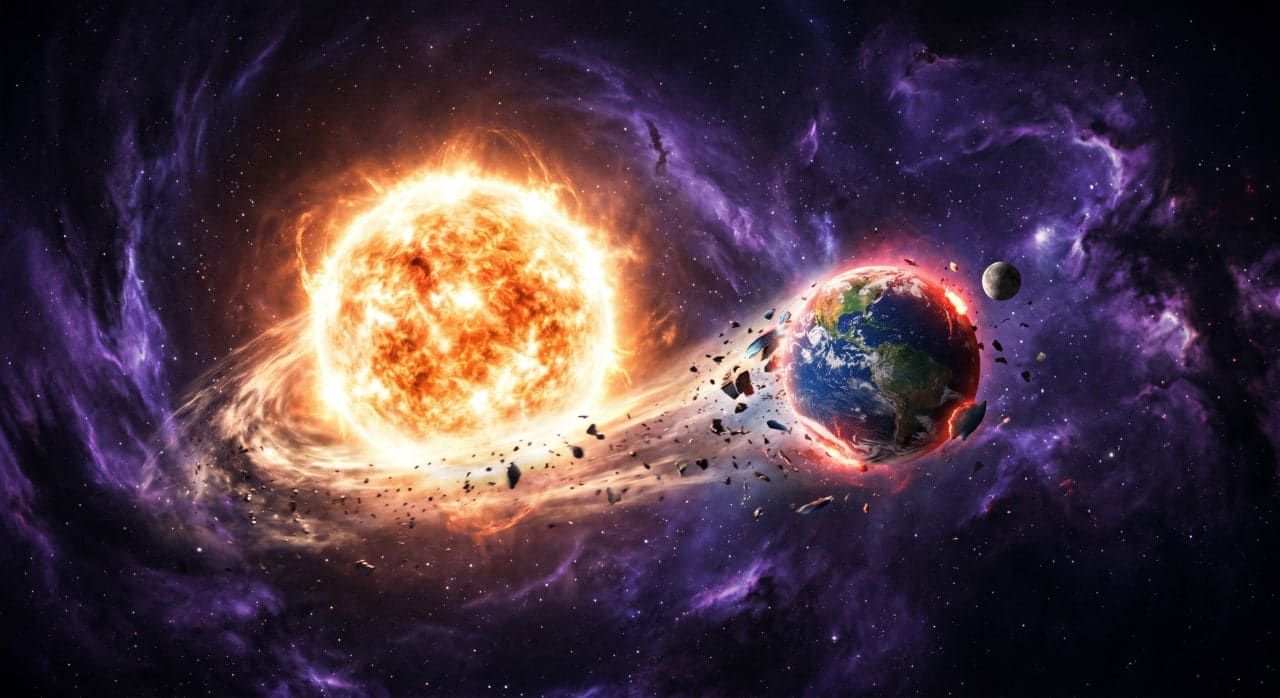
The mechanism is identical to what happens in our thought experiment: a rogue star or stellar flyby passes close enough to the solar system to perturb planetary orbits, and a gravitational slingshot interaction transfers enough energy to an inner planet to exceed solar escape velocity (42 km/s at Earth’s current orbit). Earth becomes a rogue planet — a starless planet drifting through the void.
How Fast Would Earth Freeze Without the Sun?
Earth’s surface temperature is maintained primarily by solar radiation (about 1.4 kilowatts per square metre) and secondarily by geothermal heat from the planet’s interior (about 0.087 W/m²). Without sunlight, the cooling timeline would be:
- Week 1: Average surface temperature falls from 15°C to roughly -20°C. Coastal areas cooled by ocean thermal mass, interiors freeze rapidly.
- 1 year: Upper ocean surface freezes. Atmosphere begins precipitating — CO₂ freezes out at -78°C, eventually blanketing the surface in dry ice snow. Surface temperature approaches -100°C.
- 100 years: Ocean surface frozen to ~100 m depth. Geothermal heat maintains liquid water beneath. Surface temperature stabilises around -240°C — close to the temperature of the interstellar medium.
- Long term: The frozen ocean insulates liquid water beneath from the cold. A 10-km-deep liquid ocean could persist, heated by geothermal flux, indefinitely.
Would Anything Survive on a Starless Planet?
The surface becomes uninhabitable within months, but Earth’s deep oceans offer a genuine survival scenario. Hydrothermal vents — seafloor structures where geothermal energy heats mineral-rich water — currently support ecosystems entirely independent of sunlight. Tube worms, chemosynthetic bacteria, archaea, and dozens of other organisms thrive around mid-ocean ridge vents where temperatures reach 400°C at the vent mouth, cooling to perhaps 2°C a few metres away.
These communities derive energy not from photosynthesis but from chemosynthesis — metabolising hydrogen sulphide, methane, and iron compounds. On an ejected planet, vent communities could persist for as long as the planet’s core and mantle remain hot: roughly 4–5 billion years for an Earth-mass body. The concept of a starless planet supporting life in its oceans is no longer purely theoretical — it underpins the scientific case for searching for life on ocean moons like Europa and Enceladus, which are also independent of sunlight for their subsurface oceans.
How Close Would a Rogue Star Need to Pass?
The Oort Cloud — the distant reservoir of comets at the solar system’s outer boundary — extends from roughly 2,000 to 100,000 AU. A stellar flyby at 100,000 AU would disturb comets but leave the inner solar system intact. To meaningfully perturb Earth’s orbit, a rogue star would need to pass within perhaps 100–200 AU of the Sun, which is roughly the distance to the inner Oort Cloud.
Stellar encounters this close are extraordinarily rare. The nearest star, Proxima Centauri, is about 270,000 AU away. In 1.4 million years, the star Gliese 710 is projected to pass within about 10,000 AU — close enough to shower Earth with comets from the Oort Cloud but far too distant to eject Earth from the solar system. For Earth to become a rogue planet via stellar flyby, we would need a star to pass perhaps 1,000 times closer than Gliese 710 will — a statistically negligible probability on any human timescale.
Q&A
A rogue planet is a planetary-mass object that travels through space without orbiting a star. Most were gravitationally ejected from their original star systems during the chaotic formation period of planetary systems. The Milky Way may contain tens of billions of free-floating planets.
Surface civilisation would likely collapse within a year as temperatures plummeted to -100°C and the atmosphere began freezing out. Underground or deep-ocean communities with geothermal power could persist for centuries. Microbial life around hydrothermal vents could survive for billions of years on a free-floating planet.
Yes, in principle — but it would require a stellar flyby within roughly 100 AU of the Sun, which has a near-zero probability on human timescales. The closest confirmed future stellar approach, Gliese 710, will pass at about 10,000 AU in 1.4 million years — 100 times too far to threaten the inner planets.
Yes. Microlensing surveys have confirmed many free-floating planetary-mass objects in the Milky Way. Estimates suggest there may be 50 billion or more rogue planets in our galaxy, outnumbering stars. Some were formed in isolation; most were ejected from forming star systems early in their histories.
An interstellar object is any object passing through the solar system from another star system. The first confirmed examples were ‘Oumuamua (2017) and Borisov (2019). Rogue planets are free-floating planet-mass bodies; interstellar objects is a broader category including asteroids, comets, and planetary fragments.
Internal links: space facts | What If Space Dust Contained Alien Life? | What If a Magnetar Replaced the Moon?