 By
By 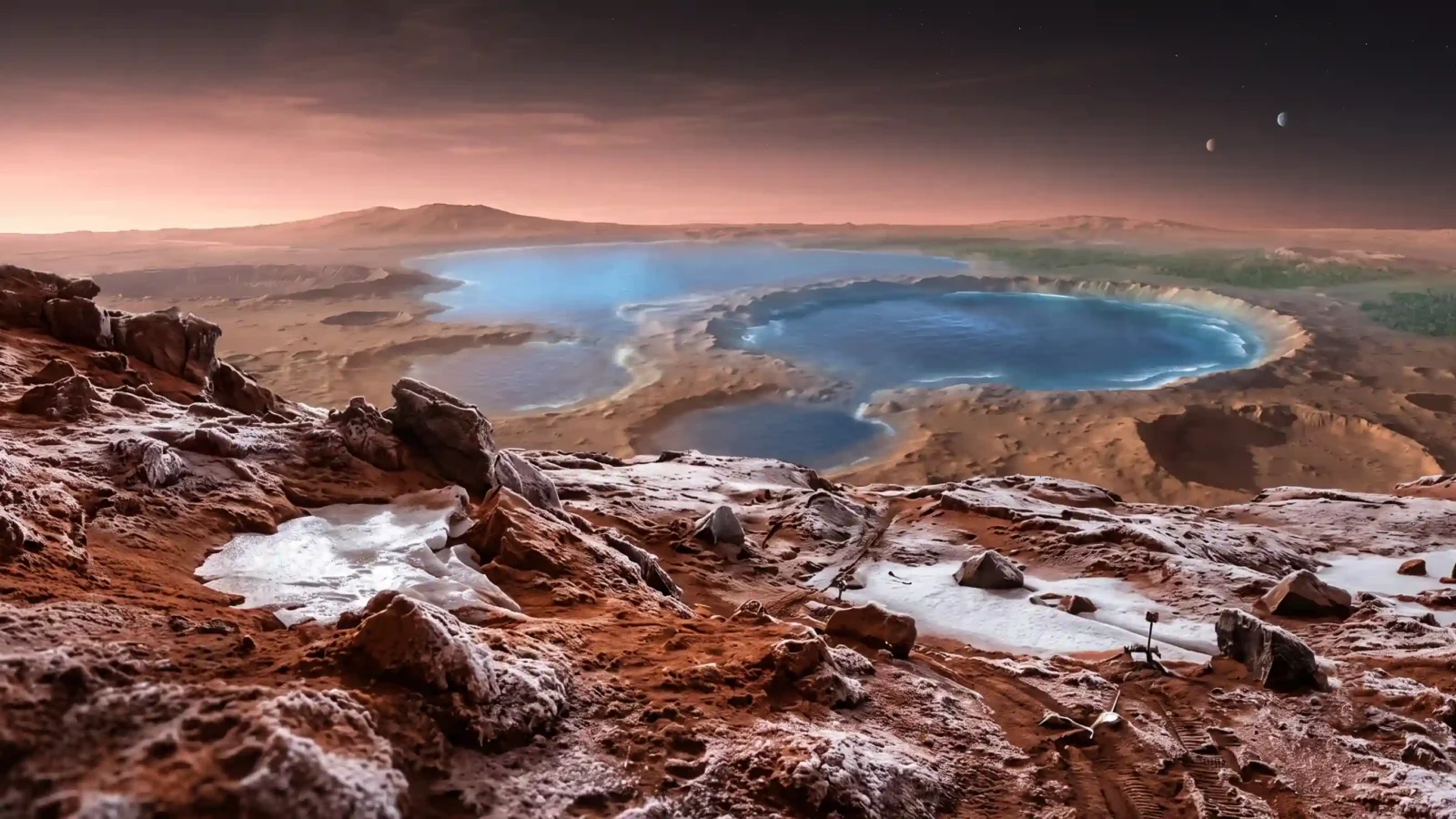
Quick Answer
Yes, there is water on Mars — but almost all of it is frozen. Mars holds vast amounts of water ice in its polar caps and buried beneath its surface, and billions of years ago it had rivers, lakes, and possibly an ocean. Today the planet is too cold and its atmosphere too thin for liquid water to last on the surface, though briny, salty water may still exist underground. Water is the single most important resource for any future Mars colony.
Few questions about the Red Planet are searched as often as “is there water on Mars?” The answer matters enormously, because water is the master key to everything — drinking, breathing, growing food, making rocket fuel, and the possibility of life itself. This guide traces Mars’ water through its past, present, and future, and explains why a planet that once had oceans is now a frozen desert.
Did Mars Once Have Oceans?
The evidence that ancient Mars was a wet world is overwhelming. Roughly 3.5 to 4 billion years ago, Mars appears to have been warmer, wetter, and wrapped in a thicker atmosphere. Liquid water flowed across its surface, carving features we can still see today and leaving chemical fingerprints in its rocks.
Evidence from riverbeds and minerals
Orbiters and rovers have mapped sprawling networks of dried-up river valleys, ancient lake basins, and enormous outflow channels far larger than anything on Earth. NASA’s Perseverance rover is exploring Jezero Crater, which contains a textbook river delta — sediment fanned out exactly as it would where a river once emptied into a standing lake.
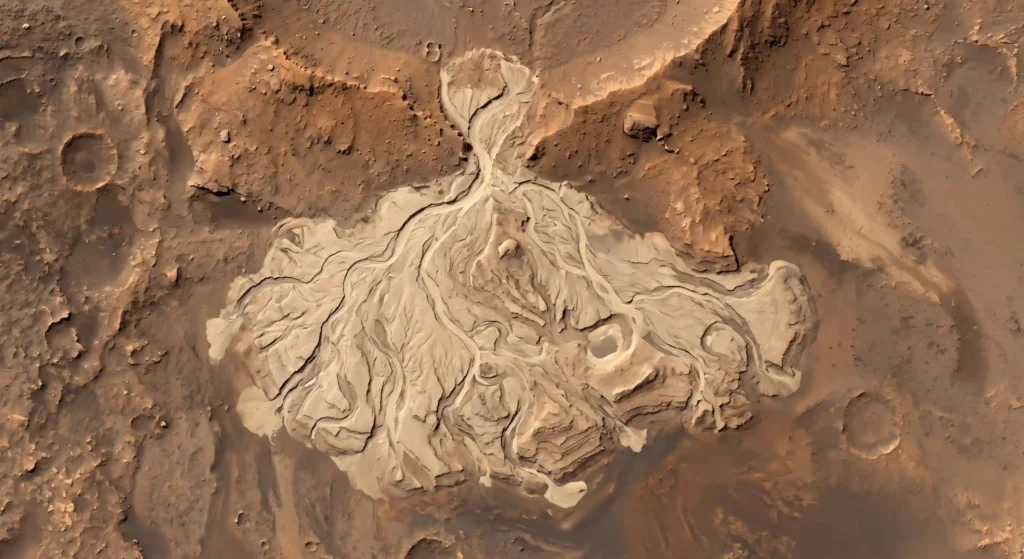
The mineral evidence is just as compelling. Spacecraft have detected clays and sulfate salts that only form in the presence of water, and the Opportunity rover famously found tiny hematite spheres — nicknamed “blueberries” — that form in watery conditions. Many scientists think a shallow ocean may once have covered much of the low-lying northern hemisphere. To understand how that warm, wet world was lost, see our companion article on why Mars lost its atmosphere.
How Much Water Did Mars Actually Have?
Planetary scientists measure a world’s water in global equivalent layer — how deep the water would be if you melted all of it and spread it evenly over the entire surface. It is a useful unit because it lets you compare a planet’s total inventory across eras without arguing about where the coastlines were.
- Ancient Mars: estimates for the early inventory range from roughly 100 metres to well over 500 metres of global equivalent layer. For comparison, Earth’s oceans amount to about 2,700 metres — so even generous estimates make ancient Mars a considerably drier world than Earth, not a twin.
- Mars today: the known ice, in the polar caps and buried deposits, comes to roughly 20 to 30 metres global equivalent. Enough to matter enormously for settlement, and a small fraction of what the planet started with.
- The missing water: some escaped to space as hydrogen after ultraviolet light split water molecules apart, and some was chemically bound into the crust as hydrated minerals — locked into rock rather than lost. Both processes were at work, and their relative share is still actively debated.
The evidence for space loss comes from a chemical fingerprint. Mars’ atmosphere is strongly enriched in deuterium — heavy hydrogen — relative to ordinary hydrogen, by roughly five to six times the terrestrial ratio. Because lighter hydrogen escapes to space more readily, that enrichment is a direct measure of how much water has been lost over billions of years. What is left is the heavy residue.
Where Is Mars’ Water Now?
Mars did not lose all of its water — much of it simply froze or retreated underground. The planet still holds enough ice that, if melted and spread evenly, it could cover the whole surface in a shallow global sea.
Polar ice caps
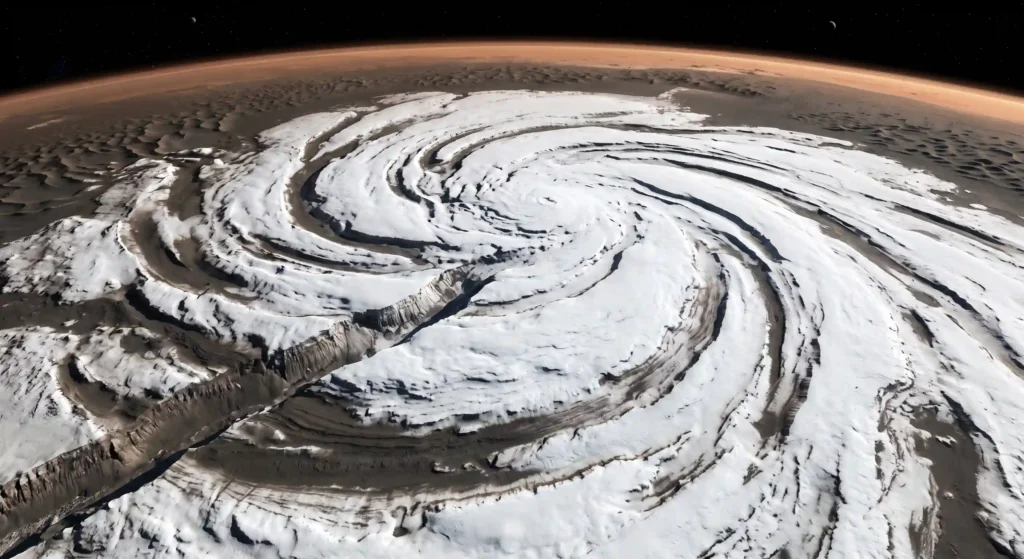
Mars has bright polar caps at both poles. They are made mostly of water ice, capped by a seasonal layer of frozen carbon dioxide (dry ice) that grows and shrinks with the Martian seasons. The permanent caps, especially in the south, lock away a huge reservoir of water ice — a substantial fraction of the planet’s known water.
Subsurface ice and possible briny lakes
Beyond the poles, orbiters using ground-penetrating radar have found buried ice across vast areas, including thick deposits at mid-latitudes. The Phoenix lander dug into shallow soil near the north pole in 2008 and exposed white ice that vanished by sublimation over a few days, confirming ice lies just centimetres beneath the surface in places.
There are also tantalising hints of liquid water. In 2018, radar data suggested a possible pond of briny liquid water beneath the south polar ice, though later studies argued the bright radar signal might instead come from certain clays or frozen materials — so it remains debated. Salty brines can stay liquid at lower temperatures than pure water, which keeps the door open for small amounts of underground liquid today.
The South Polar Lake: A Detective Story
That 2018 result deserves the full account, because it is the single most consequential claim about liquid water on Mars this century — and because the evidence has moved substantially against it.
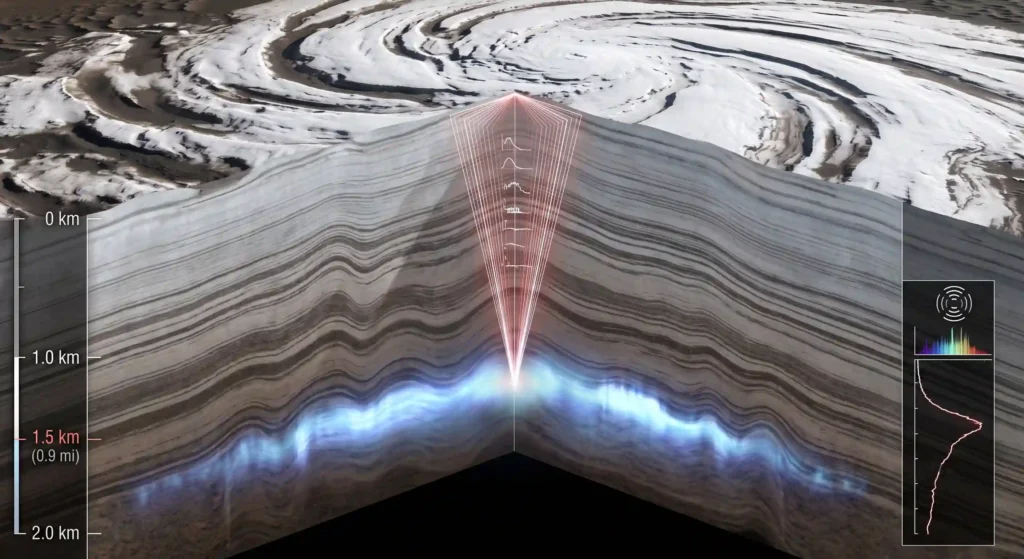
The claim. In 2018, a team using MARSIS, the low-frequency radar aboard ESA’s Mars Express, reported an unusually bright reflection from the base of the south polar layered deposits, about 1.5 kilometres down. On Earth, that signature is the classic radar fingerprint of a subglacial lake — bright because liquid water is far more electrically reflective than ice or rock. The team announced a body of briny liquid water roughly 20 kilometres across. Follow-up work in 2020 reported additional patches nearby.
The problem. Two things were awkward from the start. First, the temperature at that depth should be well below the freezing point even of a heavily salted brine, unless there is a local heat source nobody has identified. Second, the interpretation depends entirely on knowing the electrical properties of 1.5 kilometres of overlying material you cannot sample.
The alternatives. Subsequent studies proposed several dry explanations that produce the same bright reflection: layers of smectite clays, which are common on Mars and unusually radar-reflective when cold; saline ice, where salt is frozen into the ice rather than dissolved in liquid; and constructive interference from thin alternating layers of CO₂ and water ice, which can mimic a bright basal return without any liquid at all.
The 2025 test. The decisive work used SHARAD, the higher-frequency radar aboard NASA’s Mars Reconnaissance Orbiter, which had previously been unable to see that deep. Engineers put the spacecraft through large deliberate rolls to boost the antenna’s signal strength, and the improved data reached the base of the deposits. Published in Geophysical Research Letters in late 2025, the results were not consistent with liquid water at that location — pointing instead toward a very smooth basal material as the source of the bright return.
The current position, then, is that the south polar lake is probably not a lake. That is not a failure; it is exactly how the process is supposed to work — a bold claim, published openly, tested by an independent instrument, and revised. What survives is the broader point: brines can be liquid at Martian temperatures, and the deep subsurface remains the most plausible place on Mars for standing liquid water to exist.
The Streaks That Weren’t: Recurring Slope Lineae
A similar arc played out on the surface, and it is worth knowing because the images are still widely circulated as proof of flowing water.
In 2011, high-resolution orbital imaging revealed dark streaks on steep Martian slopes that appeared in warm seasons, lengthened downhill, faded in cold seasons, and returned the following year. Named recurring slope lineae, they looked exactly like seasonal seeps of briny meltwater. A 2015 announcement of hydrated salt signatures in the streaks was widely reported as confirmation of flowing water on modern Mars.
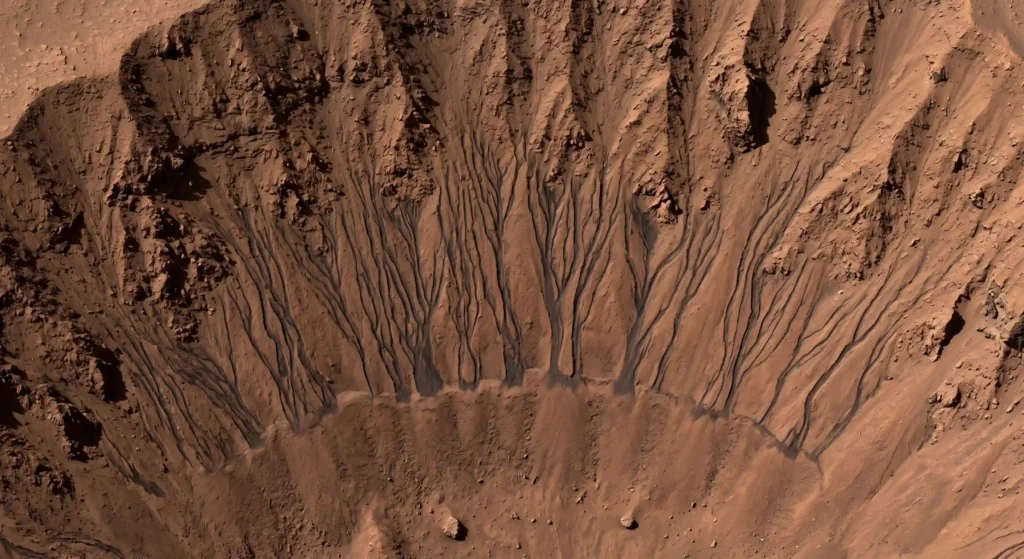
The reinterpretation came quickly. Detailed analysis showed the streaks terminate precisely at the angle of repose — the steepest slope loose granular material can hold before it slides — which is the behaviour of dry sand, not of water, since water would continue running onto gentler ground below. The hydrated-salt signal was reassessed and attributed at least partly to spectral artefacts. The scientific consensus shifted toward dry granular flows, possibly with small amounts of water or frost acting as a trigger rather than as the flowing medium.
Both stories carry the same lesson, and it is worth holding onto when reading any Mars water headline: on a planet where liquid water is thermodynamically forbidden across most of the surface, the prior probability of any given observation being liquid water is low, and the burden of proof correspondingly high.
Why Liquid Water Can’t Last on the Surface Today
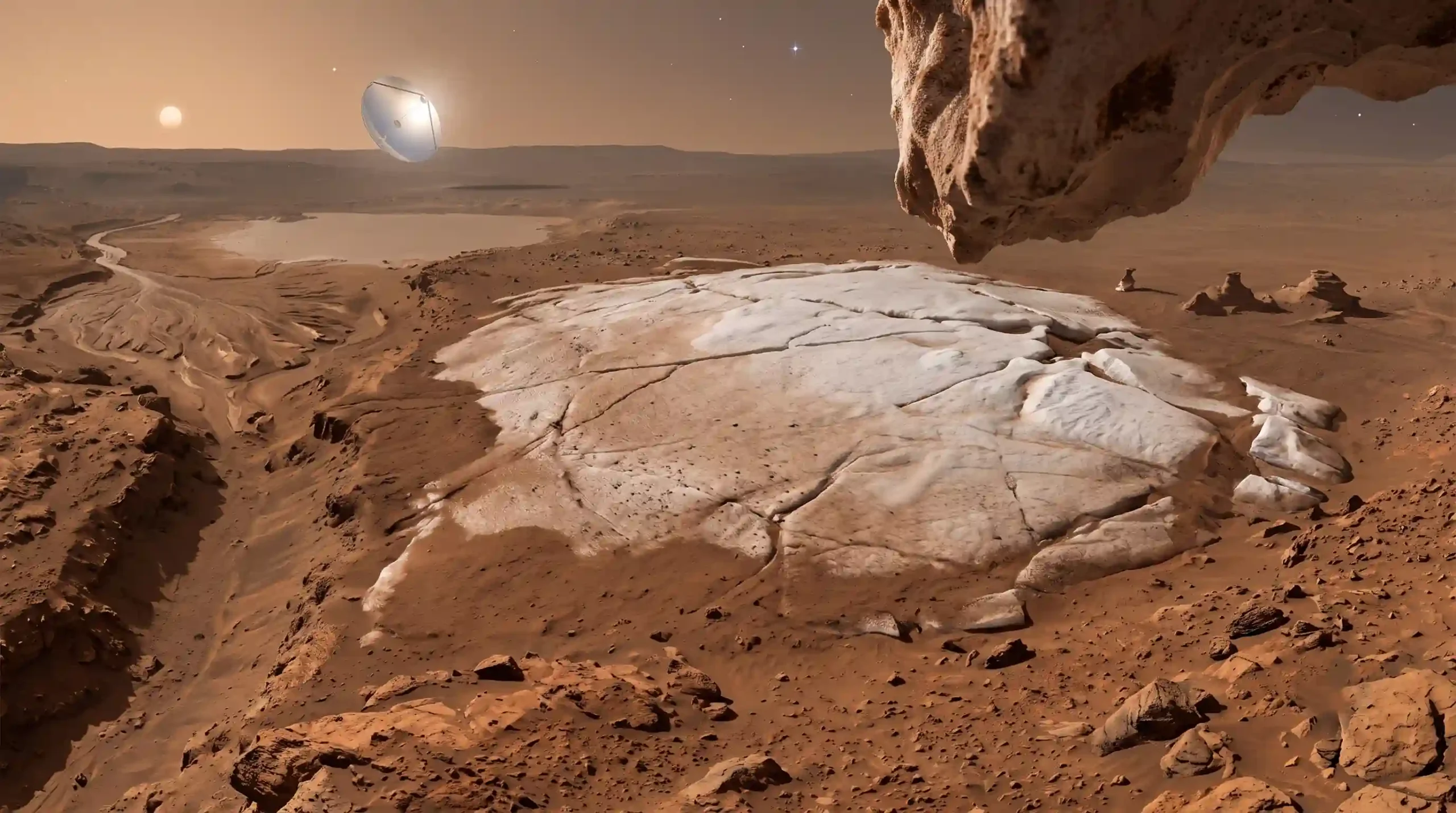
The reason Mars cannot keep surface water is a matter of pressure and temperature. The Martian atmosphere is extremely thin — only about 0.6% the pressure of Earth’s at sea level — and the average surface temperature is a frigid −60°C. Under such low pressure, water cannot remain a stable liquid: it either freezes or, when warmed, boils and sublimates straight into vapour even at low temperatures.
This is a consequence of physics called the triple point of water. On most of Mars, conditions sit below the pressure at which liquid water is stable, so water skips the liquid phase almost entirely. Any liquid that did appear — say, from melting ice on a warm day — would not last long before freezing or evaporating away.
Brines: The Loophole in the Physics
There is one genuine exception, and it explains why scientists have not written off Martian liquid water entirely.
Dissolving salt in water lowers its freezing point — the same reason salt is spread on icy roads. Mars happens to be unusually rich in exactly the right salts. Its regolith contains perchlorates at roughly half a percent to one percent by weight, and calcium perchlorate brines can remain liquid down to around −70 °C, far below anything pure water could manage. The Phoenix lander photographed droplets on its own landing struts that many researchers interpreted as perchlorate brine.
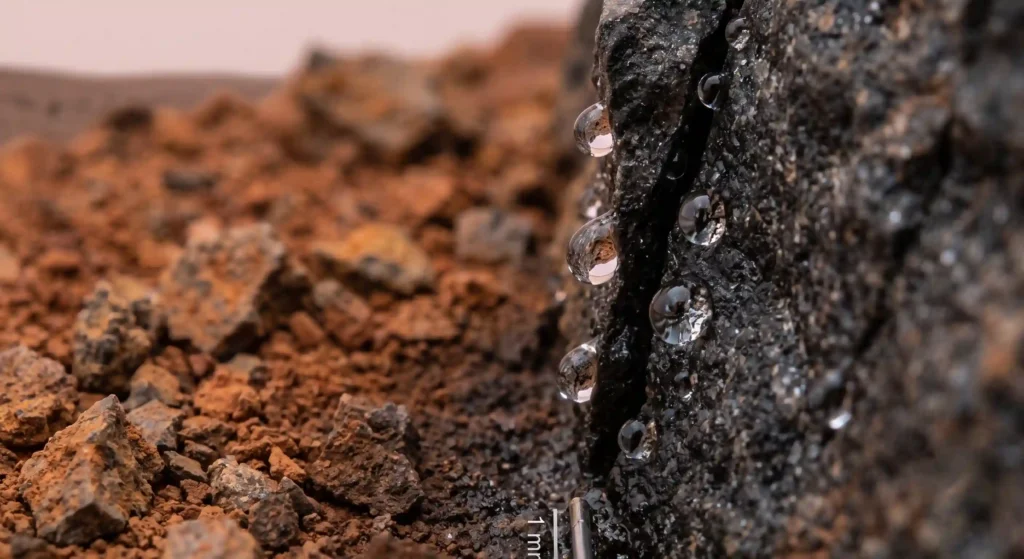
Perchlorates are also strongly deliquescent, meaning they pull water vapour directly out of the air and dissolve into it. At certain times of day and year, the humidity and temperature at the Martian surface cross into the range where this can occur — so thin films of brine may form transiently, particularly in the shallow subsurface where they are shielded from the low atmospheric pressure that would otherwise boil them away.
The catch is biological rather than physical. Life needs more than liquid; it needs water activity — the fraction of water molecules free to participate in chemistry rather than bound to dissolved ions. Highly concentrated perchlorate brines have water activity well below the threshold at which any known terrestrial organism can grow. So Martian brines may be liquid and still be uninhabitable. It is a real loophole in the thermodynamics, and probably not a loophole for life.
Could We Melt Mars’ Ice to Create Water?
If Mars has so much frozen water, could we simply melt it and bring the planet back to life? This is the central idea behind terraforming, and it is exactly the scenario we explore in what if a space mirror melted Mars’ ice caps. The concept is to use giant orbital mirrors, or to deliberately thicken the atmosphere, to warm the planet enough that ice turns to liquid and vapour.
The physics is genuinely tricky. Melting the ice is one thing; keeping the water liquid is another, because that requires raising both the temperature and the atmospheric pressure at the same time. Releasing frozen carbon dioxide could thicken the air and trap heat in a greenhouse effect, but studies suggest Mars may not have enough accessible CO2 to do this on its own. Still, the thought experiment captures why water is the linchpin of any plan to make Mars habitable.
It is worth being precise about the order of operations, because this is where most popular accounts go wrong. You cannot melt your way to a wet Mars. Below the triple-point pressure, ice does not melt at all — it sublimates straight to vapour, and the vapour disperses. Pressure has to come first, temperature second, and standing water only third. That sequencing constraint, along with the warming methods that might achieve it and the hard ceiling imposed by Mars’ limited carbon dioxide, is laid out in full in our complete guide to terraforming Mars.
What Water Means for Future Mars Colonists
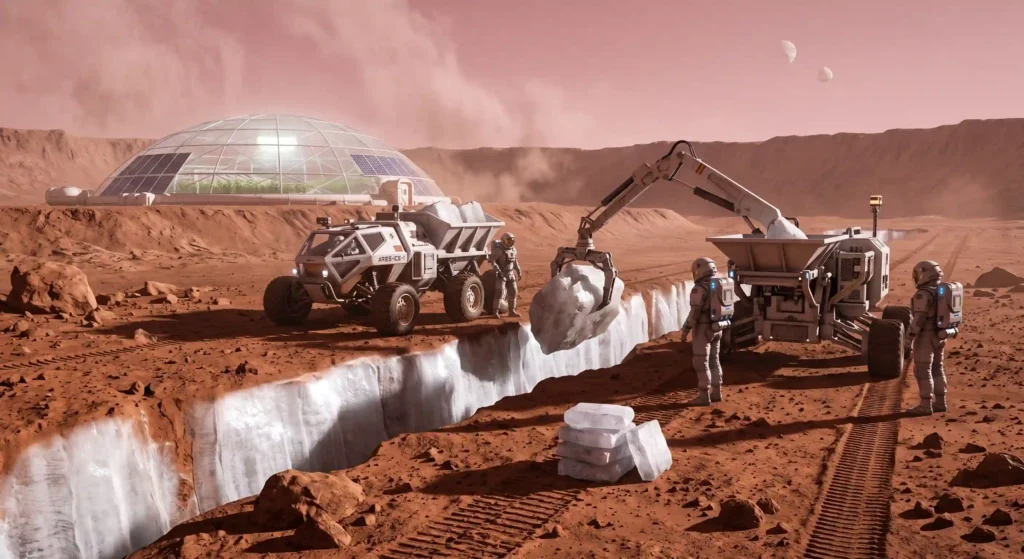
For the first humans on Mars, finding water locally would be transformative. Hauling water from Earth is prohibitively expensive, so a colony would need to “live off the land,” extracting water from buried ice and the atmosphere.
- Drinking and farming: the obvious necessity for survival and growing food.
- Breathable oxygen: water can be split into hydrogen and oxygen by electrolysis.
- Rocket fuel: that same hydrogen and oxygen make potent propellant for the trip home.
- Radiation shielding: water and ice are effective at blocking harmful space radiation.
This is why mission planners care so much about where the ice is. A base built near accessible subsurface ice could become largely self-sufficient in water, oxygen, and fuel — turning a frozen liability into the foundation of a settlement.
Where the Ice Actually Is — and Why Landing Sites Are Contested
NASA’s Subsurface Water Ice Mapping project exists specifically to answer this, combining radar, thermal imaging, neutron spectroscopy and fresh-crater observations to build consensus maps of where ice sits within a few metres of the surface. The results define a genuine engineering dilemma.
- Poles (above ~70°): enormous, unambiguous ice. Also brutal cold, months of darkness, and almost no solar power — you would need nuclear generation from day one.
- Mid-latitudes (~30–60°): the sweet spot. Radar has revealed buried glaciers and thick ice sheets under thin debris blankets, including deposits tens to hundreds of metres thick. Workable temperatures, usable sunlight, and ice potentially within a few metres of the surface.
- Equator (below ~30°): the best sunlight, the mildest temperatures, the easiest landing energetics — and very little shallow ice. Some equatorial hydrogen signals exist but are more likely bound in hydrated minerals than present as accessible ice.
The mid-latitude compromise is why most serious landing-site studies cluster there. There is a further complication: those same ice-rich regions are the ones planetary-protection rules classify as most sensitive, because subsurface ice is where Martian life would most plausibly persist. The best places to build a base are also the places we are most obliged to keep clean — an unresolved tension that will have to be settled before the first crewed landing, not after.
Missions Hunting for Martian Water
Tracking Mars’ water has been a goal of nearly every recent mission. Mars Odyssey first mapped large amounts of subsurface hydrogen (a sign of ice) from orbit. The Mars Reconnaissance Orbiter’s radar and high-resolution cameras revealed buried glaciers and seasonal flows. The Phoenix lander touched Martian ice directly, and Curiosity and Perseverance study rocks shaped by ancient water. Europe’s ExoMars Trace Gas Orbiter continues to map subsurface water-rich layers, while the MAVEN orbiter studies how Mars lost its water and air to space over billions of years.
What Comes Next
Several efforts now target the questions the current fleet cannot close.
Perseverance’s sample cache is the most scientifically valuable material in the solar system that is not yet on Earth. The rover has sealed tubes of Jezero Crater delta sediment — rock deposited in standing water, precisely the material most likely to preserve biosignatures. Returning it would allow laboratory instruments far beyond anything a rover can carry. The return architecture has been repeatedly restructured on cost grounds, so the timeline remains genuinely uncertain, but the samples are already collected and waiting.
ESA’s Rosalind Franklin rover carries a two-metre drill — deeper than any previous Mars mission by a wide margin. That depth matters because it reaches below the layer sterilised by ultraviolet light and cosmic radiation, into ground where organic molecules and, conceivably, life could survive. Delayed by the collapse of the original launch partnership, it is now targeting the end of this decade.
Dedicated ice-mapping remains the most requested capability for crewed planning. Existing radar was designed for geology, not for prospecting, and resolves ice at kilometre scales when landing-site selection needs metres. Proposals for a purpose-built ice-mapping orbiter have circulated for years without securing a firm flight.
The deep-drilling question sits behind all of it. Every serious candidate for present-day liquid water on Mars is kilometres down. No mission has ever drilled deeper than a few centimetres, and reaching a subsurface aquifer without contaminating it is an unsolved problem in both engineering and planetary protection.
Q&A
Not straight from the ground. Martian ice and soil are mixed with perchlorate salts and dust that are toxic to humans, so the water would need to be melted and purified first. Once filtered and treated, however, it could be made safe to drink.
Yes. Mars gets two kinds of snow: ordinary water-ice snow high in the atmosphere, and carbon-dioxide (“dry ice”) snow that falls near the poles in winter. Spacecraft have detected snow falling from Martian clouds, though it often sublimates before reaching the ground.
Possibly, but unconfirmed. Seismic data from the InSight lander has been interpreted as hinting at liquid water deep in the Martian crust, and brines may exist near the south pole. There is no proof of a large underground ocean, but the deep subsurface remains one of the best places to keep liquid water stable.
The wettest period was roughly 3.5 to 4 billion years ago, during what geologists call the Noachian era. After that, Mars gradually lost its thick atmosphere and cooled, and surface water froze or escaped — a transition explored in our article on why Mars lost its atmosphere.
Probably not, on current evidence. The 2018 MARSIS radar detection of a bright basal reflection was interpreted as a briny subglacial lake, but the temperature at that depth should be too cold even for brine, and several dry explanations produce the same signal. In late 2025, higher-frequency SHARAD radar data — obtained by rolling the Mars Reconnaissance Orbiter to boost signal strength — proved inconsistent with liquid water there, pointing instead to very smooth basal material.
The known ice — polar caps plus buried deposits — amounts to roughly 20 to 30 metres of global equivalent layer, meaning it would cover the whole planet to that depth if melted and spread evenly. Ancient Mars likely held several times more, from around 100 metres upward. For comparison, Earth’s oceans equate to about 2,700 metres.
Because atmospheric pressure is only about 0.6% of Earth’s, which sits below the triple point of water. At that pressure water has no stable liquid phase — ice sublimates directly to vapour, and any liquid that formed would boil away or freeze almost immediately. It is a pressure problem as much as a temperature one.
Dark streaks that appear on steep Martian slopes in warm seasons and fade in cold ones. Discovered in 2011, they were initially interpreted as seasonal flows of briny water. Later analysis showed they stop exactly at the angle of repose for loose granular material — behaviour typical of dry sand rather than liquid — and the scientific consensus has shifted toward dry granular flows, possibly triggered by small amounts of frost.
Probably not, even if they are liquid. Calcium perchlorate brines can stay liquid down to around −70 °C, but they have very low water activity — meaning most water molecules are locked to dissolved ions rather than free for biochemistry. The values fall below the threshold at which any known terrestrial organism can grow. Liquid and habitable are not the same thing.
Most landing-site studies favour the mid-latitudes, roughly 30 to 60 degrees, where radar has found buried glaciers and ice sheets within a few metres of the surface while sunlight and temperatures remain workable. The poles have far more ice but almost no solar power and months of darkness; the equator has the best conditions and very little shallow ice.
The Bigger Question
Mars proves that a planet can have oceans and then lose them. The water is still there, locked in ice — which raises the tantalising possibility of melting it to wake the planet up. That is the dream, and the engineering nightmare, at the heart of what if a space mirror melted Mars’ ice caps. Whether such terraforming is even possible depends on the very atmosphere Mars lost long ago, which we unpack in why Mars lost its atmosphere.
For more on humanity’s future beyond Earth, visit our Space & Cosmos hub.
Watch the terraforming scenario to see what would really happen if we tried to melt the Red Planet’s ice.