 By
By 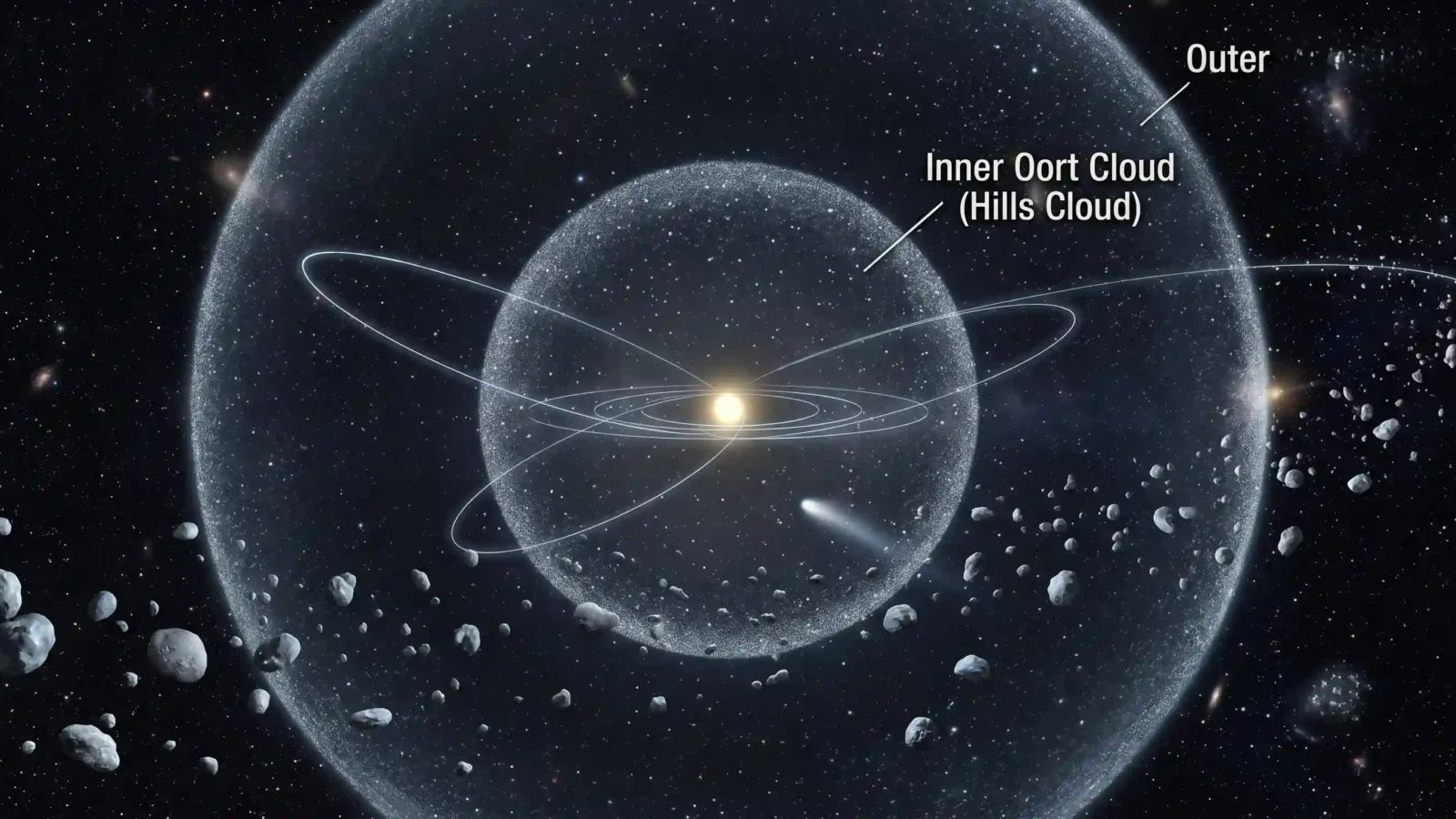
Quick Answer
The Oort cloud is a vast, spherical shell of trillions of icy objects surrounding the solar system at its outermost edge — the true boundary of the Sun’s domain. It lies so far away that its outer reaches may extend up to a few light-years from the Sun, roughly halfway to the nearest star. The Oort cloud is the source of long-period comets, and although we have never seen it directly, the comets it sends us are strong evidence that it exists.
When people picture the edge of the solar system, they usually think of Neptune or Pluto. But the Sun’s real frontier lies thousands of times farther out, in a faint, frozen shell of comet-stuff so distant that sunlight there is barely brighter than the other stars. This guide explains what the Oort cloud is, how unimaginably far away it is, where it came from, and how a single passing star could send a storm of comets falling toward us.
What Is the Oort Cloud?
The Oort cloud is a theorised cloud of icy planetesimals — leftover building blocks from the birth of the solar system — that surrounds the Sun in a roughly spherical shell. It is named after the Dutch astronomer Jan Oort, who proposed it in 1950 to explain where long-period comets come from. Estimates suggest it contains trillions of objects, ranging from tiny ice chunks to bodies tens of kilometres across, though their combined mass may only amount to a few times the mass of Earth.
Unlike the planets, which orbit in a flat disk, the Oort cloud is believed to wrap around the solar system in all directions, like a tenuous bubble. Its inner region may be more doughnut-shaped (sometimes called the Hills cloud), transitioning to a spherical outer shell. This is why comets from the Oort cloud can arrive from any angle, plunging toward the Sun from above or below the plane of the planets.
How Far Away Is It? (light-years vs light-minutes)
The scale of the Oort cloud is what makes it so mind-bending. Distances within the inner solar system are measured in light-minutes: sunlight reaches Earth in about 8 minutes. But the Oort cloud is measured in light-years.
- Earth to Sun: about 8 light-minutes (1 astronomical unit, or AU).
- Neptune’s orbit: about 30 AU.
- Inner Oort cloud: begins around 2,000 AU from the Sun.
- Outer Oort cloud: may extend to 100,000 AU or more — well over a light-year.
- Nearest star: Proxima Centauri is about 4.2 light-years away.
In other words, the outermost edge of the Oort cloud may reach a substantial fraction of the way to the next star. The Sun’s gravity is so dominant that it can hold onto objects more than a light-year away — but only just. At those distances, the grip is so weak that the nudge of a passing star can pull objects loose.
Where the Oort Cloud Came From
The Oort cloud’s icy bodies did not form where they are now — it is far too cold and sparse out there for them to have grown. Instead, they are thought to have formed much closer in, among the giant planets, during the chaotic early days of the solar system. As Jupiter, Saturn, Uranus, and Neptune settled into their orbits, their immense gravity flung countless icy objects outward.
Some were ejected from the solar system entirely; others were thrown into enormous, distant orbits. Over time, gravitational nudges from passing stars and the galaxy itself rounded these orbits into the spherical shell we now call the Oort cloud. It is, in effect, a deep-freeze archive of the solar system’s leftover construction material, preserved almost unchanged for over four billion years.
The Source of Long-Period Comets
The strongest evidence for the Oort cloud is the comets it sends us. Comets are divided into two groups by their orbital periods. Short-period comets, which return every 200 years or less, come from the Kuiper Belt beyond Neptune. Long-period comets, which can take thousands or even millions of years to complete a single orbit, arrive on enormously stretched paths that point back to the Oort cloud.
These long-period comets fall toward the Sun from all directions, exactly as you would expect from a spherical cloud. When one is nudged inward, it plunges through the inner solar system, heats up, and grows a glowing tail before either looping back out for thousands of years or breaking apart. Each one is a messenger from the frozen edge of the Sun’s realm.
How a Passing Star Could Disturb It
Because the Oort cloud sits at the very limit of the Sun’s gravitational reach, it is vulnerable to outside disturbance. Roughly every few hundred thousand to a million years, a star passes close enough to the solar system to gravitationally tug on the Oort cloud. Such an encounter can knock large numbers of icy bodies loose, sending a comet shower raining toward the inner solar system over the following millions of years.
This is more than a curiosity. A star that came close enough to stir up the Oort cloud could also, in principle, disturb the planets themselves — even fling one out of the solar system. That dramatic possibility is the focus of what if a rogue star ejected Earth from the solar system. The Oort cloud is the first place such a stellar intruder would make itself felt, long before it reached the planets.
Have We Ever Detected It Directly?
No — the Oort cloud has never been observed directly. Its objects are small, dark, and so far away that they reflect almost no sunlight. Everything we know about it is inferred from the orbits of long-period comets, which trace back to a distant, spherical reservoir. The Voyager probes, the fastest objects humans have ever launched into deep space, will not even reach the inner edge of the Oort cloud for roughly 300 years, and would take tens of thousands of years to pass all the way through it.
For now, the Oort cloud remains a well-supported theory rather than a directly observed structure — a frozen frontier we understand only through the comets it occasionally sends our way.
Q&A
The Kuiper Belt is a relatively flat, doughnut-shaped region just beyond Neptune (about 30–50 AU) that holds objects like Pluto and supplies short-period comets. The Oort cloud is far more distant, spherical, and the source of long-period comets — thousands of times farther out than the Kuiper Belt.
No. The Voyager spacecraft have left the heliosphere and entered interstellar space, but they are still nowhere near the Oort cloud. At their current speed, they would need roughly 300 years just to reach its inner edge and tens of thousands of years to cross it.
The hypothesised Planet Nine, if it exists, would orbit in the scattered disk or inner Oort cloud region — far beyond Neptune but well inside the outer Oort cloud. It has been proposed to explain the clustered orbits of some distant objects, but it has not been found.
Long-period comets do. These are comets on very long, stretched orbits that can take thousands to millions of years to circle the Sun, and they arrive from all directions — the signature of the spherical Oort cloud. Short-period comets, by contrast, come from the Kuiper Belt.
The Bigger Question
The Oort cloud marks the fragile outer boundary of the Sun’s gravitational kingdom — fragile because anything that passes close to the solar system would disturb it first. A star drifting near enough to scatter the Oort cloud could do far more than send us comets; it could destabilise the planets themselves. That is the unsettling premise of what if a rogue star ejected Earth from the solar system, where a stellar visitor turns our planet into a frozen wanderer — a fate that echoes our companion piece on what would happen if the Sun disappeared.
Discover more about the solar system’s hidden structure on our Space & Cosmos hub.
Watch the rogue star scenario to see what happens when an intruder reaches the edge of our solar system — and beyond.