 By
By 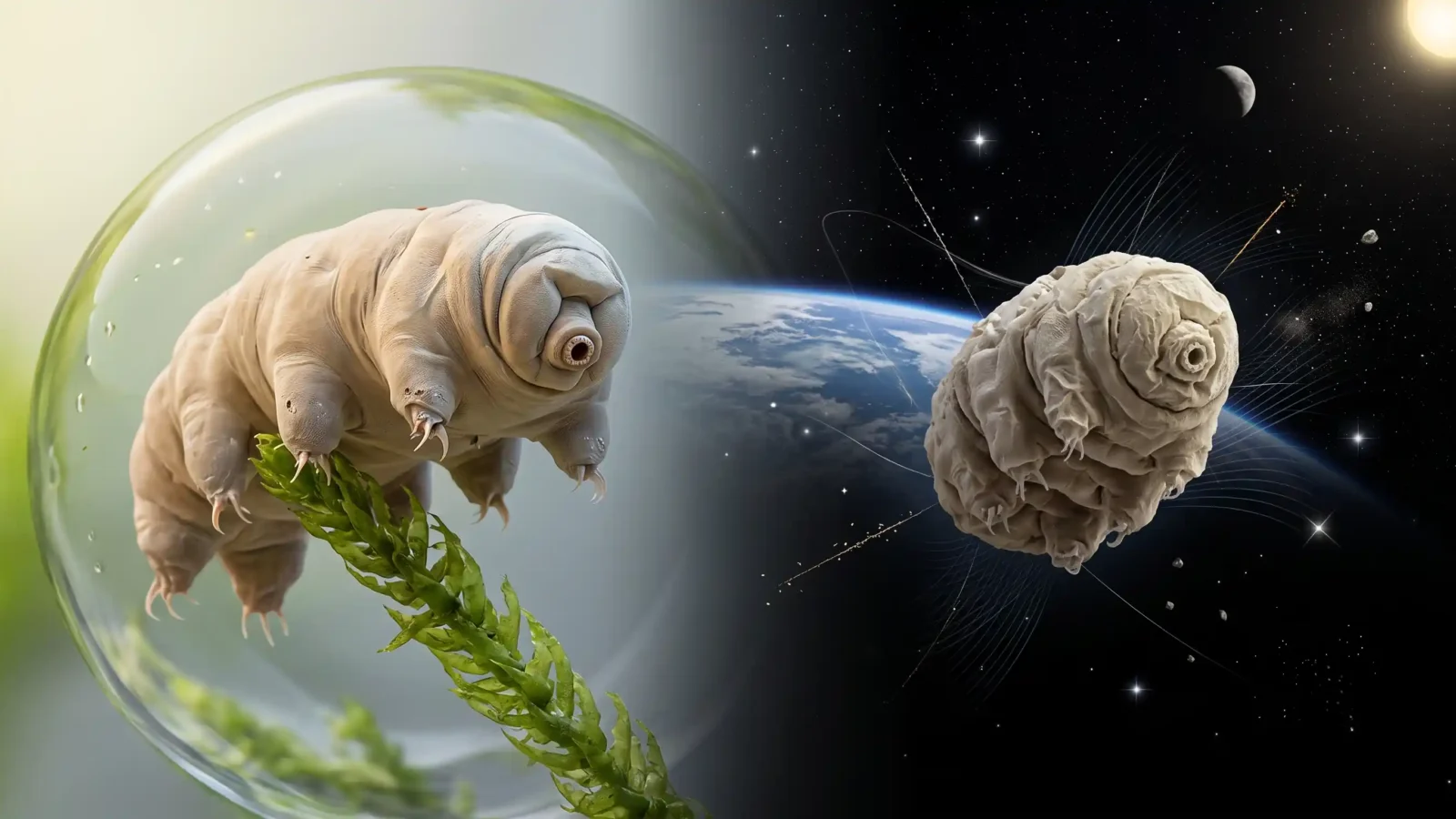
Quick Answer
Tardigrades — also called water bears — are microscopic eight-legged animals that can survive conditions that would kill almost any other living thing, including the vacuum of outer space. By drying out and entering a death-like dormant state called cryptobiosis, tardigrades can endure temperatures near absolute zero, intense radiation, crushing pressure, and years without water — then spring back to life when conditions improve. In 2007, they became the first animals shown to survive direct exposure to open space.
At under a millimetre long, the tardigrade looks like a chubby, clawed gummy bear under a microscope — and it may be the toughest animal that has ever existed. This guide explains what tardigrades are, the astonishing biology that lets them cheat death, the time they survived in orbit, and why scientists studying the origins of life elsewhere keep coming back to these tiny survivors.
What Is a Tardigrade?
Tardigrades are a phylum of tiny aquatic animals, typically around 0.5 millimetres long, with plump segmented bodies and eight stubby legs tipped with claws. Their nickname “water bear” comes from their lumbering, bear-like walk, and “moss piglet” from their favourite habitat. They were first described in 1773 and have since been found almost everywhere on Earth: in moss and lichen, in soil and leaf litter, on mountaintops, in deep-sea sediments, and in polar ice.
Despite their fearsome reputation, tardigrades are not invincible in their normal, active state — they need a film of water to live, eat, and reproduce, feeding on plant cells, algae, and tiny invertebrates. Their superpower is not toughness while alive, but their ability to essentially shut themselves off when conditions turn deadly.
The Superpower of Cryptobiosis
The secret to a tardigrade’s survival is cryptobiosis — a state of suspended animation in which it expels almost all the water from its body, curls into a tiny dehydrated ball called a “tun,” and slows its metabolism to less than 0.01% of normal, effectively pausing life itself. In this state it is not really alive in the usual sense, but it is not dead either; it is waiting.
Surviving vacuum, radiation, and absolute cold
In the tun state, tardigrades have survived a catalogue of extremes that read like science fiction:
- Temperature: from close to absolute zero (−272°C) up to about 150°C, at least briefly.
- Pressure: the vacuum of space, and pressures far greater than the deepest ocean trench.
- Radiation: doses of radiation hundreds of times higher than would kill a human.
- Dehydration: losing nearly all their body water and remaining dormant for years.
They pull this off using special protective molecules. Tardigrades produce sugars such as trehalose and unique “tardigrade-specific” proteins that replace water and form a glass-like matrix, cushioning their cells and DNA. One protein, nicknamed Dsup (“damage suppressor”), physically shields their DNA from radiation. When water returns, the tun rehydrates and the animal resumes life as if no time had passed.
The Time Tardigrades Went to Space (and Survived)
In September 2007, the European Space Agency’s TARDIS experiment carried dehydrated tardigrades aboard the FOTON-M3 mission and exposed them directly to the open vacuum of space in low Earth orbit. Some were also subjected to the Sun’s full unfiltered ultraviolet radiation. When the samples were brought back and rehydrated, many of the tardigrades revived — and some even went on to lay viable eggs.
This made tardigrades the first animals known to survive direct exposure to outer space. The vacuum alone did not kill them; the harshest factor was solar ultraviolet radiation, yet even some of those exposed survived. The result electrified astrobiologists, because it proved that complex animal life can endure the journey through space — at least for a while.
Could Tardigrades Spread Life Between Worlds?
The discovery that tardigrades can survive space raises a profound question: could living things travel between planets? This is the idea of panspermia — the hypothesis that life, or its building blocks, can be carried across space on dust, meteorites, or comets, potentially seeding life on other worlds. We explore this directly in what if space dust in human hair contained alien life.
Tardigrades are not proof of panspermia — surviving orbit for days is very different from surviving millions of years drifting between stars, and they still need liquid water to grow and reproduce. But they demonstrate that the resilience required for such a journey is not impossible for animal life. If a humble moss piglet can shrug off the vacuum of space, the universe may be more hospitable to hardy life than we once assumed. The deeper question of how life arose in the first place is covered in our companion article, how did life begin on Earth.
The Tardigrades Possibly Spilled on the Moon
In 2019, the Israeli Beresheet spacecraft attempted to land on the Moon but crashed. On board was a payload that included thousands of dehydrated tardigrades in tun state. This led to headlines suggesting the Moon had been “seeded” with tardigrades.
The reality is more sobering for the water bears. While the dormant tardigrades may well have survived the crash, they cannot do anything on the Moon. There is no liquid water to revive them, no atmosphere, and they cannot grow, eat, or reproduce. At best they are inert, dehydrated specimens scattered across the lunar surface — a quirky footnote rather than the start of a lunar ecosystem.
What Tardigrades Teach Us About Life’s Limits
Tardigrades belong to a broader group scientists call extremophiles — organisms that thrive in or survive conditions once thought impossible for life. Studying them stretches our understanding of where life can exist, which directly informs the search for life beyond Earth. If life here can endure radiation, vacuum, and near-absolute-zero cold, then the icy moons of Jupiter and Saturn, or the frozen subsurface of Mars, suddenly look less hostile.
Tardigrades also have practical value. Their protective proteins are being studied to stabilise vaccines and medicines without refrigeration, and to protect human cells from radiation damage. The tiny animal that survives space may end up helping medicine on Earth.
Q&A
Not forever, but for a remarkably long time. In their dormant tun state, tardigrades can survive for years and possibly decades. There are reports of specimens revived after being frozen for around 30 years, though such extreme cases are debated. Their normal active lifespan is only months.
No. Their toughness applies only to the dormant tun state. While active and hydrated, tardigrades are fragile and can be killed easily. Even in tun form, sustained extreme heat or prolonged radiation will eventually kill them — they are extraordinarily resilient, not invulnerable.
A dormant tardigrade could likely survive the cold, low pressure, and radiation of Mars for a time, but it could not live there in any meaningful sense. Without liquid water it cannot revive, grow, or reproduce, so Mars would simply preserve it in suspended animation, not host it.
Researchers in Japan reported reviving tardigrades from moss that had been frozen for about 30 years, with one even reproducing afterward. Claims of revival after a century from museum samples exist but are not well substantiated, so the verified record is on the order of decades.
The Bigger Question
Tardigrades prove that animal life can survive the brutal conditions of space — at least briefly. That single fact transforms a fringe idea into a serious scientific question: if tough microbes or their dormant forms can ride dust and rock between worlds, could life on Earth have arrived from somewhere else? Or could life from Earth already be spreading outward? That is the captivating premise behind what if space dust in human hair contained alien life.
To explore how life might have started here in the first place, read how did life begin on Earth, or browse more on the search for life across the cosmos at our Space & Cosmos hub.
Watch the panspermia scenario to see how the toughest life forms could turn the galaxy into a seedbed.