 By
By 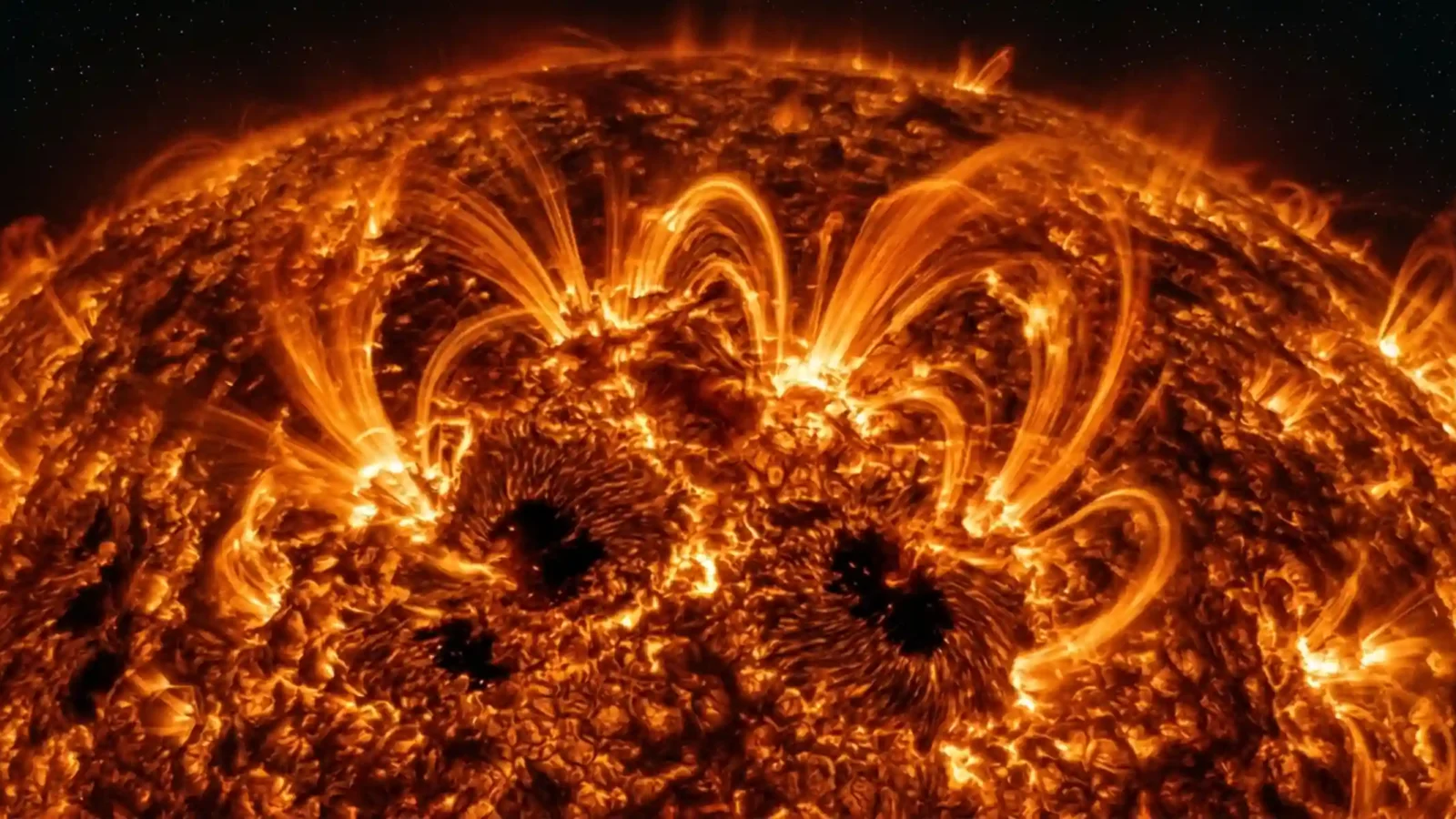
Quick Answer
A solar flare is a sudden, intense burst of radiation from the Sun, while a coronal mass ejection (CME) is a massive cloud of charged particles and magnetic field hurled into space. Flares reach Earth at the speed of light in about 8 minutes and cause radio blackouts; CMEs take hours to days to arrive and trigger the geomagnetic storms that threaten power grids and satellites. Both are driven by the Sun’s tangled magnetic field and peak during solar maximum.
The Sun is not a calm, steady lamp. It is a roiling ball of magnetised plasma that regularly blasts energy and matter into space — invisible “space weather” that paints the skies with auroras and, at its worst, can knock out the technology we depend on. This guide explains what solar flares and CMEs are, how they differ, how they affect Earth, and why they cluster around the peak of the Sun’s natural cycle.
What Is a Solar Flare?
A solar flare is a sudden flash of increased brightness on the Sun, releasing a huge amount of energy across the electromagnetic spectrum — especially in X-rays and ultraviolet light. Flares occur when the Sun’s intense magnetic fields, twisted and stressed around sunspots, suddenly snap and reconnect into a simpler configuration, releasing stored magnetic energy in an instant. The largest flares can release the energy equivalent of billions of nuclear bombs.
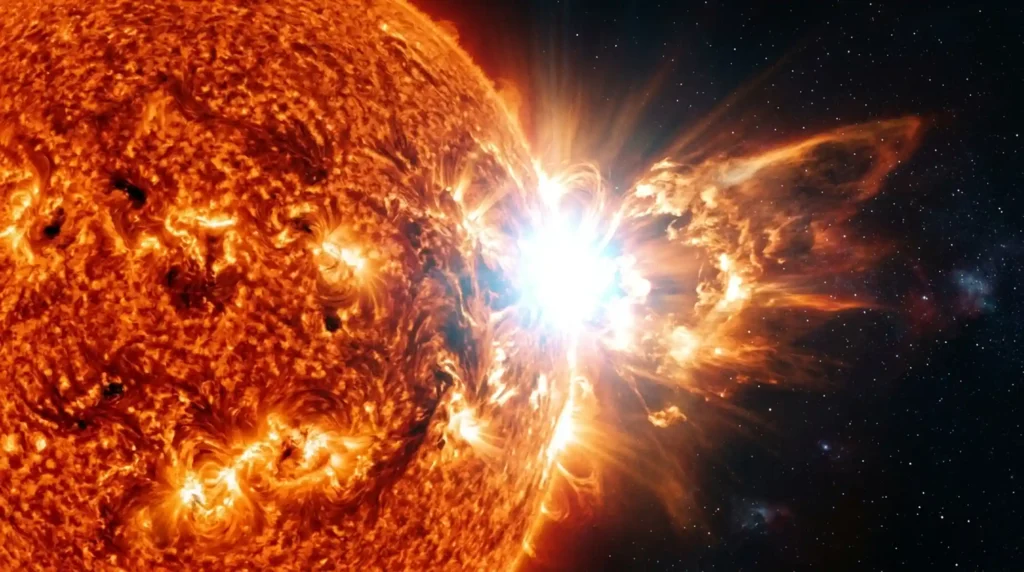
Because a flare is a burst of light and radiation, it travels at the speed of light and reaches Earth in about 8 minutes. Its main effect on Earth is a sudden surge of X-rays that ionises the upper atmosphere on the daylit side of the planet, disrupting high-frequency radio communications — a radio blackout.
Coronal Mass Ejections — The Bigger Threat
A coronal mass ejection is a far more massive event: the Sun launches a billion-tonne cloud of magnetised plasma — protons, electrons, and embedded magnetic field — outward into space. While a flare is a flash, a CME is a physical eruption of matter. CMEs travel much more slowly than light, typically taking one to three days to reach Earth, though the fastest can arrive in under a day.
When a CME’s cloud strikes Earth’s magnetic field, it can set off a geomagnetic storm — the kind of event responsible for the 1859 Carrington Event, the most powerful solar storm in recorded history. CMEs are the primary danger to power grids and satellites because they physically compress and shake Earth’s magnetic field.
Flare vs CME (the key difference)
- Solar flare: a burst of radiation (light and X-rays); reaches Earth in ~8 minutes; causes radio blackouts.
- CME: a cloud of charged particles and magnetic field; reaches Earth in 1–3 days; causes geomagnetic storms.
- Together or apart: a single eruption can produce a flare, a CME, or both — they are related but distinct.
- Bigger threat: CMEs do the most damage to grids and satellites; flares mainly disrupt radio and add radiation.
A useful way to remember it: the flare is the muzzle flash, and the CME is the cannonball.
How They Affect Earth
Most of the time, Earth’s magnetic field and atmosphere absorb the Sun’s outbursts and the only visible result is a beautiful light show. But strong events have real consequences.
Auroras, geomagnetic storms, radio blackouts
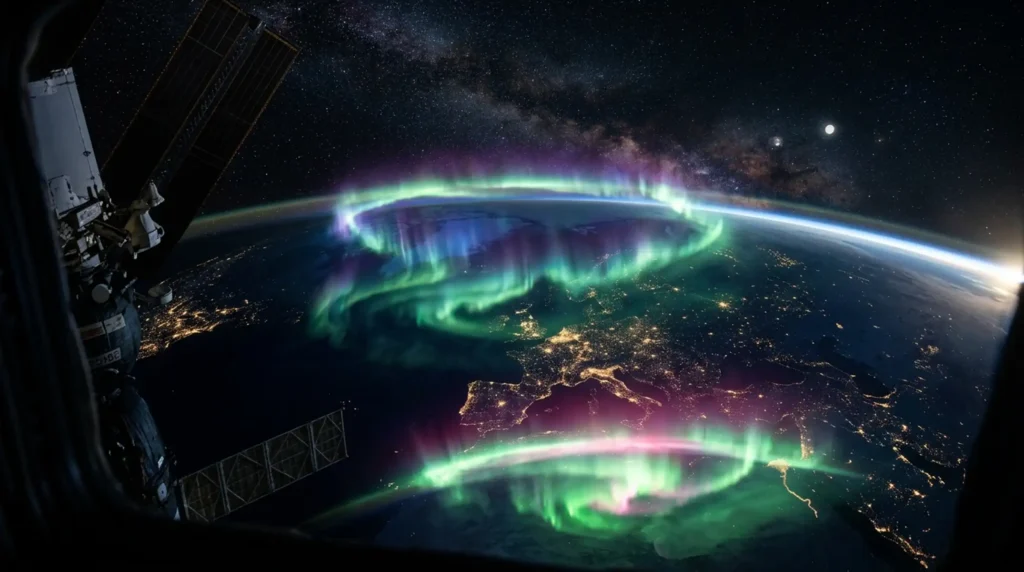
When charged particles from a CME funnel down Earth’s magnetic field lines toward the poles, they collide with gases in the upper atmosphere and make them glow — producing the auroras (the northern and southern lights). During strong storms, auroras can be seen far from the poles. At the same time, the disturbance to Earth’s magnetic field — a geomagnetic storm — can induce currents in power lines, interfere with GPS accuracy, increase drag on satellites, and cause radio blackouts.
The strength of a geomagnetic storm is rated on a scale from G1 (minor) to G5 (extreme).
Flare Classes (A, B, C, M, X) Explained
Solar flares are classified by their X-ray brightness using letters: A, B, C, M, and X, from weakest to strongest. The scale is logarithmic, meaning each letter represents ten times more energy than the one before. Within each class, a number from 1 to 9 indicates the relative strength.
- A and B: the weakest flares, with little or no effect on Earth.
- C-class: small flares, generally harmless to our technology.
- M-class: medium flares that can cause brief radio blackouts and minor radiation storms near the poles.
- X-class: the most powerful flares, capable of major radio blackouts and, when paired with a CME, severe geomagnetic storms.
An X10 flare is ten times stronger than an X1, and the very largest flares on record have exceeded X20. These are the events space-weather forecasters watch most closely.
Why They Peak During Solar Maximum
Flares and CMEs are governed by the Sun’s roughly 11-year cycle of magnetic activity. At solar maximum, the Sun’s magnetic field is at its most twisted and complex, sunspots are abundant, and eruptions become frequent and powerful. At solar minimum, the Sun is comparatively quiet. Solar Cycle 25 reached its maximum in late 2024, so the Sun has been especially active in this period.
The cycle itself is driven by the Sun’s magnetic field gradually winding up and then flipping its polarity every cycle. That dramatic magnetic reversal is the subject of what if the Sun’s magnetic field flipped tomorrow — the deeper mechanism behind every flare and CME the Sun produces.
Protecting Satellites and Astronauts
Space weather is a genuine hazard for spacecraft and astronauts. The radiation from a strong flare and the particles from a CME can damage satellite electronics, degrade solar panels, and increase atmospheric drag that pulls satellites into lower orbits. Operators respond by switching satellites into protective “safe modes” during major events.
For astronauts, the danger is greater. Those on the International Space Station are largely protected by Earth’s magnetic field, but a major radiation storm may prompt them to shelter in the most shielded part of the station. For future missions to the Moon or Mars, beyond the protection of Earth’s magnetic field, solar radiation storms are one of the most serious risks — which is why reliable space-weather forecasting is considered essential for deep-space exploration.
Q&A
The radiation from a flare does reach Earth directly, arriving in about 8 minutes and disrupting radio signals on the daylit side. But the flare itself is light, not matter — it cannot physically strike the surface, and Earth’s atmosphere absorbs the harmful X-rays before they reach the ground.
Not on the ground — Earth’s atmosphere and magnetic field shield us completely. The risk is to astronauts in space and, during extreme events, to passengers and crew on high-altitude polar flights, who may receive a slightly elevated radiation dose. People on the surface are safe.
Yes. A strong CME can trigger a geomagnetic storm that induces damaging currents in power grids. The most famous case was in March 1989, when a solar storm knocked out the power grid in Quebec, Canada, leaving millions without electricity for about nine hours.
Only partially. Forecasters can identify active sunspot regions likely to flare and estimate the probability over the coming days, but they cannot predict the exact timing. Once a CME erupts, spacecraft can refine its likely impact and severity in the hours before it reaches Earth.
The Bigger Question
Solar flares and CMEs are the Sun’s everyday violence — flashes of radiation and clouds of plasma flung at our planet. Both are symptoms of the same underlying force: the Sun’s powerful, ever-shifting magnetic field, which winds itself up and flips polarity on an 11-year rhythm. What would happen if that field did something sudden and dramatic? Explore the engine behind all of this space weather in what if the Sun’s magnetic field flipped tomorrow.
For the historical worst case, revisit the Carrington Event, and find more about our home star on the Space & Cosmos hub.
Watch the solar magnetic field scenario to see what the Sun’s restless magnetism could unleash.