 By
By 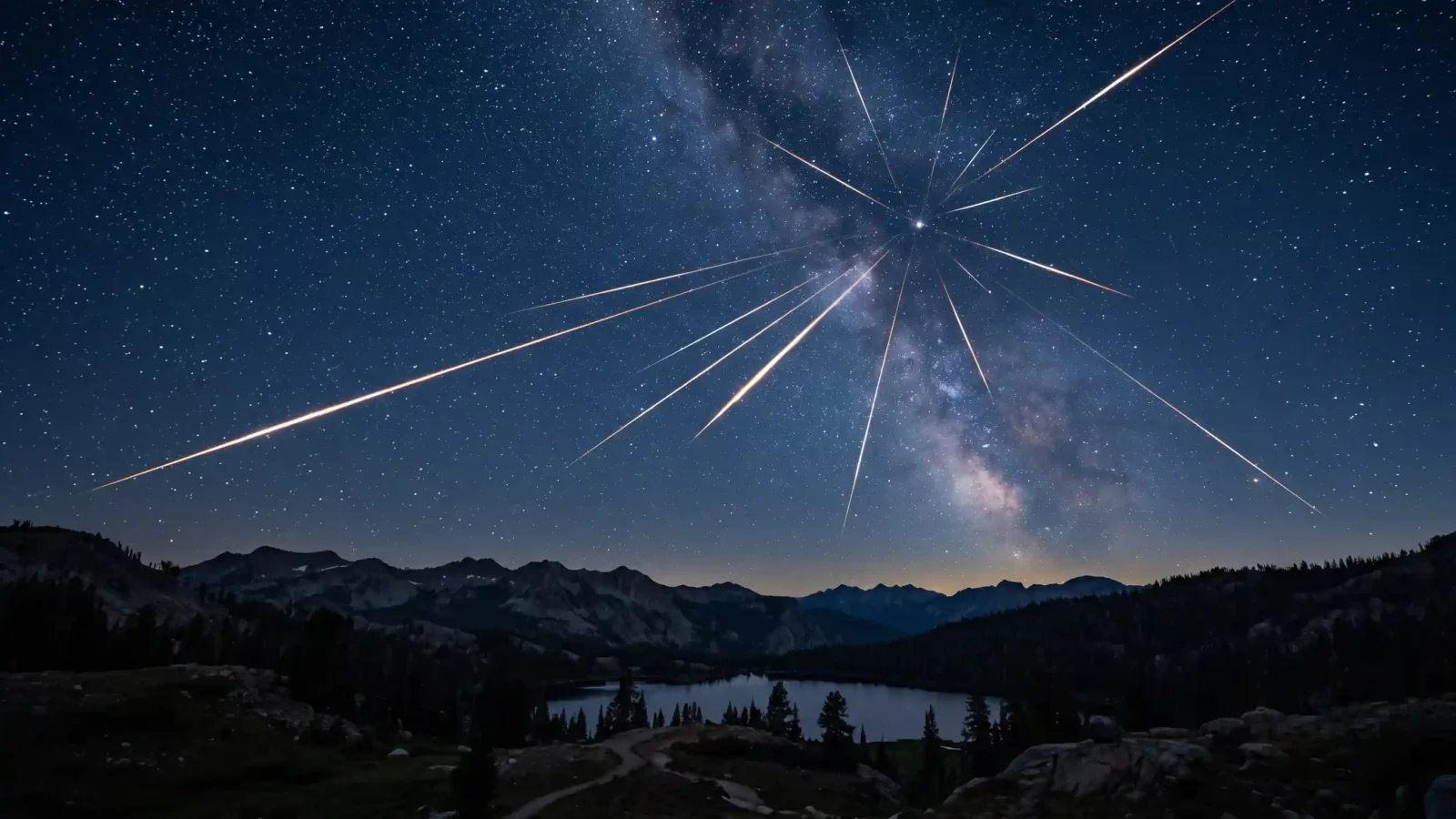
Here’s a coincidence worth staying up for. The August 12, 2026 total solar eclipse happens because the Moon passes exactly between Earth and Sun — which means it’s a new moon. And a new moon means no moonlight in the sky that night. That same night, the Perseid meteor shower hits its peak. So 2026 hands sky-watchers the rarest gift in meteor-watching: a major shower maximum under the darkest possible sky.
In a normal year, the Perseids are half-ruined by whatever the Moon is doing. A bright gibbous moon can wipe out three-quarters of the meteors you’d otherwise catch. In 2026, that problem simply doesn’t exist — the Moon is a black disc in front of the Sun, and by nightfall it’s below the horizon entirely.
What you’re actually watching burn
Every Perseid is a fragment shed by Comet Swift–Tuttle, a 26-km chunk of ice and dust that loops through the inner solar system every 133 years. Earth plows through its debris trail each August. The pieces that make the streaks are tiny — most are the size of a grain of sand — yet they blaze bright enough to see from a city’s edge. The reason is speed.
Perseids strike the atmosphere at about 59 km/s (59,000 m/s), among the fastest of any shower. Take a single grain with a mass of just 0.02 grams (2 × 10⁻⁵ kg) and compute its kinetic energy, KE = ½mv²:
KE = ½ × (2 × 10⁻⁵ kg) × (59,000 m/s)² ≈ 35,000 joules.
A high-powered rifle bullet carries roughly 3,000–4,000 joules. So a single grain of comet dust arrives with the energy of about ten rifle bullets — not because it’s heavy, but because energy scales with the square of speed. That energy dumps into the air in a fraction of a second, ionizing a column of atmosphere ~100 km up. The glowing trail is the air, not the grain.
Why they all seem to come from one spot
The meteors appear to radiate from a single point in the constellation Perseus — the “radiant.” That’s pure perspective. The debris particles travel on nearly parallel paths, and parallel lines coming toward you appear to fan out from a vanishing point, the same way railway tracks converge in the distance. The radiant isn’t a place in space; it’s the direction Earth is heading into the stream.
What the night actually offers
Under a truly dark, moonless sky, the Perseids can deliver 50 to 75 visible meteors per hour at peak from a rural site — and 2026’s new moon makes that ceiling reachable rather than theoretical. The best window is the pre-dawn hours of August 13, when your side of Earth turns to face directly into the debris stream and meteor rates climb.
Comet Swift–Tuttle itself belongs to a much larger family of icy bodies that seed the outer solar system with debris — the same deep reservoir that occasionally sends comets sunward. If you want the big picture of where all this material comes from, start with what the Oort Cloud actually is.
What we know, and what the weather owns
The orbital timing is exact: new moon, Perseid maximum, same 24 hours. What no one can promise is a clear sky — and unlike the eclipse, the meteors don’t care about the horizon, so a patch of open sky in any direction will do. If clouds win on the 12th, the shower stays strong for a night or two on either side, still under minimal moonlight.
Most years you fight the Moon to see the Perseids. In 2026, the Moon steps aside and blackens the Sun on its way out. Point a chair away from any light, look up, and let the sand grains do the rest.