 By
By 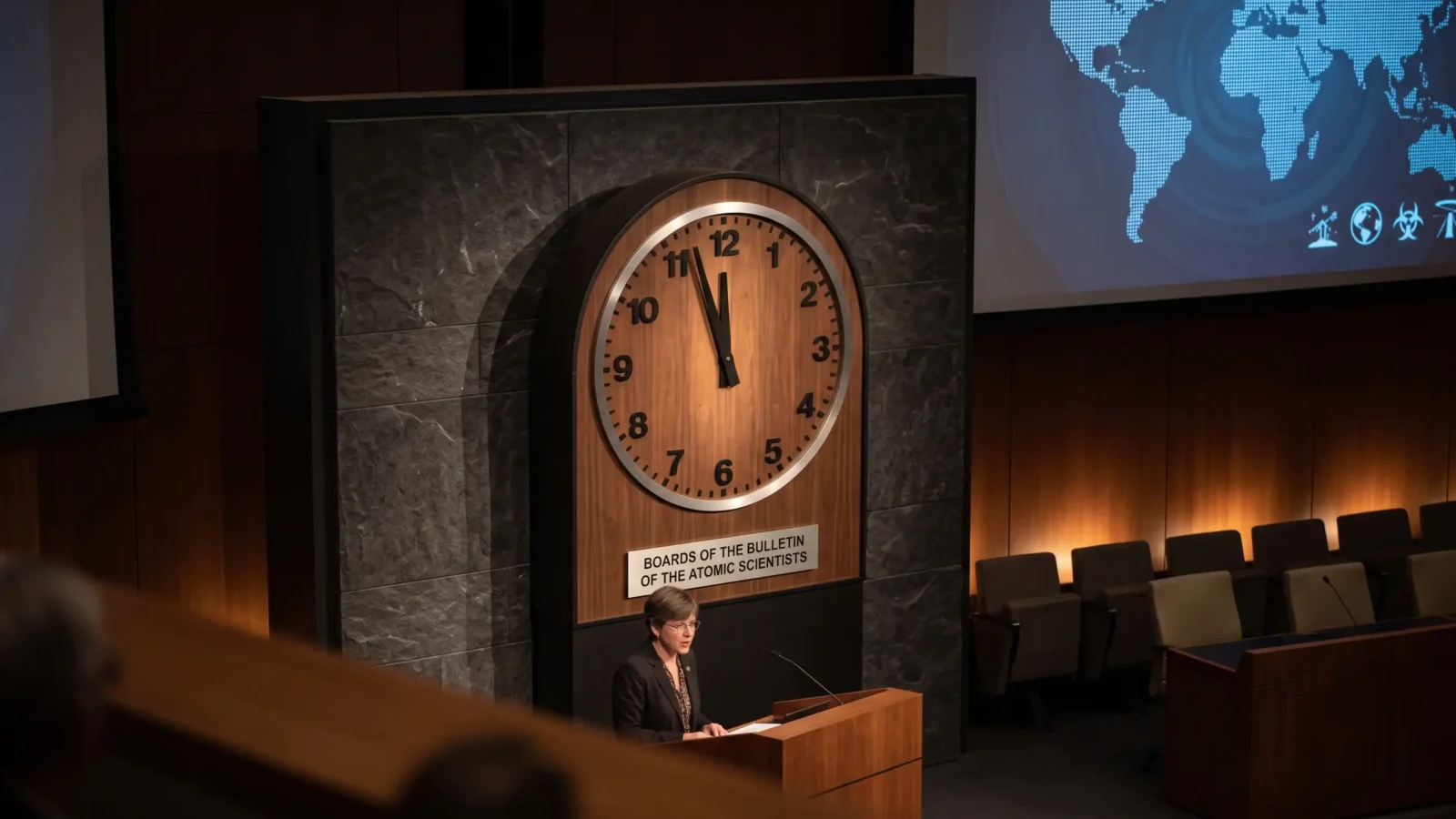
Quick Answer
The Doomsday Clock is a symbolic clock that represents how close humanity is to global catastrophe, with midnight standing for the end of the world. Created in 1947 by the Bulletin of the Atomic Scientists, it is reset each year to reflect threats such as nuclear war, climate change, artificial intelligence, and biological dangers. In January 2026 it was set to 85 seconds to midnight — the closest to catastrophe it has ever been.
It is not a real countdown or a scientific prediction, but a powerful warning device — a way for leading scientists to communicate, in a single image, how dangerous they judge our moment in history to be. This guide explains what the Doomsday Clock is, who sets it and how, its history of movements, what drives it toward midnight, and whether it actually does any good.
What Is the Doomsday Clock?
The Doomsday Clock is a metaphor, displayed as a clock face, for how close humanity is to destroying the world with its own technologies. The closer the hands are set to midnight, the closer the scientists believe we are to global catastrophe. It was created in 1947 by the Bulletin of the Atomic Scientists, a group founded by researchers who had worked on the atomic bomb and wanted to warn the world about the dangers of nuclear weapons.
Originally focused solely on the nuclear threat, the Clock has evolved to reflect the full range of human-made existential dangers. It is updated once a year, and each setting is accompanied by a detailed statement explaining the reasoning. The Clock is deliberately symbolic — its purpose is to capture attention and convey urgency, not to measure time literally.
Why a Clock? The Origin of the Image
The Clock was not designed by a committee of risk analysts. It was designed by an artist, for a magazine cover, under a deadline.
The Bulletin of the Atomic Scientists was founded in 1945 by Manhattan Project physicists — including Eugene Rabinowitch and Hyman Goldsmith — who had built the bomb and were alarmed by what they had made possible. For its first two years the Bulletin was a plain newsletter. When it converted to a magazine format in June 1947, the landscape artist Martyl Langsdorf, wife of Manhattan Project physicist Alexander Langsdorf, was asked to produce a cover.
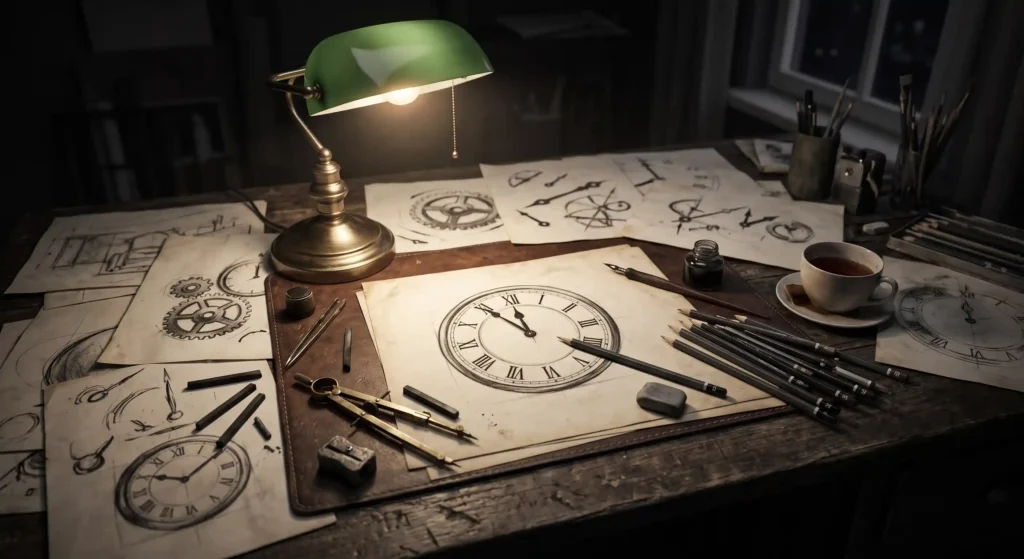
She initially considered using the uranium symbol, but wanted something that conveyed urgency rather than chemistry. She chose a clock face showing only the final quarter hour — the visual language of a countdown, of time running out. The hands were set at seven minutes to midnight for no analytical reason at all. As she later explained, it simply “looked good to my eye.”
That origin story is worth knowing, because it clarifies what the Clock is and is not. The starting position was an aesthetic judgement. Everything since has been a relative movement from that arbitrary baseline. The Clock has never claimed to measure an absolute probability — it measures direction and urgency, and it was built to be looked at, not calculated.
Who Sets It and How
The Doomsday Clock is set by the Bulletin’s Science and Security Board, a panel of scientists and security experts, in consultation with the Bulletin’s Board of Sponsors, which has included numerous Nobel laureates. Each year, the board reviews global developments across several categories of risk and debates whether the world has become more or less dangerous over the past year.

Based on that assessment, they decide whether to move the Clock closer to or further from midnight, or leave it unchanged, and they publish a statement laying out the factors behind the decision. The judgement is expert opinion rather than a calculated formula, which is both its strength — it synthesises broad expertise into a clear signal — and a source of criticism, since it is inherently subjective.
How the Decision Is Actually Made
The annual cycle is more structured than the phrase “expert opinion” suggests, even though the final call remains a judgement rather than an output.
- Autumn — the review. The Science and Security Board convenes, typically in November, and works through the year’s developments domain by domain: nuclear arsenals and arms control, climate indicators and policy, biosecurity, and disruptive technologies including artificial intelligence.
- The question they ask. Not “how bad is the world,” but “is the world more or less secure than it was twelve months ago.” The Clock is a differential instrument. This is why it can stay put during a genuinely dangerous year — standing still means conditions did not measurably worsen, not that things are fine.
- Consultation. The board consults the Board of Sponsors, a group that has included dozens of Nobel laureates across physics, chemistry, medicine and economics.
- January — the announcement. The new setting is released publicly in late January alongside a detailed written statement explaining the reasoning and, importantly, naming the specific actions that would move the Clock back.
Two design features are often missed. First, the Clock is intentionally not a probability estimate — nobody at the Bulletin claims that 85 seconds corresponds to any particular chance of catastrophe in any particular timeframe. Second, the accompanying statement, not the number, is the actual product. The clock face is the headline that gets people to read the analysis.
A History of the Clock’s Movements
The Clock has moved many times since 1947, tracking the rise and fall of global tensions.
- 1947: the Clock debuts at 7 minutes to midnight.
- 1953: moves to 2 minutes after the U.S. and Soviet Union test hydrogen bombs.
- 1991: set to 17 minutes — the farthest from midnight ever — as the Cold War ends.
- 2023–2024: moved to 90 seconds, then in 2025 to 89 seconds, citing nuclear risk, climate, and emerging threats.
- 2026: set to 85 seconds to midnight — the closest to catastrophe in its history.
The trend in recent years has been steadily toward midnight, reflecting the board’s growing alarm about overlapping global dangers. The 17-minute mark of 1991 stands as a reminder that the Clock can also move back when the world becomes safer.
Every Major Setting Since 1947
The Clock has been reset roughly twenty-five times in nearly eight decades. Reading the full sequence is more informative than any single setting, because the movements track identifiable events with striking precision — and because it shows just how often the hands have moved away from midnight.
- 1947 — 7 minutes. The Clock debuts.
- 1949 — 3 minutes. The Soviet Union tests its first atomic bomb; the US nuclear monopoly ends.
- 1953 — 2 minutes. Both superpowers test thermonuclear weapons within months of each other. This remained the record for 65 years.
- 1960 — 7 minutes. Growing scientific cooperation across the Iron Curtain.
- 1963 — 12 minutes. The Partial Test Ban Treaty ends atmospheric nuclear testing.
- 1968 — 7 minutes. France and China develop nuclear weapons; war in Vietnam and the Middle East.
- 1969 — 10 minutes. The Nuclear Non-Proliferation Treaty is ratified.
- 1972 — 12 minutes. The SALT I and ABM treaties are signed.
- 1974 — 9 minutes. Arms talks stall; India tests a nuclear device.
- 1981 — 4 minutes. Détente collapses; the arms race accelerates sharply.
- 1984 — 3 minutes. US–Soviet relations reach their coldest point since the Cuban Missile Crisis.
- 1988 — 6 minutes. The INF Treaty eliminates an entire class of missiles.
- 1990 — 10 minutes. The Berlin Wall falls.
- 1991 — 17 minutes. The Soviet Union dissolves and START is signed. The safest reading ever recorded.
- 1995 — 14 minutes. Post-Soviet arsenals remain large and poorly secured.
- 1998 — 9 minutes. India and Pakistan both conduct nuclear tests.
- 2007 — 5 minutes. A turning point: climate change is formally added as an existential threat alongside nuclear weapons.
- 2015 — 3 minutes. Unchecked climate change and arsenal modernisation programmes.
- 2018 — 2 minutes. The 1953 record is equalled.
- 2020 — 100 seconds. The Clock abandons minutes entirely for the first time.
- 2023 — 90 seconds. The war in Ukraine and explicit nuclear signalling.
- 2025 — 89 seconds.
- 2026 — 85 seconds. The closest to midnight in the Clock’s history.
Two patterns stand out. The Clock responds fastest and most decisively to treaties — the four largest backward movements in its history all followed arms-control agreements. And the era of large swings ended around 2007. Since climate change joined the assessment, the hands have moved almost entirely in one direction, in increasingly small increments, which tells you something about how the board views slow-moving risks that do not resolve.
Why It Switched from Minutes to Seconds
In January 2020 the Bulletin did something it had never done in 73 years: it stopped using minutes. The Clock moved from 2 minutes to 100 seconds, and it has been measured in seconds ever since.
The reasoning was practical. The board judged that conditions had worsened past the 1953 and 2018 record of two minutes, but the next available notch — one minute — would have been an enormous jump, and would have left the Clock with almost nowhere further to go. Switching to seconds created finer resolution at the dangerous end of the dial.
The change also had a rhetorical purpose the Bulletin acknowledged openly: seconds convey a different kind of urgency than minutes. “Two minutes to midnight” sounds like a warning; “eighty-five seconds to midnight” sounds like an emergency, even though the underlying judgement moved only slightly.
This is also where the sharpest criticism of the Clock lands. Once you are counting in seconds, the increments become very small — 90, then 89, then 85 — and a four-second move is difficult to interpret as anything other than symbolic. Defenders reply that this was always true; the Clock has never been a measurement, and the granularity was never the point.
What Pushes It Toward Midnight (nukes, climate, AI, bio)
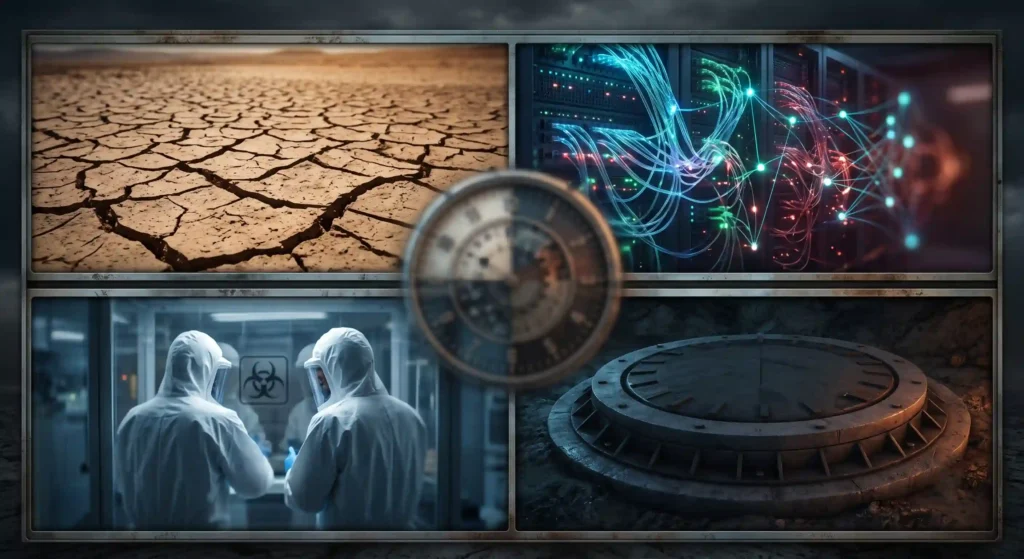
Modern Doomsday Clock decisions weigh several intertwined categories of existential risk. Nuclear weapons remain the original and central concern — arsenals, arms races, and the danger of conflict between nuclear-armed states. Climate change is now a major factor, given its potential to destabilise societies and ecosystems worldwide.

Disruptive technologies, especially advances in artificial intelligence, have become a growing concern, as has the threat of engineered or naturally emerging biological dangers. The board also weighs the erosion of the international cooperation and arms-control agreements needed to manage these risks. The 2026 statement specifically cited a failure of global leadership in confronting these compounding threats.
Inside the 2026 Decision
The move to 85 seconds, announced on 27 January 2026, was four seconds closer than the 2025 setting. The Science and Security Board identified nuclear weapons, climate change and biological threats as the three central concerns, with several specific developments cited as having worsened over the preceding year.
- Expiring nuclear treaties. The arms-control architecture built across the late Cold War has been steadily dismantled, with agreements lapsing and not being replaced. Historically, treaties are the single factor most associated with the Clock moving back — so their expiry carries disproportionate weight in the assessment.
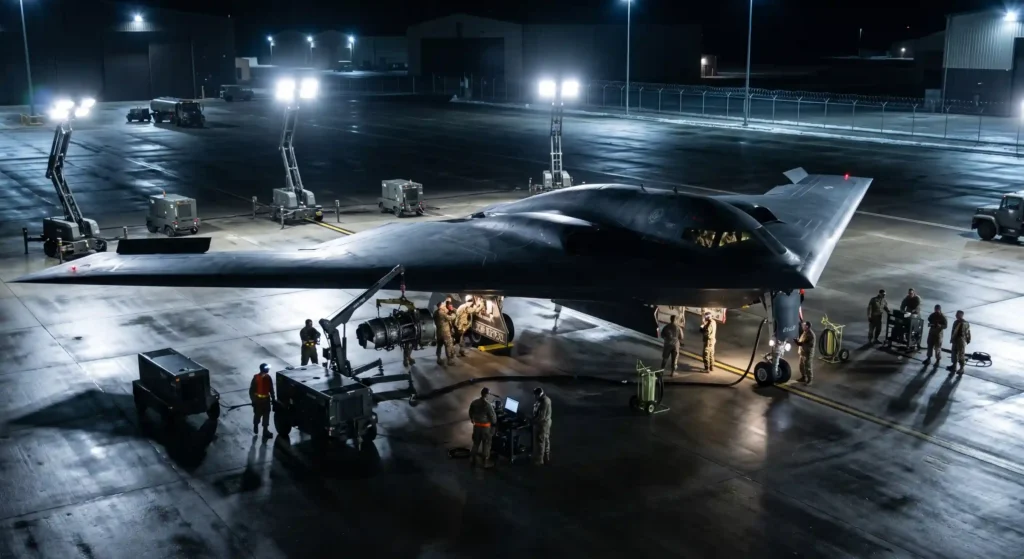
- Arsenal modernisation and expansion. Every nuclear-armed state is currently modernising its arsenal, and several are expanding warhead counts for the first time in decades.
- Climate change. Continued emissions and warming indicators moving in the wrong direction, with adaptation and mitigation efforts judged insufficient relative to the pace of change.
- Artificial intelligence and disinformation. Increasingly cited not as a standalone extinction risk but as a risk multiplier — degrading the information environment, compressing decision-making time in crises, and raising the danger of miscalculation between nuclear-armed states.
- Biological threats. Advances in biotechnology outpacing the governance frameworks meant to contain them.
Alongside the setting, the board issued specific recommendations: limit nuclear arsenals through renewed agreements, establish international guidelines governing the military and civil use of artificial intelligence, and build multilateral frameworks for biological threats. That prescriptive element is deliberate. The Bulletin’s position has always been that the Clock is not a forecast to be observed but a call to action to be answered.
Nuclear War and Nuclear Winter as Drivers
Of all the threats, nuclear war has always loomed largest, because it could cause sudden, civilisation-ending devastation. Beyond the immediate destruction of a nuclear exchange, scientists warn of nuclear winter — a scenario in which soot and smoke from burning cities rise into the atmosphere, block sunlight, and cause a sharp global cooling that could devastate agriculture and cause widespread famine far from any blast.
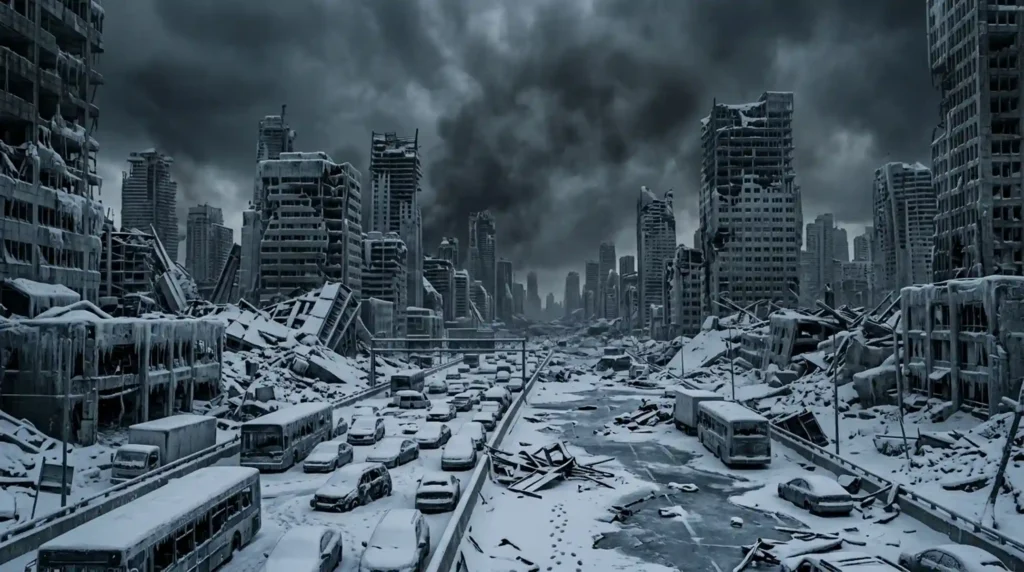
This is why nuclear arsenals weigh so heavily in the Clock’s setting. The full scientific picture of such an event — from the blasts themselves to the long climatic aftermath — is explored in what if all nuclear weapons detonated at once, and the underlying physics of the weapons is explained in our article on nuclear fission.
There is a direct historical link between the two ideas that is easy to miss. The Bulletin was founded by the physicists who built the bomb, and the concept that made those weapons look civilisation-ending rather than merely devastating — the 1983 TTAPS study, co-authored by Carl Sagan — came out of the same scientific community. It is what turned nuclear war from a regional catastrophe into a planetary one, because it showed that the smoke from burning cities would starve countries that never fired a weapon. That mechanism, the four decades of scientific argument over how severe it would really be, and what it would mean for global food supplies, are set out in our complete guide to nuclear winter.
What Would Move the Clock Back?
Because the Clock has moved backward twelve times, the question has concrete historical answers rather than speculative ones. Each of the four largest reversals followed the same kind of event.
- Verified arms-control agreements. The Partial Test Ban Treaty (1963, +5 minutes), the NPT (1969, +3), SALT I and the ABM Treaty (1972, +2), the INF Treaty (1988, +3), and START alongside the Soviet collapse (1991, +7). Nothing else in the Clock’s history produces movements of that size.
- Reduction in deployed warheads, not just stockpiled ones. The board consistently distinguishes between weapons in storage and weapons on missiles.
- Functioning dialogue between adversaries. Communication channels and crisis-management mechanisms weigh heavily, because most of the Clock’s nuclear concern is about miscalculation rather than intent.
- Measurable climate progress. Emissions trending down rather than commitments trending up.
- Governance frameworks for AI and biotechnology. The newest category, and the one where the board has explicitly said no adequate framework yet exists.
The 1991 setting of 17 minutes is the standing proof that large reversals are possible. It is also a reminder of how quickly the gains were given back: within seven years the Clock had returned to 9 minutes, and it has not moved backward at all since 2010.
Is the Clock Actually Useful?
The Doomsday Clock has its critics. Some argue it is too subjective, too pessimistic, or that compressing diverse and very different risks into a single number oversimplifies them. Others note that it has never literally predicted anything, since it is a symbol rather than a forecast.
Its defenders counter that this misses the point. The Clock is a communication tool, designed to cut through complexity and make abstract, slow-moving dangers feel immediate and real. Each year it generates global headlines and public conversation about threats that might otherwise be ignored. Whether or not one agrees with a particular setting, the Clock has succeeded for over 75 years at keeping existential risk in the public eye — which was always its purpose.
The Criticisms, Stated Fairly
The arguments against the Clock deserve to be laid out properly rather than waved off, because several of them are serious and are made by people who take existential risk very seriously indeed.
- The single-metric problem. Nuclear war and climate change operate on completely different timescales and mechanisms — one is instantaneous and discrete, the other gradual and cumulative. Collapsing them onto one dial requires an exchange rate between incommensurable risks that no one can justify.
- The ratchet effect. The Clock has not moved backward since 2010 and has moved forward in most years since. Critics argue this reflects an institutional bias toward alarm as much as a deteriorating world — and that a warning device which only ever gets louder eventually stops being informative.
- Crying wolf. If the Clock stood at two minutes to midnight in 1953 and catastrophe did not follow for seventy-three years, what does 85 seconds actually communicate? Repeated maximum-urgency signalling risks desensitisation.
- No accountability loop. Because the Clock makes no falsifiable prediction, it can never be shown to have been wrong, and therefore never improves through error correction the way a forecasting method does.
- Political framing. Some critics argue the board’s composition and the policy recommendations attached to each setting reflect a particular worldview, and that the scientific authority of the Bulletin lends unearned objectivity to what are ultimately contestable political judgements.
The defence is not that these points are wrong but that they measure the Clock against the wrong standard. It was never built as a forecasting instrument, and the Bulletin has never claimed it was. It is a piece of science communication — an artist’s clock face designed to make people read a policy statement they would otherwise ignore. Judged as a prediction, it fails by construction. Judged as a device for keeping nuclear risk, climate risk and biosecurity in public conversation for nearly eight decades, it has few rivals.
Other Ways Experts Measure Existential Risk
The Clock is the most visible tool in this space but far from the only one, and the alternatives illuminate what it is doing by contrast.
- Structured expert elicitation. Researchers survey domain specialists for explicit numerical probabilities — for example, the chance of a nuclear detonation in conflict within a decade. Produces falsifiable numbers, but expert probability estimates on rare events are notoriously poorly calibrated.
- Forecasting platforms and prediction markets. Aggregate many forecasters, score them against outcomes, and weight by track record. Genuinely accountable, and demonstrably better calibrated on short-horizon questions — but nearly useless for events that have never happened and would end the scoring system if they did.
- Academic risk assessment. Institutions such as the Future of Humanity Institute and the Centre for the Study of Existential Risk have published explicit estimates for various catastrophe categories, with stated reasoning and uncertainty ranges.
- Physical indicators. Warhead inventories from the Federation of American Scientists and SIPRI, atmospheric CO₂ concentration, and pathogen surveillance data. Objective and verifiable, but they measure inputs rather than risk, and no one agrees how to combine them.
None of these has achieved a fraction of the Clock’s public recognition — which is arguably the strongest argument in its favour. A perfectly calibrated risk estimate that nobody reads has less effect on the world than an imprecise symbol that leads the news every January.
Q&A
As of January 2026, the Doomsday Clock is set to 85 seconds to midnight — the closest it has ever been. It was moved forward from 89 seconds in 2025, with the Bulletin citing nuclear danger, climate change, artificial intelligence, biological threats, and a failure of global leadership.
The closest is the current setting of 85 seconds to midnight, established in January 2026. This surpassed the previous records of 89 seconds (2025) and 90 seconds (2023–2024), reflecting the board’s growing concern about multiple overlapping global threats.
The Clock is set by the Science and Security Board of the Bulletin of the Atomic Scientists, in consultation with its Board of Sponsors, which includes Nobel laureates. They assess global risks each year and decide whether to move the Clock based on expert judgement.
Yes, several times. The most dramatic was in 1991, when it moved back to 17 minutes to midnight — the farthest ever — as the Cold War ended and the U.S. and Soviet Union signed arms-reduction treaties. This shows the Clock reflects improvements as well as deteriorations.
The artist Martyl Langsdorf designed it for the June 1947 cover of the Bulletin of the Atomic Scientists. She chose a clock face showing the last quarter hour to convey urgency, and set the hands at seven minutes to midnight for purely aesthetic reasons — it “looked good to my eye,” as she later put it. Every setting since has been a relative movement from that arbitrary starting point.
The Bulletin switched from minutes to seconds in January 2020, moving from 2 minutes to 100 seconds. The board judged conditions had worsened past the previous record of two minutes, but dropping to one minute would have been too large a jump and left almost no room for further movement. Seconds provide finer resolution — and convey sharper urgency.
No. It is a symbol, not a forecast, and the Bulletin has never claimed a specific setting corresponds to a probability of catastrophe within a given timeframe. It measures direction and urgency relative to the previous year, and its real product is the detailed annual statement that accompanies the announcement.
In 1991, at 17 minutes to midnight — the safest reading in its history. The Soviet Union had dissolved and the United States and Russia had signed the START arms-reduction treaty. The Clock has moved steadily closer to midnight since, and has not moved backward at all since 2010.
In 2007 the Bulletin formally expanded the Clock’s remit beyond nuclear weapons to include climate change, reasoning that it represented a comparable threat to civilisation operating on a longer timescale. Artificial intelligence, disinformation and biological threats have since been added as further categories the board assesses each year.
Historically, arms-control treaties. The four largest backward movements in the Clock’s history all followed verified agreements — the Partial Test Ban Treaty in 1963, the NPT in 1969, the INF Treaty in 1988, and START in 1991. The Bulletin’s 2026 recommendations also name international guidelines for artificial intelligence and multilateral frameworks for biological threats.
The Bigger Question
The Doomsday Clock distils humanity’s existential risks into a single, sobering image — and nuclear weapons have always been the heaviest hand pushing it toward midnight. But what would actually happen if those weapons were ever used on a global scale, from the immediate devastation to the lasting nuclear winter that could follow? That is the scenario examined in what if all nuclear weapons detonated at once.
The science of the weapons themselves is covered in our article on nuclear fission. Explore more about the threats facing civilisation on the Earth & Humanity Survival hub.
Watch the nuclear scenario to see what is really at stake as the Clock ticks toward midnight.