 By
By What Causes an Ice Age — and How Many Theories Exist?
An ice age — technically a glacial period — is a phase of Earth’s history characterised by the growth of continental ice sheets and a global mean temperature drop of 4–7°C from interglacial conditions. The dominant current theory invokes Milankovitch cycles: the ~100,000-year cycle of Earth’s orbital eccentricity, the ~41,000-year cycle of axial tilt, and the ~26,000-year cycle of axial precession combine to modulate the distribution and intensity of solar radiation reaching the Northern Hemisphere. When northern summers are cool enough to preserve winter snow year after year, ice sheet growth begins via a positive albedo feedback loop.
But Milankovitch cycles don’t fully explain the ice age record — in particular, why the current series of glacial cycles began about 2.6 million years ago (the “Mid-Pleistocene Transition” is still not fully understood). This is where interstellar factors become compelling. What causes an ice age on earth at this particular moment in geological time?
What Did the 2024 Interstellar Cloud Discovery Find?
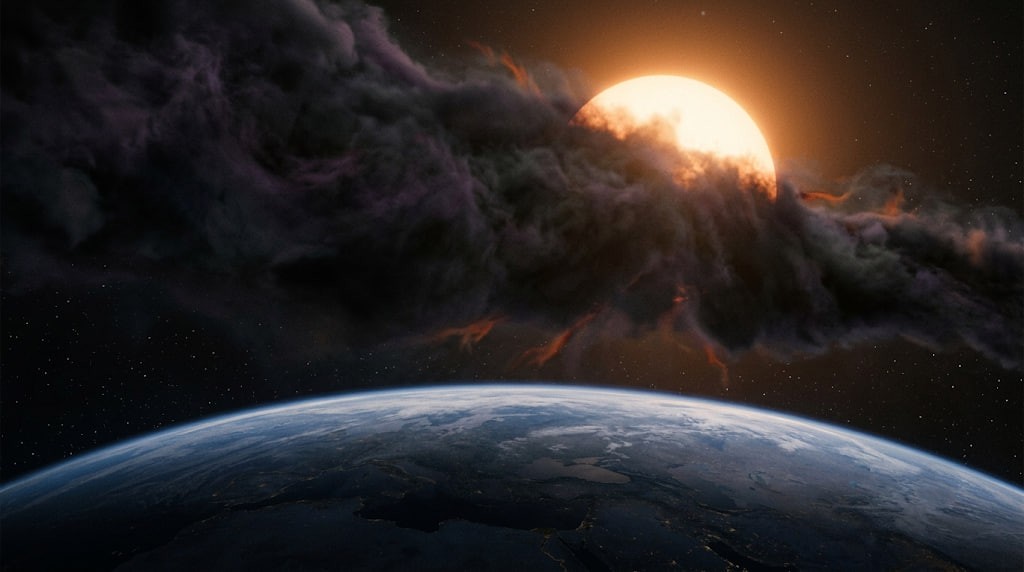
A 2024 study published in Nature Astronomy (Redfield et al.) found strong evidence that the solar system passed through the Local Ribbon of Cold Clouds — a region of cold, dense interstellar hydrogen — approximately 2–3 million years ago. The timing is strikingly coincident with the initiation of major Pleistocene glaciation and the appearance of the first hominids in Africa.
The mechanism is physical: a dense molecular cloud could compress or disrupt the heliosphere — the magnetic bubble of solar wind that normally extends out to ~120 AU (the heliopause). A sufficiently dense cloud could push the heliopause inward, exposing the inner solar system to elevated fluxes of interstellar cosmic rays and interstellar dust. Both effects would be climatically significant:
- Increased cosmic ray flux enhances cloud nucleation in the lower atmosphere, increasing Earth’s albedo (cloud cover fraction)
- Interstellar dust grains entering the inner solar system could seed additional cloud formation and reduce solar insolation by 1–2%
- 1–2% reduction in solar insolation is roughly comparable to the radiative forcing needed to initiate glaciation in climate models
What Would a Snowball Earth Event Look Like?
A Snowball Earth — a hypothetical state where glaciers reach the equator and the entire planetary surface is ice-covered — occurred at least twice in Earth’s history, most recently about 635 million years ago (the “Marinoan glaciation”). The mechanism is a runaway ice-albedo feedback: more ice reflects more sunlight, cooling the planet, causing more ice to form.
A complete Snowball Earth from an interstellar cloud passage would require a sustained dimming lasting millions of years — longer than the typical cloud encounter (~1 million years at our galactic orbit velocity of ~230 km/s). A partial, icehouse-style glaciation — the kind we’ve been in for 2.6 million years — is more likely from a single cloud encounter. The partial glaciation scenario matches the observed record: 40–100 km-thick ice sheets over North America and Eurasia, sea ice to 50° latitude, but open equatorial oceans.
Could This Happen Again?
Yes. The solar system is currently embedded in the “Local Interstellar Cloud” — a warm, low-density region of partially ionised hydrogen. This cloud is relatively benign. But the Local Bubble (the large low-density region of space we currently occupy) has boundaries at various distances in different directions, and the solar system is drifting toward denser regions of the interstellar medium. Our galactic orbit will carry us through different cloud environments over millions of years, making periodic encounters with denser clouds an expected feature of Earth’s climate history on geological timescales.
Q&A
Multiple factors trigger ice ages. The dominant mechanism for the Pleistocene ice age cycles is Milankovitch cycles — periodic changes in Earth’s orbital eccentricity, axial tilt, and precession that alter solar radiation distribution. Additional triggers include interstellar cloud passages that reduce solar insolation, major volcanic events, and changes in ocean circulation. The initiation of the current glacial era 2.6 million years ago may have been partially triggered by a cold interstellar cloud passage.
The heliosphere is the vast bubble of charged particles and magnetic field generated by the solar wind, extending from the Sun outward to the heliopause at approximately 120 AU. It shields the inner solar system from most interstellar cosmic rays and dust. The Voyager probes crossed the heliopause in 2012 (Voyager 1) and 2018 (Voyager 2).
A molecular cloud is a dense region of interstellar gas and dust where hydrogen exists primarily in molecular form (H₂) rather than atomic or ionised form. They are the birthplaces of stars and planetary systems. Their densities (102–106 molecules/cm³) are vastly higher than the average interstellar medium (~0.1 atoms/cm³), and their temperatures are typically 10–30 K.
Snowball Earth events were periods, most clearly identified at ~710 million years ago (Sturtian) and ~635 million years ago (Marinoan), when geological evidence suggests ice sheets extended to equatorial latitudes. They are identified by glacial deposits (tillites) found at equatorial paleolatitudes and carbon isotope anomalies. The trigger likely involved reduced volcanic CO₂ outgassing combined with ice-albedo feedback.
Milankovitch cycles are the periodic changes in Earth’s orbital and rotational parameters: orbital eccentricity (~100,000-year cycle), axial obliquity/tilt (~41,000-year cycle), and axial precession (~26,000-year cycle). These cycles modulate how much solar radiation reaches different latitudes and seasons, pacing the glacial-interglacial cycle of the past 2.6 million years.
Internal links: space facts | What If Yellowstone Erupted Tomorrow? | What If Earth’s Core Solidified?