 By
By What Is a Primordial Black Hole?
A primordial black hole is a hypothetical type of black hole formed not from stellar collapse but from density fluctuations in the very early universe — within the first second after the Big Bang. Unlike stellar black holes, which have masses of several solar masses or more, primordial black holes could span an enormous range of masses: from 10-8 kg (the Planck mass) up to thousands of solar masses. They are a leading dark matter candidate because they would interact gravitationally but not electromagnetically, making them invisible to telescopes.
A micro black hole is simply a black hole with a very small mass. Any black hole smaller than about 1011 kg would have already evaporated via Hawking radiation in the age of the universe; primordial black holes above this mass threshold could still exist today.
What Would Happen as a Micro Black Hole Passed Through Earth?
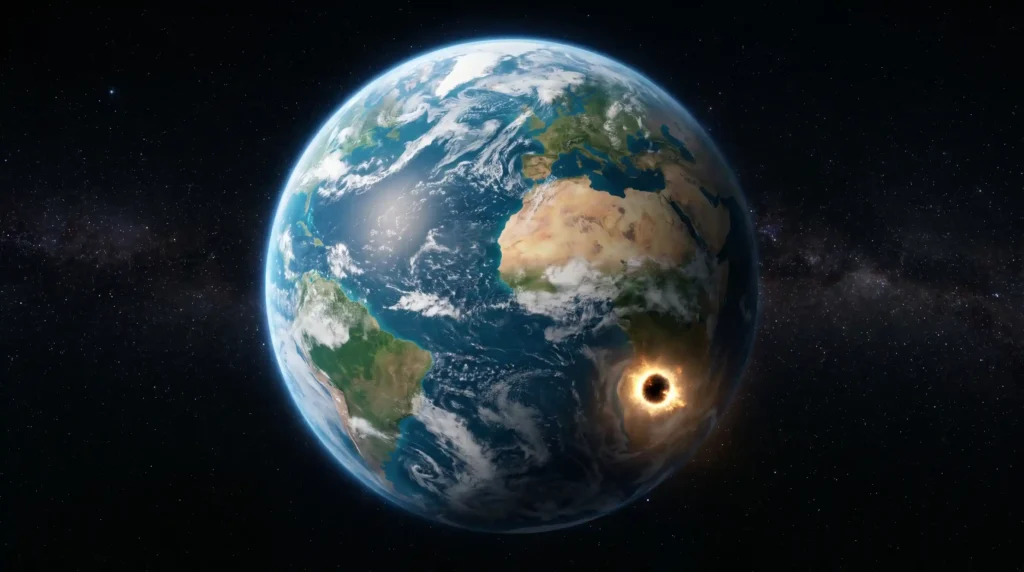
The key parameter is the Schwarzschild radius — the radius of the event horizon. For a black hole of mass M, the Schwarzschild radius is rs = 2GM/c² ≈ 1.5 × 10⁻²⁷ × M(kg) metres.
- A 1012 kg micro black hole (asteroid mass): rs ≈ 10-15 m — smaller than a proton
- A 1015 kg micro black hole (small mountain mass): rs ≈ 10-12 m — about the size of an atomic nucleus
- A lunar mass black hole: rs ≈ 0.1 mm
For the asteroid-mass case, the black hole’s gravitational influence extends only to distances where its tidal force exceeds atomic binding energy — roughly a few millimetres. As it passes through at, say, 100 km/s, it would create a cylindrical tunnel roughly 2 mm in diameter by accreting and compressing rock. The passage through Earth’s core would take about 2 minutes. At exit, the compressed and heated material ejected by the passage would create a blast roughly equivalent to 100 megatons of TNT — devastating to anything within 50 km of the exit point but not globally lethal.
Could a Micro Black Hole Get Trapped Inside Earth?
Only if it is moving slower than Earth’s escape velocity (11.2 km/s). A captured micro black hole would then oscillate through the Earth like a pendulum, each pass eating a tiny tunnel. The accretion rate onto a micro black hole is extremely slow at the low densities of rock compared to, say, a neutron star core. A 1012 kg black hole would take longer than the age of the universe to accrete a significant fraction of Earth’s mass. A larger primordial black hole — say, 1020 kg — would have a higher accretion rate and could genuinely destabilise Earth over millions of years if captured.
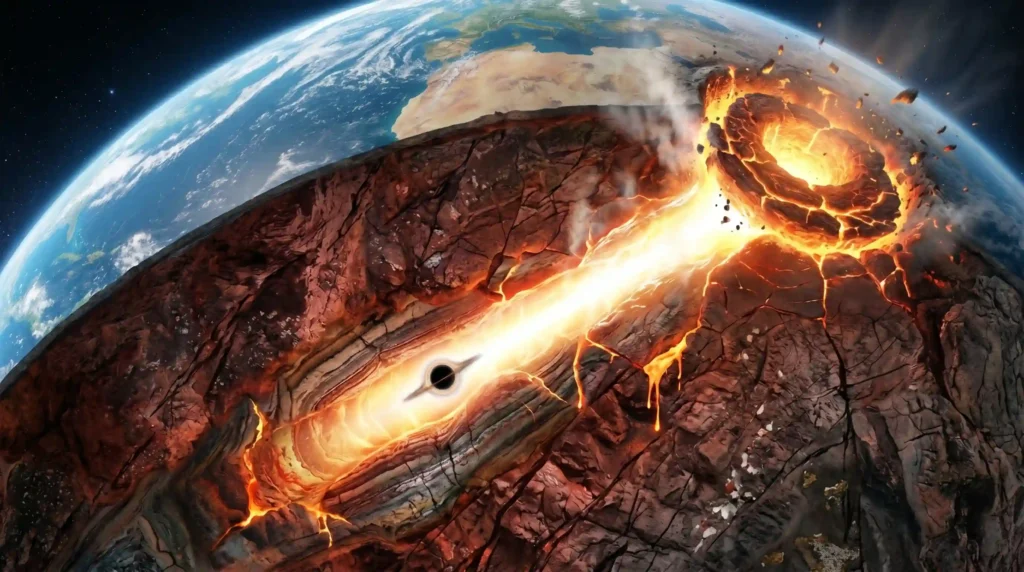
The LHC safety concern about producing black holes was addressed by exactly this analysis: any micro black holes produced in collisions would have masses of roughly 10-24 kg (just above the Planck mass), move near light speed, and evaporate via Hawking radiation in 10-27 seconds — far faster than they could interact with any matter. The cosmic ray argument applies here too: far more energetic collisions have been occurring on Earth and throughout the universe for billions of years with no black hole accretion catastrophe.
Are Primordial Black Holes Real Dark Matter Candidates?
Yes, and they remain one of the most compelling non-particle dark matter candidates. Microlensing surveys (EROS, MACHO, Subaru/HSC) have placed tight constraints on primordial black holes in certain mass ranges, but there are still windows — particularly around asteroid mass (1017–1022 kg) and above several solar masses — where primordial black holes could account for all or part of dark matter.
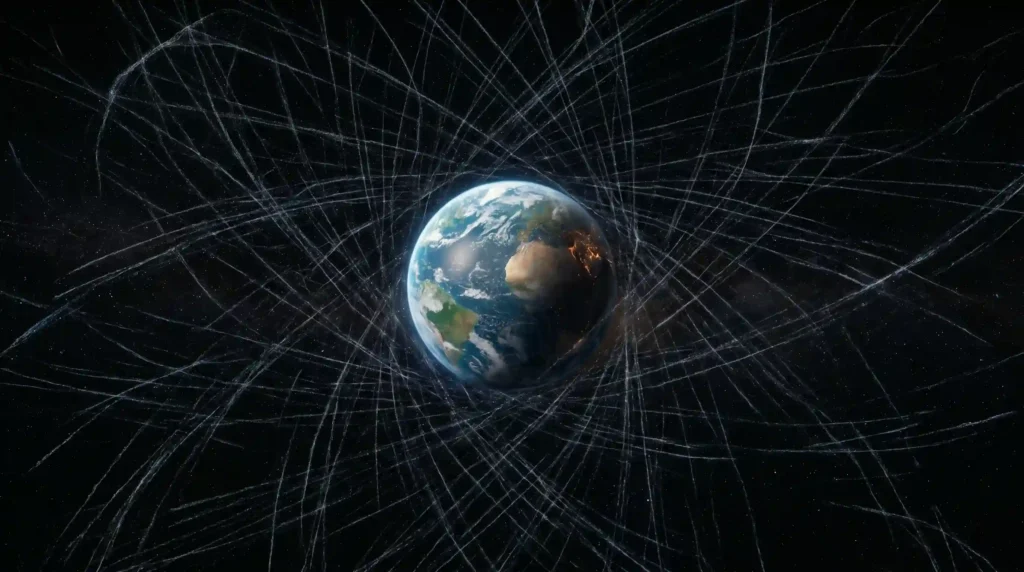
The gravitational wave detections by LIGO/Virgo have shown a population of binary black hole mergers with masses in the 20–100 solar mass range that were not expected from stellar evolution — some of these could be primordial black holes.
Q&A
A primordial black hole is a hypothetical black hole formed from density fluctuations in the early universe, within the first second after the Big Bang. Unlike stellar black holes, they can span a huge range of masses. Those above roughly 1011 kg would still exist today; lighter ones would have evaporated via Hawking radiation.
Hawking radiation is the theoretical thermal emission of particles by black holes due to quantum effects near the event horizon. It causes black holes to lose mass and, given enough time, evaporate completely. For stellar-mass black holes, the process takes 1067 years; for micro black holes near the Planck mass, it takes a fraction of a second.
No. Any micro black holes created by the LHC would evaporate via Hawking radiation in ~10-27 seconds — far too quickly to interact with matter. Additionally, cosmic rays perform equivalent high-energy collisions on Earth continuously; no black hole hazard has ever manifested despite billions of years of such impacts.
Dark matter is a form of matter that does not interact with light (electromagnetic force) but exerts gravitational influence. It comprises about 27% of the universe’s total energy content. Its nature is unknown. Candidates include weakly interacting massive particles (WIMPs), primordial black holes, axions, and sterile neutrinos.
The theoretical minimum is the Planck mass black hole (~2.2 × 10⁻⁸ kg), where quantum gravity effects dominate and our current physics breaks down. The smallest confirmed black hole from stellar collapse is XTE J1650-500, estimated at approximately 3.8 solar masses. Primordial black holes could in theory span the full mass range between these extremes.
Internal links: space facts | White Hole vs Black Hole | What If Vacuum Decay Began in a Collider?