 By
By What Is Vacuum Decay and Why Does the Higgs Field Matter?
The Higgs field permeates all of space. Every electron, quark, and massive particle acquires its mass by interacting with this field. The current value of the Higgs field — its “vacuum expectation value” — determines the masses and interactions of all fundamental particles. Quantum field theory suggests the Higgs field currently sits at a local energy minimum: the false vacuum. There may be a deeper, lower-energy state — the true vacuum — separated from our current state by a quantum energy barrier.
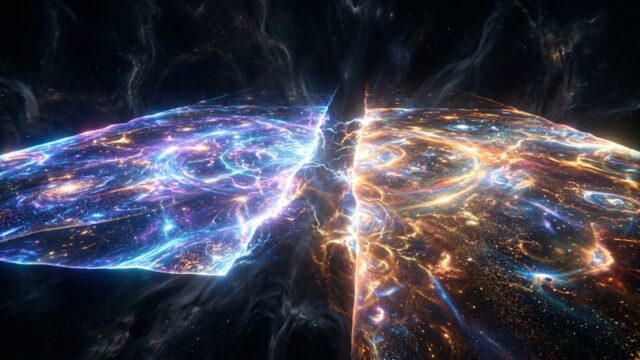
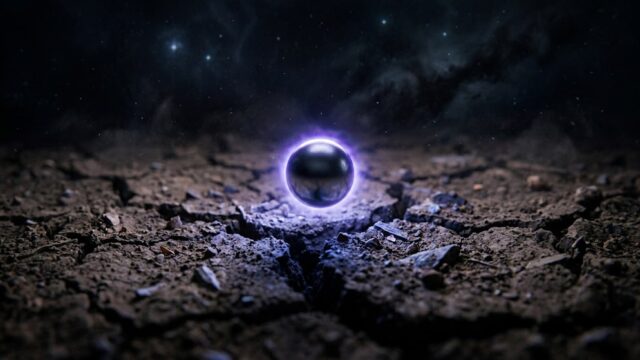
Vacuum decay is the catastrophic tunnelling of the Higgs field from the false vacuum to the true vacuum. Once a small region of true vacuum nucleates — a bubble nucleation event — it expands outward at exactly the speed of light. Inside the bubble, the physical constants are different. Atoms cannot form, chemistry does not work, and any matter encountered is instantly restructured or annihilated. There is no warning: the bubble wall arrives at light speed, meaning you cannot detect it before it reaches you.
What Does the Higgs Boson Discovery Tell Us About Our Vacuum Stability?
The 2012 Higgs boson discovery at the Large Hadron Collider was not just a triumph — it was a portent. The Higgs mass of 125.09 GeV places our universe in a specific region of the “phase diagram” of vacuum stability. Calculations using the measured Higgs mass and top quark mass (the other critical parameter) show that our vacuum lies in the “metastable” region: it is not absolutely stable, but the tunnelling time to decay is extremely long. Current best estimates give the lifetime of our false vacuum as approximately 10139 years — staggeringly longer than the age of the universe (1.4 × 10¹⁰ years).
To picture the scale of the timescale:
- Age of the universe: 1.4 × 10¹⁰ years
- Time for all black holes to evaporate via Hawking radiation: ~1067–10100 years
- Estimated false vacuum lifetime: ~10139 years
- Probability of vacuum decay in the next billion years: essentially zero
Could a Particle Collider Trigger Vacuum Decay?
This is the critical question, and the answer from theoretical physics is almost certainly no — for two reasons.
First, cosmic rays have been colliding with Earth and with atmospheric particles at energies far exceeding those of the LHC for billions of years. Ultra-high-energy cosmic rays reach energies of 1020 eV; the LHC’s maximum is around 1013 eV. If a particle collision could nucleate a true vacuum bubble, it would have happened long ago across the universe from cosmic ray impacts, and we would not exist to pose the question.
Second, bubble nucleation requires the Higgs field to tunnel through a quantum barrier in a sufficiently large volume simultaneously — not just at a single point. A particle collider creates extremely high energy densities at a single point for an extremely short time, but this is very different from the large-volume, coherent field configuration needed for bubble nucleation.
The end of the universe via false vacuum collapse is real physics, but it is a cosmological-timescale phenomenon driven by quantum fluctuations across astronomical volumes — not something a human instrument can trigger.
What Would Vacuum Decay Actually Look Like?
If vacuum decay did occur somewhere in the observable universe today, there would be no warning. The bubble wall expands at the speed of light; the first indication of its arrival would be the simultaneous end of all physics as we know it. No radiation precedes the wall, no gravitational wave is distinguishable above background, no neutrino burst arrives first. The process is described in theoretical physics as “the end of the universe” — not metaphorically, but literally: the laws of physics that enable atoms, chemistry, and life are replaced by a different set of constants that do not permit any of these structures.
Q&A
Vacuum decay is the hypothetical transition of the Higgs field from its current metastable state (the false vacuum) to a lower-energy true vacuum via quantum tunnelling. A bubble nucleation event would expand at light speed, replacing all known physics inside it with a different set of constants incompatible with atoms, chemistry, or life.
No. Cosmic rays at energies millions of times higher than the LHC have been striking Earth and other dense objects across the universe for billions of years with no vacuum decay event. The LHC cannot approach the energy densities or spatial scales required for bubble nucleation. Safety analyses confirm this.
The false vacuum is the current state of the Higgs field — a local energy minimum that appears stable but is not the lowest possible energy state. Quantum theory allows it to tunnel to the true vacuum (a lower energy state) given enough time. The estimated tunnelling time for our universe is ~10139 years.
Metastable. Based on the measured Higgs boson mass (125.09 GeV) and top quark mass, calculations suggest the universe’s vacuum is metastable — not absolutely stable, but with a decay timescale of ~10139 years. This is so much longer than the current age of the universe that the practical difference from stable is negligible.
Nothing in the conventional sense. Inside a true vacuum bubble, the masses of elementary particles and the strengths of fundamental forces are different. Atoms cannot form because electrons and protons have different effective masses. Chemistry, biology, and physics as we know them are impossible inside the bubble. The event is not a catastrophe in the ordinary sense — it is a discontinuity in the laws of nature.
Internal links: theoretical physics | What If a Strangelet Touched Earth? | What If Two Braneworlds Collided?