 By
By 
Quick Answer
A volcanic winter is a period of global cooling caused by a major volcanic eruption injecting sulfur and ash high into the atmosphere, where they block sunlight. The tiny sulfur droplets form a reflective haze in the stratosphere that can cool the entire planet by a degree or more for one to three years, disrupting weather and agriculture worldwide. The most famous example is the “Year Without a Summer” of 1816, which followed the eruption of Mount Tambora.
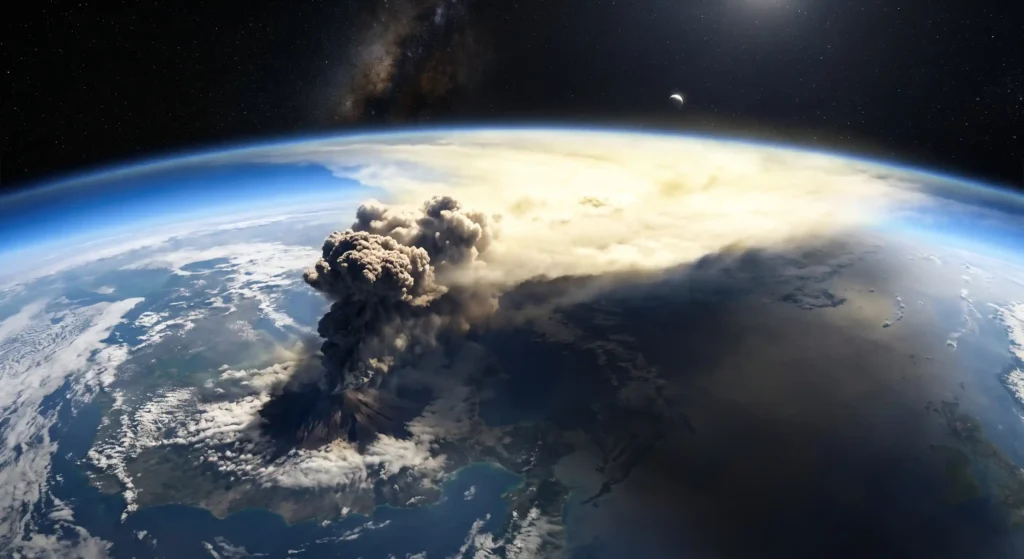
It is a striking idea: a single volcano, no matter how large, is tiny compared to the planet — yet one big eruption can chill the whole Earth and ruin harvests on the other side of the world. This guide explains what a volcanic winter is, the science behind it, the real history of summers that never came, and what a future super-eruption could mean for the global climate.
What Is a Volcanic Winter?
A volcanic winter is a temporary drop in global temperatures caused by the material a large eruption throws into the upper atmosphere. When a powerful volcano erupts, it can blast gases and fine particles all the way up into the stratosphere — the layer of atmosphere high above where weather occurs. There, this material spreads around the globe and reflects a portion of the Sun’s energy back into space, cooling the surface below.
The effect is global, not local, because stratospheric winds distribute the haze worldwide over a matter of months. The cooling typically lasts a few years until the particles gradually settle out of the atmosphere. A volcanic winter is essentially the planet briefly turning down its own thermostat in response to a volcanic outburst.
The Science (sulfur aerosols and sunlight)
The key ingredient is not ash, but sulfur. Large eruptions release huge amounts of sulfur dioxide gas, which rises into the stratosphere and reacts with water vapour to form a fine mist of sulfuric acid droplets, called sulfate aerosols. These microscopic droplets are extremely good at scattering and reflecting incoming sunlight.
Crucially, because they reach the stratosphere — above the rain and weather that would otherwise wash them out — these aerosols can linger for one to three years, blanketing the planet. Volcanic ash, by contrast, is heavier and falls back to the ground within days to weeks, so it contributes mainly to local devastation rather than long-term cooling. It is the high-altitude sulfur haze that drives a true volcanic winter, and the amount of sulfur an eruption releases matters even more than its sheer explosive size.
Why Size Alone Doesn’t Decide It
This is the part that surprises people. Two eruptions of identical size can have wildly different climate effects, because a volcanic winter depends on four variables — and only one of them is how big the bang was.
- Sulfur content of the magma. Some magmas are sulfur-rich, others are not. An eruption can throw out enormous volumes of rock and still deliver very little sulfur — in which case there is regional devastation but no global chill.
- Plume height. The sulfur has to clear the tropopause, roughly 10–17 km up. Below that, rain scrubs it out of the sky within days. Above it, there is no rain, and the haze persists for years. This is a hard threshold, not a gradient.
- Latitude. A tropical eruption is far more effective at cooling the whole planet, because stratospheric circulation carries the aerosol into both hemispheres. A high-latitude eruption tends to keep its haze over one hemisphere, producing a strong regional effect but a weaker global one.
- Season. Timing matters for agriculture even more than for temperature. An eruption in late spring in the Northern Hemisphere hits the growing season head-on; the same eruption in autumn gives farmers a year to adapt.
There is also a self-limiting effect at the very top end. When an eruption injects extreme quantities of sulfur, the aerosol droplets collide and grow larger. Bigger droplets are worse at scattering sunlight per unit of mass, and they fall out of the stratosphere faster. So doubling the sulfur does not double the cooling — the climate response saturates. This is one of the main reasons modern estimates for a Yellowstone-scale volcanic winter are lower than the most dramatic figures once quoted.
How We Know: Ice Cores and Tree Rings
Nobody was taking global temperature readings in 536 AD, so how can anyone say the summer was 2.5 °C colder? The answer is that eruptions leave two independent physical archives, and they can be cross-checked against each other.
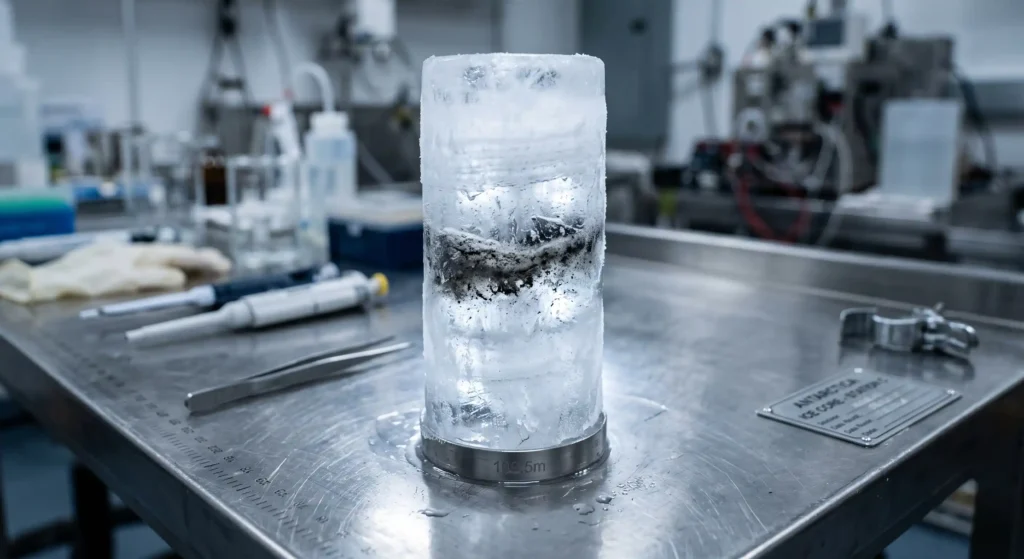
Ice cores record the sulfur. When a stratospheric sulfate haze eventually settles out, some of it lands on the Greenland and Antarctic ice sheets and is buried by the next season’s snow. Drilling down through that ice produces an annually layered record in which large eruptions appear as sharp sulfate spikes. If a spike appears in both polar records simultaneously, the eruption was tropical — the haze reached both hemispheres. If it appears in only one, the source was at high latitude. Volcanic ash shards trapped in the same layer can sometimes be chemically fingerprinted to a specific volcano.
Tree rings record the response. Trees at high altitude and high latitude grow measurably less in cold summers, leaving narrow rings, sometimes with frost damage visible in the wood. Because rings are annual and can be dated precisely, they convert a sulfate spike into an actual temperature history — telling us not just that an eruption happened but how hard and how long the climate reacted.
Layered on top of these are written records: harvest ledgers, grain prices, famine chronicles, and descriptions of a dimmed sun. When ice cores, tree rings, and human documents all point at the same year, the case is about as solid as historical climate science gets. The 1815 Tambora eruption, where the modern satellite-era physics can also be checked against the 1991 Pinatubo eruption, is the anchor that validates the whole method.
The Year Without a Summer (Tambora, 1816)
The best-documented volcanic winter followed the eruption of Mount Tambora in Indonesia in April 1815 — the largest eruption in recorded history, a VEI 7. The sulfur it injected into the stratosphere caused 1816 to become known as the “Year Without a Summer.”
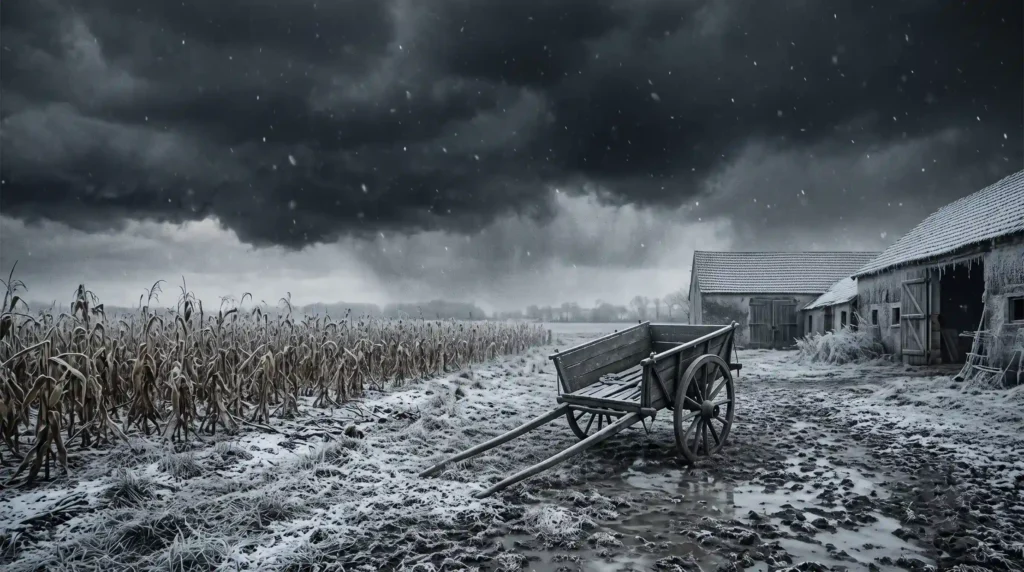
Across the Northern Hemisphere, the consequences were severe. Snow fell in New England in June, frost killed crops through the summer months, and Europe suffered cold, wet weather that ruined harvests. The result was widespread crop failure, food shortages, and famine in many regions — one of the worst subsistence crises of the 19th century. The gloomy, stormy weather even influenced culture: it was during that dismal summer, kept indoors by the rain, that Mary Shelley began writing Frankenstein. The Year Without a Summer remains the clearest historical proof of how a single eruption can reshape the global climate.
Volcanic Winters Through History
Tambora is the most famous case, but it is far from the only one. The historical record contains a whole series of eruption-driven cold spells, each with a distinct signature — and together they show how consistently this pattern repeats.
- 536 AD — the mystery cloud. Northern Hemisphere summers fell by as much as 2.5 °C, with a second eruption in 539–540 pushing the anomaly to around 2.7 °C. Contemporaries across the Mediterranean, the Middle East and China described a dimmed, bluish sun for over a year.
- 1257 — Samalas, Indonesia. A VEI 7 eruption on Lombok, only identified as the culprit in the 2010s. It left the largest sulfate spike of the last 2,000 years in the ice records and coincides with crop failure and mass burials in medieval London.
- 1600 — Huaynaputina, Peru. A VEI 6, and the largest eruption in South American recorded history. It is linked to the Russian famine of 1601–1603, one of the deadliest in Russian history.
- 1783–84 — Laki, Iceland. A fissure eruption rather than an explosive one, but so sulfur-rich that it produced a choking haze across Europe, a brutal winter, and mass mortality — including roughly a quarter of Iceland’s population.
- 1815 — Tambora, Indonesia. The Year Without a Summer, described above; the reference case for the whole phenomenon.
- 1883 — Krakatoa, Indonesia. A VEI 6 that cooled the planet by a few tenths of a degree and produced years of lurid red sunsets recorded by painters and astronomers worldwide.
- 1991 — Pinatubo, Philippines. A VEI 6 that injected around 20 million tonnes of sulfur dioxide and cooled global average temperatures by roughly 0.5 °C for about two years. The first volcanic winter observed by a full satellite network — and the one that turned the theory into measured physics.
Notice the pattern in the dates. Meaningful volcanic cooling is not a once-in-an-age freak event; something on this list happens every century or two. It is only the super-eruption-scale version that is genuinely rare.
The Winter That Broke Late Antiquity (536 AD)
Of all the entries on that list, 536 AD deserves its own section, because it may be the single worst year to have been alive in recorded history — and because it shows what a volcanic winter looks like when it lands on a society with no reserves.
The Byzantine historian Procopius wrote that “the sun gave forth its light without brightness, like the moon, during this whole year.” Chroniclers in Ireland recorded a failure of bread. Records from China describe summer frost and snow. Tree rings across Europe, Asia and North America register one of the sharpest growth collapses in two millennia.
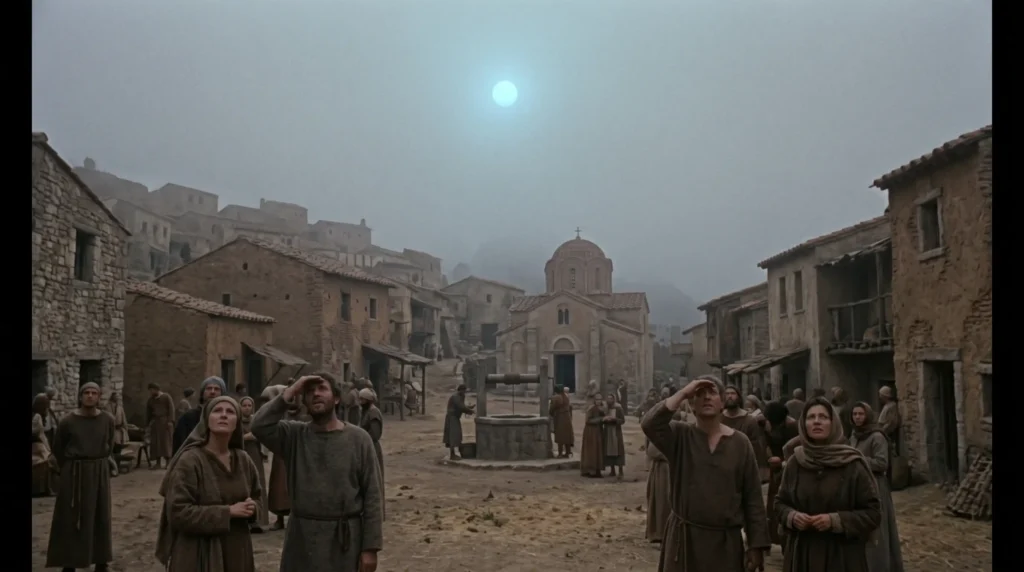
The cause was almost certainly a high-latitude Northern Hemisphere eruption in late 535 or early 536, followed by a second, tropical eruption in 539–540 — a one-two punch that prevented any recovery. Ice cores from both Greenland and Antarctica confirm the double signature.
What followed was not a bad harvest but a cascade. Researchers now describe the period from roughly 536 to 660 AD as the Late Antique Little Ice Age: a sustained cold phase that overlaps with the Plague of Justinian, upheaval across the Eastern Roman Empire, migration pressure in the Eurasian steppe, and the collapse of several Central American and Andean polities. Historians are careful not to claim a volcano single-handedly rewrote the sixth century — but the correlation between the sulfate spike and a century of instability is one of the strongest arguments that climate shocks and civilisational stress are linked.
The Toba Catastrophe and Human History
Going further back, the eruption of the Toba supervolcano in Sumatra around 74,000 years ago was vastly larger than Tambora — a true super-eruption. It would have caused a far more intense volcanic winter, and some scientists proposed the “Toba catastrophe theory,” suggesting the resulting climate shock nearly wiped out early humans, creating a population “bottleneck” that left genetic traces in modern people.
It is important to note this remains a debated hypothesis. Some genetic studies support the idea of an ancient population bottleneck, while archaeological evidence from sites in Africa and India suggests human populations and other life may have weathered the Toba eruption better than the most dramatic versions of the theory claim. What is clear is that Toba caused a significant global cooling; how catastrophic it was for early humans is still an open scientific question.
When a Huge Eruption Doesn’t Cause a Winter
The most instructive recent case is one that broke the rules entirely. In January 2022, the Hunga Tonga–Hunga Haʻapai volcano erupted underwater in the South Pacific with a plume that punched higher into the atmosphere than any eruption ever recorded by satellite — well into the mesosphere, far above the stratosphere.
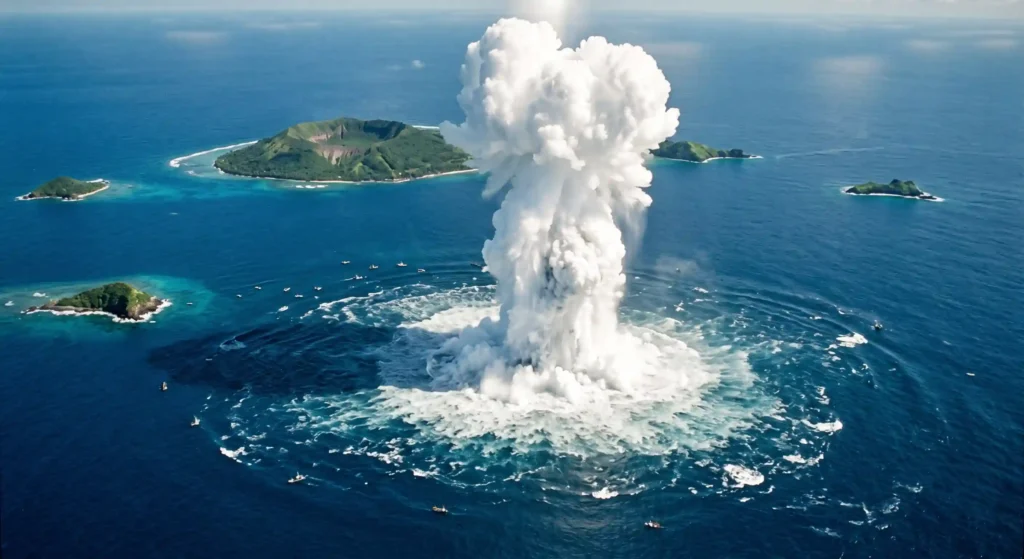
By the usual logic it should have chilled the planet. It did not. Because the vent sat beneath shallow seawater, the eruption injected an extraordinary quantity of water vapour into the stratosphere — on the order of 150 million tonnes — but comparatively modest sulfur. Water vapour is a greenhouse gas. Instead of a clean cooling signal, scientists measured a complicated mix of effects, with some studies concluding the eruption may have produced a slight net warming and disturbed stratospheric chemistry for years.
Hunga Tonga is the exception that proves the rule: it is the sulfur, delivered to the right altitude, that makes a volcanic winter. Height alone does not. Explosive power alone does not. Even the volume of erupted rock does not. This is exactly why the Volcanic Explosivity Index — which tracks volume and plume height but not sulfur — is a poor predictor of climate impact, a limitation covered in our companion article on what is a supervolcano.
What a Yellowstone-Scale Volcanic Winter Would Look Like
A future super-eruption from a volcano like Yellowstone would dwarf Tambora and produce a volcanic winter on a scale modern civilisation has never experienced. The stratosphere would be loaded with sulfur aerosols, dropping global temperatures by several degrees for years and slashing the growing seasons across the world’s major agricultural regions at once.
The greatest threat would not be the eruption’s blast or ash near the volcano, but the global disruption to food production — potentially triggering crop failures, food shortages, and economic chaos worldwide. This is exactly why the climatic aftermath, not just the eruption itself, is the focus of what if Yellowstone erupted tomorrow. The eruption scale and the supervolcanoes capable of producing it are detailed in our companion article on what is a supervolcano.
It is worth adding a note of scientific caution here, because the numbers in circulation vary enormously. Because of the aerosol-saturation effect described earlier, and because Yellowstone’s rhyolitic magma is not necessarily as sulfur-rich as the tropical eruptions we have measured, the USGS explicitly warns that the climate impact of a Yellowstone super-eruption is difficult to predict and could be milder than the most dramatic published scenarios. The full picture of what the system is actually capable of — and why an eruption is not on the horizon in the first place — is set out in our guide to the Yellowstone supervolcano.
What It Would Do to a Modern Food System
Here is the uncomfortable asymmetry: modern civilisation is far better than 1816 at surviving cold, and far worse at surviving a global harvest failure.
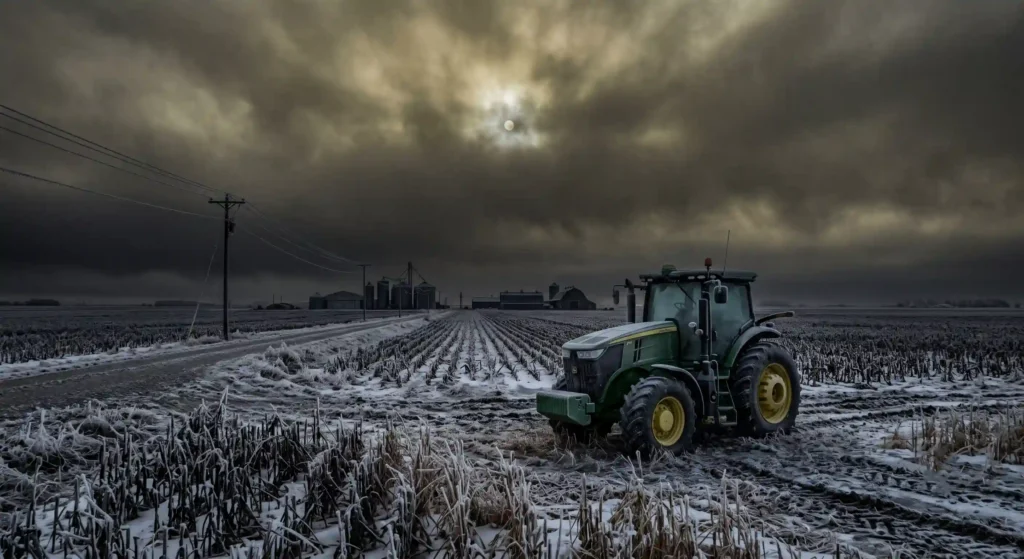
In 1816 most people ate food grown within a few dozen kilometres of where they lived. When the harvest failed, they starved locally — which was catastrophic, but the failure did not propagate. Today the world runs an efficient, tightly optimised, globally traded food system that holds only a few months of grain in reserve and depends on a handful of breadbasket regions: the North American Midwest, the Black Sea belt, the South American soy corridor, and South and East Asian rice deltas.
- Year 1 — the shortfall. A shortened growing season and cold snaps cut yields across multiple breadbaskets simultaneously. Stocks absorb the first hit; prices spike.
- Year 1–2 — export bans. This is the real accelerant. Producing nations restrict exports to protect their own populations, as happened during the 2008 and 2010 food price crises. Importing nations — many of them low-income and heavily dependent — face shortages far worse than the actual global production shortfall.
- Year 2–3 — reserve exhaustion. With reserves drawn down and a second and third failed harvest, price becomes irrelevant to availability. Fertiliser and fuel supply chains, themselves energy-intensive, come under strain.
- Year 3+ — adaptation. Shifts to cold-tolerant and fast-maturing crops, greenhouse and indoor production, and reallocation of grain from animal feed to human consumption. This last lever is larger than most people realise — a substantial share of global grain currently feeds livestock, not people.
The encouraging half of the analysis is that the levers exist. Global grain redistribution, a shift away from feed grain, cold-hardy cultivars, and coordinated release of strategic reserves could plausibly carry the world through a multi-year cooling event. The discouraging half is that every one of those levers requires international cooperation at precisely the moment when national governments are under maximum pressure to hoard.
Volcanic Winter vs Nuclear Winter
The two ideas are often used interchangeably, and they do share a mechanism — a stratospheric aerosol layer blocking sunlight. But the differences matter, and in some ways the volcanic version is the gentler of the two.
- The particle. A volcanic winter is driven by sulfate droplets, which scatter sunlight. A nuclear winter is driven by black soot from burning cities, which absorbs it — heating the stratosphere directly and making the soot layer loft even higher.
- The lifetime. Sulfate aerosols settle out within one to three years. Soot, lofted by its own absorbed heat, can persist for a decade or more.
- The severity. Modelled nuclear winter scenarios produce deeper and far longer cooling than any plausible volcanic event, along with severe ozone destruction.
- The warning. A super-eruption would announce itself with months or years of geological unrest. A nuclear exchange would not.
- The precedent. Volcanic winters have demonstrably happened, repeatedly, and we have measured one directly. Nuclear winter remains a modelled projection.
The overlap is not academic. Much of the modern understanding of nuclear winter comes from studying volcanic ones — Pinatubo in particular gave climate modellers a real-world stratospheric aerosol event to test their code against, and the models that reproduced Pinatubo correctly are the ancestors of the ones used for nuclear winter projections today.
What Volcanic Winters Taught Us About Geoengineering
There is one more reason scientists study these events so intensely: every volcanic winter is an unplanned full-scale experiment in cooling the planet on purpose.
The most discussed form of solar geoengineering — stratospheric aerosol injection — proposes deliberately releasing sulfate particles into the stratosphere to offset greenhouse warming. It is, in essence, a controlled artificial Tambora. Pinatubo in 1991 is the closest thing to a trial run: it demonstrated that the cooling works roughly as predicted, and it let researchers measure the side effects rather than guess at them.
Those side effects are the reason the idea remains deeply contested. After Pinatubo, scientists observed reduced global precipitation and disruption to monsoon patterns, accelerated ozone loss in the stratosphere, and a shift from direct to diffuse sunlight that changes how plants photosynthesise. There is also the termination problem: because the aerosols fall out within a few years, stopping an injection programme abruptly would unmask the accumulated warming all at once.
So the volcanic record cuts both ways. It proves the cooling lever exists and works. It also shows that pulling it is not a clean substitute for reducing emissions — you get the temperature drop bundled with a set of hydrological and chemical consequences you did not order.
Q&A
Typically one to three years, depending on the eruption’s size and how much sulfur it releases. The cooling peaks within a year or two as the sulfate aerosols spread through the stratosphere, then fades as the particles gradually settle out of the atmosphere.
Yes. By shortening growing seasons and lowering temperatures across major farming regions, a volcanic winter can cause widespread crop failures. The 1816 Year Without a Summer led to food shortages and famine across the Northern Hemisphere, and a much larger super-eruption could threaten global food security.
In recent history, 1816 — following Tambora — is the most famous, with summer temperatures across the Northern Hemisphere dropping enough to cause frost and snow in summer. Other eruptions, like a major event around 536 AD, also caused severe multi-year cooling recorded in tree rings and historical accounts.
It is impossible to predict precisely. A moderate volcanic winter can follow any sufficiently large, sulfur-rich eruption, which happen every few decades to centuries. A severe, super-eruption-scale volcanic winter is far rarer, occurring on timescales of tens of thousands of years, and none appears imminent.
The 1991 eruption of Mount Pinatubo in the Philippines injected roughly 20 million tonnes of sulfur dioxide into the stratosphere and lowered global average surface temperatures by about 0.5 °C for around two years. It is the best-measured volcanic cooling event in history and remains the benchmark against which climate models are tested.
Because cooling depends on sulfur reaching the stratosphere, not on explosive size. An eruption with sulfur-poor magma, or one whose plume stays below the tropopause where rain washes particles out, can be enormous and still have no global climate effect. Latitude matters too — tropical eruptions spread aerosol into both hemispheres, while high-latitude ones mostly affect one.
No. The January 2022 Hunga Tonga–Hunga Haʻapai eruption produced the highest plume ever recorded by satellite, but because it erupted through shallow seawater it delivered a huge amount of water vapour and relatively little sulfur. Water vapour is a greenhouse gas, so instead of clear cooling, researchers measured a mixed signal — with some studies finding a slight net warming effect.
Two independent archives. Ice cores from Greenland and Antarctica preserve annual layers containing sulfate spikes from past eruptions, and tree rings from cold-climate trees record the growth collapse that follows a cold summer. When both line up on the same year — and written records mention a dimmed sun or a failed harvest — the event can be dated with high confidence.
Only briefly, and not usefully. Even a large eruption cools the planet for a couple of years before the aerosols settle out, after which warming resumes exactly where it left off. The idea has inspired proposals for deliberate stratospheric aerosol injection, but the observed side effects of past eruptions — disrupted rainfall, monsoon changes and ozone loss — make it a heavily contested approach rather than a solution.
Many historians nominate 536 AD. A major eruption dimmed the sun for over a year, dropping Northern Hemisphere summer temperatures by as much as 2.5 °C, with a second eruption in 539–540 deepening the cold. The resulting decades of hardship — now called the Late Antique Little Ice Age — overlapped with famine, the Plague of Justinian, and widespread political upheaval.
The Bigger Question
A volcanic winter shows how a single eruption can reach across the entire planet through the climate — cooling the Earth and threatening harvests far from the volcano itself. Scale that up to a super-eruption from a giant like Yellowstone, and the global food system, not the local blast, becomes the real danger. That full chain of consequences is what we explore in what if Yellowstone erupted tomorrow.
To understand the eruptions powerful enough to trigger such a winter, read what is a supervolcano, and find more on Earth’s climate-shaping forces at the Geology hub.
Watch the Yellowstone scenario to see how one eruption could chill the whole world.