 By
By 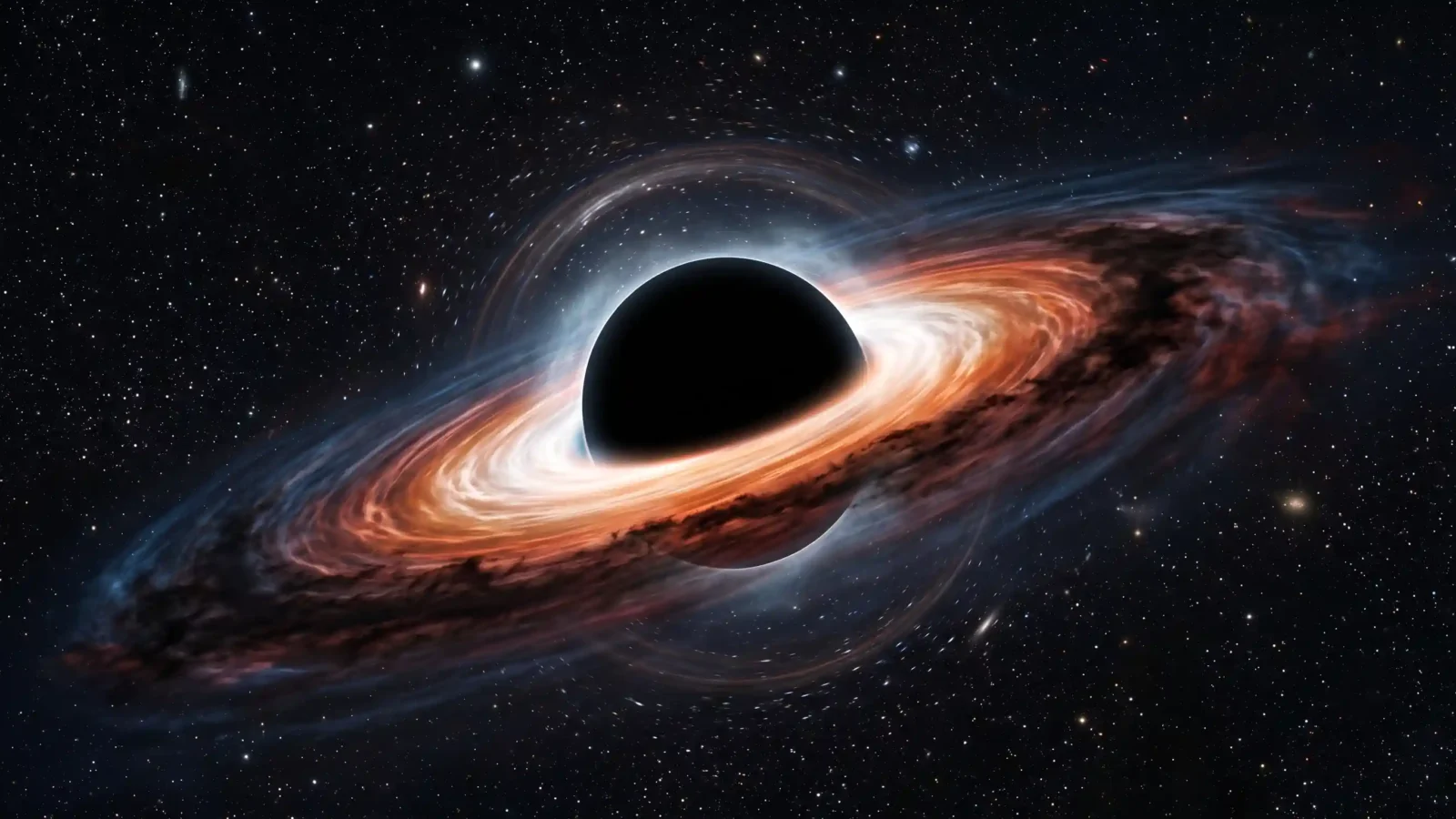
Quick Answer
The black hole information paradox is a deep conflict between two pillars of physics: quantum mechanics says information can never be destroyed, but black holes appear to destroy it. When a black hole slowly evaporates through Hawking radiation, the information about everything that fell in seems to vanish forever — which should be impossible. Resolving this paradox is one of the great challenges in physics, and recent work suggests the information is preserved after all.
It sounds abstract, but the information paradox sits at the fault line between the two most successful theories ever devised — quantum mechanics and Einstein’s general relativity — and they cannot both be fully right about black holes. This guide explains what “information” means here, why physics insists it cannot be lost, how Hawking radiation created the crisis, and the ingenious solutions scientists have proposed.
What Is the Information Paradox?
In physics, “information” refers to the complete quantum description of a system — the precise details that distinguish one arrangement of particles from another. A core principle of quantum mechanics is that this information is always conserved: in principle, if you knew the exact quantum state of a system now, you could reconstruct its past and predict its future. Information can be scrambled and hidden, but never truly erased.
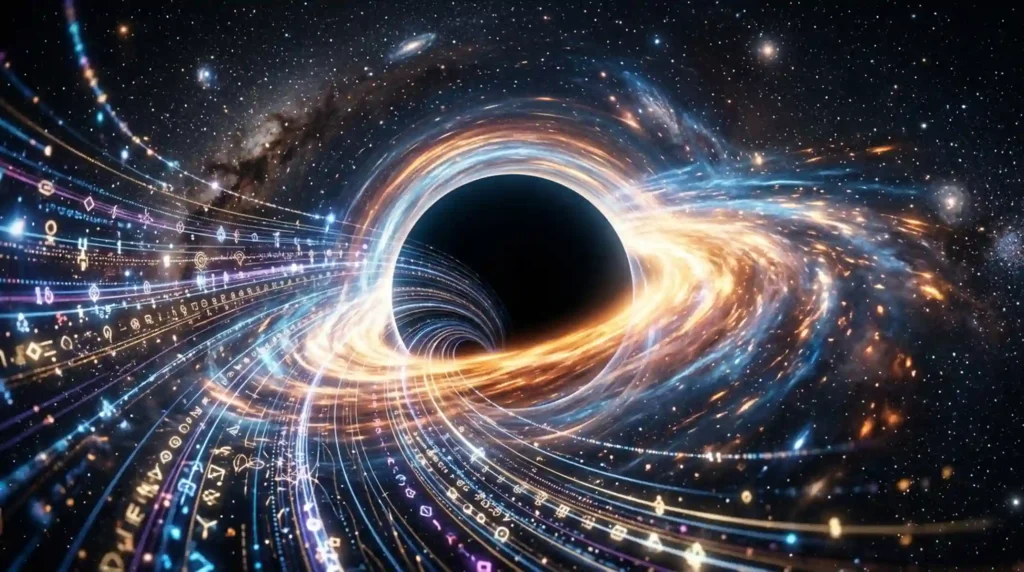
Black holes seem to violate this. According to general relativity, anything that falls into a black hole is lost behind the event horizon, and the black hole itself can be described by just three numbers — its mass, spin, and electric charge. All the rich detail of what fell in (a book, a star, a planet) appears to be wiped out. As long as the black hole exists, you might argue the information is merely hidden inside. The real crisis comes when the black hole disappears.
Why Physics Says Information Can’t Be Destroyed
The conservation of information is not a minor technicality — it is woven into the mathematical structure of quantum mechanics, a property called unitarity. Unitarity guarantees that the total probability of all possible outcomes always adds up to one, and that the evolution of a quantum system is, in principle, reversible. If information could simply vanish, this entire framework would break down, undermining the predictive power of quantum physics itself.
This is why physicists were so disturbed by the idea that black holes might destroy information. It is not just inconvenient; it would mean one of our most fundamental and well-tested theories is wrong at a basic level. Something had to give.
Hawking Radiation and the Problem It Created
The paradox sharpened dramatically in 1974, when Stephen Hawking showed that black holes are not perfectly black. Due to quantum effects near the event horizon, a black hole slowly emits radiation — now called Hawking radiation — and over immense timescales, it gradually loses mass and evaporates away entirely.
Here is the problem: Hawking’s calculation suggested this radiation is purely thermal, meaning it is random and carries no information about whatever fell into the black hole. So if the black hole eventually evaporates completely, leaving only this featureless radiation, the information about everything it ever swallowed would be gone for good — in direct violation of quantum mechanics. A black hole would be the one place in the universe where information truly dies. That is the paradox in its sharpest form.
Proposed Solutions (firewalls, holography, the island formula)
Physicists have proposed several ways out, each revealing something profound about the nature of reality.
- Holographic principle: all the information inside a black hole may be encoded on its two-dimensional surface, so nothing is truly lost — a cornerstone of the AdS/CFT approach.
- Black hole complementarity: information is both reflected at the horizon and falls in, with no single observer ever seeing a contradiction.
- Firewalls: a controversial proposal that a wall of high-energy particles at the horizon would destroy infalling matter — preserving information but breaking other expectations.
- The island formula: recent calculations using “replica wormholes” show that Hawking radiation can carry information out after all, reproducing the expected “Page curve.”
The most promising recent breakthrough is the “island formula,” developed around 2019–2020. Using subtle quantum-gravity calculations, physicists showed that the entanglement of Hawking radiation follows the so-called Page curve — the pattern expected if information is preserved. This strongly suggests the information escapes, though exactly how it is encoded in the radiation is still being worked out.
How White Holes Enter the Debate
One intriguing line of thought involves white holes — the theoretical opposite of black holes, which expel matter rather than swallow it. Some quantum-gravity proposals suggest that when a black hole finishes evaporating, it might transition into a white hole, releasing the trapped information back into the universe rather than destroying it. In these “black hole to white hole” or “Planck star” models, the information that seemed lost is ultimately returned.
This is one reason the collision of these two opposites is such a fertile thought experiment, explored in what if a white hole collided with a black hole. White holes and black holes are also the two ends of the theoretical tunnels described in our article on wormholes, tying the information paradox to some of the strangest geometry in physics.
Why It Matters for a Theory of Everything
The information paradox is far more than a puzzle about black holes. It is a precise testing ground for the long-sought unification of quantum mechanics and gravity — a “theory of everything.” Because the paradox arises exactly where the two theories collide, any successful resolution must reveal how they fit together. The progress made on it, from the holographic principle to the island formula, has already reshaped how physicists think about space, time, and information, and may be pointing the way toward the deeper theory that lies beneath both.
Q&A
Not completely, but there has been major progress. Recent calculations strongly indicate that information is preserved and escapes in the Hawking radiation, reproducing the expected “Page curve.” The precise mechanism by which the information is encoded, however, is still an active area of research.
It means the complete quantum description of a system — the exact details that distinguish one physical state from another. Quantum mechanics holds that this information can be transformed or hidden but never destroyed, which is precisely what black holes appeared to violate.
Yes. For years Hawking argued information was destroyed, but in 2004 he conceded that it is likely preserved, and famously paid off a bet to physicist John Preskill. His shift reflected growing evidence from the holographic principle that black holes do not destroy information after all.
Current thinking says yes — it is gradually returned, encoded in the subtle correlations of Hawking radiation as the black hole evaporates. Some speculative models also suggest a black hole could end its life as a white hole, releasing its trapped information in a final burst.
The Bigger Question
The information paradox hints that black holes are not simply cosmic shredders — the information they swallow may find a way back out, perhaps even through their theoretical opposite, the white hole. What would happen if a black hole, which devours everything, met a white hole, which releases everything? That ultimate confrontation is the subject of what if a white hole collided with a black hole.
The escape route for information runs through Hawking radiation, and the geometry connecting these objects appears in our piece on wormholes. Explore more on the Extreme Physics hub.
Watch the white hole scenario to see the two opposite ends of gravity collide.