 By
By What Is the Solar Cycle and Why Does the Sun’s Magnetic Field Flip?
The solar cycle is an approximately 11-year pattern of increasing and decreasing sunspot activity driven by the Sun’s internal magnetic dynamo. The Sun’s magnetic field is generated by the differential rotation of its plasma — the equatorial regions rotate faster (about every 25 days) than the poles (about every 35 days). This differential stretches and twists magnetic field lines, building tension over roughly 11 years until the poles flip entirely.
At solar maximum — the peak of sunspot activity — the Sun’s magnetic north and south poles reverse. The sunspot cycle reflects this: sunspot groups appear at mid-latitudes early in a cycle and migrate toward the equator over time (Spörer’s Law). We are currently in Solar Cycle 25, which reached solar maximum in late 2024, near the strongest period in 20 years. This means the magnetic field flip has been happening right now — gradually, over months — and the complete reversal is essentially underway.
What Actually Changes When the Solar Cycle Peaks and the Field Flips?
The flip itself is not an instantaneous event, but the period around solar maximum brings measurable changes to Earth’s space environment:
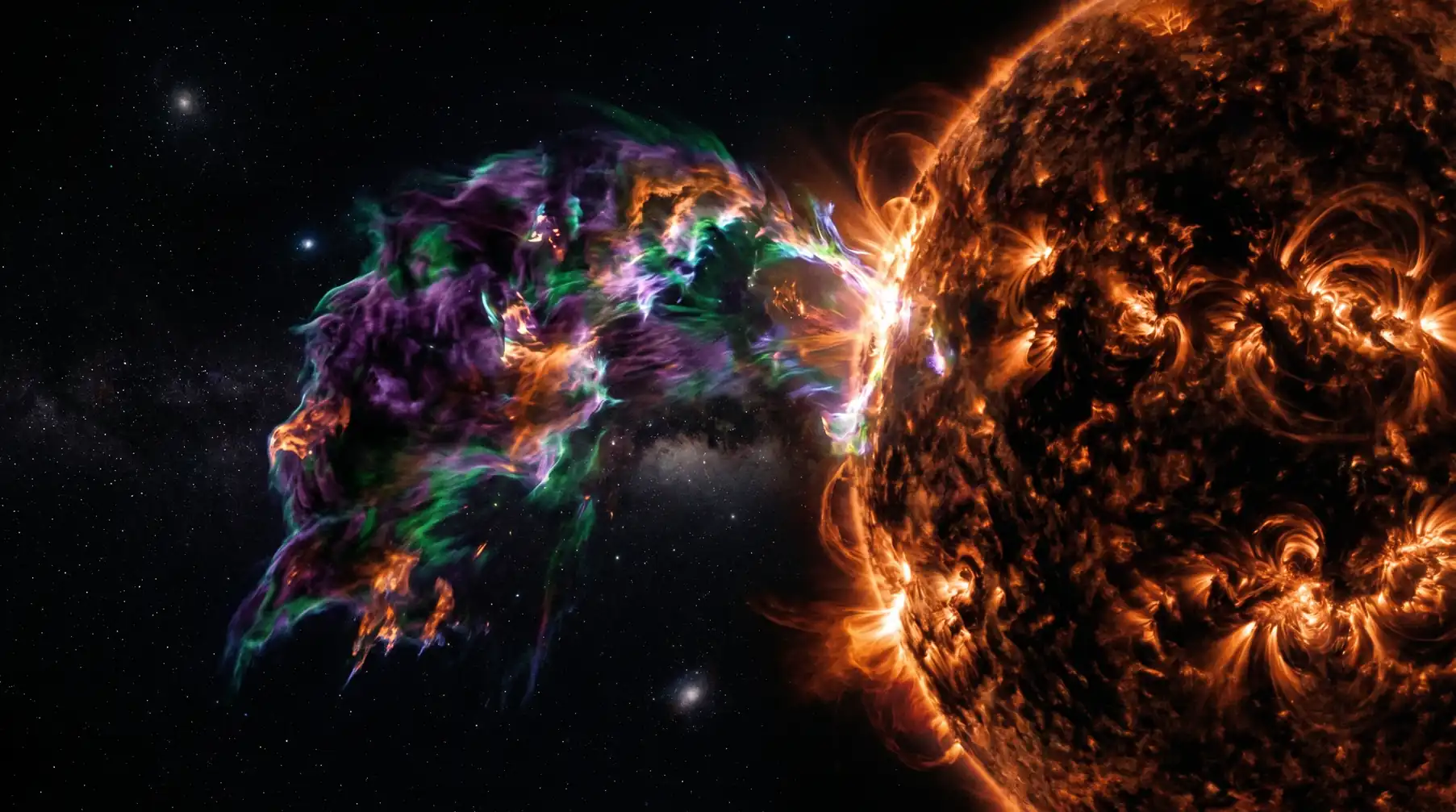
- Coronal mass ejections (CMEs): CME frequency rises from about 1 per day at solar minimum to 3–5 per day at solar maximum. A large CME carries a billion tonnes of magnetised plasma at 1,000–3,000 km/s.
- Solar flares: X-class flares — the most powerful — occur multiple times per month at maximum vs. once or twice per year at minimum.
- Cosmic ray flux: During the transition the heliospheric current sheet becomes more convoluted, briefly reducing its effectiveness as a shield against galactic cosmic rays. Radiation exposure at aircraft altitudes and in low Earth orbit increases by ~10–15%.
- Geomagnetic storms: Large CMEs that strike Earth can create G4–G5 storms, inducing currents in power transmission lines that can trip circuit breakers or burn out transformers.
What Was the Carrington Event, and Could It Happen Again?
The most powerful recorded geomagnetic storm occurred on 1–2 September 1859, when a massive coronal mass ejection struck Earth. The Carrington Event induced currents so strong that telegraph operators received electric shocks and their machines caught fire; the Northern Lights were visible as far south as Cuba. A similar event today would affect a globally interconnected electrical grid that simply did not exist in 1859.
A 2013 Lloyd’s of London report estimated that a Carrington-scale geomagnetic storm today could cause $0.6–2.6 trillion in damage to the US electrical grid alone, with recovery times of 4–10 years for the most severely affected areas. The event is not a question of if but when: the Carrington Event had an estimated recurrence interval of roughly 150 years, and we are past that. The 2003 “Halloween storms” were the largest of the modern satellite era, causing blackouts in Sweden and destroying 14 power transformers in South Africa.
What Would an Abrupt, Extreme Field Flip Look Like?
The Sun’s solar cycle flip is gradual — it takes months for the poles to reverse, and the transition period is typically characterised by a complex multipole field where north and south poles temporarily coexist. A truly abrupt flip (completing in hours or days rather than months) has no precedent in the solar record. Stellar observations suggest some stars do flip more rapidly, but for the Sun the evidence suggests slow, gradual reversals every cycle.
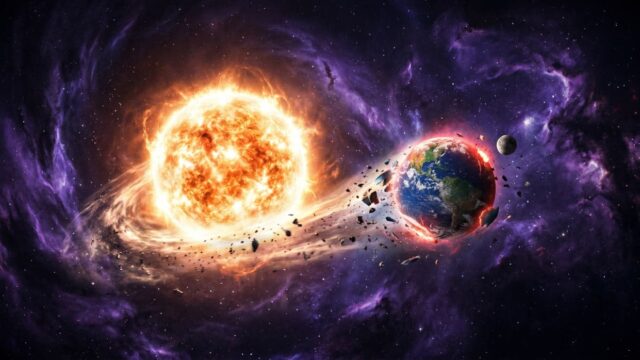
The primary space weather risk around solar maximum is not the flip itself — it’s the increased frequency of solar flares and coronal mass ejections that accompanies the scrambled, high-energy field configuration during peak activity. The Sun’s magnetic field during maximum is messier and more energetic, creating more opportunities for magnetic reconnection events that launch CMEs toward Earth.
Q&A
The solar cycle is an approximately 11-year pattern of rising and falling sunspot activity driven by the Sun’s internal magnetic dynamo. At solar maximum, the Sun’s magnetic poles reverse. At solar minimum, activity quiets and the poles are stable. We are currently in Solar Cycle 25, which reached maximum around late 2024.
A coronal mass ejection (CME) is a large burst of magnetised plasma released from the Sun’s corona. CMEs can contain up to a billion tonnes of charged particles travelling at up to 3,000 km/s. When a CME’s magnetic field connects with Earth’s magnetosphere in the right orientation, it causes geomagnetic storms.
A powerful geomagnetic storm from a solar flare or CME could damage undersea internet cables (which carry ground currents from geomagnetically induced currents), disrupt satellite communications, and destroy transformers in high-latitude power grids. A study by University of California Irvine estimated a Carrington-scale event could cause internet outages lasting weeks to months globally.
The Sun’s magnetic poles flip roughly every 11 years, aligned with solar maximum. The transition from north-to-south and south-to-north takes several months and is preceded by a period of complex multipole magnetic geometry. The last complete reversal occurred around late 2024 as Solar Cycle 25 peaked.
Space weather refers to changing conditions in the space environment — primarily caused by solar activity — that affect Earth’s magnetosphere, ionosphere, satellites, power grids, and communications systems. Severe space weather from large CMEs is the primary natural hazard to modern technological infrastructure, with estimated economic impacts in the hundreds of billions to trillions of dollars for extreme events.
Internal links: space facts | What If a Magnetar Replaced the Moon? | What If Earth’s Core Solidified?