 By
By Why Melting Mars’ Ice Caps Could Restart an Atmosphere
Terraforming Mars is not science fiction — it is an engineering problem with real, solvable constraints. The Martian atmosphere today is about 95% CO₂ but so thin (0.006 atm) that liquid water cannot exist on the surface. The polar ice caps hold the answer: the south polar cap alone contains a layer of frozen CO₂ up to 8 metres thick sitting atop a much larger water-ice deposit. Release that frozen CO₂ and you trigger a greenhouse feedback loop that could, in principle, begin making Mars habitable.
A 2018 study in Nature Geoscience by Bruce Jakosky and Christopher Edwards found that even releasing all accessible Martian CO₂ reservoirs would only raise atmospheric pressure to about 1.2% of Earth’s — not enough for humans without suits, but enough to dramatically change the planet’s thermal environment and, crucially, to keep liquid water stable across larger areas of the surface.
What Is Actually in the Two Ice Caps
The two poles are not mirror images of each other, and the difference matters enormously for any warming scheme, because only one of them holds a meaningful reserve of the gas you actually want.
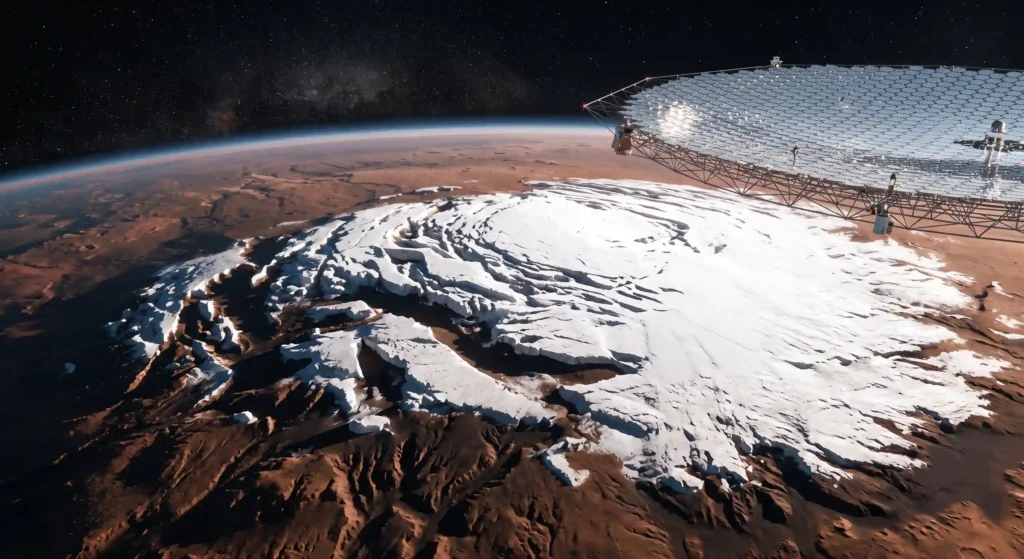
- The north polar cap (Planum Boreum). Almost entirely water ice, in layered deposits up to roughly 3 kilometres thick and containing on the order of 800,000 cubic kilometres of ice — enough, if melted and spread evenly over the whole planet, to form a global layer several metres deep. Its carbon-dioxide component is only a thin seasonal frost that condenses each winter and sublimates every spring.
- The south polar cap (Planum Australe). Also predominantly water ice, but with something the north lacks: a permanent slab of frozen carbon dioxide sitting on top, and buried CO₂ deposits within the layered terrain beneath. This is the only substantial reservoir of solid CO₂ on the planet, which is why every mirror proposal points south.
- The seasonal cycle. Roughly a quarter of the entire Martian atmosphere freezes onto whichever pole is in winter and sublimates back in spring. Atmospheric pressure across the planet rises and falls measurably with the seasons — the atmosphere is small enough that its polar caps are effectively a bank account it draws on twice a year.
The asymmetry sets up the central tension of the whole scheme. The water is mostly in the north; the carbon dioxide you need to trap heat is in the south. And the water ice is the wrong target for a first move — melting it does nothing for atmospheric pressure, and liquid water at 0.006 atm boils away rather than pooling. You have to fix the air before the water is any use at all.
How Would an Orbital Solar Mirror Work?
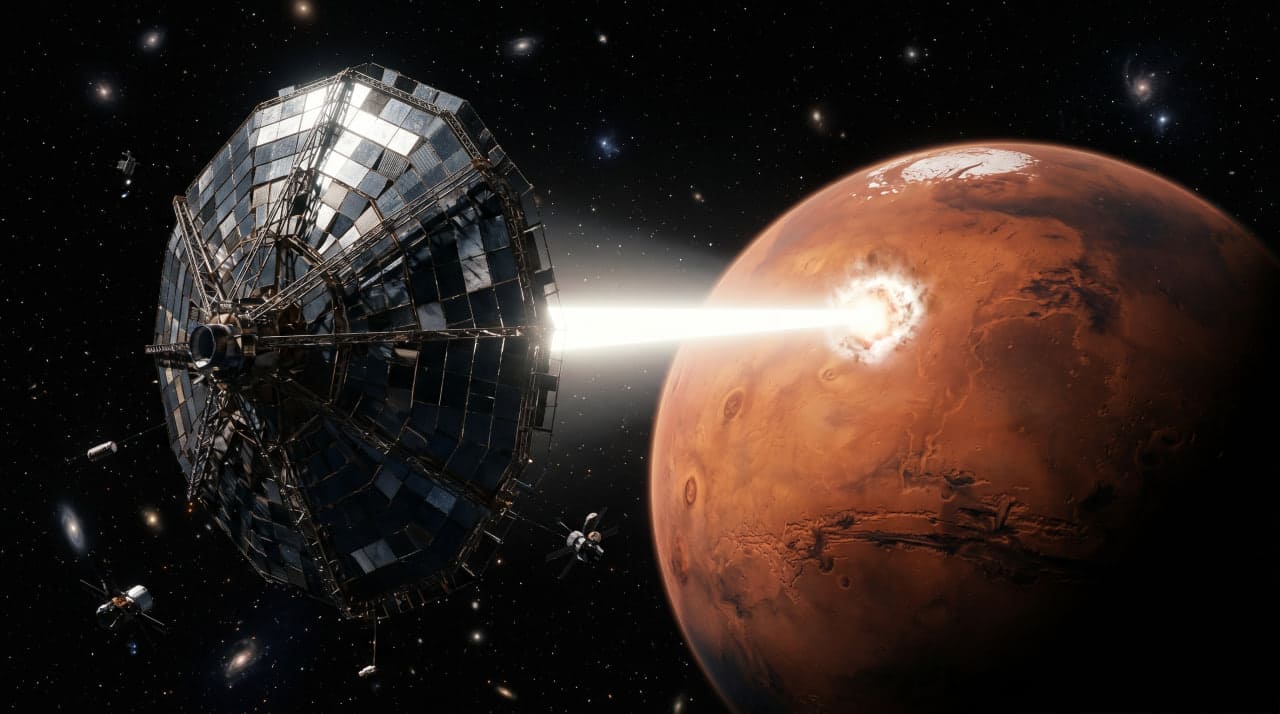
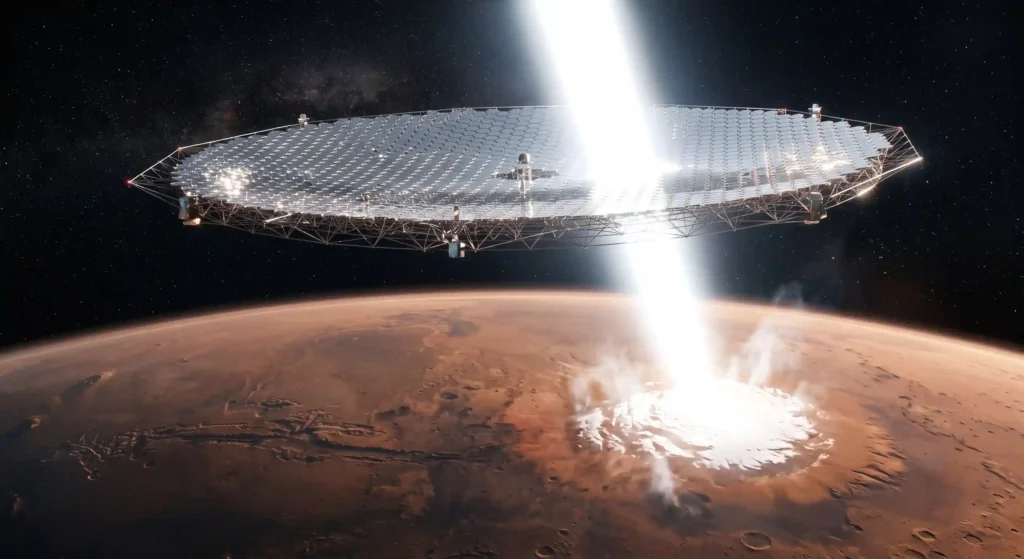
The concept of using an orbital solar mirror for planetary engineering dates to Carl Sagan’s early Mars terraforming proposals. A highly reflective mylar or aluminium film mirror positioned at a Mars-Sun Lagrange point would redirect concentrated sunlight onto the polar regions.
To picture the scale of the engineering:
- Mars receives about 590 W/m² of sunlight (vs Earth’s 1,361 W/m²)
- To melt the CO₂ polar cap requires delivering roughly 4 × 10²⁰ joules of heat
- A mirror 200 km in diameter concentrating sunlight onto the south pole could deliver this energy in approximately 50–100 years
- The mirror’s total mass, using ultra-thin reflective film, could be as low as a few million kilograms — feasible with future heavy-lift rockets
The mirror doesn’t need to melt the ice directly. It needs to raise the polar surface temperature by just 5–7°C — enough to trigger CO₂ sublimation, which then feeds the greenhouse effect, which melts more ice, which releases more gas: a planetary engineering cascade.
Where Would You Actually Park It?
“Position it at a Lagrange point” hides a genuine problem. A mirror this large and this light is not a normal spacecraft — it is a solar sail with a job, and sunlight pushes on it hard enough to break the orbital mechanics that Lagrange points depend on.
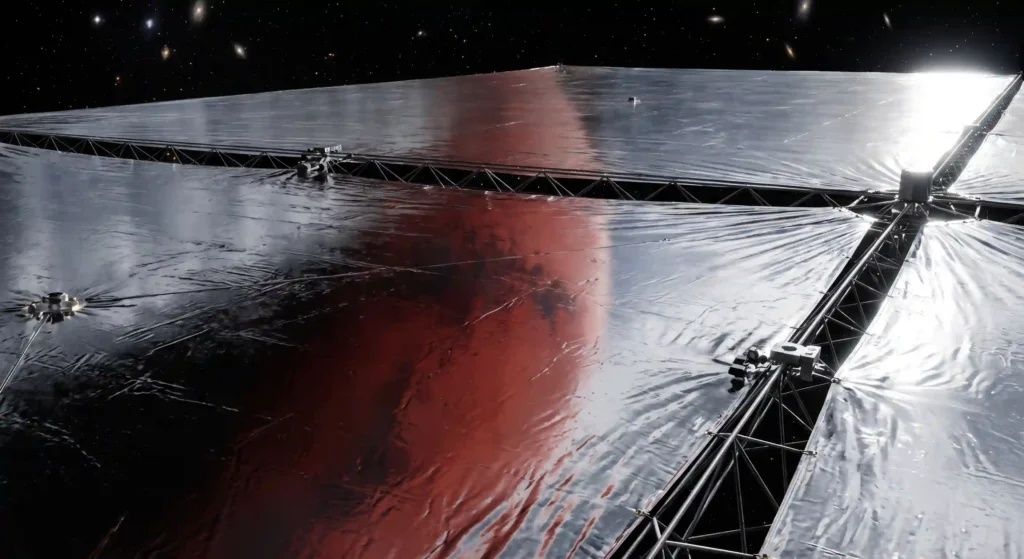
Radiation pressure at Mars is roughly 2 micronewtons per square metre on a reflective surface. Trivial for a dense satellite. For a film weighing a few grams per square metre, that force is comparable to the local gravitational and centrifugal terms — so the mirror would be steadily blown out of any classical L1 position.
The physicist Robert Forward proposed the workaround decades ago: the statite. Instead of orbiting, a sufficiently light reflector can hover, using radiation pressure itself to balance gravity and hold a fixed position relative to the planet. This turns the problem from a liability into a feature — a statite can be parked somewhere no orbit exists, including directly over a pole.
That leads to a second, subtler constraint that most popular accounts skip entirely. Mars’ rotation axis is tilted about 25 degrees, so its poles spend half the Martian year — roughly 11 Earth months — in total darkness. A mirror in a simple sunward position cannot illuminate a pole that is facing away from the Sun. Any workable design has to either hold a steeply off-axis station, accept a roughly 50% duty cycle, or use a constellation of reflectors rather than one disc. The single giant mirror of the illustrations is the easiest version to draw and the hardest version to fly.
The Construction Problem
A 200-kilometre disc has an area of roughly 31,000 square kilometres — comparable to Belgium. Building anything of that area, in space, is the part of the proposal that separates it from every engineering project in human history.
The mass estimate above assumes ultra-thin film. It is worth checking against what has actually flown. Japan’s IKAROS solar sail used a polyimide membrane around 7.5 micrometres thick; LightSail 2 used aluminised Mylar around 4.5 micrometres. Films like these run to several grams per square metre. At even 1 gram per square metre — thinner than anything yet deployed in space — a 31,000 km² mirror masses around 31,000 tonnes. At a more realistic few grams per square metre, it is hundreds of thousands of tonnes.
For scale, that is thousands to tens of thousands of fully loaded heavy-lift launches — and to Mars, not to low Earth orbit, which multiplies the requirement again. Launching the mirror from Earth is not a hard project; it is arithmetic that does not close.
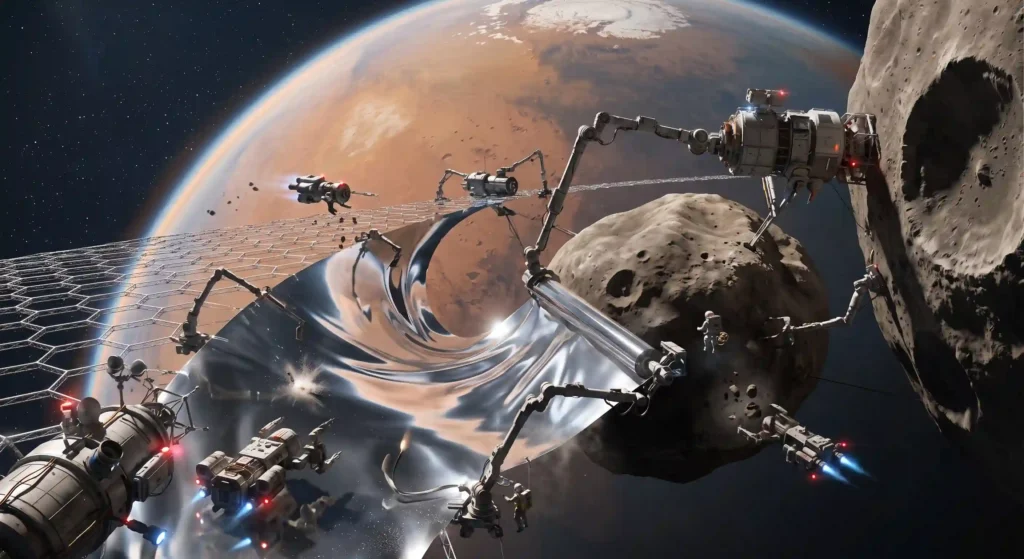
Which is why serious versions of the concept assume the mirror is never launched at all. It would have to be manufactured in space from material already there — most plausibly the Martian moons Phobos and Deimos, which are small, close, and sit at the bottom of almost no gravity well. Extracting metals, rolling reflective film, and assembling structures autonomously across thousands of square kilometres implies a mature in-space industrial economy. The mirror is not a mission. It is the output of a civilisation that already has heavy industry off Earth.
Is Terraforming Mars Actually Possible at This Scale?
The warming from released CO₂ alone is insufficient to complete terraforming Mars to Earth-like conditions. CO₂ is a greenhouse gas but a relatively weak one compared to water vapour. However, liquid water on mars — even in small quantities initially in low-lying basins — would produce water vapour, which is a much stronger greenhouse gas. The two-gas feedback loop could, over centuries, push equatorial surface temperatures above 0°C regularly.
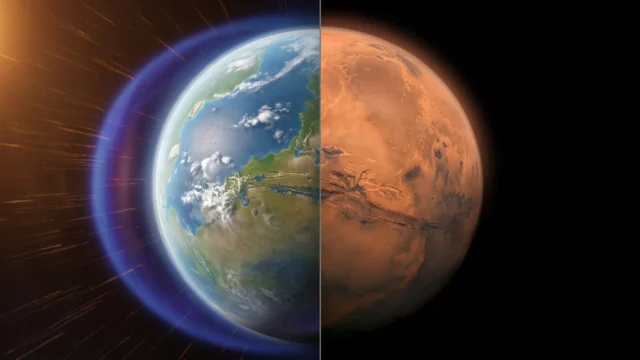
The remaining barriers are significant. Mars has lost its global magnetic field — the magnetosphere that once protected it from solar wind stripping of the atmosphere collapsed roughly 4 billion years ago when the Martian core cooled. A terraformed Martian atmosphere would continue leaking to space at a rate of about 100 grams per second without an artificial magnetic shield, a separate and even larger engineering challenge.
Mars colonization scenarios typically use a staged approach: orbital solar mirror to warm the poles → atmospheric thickening → pressurised surface habitats while the atmosphere develops → eventual full surface access over 500–1,000 years.
The CO₂ Numbers, Reconciled
You will see wildly different pressure figures quoted for what Mars could reach, and the disagreement is not sloppiness — it comes from which reservoirs an author counts as reachable. It is worth laying them out separately.
- Today: about 6 millibars — roughly 0.6% of Earth’s sea-level pressure, and it varies seasonally as CO₂ freezes onto and sublimates off the poles.
- The south polar CO₂ ice: roughly 10–12 millibars’ worth. This is the reservoir a mirror would directly target. Releasing all of it roughly triples the atmosphere — a genuinely dramatic change that nonetheless leaves you at under 2% of Earth’s pressure.
- CO₂ adsorbed in the regolith: a few millibars more. Bound to soil grains across the planet, released slowly by warming, and difficult to mobilise deliberately.
- Everything realistically accessible: roughly 15–20 millibars. This is the figure at the heart of the 2018 analysis, and it is why the study concluded terraforming is not achievable with present-day technology.
- Carbonate rock: potentially far more, and effectively locked. Much of Mars’ original carbon dioxide did not escape to space — it reacted with water and rock and was buried as carbonate minerals. Curiosity’s 2025 detection of iron carbonate (siderite) in Gale Crater sediments provided direct ground-truth for this. Counting deep carbonate deposits produces the higher upper-bound figures sometimes quoted, but extracting it would mean strip-mining and thermally decomposing a substantial fraction of the planet’s crust.
So the honest framing is this. A mirror could plausibly triple the Martian atmosphere. Tripling six millibars gets you to about eighteen. Human survival without a pressure suit requires roughly 300 millibars minimum, and comfortably more. The mirror does not fail because the physics is wrong — the greenhouse cascade is real. It fails because the fuel tank is nearly empty before you start.
What Would Go Wrong
Even granting the mirror exists and is correctly positioned, a set of failure modes sits between the plan and the outcome.
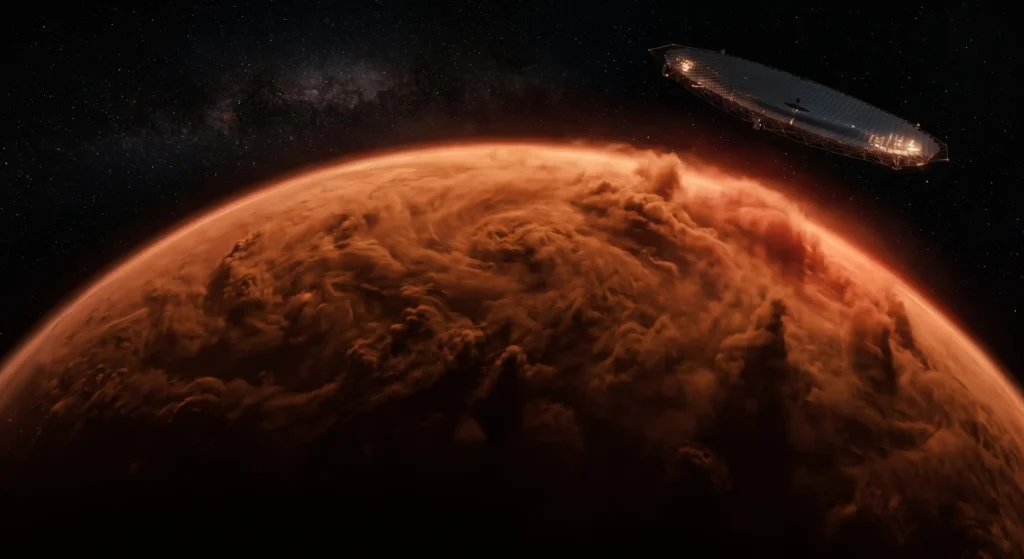
- Global dust storms. Every few Martian years, dust storms engulf the entire planet for weeks to months, blocking a large fraction of incoming sunlight. The 2018 storm ended the Opportunity rover’s mission by starving its solar panels. A mirror scheme depending on delivered insolation would have its power supply interrupted, unpredictably, for extended periods.
- Albedo feedback runs the wrong way at first. Fresh CO₂ frost is bright and reflective. As it sublimates it exposes darker terrain, which absorbs more heat — a helpful positive feedback. But warming also lifts more dust into the atmosphere, and airborne dust reflects sunlight back to space. Whether the net feedback accelerates or damps the warming is genuinely uncertain.
- Sublimation, not melting. At Martian pressures, CO₂ ice does not melt into liquid — it goes straight from solid to gas. So does water ice across most of the planet. There is no meltwater stage until the pressure is already high enough, which means the appealing image of polar ice caps running as rivers is out of sequence.
- Station-keeping over centuries. A structure the area of Belgium, made of film microns thick, would be steadily degraded by micrometeoroids, ultraviolet exposure and thermal cycling — and it must hold position for a century or more. Maintenance, not construction, may be the binding constraint.
- Dual use. An orbital reflector capable of raising a polar region’s temperature is, by definition, capable of directing concentrated sunlight anywhere else. Any real proposal would have to survive that objection before a single square metre was built.
What Would Mars Look Like After the Ice Caps Melted?
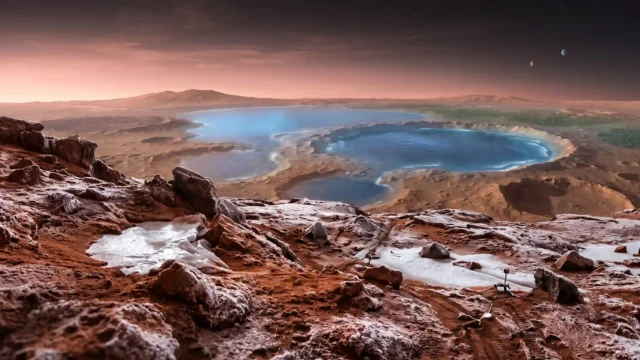
The southern polar ice cap contains water ice beneath the CO₂ layer. As the CO₂ sublimates, the water ice underneath — estimated at hundreds of thousands of cubic kilometres — would eventually melt too, flowing into the ancient Martian outflow channels and potentially refilling parts of the ancient northern ocean basin (Vastitas Borealis) that covered perhaps a third of the planet 3.5 billion years ago. Liquid water on mars at scale would be the most profound change to the planet since its ancient hydrological period ended.
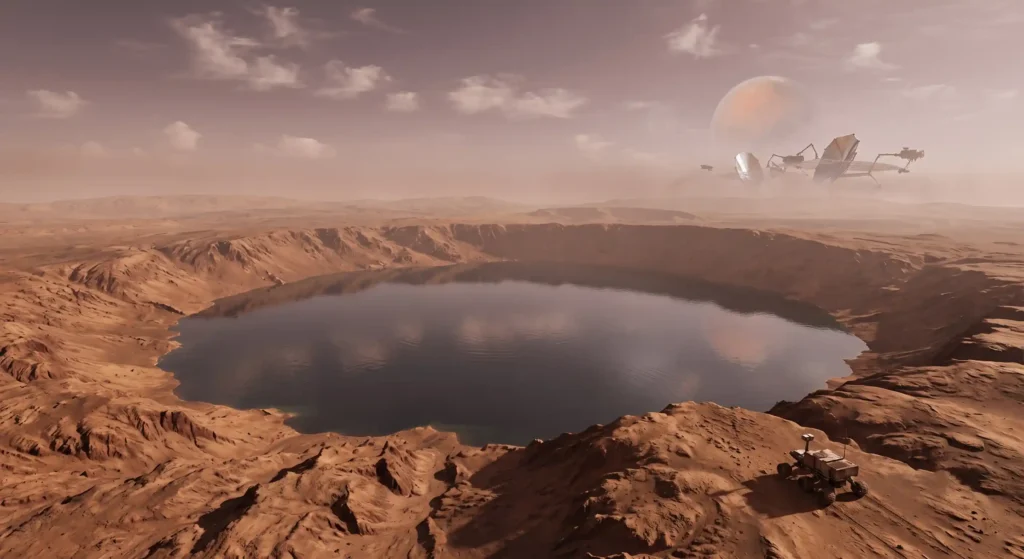
Mars temperature at the equator today already reaches 20°C on summer afternoons, but plummets to -80°C at night. With a denser atmosphere retaining heat, the diurnal temperature swing would compress dramatically, and the equatorial band would become the first region suitable for pressurised greenhouse agriculture.
The Cheaper Rival: Engineered Nanoparticles
In August 2024, a team led by Samaneh Ansari and Edwin Kite published an alternative in Science Advances that makes the mirror look almost quaint. Instead of building a reflector the size of a country, release engineered dust into the Martian atmosphere.
The particles are conductive nanorods roughly nine micrometres long, manufactured from iron and aluminium already abundant in Martian regolith. Their geometry is tuned so that they forward-scatter incoming sunlight down toward the surface while blocking infrared heat from radiating back out — a one-way valve for energy. The team calculated a warming of more than 30 °C, potentially within a decade of continuous release.
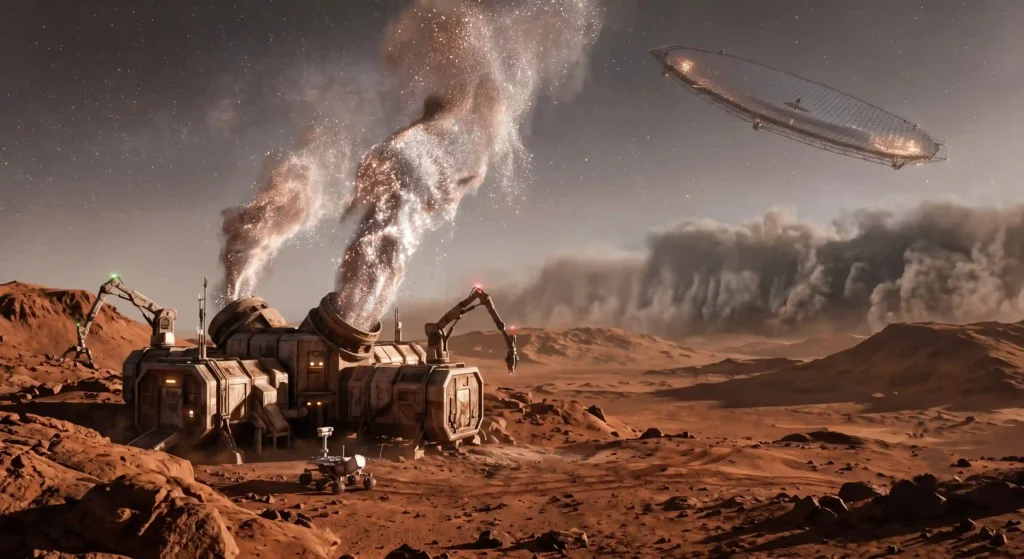
The efficiency comparison is stark. Per unit of warming delivered, the approach is estimated to be thousands of times more efficient than manufacturing artificial greenhouse gases, and it requires no orbital megastructure at all — just a surface industrial process feeding particles into the air. Feedstock is local. There is no station-keeping problem, no dust-storm shadowing of a distant reflector, and no launch mass from Earth beyond the factory.
It shares the mirror’s fundamental limitation, though. Warming Mars by 30 °C releases the frozen CO₂, and the frozen CO₂ is still only worth about fifteen millibars. Both approaches solve the temperature problem and leave the pressure problem untouched. That is the honest state of the field: the warming step now looks tractable, and the step after it does not.
Would Anyone Be Allowed To Do It?
The legal and scientific objections arrive well before the engineering ones, and they are not easily dismissed.
The 1967 Outer Space Treaty, ratified by every spacefaring nation, contains Article IX, which obliges parties to avoid “harmful contamination” of celestial bodies and to consult internationally before any activity that might cause “potentially harmful interference.” Deliberately altering the climate of an entire planet is difficult to characterise as anything else. The treaty also prohibits national appropriation, which raises an unresolved question about who would hold authority over a terraforming programme, or standing to object to one.
Then there is planetary protection. COSPAR’s guidelines already impose strict sterilisation requirements on spacecraft visiting regions where Martian life could plausibly exist — and the subsurface brines and ice deposits are exactly those regions. If microbial life exists on Mars, warming and wetting the planet would be the largest and most irreversible contamination event imaginable, potentially destroying a second, independent origin of life before it was ever detected. Many planetary scientists argue that a thorough search must come first, and that this alone pushes any terraforming decision well past the current century.
The Honest Verdict
The space mirror is the rare grand proposal whose physics survives scrutiny while its engineering does not. Concentrating sunlight on a polar cap would raise its temperature. Raising the temperature would sublimate CO₂. More CO₂ would trap more heat. Every link in that chain is real.
What fails is everything around it: a reflector the area of Belgium that cannot be launched and must be manufactured in space; a position that classical orbital mechanics does not provide; a target that spends half the year in darkness; centuries of maintenance; and, at the end of it, an atmosphere roughly three times thicker than today’s and still under 2% of Earth’s. The mirror buys a genuinely different Mars — one where liquid water is stable in low-lying basins and equipment can operate more easily — but not a Mars anyone walks on unprotected.
That is worth stating plainly, because the mirror is usually presented as the first move in a plan rather than as one option among several with a hard ceiling. Where it sits in the full sequence — alongside the nanoparticle approach, imported volatiles, artificial magnetic shielding, the oxygen problem that dwarfs all of them, and the domed-habitat path that will actually come first — is mapped out in our complete guide to terraforming Mars.
Q&A
The physics is sound — an orbital solar mirror could melt the CO₂ ice caps and trigger atmospheric thickening — but the engineering scale is far beyond current capability. The mirror would need to be hundreds of kilometres across. Making Mars habitable fully would take centuries even with the best plausible technology.
A 200 km orbital solar mirror focused on the Martian south pole could sublimate the CO₂ ice cap within 50–100 years. Full Mars terraforming to breathable-air conditions, however, would take 500–1,000 years minimum, accounting for atmospheric buildup, magnetic field engineering, and biological seeding.
The Martian south polar cap has a permanent layer of water ice topped by a seasonal CO₂ frost layer up to 8 metres thick. The north polar cap is mostly water ice (up to 3 km deep) with a thin seasonal CO₂ covering. Combined, the caps hold enough frozen CO₂ and water to significantly alter the Martian atmosphere if released.
No. Even releasing all Martian CO₂ reserves — from ice caps, regolith, and rocks — would only raise atmospheric pressure to about 1.2% of Earth’s, per a 2018 Nature Geoscience study. That’s enough to allow liquid water in some regions but not enough to breathe without supplemental oxygen or a pressure suit.
The loss of Mars’ global magnetic field is the most fundamental obstacle. Without a magnetosphere, the solar wind strips any rebuilt atmosphere at ~100 g/s. Solving this likely requires either an artificial magnetic dipole at the Mars-Sun L1 point or a fundamentally different approach to atmospheric retention.
Proposals centre on a reflector roughly 200 kilometres in diameter — about 31,000 square kilometres of surface, comparable in area to Belgium. Using film as thin as any solar sail yet flown, that structure would mass tens to hundreds of thousands of tonnes, which is why serious versions of the concept assume it would be manufactured in space from Phobos or Deimos material rather than launched from Earth.
Not at first. At current Martian pressures, both CO₂ ice and water ice sublimate directly from solid to gas without passing through a liquid stage. Liquid water only becomes stable once atmospheric pressure has already risen well above today’s 6 millibars — so the gas comes first and the rivers, if they ever arrive, come much later.
Because a mirror this large and this light behaves like a solar sail. Radiation pressure on a film weighing only a few grams per square metre is strong enough to push it out of any classical Lagrange position. The workaround is a “statite” — a reflector light enough that sunlight pressure itself balances gravity, letting it hover at a fixed point rather than orbit. The Martian axial tilt adds a second problem: each pole spends about eleven Earth months per year in darkness.
Yes — the leading alternative is the 2024 nanoparticle proposal published in Science Advances. It involves releasing engineered conductive nanorods, made from iron and aluminium already present in Martian dust, into the atmosphere. They scatter sunlight downward while trapping outgoing heat, and could warm Mars by over 30 °C within roughly a decade, at an estimated efficiency thousands of times better than manufacturing greenhouse gases — with no orbital megastructure required.
It is legally unresolved and scientifically contested. Article IX of the 1967 Outer Space Treaty obliges nations to avoid harmful contamination of celestial bodies and to consult before activities causing potentially harmful interference. COSPAR planetary-protection rules already restrict access to regions where Martian life might exist — which includes the subsurface ice and brines a warming programme would target. Many scientists argue a thorough search for native life must come first.
Internal links: space facts | What If a Rogue Star Ejected Earth? | What If Earth’s Core Solidified?