 By
By What Is String Theory and What Is a Braneworld?
Superstring theory — and its 11-dimensional completion, M-theory — proposes that the fundamental constituents of nature are not point particles but tiny vibrating strings of energy whose different vibrational modes manifest as different particles. To be mathematically consistent, string theory requires 10 or 11 spacetime dimensions. The extra dimensions beyond our familiar four (three spatial + one time) are either compactified (curled up too small to detect) or exist as extended extra dimensions accessible only to gravity.
A brane (short for membrane) is a multidimensional surface on which open strings — and therefore all ordinary matter and force particles — are confined. In the most studied braneworld models, our entire universe is a 3-brane: a three-dimensional slice through a higher-dimensional “bulk” space. Gravity, unlike other forces, propagates through all dimensions — both on the brane and through the bulk — which is why gravity is so much weaker than the other fundamental forces (the “hierarchy problem”).
How Would Braneworld Collision Work?
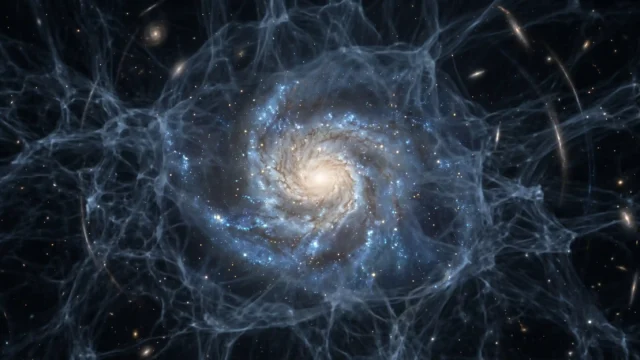
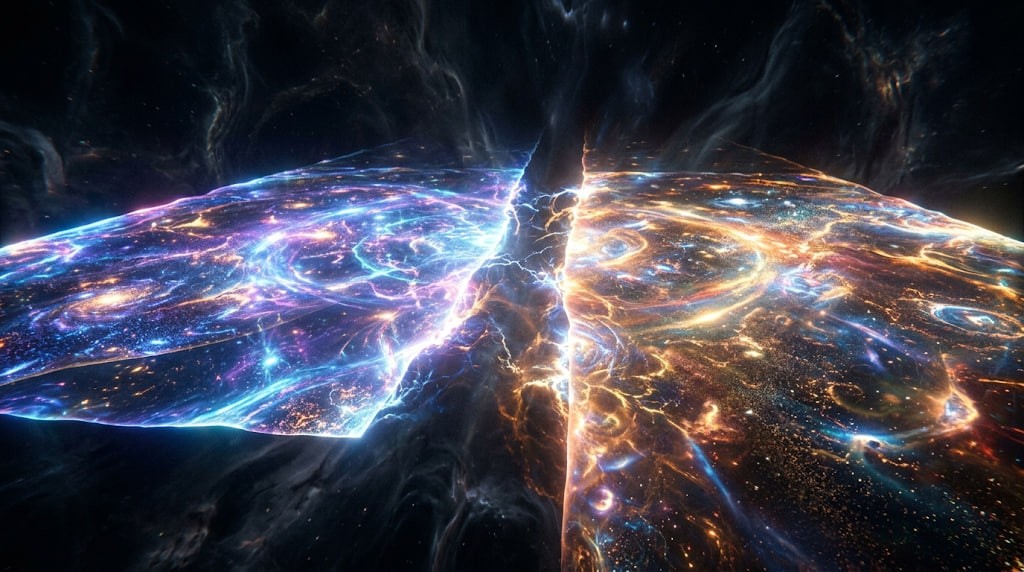
The Ekpyrotic model (from the Greek word for “conflagration”) and its descendant, the cyclic universe model, propose that the Big Bang was not a beginning from nothing but a braneworld collision: our 3-brane and a parallel 3-brane floating in the bulk slowly attracted each other gravitationally (through the extra dimensions), fell together, and collided. The collision energy heated both branes, creating the hot dense plasma of the early universe. After the collision, the branes bounce apart, cool, form structure — galaxies, stars, life — then gradually contract again over a trillion years for the next cycle.
To picture the geometry:
- Our universe: a flat, 3D surface (the brane) in 4D bulk space
- Parallel brane: a separate 3D surface separated by a tiny gap in the extra dimension
- Separation: perhaps 10-32 metres in the extra dimension — smaller than a proton
- Collision energy: sufficient to explain the observed cosmic microwave background temperature (~3,000 K at decoupling)
What Would We See During a Braneworld Collision?
From inside our brane, the collision would initially appear identical to the Big Bang — a rapid expansion from an extremely hot, dense state. The key observational signature that would distinguish a braneworld collision from a standard inflationary Big Bang is the spectrum of primordial gravitational waves. Standard inflation predicts a slightly tilted, nearly scale-invariant spectrum of tensor perturbations (primordial gravitational waves). The cyclic/ekpyrotic model predicts a negligibly small tensor-to-scalar ratio — essentially no detectable primordial gravitational waves.
Current CMB telescopes (Planck, BICEP/Keck Array) have searched for this primordial B-mode polarisation signal. As of 2024, no primordial tensor signal has been detected above the noise floor, which is consistent with the cyclic model but also consistent with low-scale inflation models. Future experiments like CMB-S4 and the LISA gravitational wave detector may be able to distinguish between these scenarios.
Does String Theory Actually Predict Parallel Universes?
String theory does not uniquely predict a specific braneworld scenario. The string theory landscape — the space of possible string theory vacua — contains an estimated 10500 different possible universes with different physical constants. This is simultaneously the theory’s greatest weakness (it seems to predict everything and nothing specifically) and its connection to the multiverse concept: if each vacuum of string theory is realised somewhere, the universe is vastly more complex than our observable patch.
The braneworld collision scenario is one of the most physically compelling alternatives to inflation because it offers testable predictions (suppressed primordial gravitational waves) and does not require a speculative inflationary mechanism. Whether M-theory is the correct framework for quantum gravity remains the deepest open question in theoretical physics.
Q&A
String theory is a framework in theoretical physics that proposes replacing point particles with tiny vibrating one-dimensional strings as the fundamental constituents of nature. Different vibrational modes of these strings manifest as different particles. The theory requires 10 or 11 spacetime dimensions and is the leading candidate for a theory of everything unifying gravity with quantum mechanics.
M-theory is the 11-dimensional completion of the five different 10-dimensional string theories, unified by physicist Ed Witten in 1995. The “M” stands for membrane (or “mystery”). M-theory contains both strings and higher-dimensional membranes (branes) and is considered the most complete version of string theory, though it remains largely unverified.
The multiverse is the hypothesis that our observable universe is just one of many (possibly infinitely many) separate regions or universes with potentially different physical laws, constants, or initial conditions. String theory’s landscape of 10500 vacua and inflationary cosmology’s eternal inflation both naturally produce multiverse scenarios, though none of the other universes are currently observable or testable.
Yes, in the framework of the Ekpyrotic/cyclic universe model proposed by Paul Steinhardt and Neil Turok. In this scenario, the Big Bang was the result of two parallel branes colliding in a higher-dimensional bulk space. The model makes a specific testable prediction — negligibly small primordial gravitational waves — consistent with current observations, though not yet confirmed as a distinguishing signal.
Extra dimensions are spatial dimensions beyond the three we experience directly. String theory requires 6–7 additional spatial dimensions to be mathematically consistent. These extra dimensions could be compactified (too small to detect, ~10-35 m), or they could be large extra dimensions accessible only to gravity, which would explain gravity’s relative weakness compared to other forces.
Internal links: theoretical physics | What If Vacuum Decay Began in a Collider? | What If a Strangelet Touched Earth?