 By
By 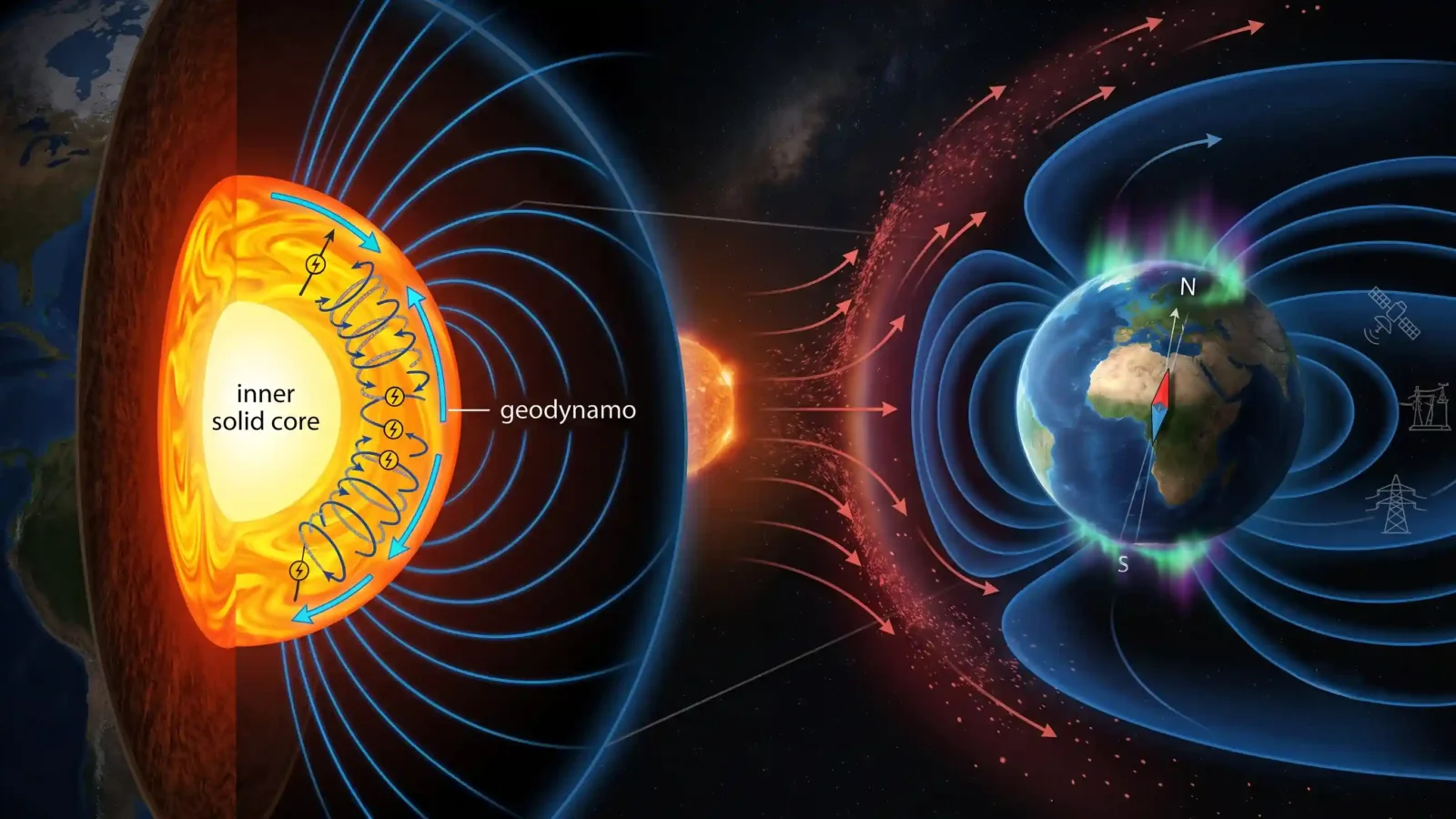
Quick Answer
Earth’s magnetic field is generated deep inside the planet by the churning of molten iron in its liquid outer core — a natural process called the geodynamo. As this electrically conductive metal flows and Earth rotates, it creates electric currents that produce a vast magnetic field surrounding the planet. This invisible shield deflects harmful solar and cosmic radiation, protects our atmosphere, and is what makes compasses point north. Without it, life on Earth would be far more exposed to space.
You cannot see it or feel it, but Earth’s magnetic field is one of the most important features of our planet — an invisible force field generated thousands of kilometres beneath your feet. This guide explains what the magnetic field is, how the geodynamo in the core creates it, what it protects us from, and what would happen if the engine driving it ever shut down.
What Is Earth’s Magnetic Field?
Earth’s magnetic field, also called the geomagnetic field, is the magnetic influence that extends from the planet’s interior out into space, forming a protective bubble called the magnetosphere. In its simplest form it behaves much like a giant bar magnet sitting near the centre of the Earth, with a north and south magnetic pole — which is why a compass needle aligns with it.
The magnetic poles are not perfectly aligned with the geographic poles (the points of Earth’s rotation); the magnetic axis is tilted by roughly 11 degrees, and the poles slowly wander over time. The field is also not perfectly steady — it varies in strength across the globe and changes gradually over years and centuries. But its essential role is constant: it surrounds the planet and shields it from the harsh environment of space.
The Geodynamo — How the Core Generates Magnetism
The magnetic field is produced by a process called the geodynamo, operating in Earth’s core. The core is made mostly of iron and nickel and is divided into two parts: a solid inner core and a liquid outer core. The field is generated in the liquid outer core, where molten metal is in constant motion.
The role of the liquid outer core
Three ingredients combine to run the geodynamo. First, the outer core is made of electrically conductive molten iron. Second, that metal is in constant convection — heat escaping from the inner core makes the hot liquid rise, cool, and sink in a churning cycle. Third, Earth’s rotation organises this churning motion through the Coriolis effect, twisting it into rolling columns. As the conductive fluid moves through existing magnetic fields, it generates electric currents, and those currents in turn generate magnetic fields — a self-sustaining loop that regenerates the planet’s magnetism. In short, Earth’s magnetic field is powered by heat flowing out of the core, converted into magnetism by moving liquid metal on a spinning planet.
What the Magnetic Field Protects Us From
The magnetosphere is a genuine planetary shield. Its most important job is deflecting the solar wind — the constant stream of charged particles flowing from the Sun — and high-energy cosmic rays from deep space. Without this protection, that radiation would steadily strip away our atmosphere and bombard the surface.
When particularly strong bursts of solar particles arrive, the magnetic field channels them toward the poles, where they collide with the upper atmosphere and create the beautiful auroras — the northern and southern lights. The field also protects satellites and power grids from the worst of space weather. The clearest demonstration of how vital this shield is comes from Mars: as explained in why Mars lost its atmosphere, the Red Planet lost its global magnetic field long ago, and the solar wind then stripped away most of its air, leaving a cold, dead world.
What Happens If the Core Stops Churning
Since the magnetic field depends entirely on the churning of the liquid outer core, the field would weaken and eventually disappear if that motion ever stopped. The convection is driven by heat escaping the core, so if the core cooled and solidified, the geodynamo would shut down.
This is exactly the scenario explored in what if the Earth’s core solidified entirely. The consequences would be severe and Mars-like: with the magnetosphere gone, the solar wind and cosmic radiation would gradually erode the atmosphere and increase radiation at the surface over very long timescales. This is precisely what is thought to have happened to Mars, whose small core cooled faster than Earth’s. Fortunately, Earth’s core is expected to remain hot and liquid for billions of years to come — but the link between a churning core and a living planet could not be more direct.
How We Know the Field Has Changed Over Time
We know Earth’s magnetic field is dynamic because rocks record its history. When certain volcanic and sedimentary rocks form, magnetic minerals within them align with the field present at the time and then “freeze” in that orientation — a phenomenon called paleomagnetism. By reading these magnetic fossils, scientists can reconstruct the field’s past direction and strength.
One of the most dramatic discoveries from this record is that Earth’s magnetic poles have completely reversed many times — north becoming south and vice versa. The seafloor, in particular, preserves a striped pattern of alternating magnetic directions on either side of mid-ocean ridges, a record that helped confirm both plate tectonics and the reality of magnetic reversals. That phenomenon is explored fully in our article on geomagnetic reversal.
Q&A
Yes, the overall field has weakened by roughly 9% over the past two centuries, and there is a notably weak region called the South Atlantic Anomaly. However, such fluctuations are normal in the field’s long history, and a weakening does not necessarily mean the field is about to disappear or reverse.
Not for billions of years. The field is sustained by the churning liquid outer core, which is expected to stay molten and convecting for a very long time. It will continue to fluctuate and occasionally reverse, but a permanent shutdown would require the core to cool and solidify, which is far in the future.
Mars is much smaller than Earth, so its core cooled faster. Once the molten motion in its core slowed and stopped, around four billion years ago, its geodynamo shut down and the global magnetic field collapsed — after which the solar wind stripped away most of the Martian atmosphere.
Yes. Many animals, including migratory birds, sea turtles, salmon, and some insects, can sense Earth’s magnetic field and use it for navigation — an ability called magnetoreception. They effectively carry a built-in compass that helps them travel vast distances and return to specific locations.
The Bigger Question
Earth’s magnetic field is generated by the restless churning of molten iron in the outer core — a process that depends entirely on the core staying hot and liquid. So what would happen if the core cooled and froze solid, shutting down the geodynamo for good? The planet would lose its protective shield, with consequences that echo the fate of Mars. That is the scenario we follow in what if the Earth’s core solidified entirely.
The field’s dramatic habit of flipping is covered in geomagnetic reversal. Explore more about the forces inside our planet on the Geology hub.
Watch the Earth’s core scenario to see what we would lose if the geodynamo ever stopped.