 By
By 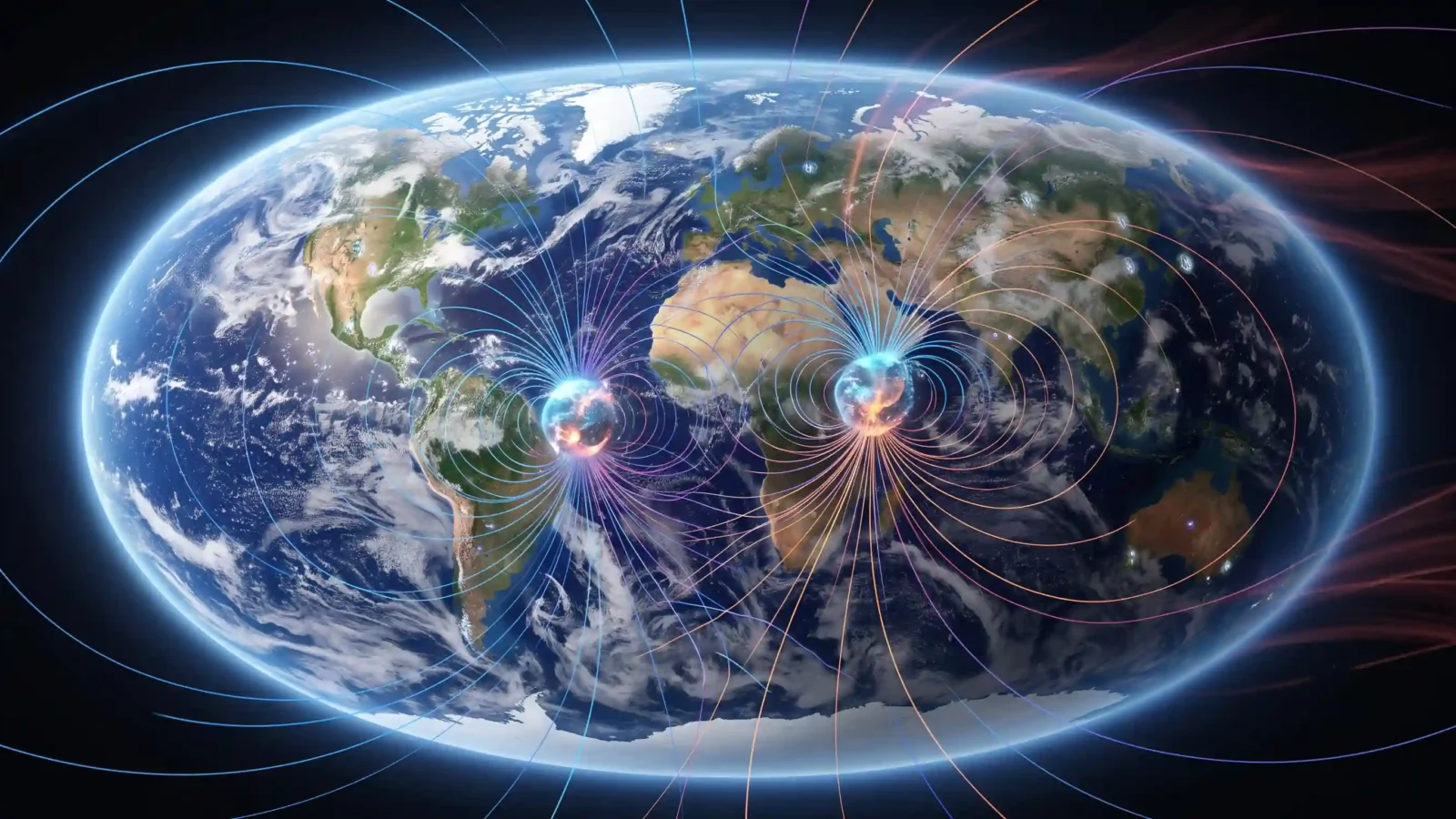
Quick Answer
A geomagnetic reversal is when Earth’s magnetic poles swap places — magnetic north becomes magnetic south and vice versa. It has happened hundreds of times throughout Earth’s history, recorded permanently in ancient rocks. A reversal is not instant; it unfolds over roughly a thousand to ten thousand years, during which the magnetic field weakens and becomes chaotic. The last full reversal occurred about 780,000 years ago, and despite recurring fears, there is no evidence one is imminent or that reversals cause mass extinctions.
The idea that north could become south sounds like science fiction, but it is a real and recurring feature of our planet. Geomagnetic reversals are written into the rocks beneath our feet and the floor of the oceans. This guide explains what a reversal is, how often they happen, what occurs during one, their connection to Earth’s core, and whether we are “due” for the next flip.
What Is a Geomagnetic Reversal?
A geomagnetic reversal is a change in Earth’s magnetic field in which the positions of magnetic north and magnetic south are exchanged. After a reversal, a compass that once pointed north would point south. These are not minor wobbles but complete flips of the planet’s magnetic polarity, and they are a natural, recurring part of how the field behaves over geological time.
We know reversals are real because of paleomagnetism — the record of past magnetic fields locked into rocks. When rock forms, magnetic minerals align with the field at the time and freeze in that direction. Reading these magnetic fingerprints, especially the striking striped pattern of alternating polarity preserved in the ocean floor, reveals a long history of the poles flipping back and forth. This evidence also helped confirm the theory of plate tectonics.
How Often Has It Happened?
Earth’s magnetic field has reversed many hundreds of times over the past few hundred million years, but the timing is highly irregular — there is no fixed schedule. The intervals between reversals have ranged from tens of thousands of years to tens of millions of years. On average over recent geological history, reversals have occurred roughly every few hundred thousand years, but averages can be misleading given how erratic the pattern is.
The last complete reversal, known as the Brunhes–Matuyama reversal, took place about 780,000 years ago. Since then, there have been several “excursions” — temporary, partial weakenings where the field began to shift but then recovered without fully flipping. The most well-known is the Laschamp excursion, around 41,000 years ago, when the field weakened dramatically for a few centuries before returning to its original orientation.
What Happens During a Flip (weakening, multiple poles)
A reversal is a gradual, messy process rather than a sudden switch. During the transition, the simple two-pole (dipole) structure of the field breaks down. The overall field strength drops significantly, and instead of one clear north and one clear south pole, the field can become complex and tangled, with multiple poles appearing at different points on the globe.
- Duration: the full process likely takes on the order of 1,000 to 10,000 years.
- Weakening: the field’s overall strength drops, though it does not vanish completely.
- Complexity: multiple magnetic poles can appear temporarily across the planet.
- Recovery: the field eventually reorganises into a stable dipole — but with reversed polarity.
Importantly, the field does not switch off entirely during a reversal. A weaker, more complicated field persists throughout, continuing to provide some protection from space radiation.
The Connection to the Core
Reversals originate in the same place as the magnetic field itself: the churning liquid iron of Earth’s outer core, where the geodynamo generates the field. The flow of molten metal in the core is turbulent and chaotic, and computer simulations suggest that this chaotic motion can occasionally cause the field to destabilise and flip its polarity on its own — no external trigger required.
In other words, reversals are an emergent feature of the restless dynamo deep inside Earth. This makes them a vivid reminder that our magnetic shield is generated by an active, ever-changing engine. The ultimate dependence of the field on the core’s motion is what makes the scenario what if the Earth’s core solidified entirely so consequential: a reversal is the field flipping, but a frozen core would mean the field failing altogether.
Are We Due for a Reversal? (the wandering north pole)
This is the question that drives recurring headlines. Two real observations fuel the speculation: Earth’s overall magnetic field has weakened by about 9% over the past two centuries, and the magnetic north pole has been drifting unusually rapidly, moving from the Canadian Arctic toward Siberia.
However, scientists caution against jumping to conclusions. A weakening field and a wandering pole are within the normal range of the field’s behaviour, and similar changes in the past did not lead to reversals. The concept of being “overdue” does not really apply, because reversals do not follow a regular schedule. The honest scientific position is that a reversal could begin in the coming millennia, or not for a very long time — and even if one started, it would unfold far too slowly for anyone alive today to experience its completion.
Would It Be Dangerous to Life and Technology?
The good news for life is reassuring: there is no evidence that past geomagnetic reversals caused mass extinctions. Life has survived hundreds of reversals, including our own ancestors living through the Laschamp excursion. The weaker field during a reversal would let somewhat more cosmic and solar radiation reach the surface, but the atmosphere would still provide substantial protection.
The bigger concern is for modern technology. A prolonged period of a weak, complex field would increase the radiation reaching satellites and astronauts, could disrupt power grids and communications more often, and would require constant updates to navigation systems that rely on the magnetic field. It would be a serious technological nuisance and require adaptation, but it is not the civilisation-ending catastrophe sometimes portrayed.
Q&A
No one can predict it. Reversals do not follow a regular schedule, so the idea of being “overdue” is misleading. The current weakening of the field and the wandering magnetic pole could be early signs of a future shift, or simply normal fluctuations — and any reversal would take thousands of years to complete.
There is no evidence that it would. Life has survived hundreds of reversals with no associated mass extinctions. The field weakens but does not disappear, and the atmosphere continues to shield the surface. The main risks would be to satellites, power grids, and navigation technology, not to human survival.
A full reversal is thought to take roughly 1,000 to 10,000 years to complete. It is a gradual process during which the field weakens and becomes complex before settling into the opposite polarity — far too slow to be noticed within a single human lifetime.
Not confirmed. Earth’s magnetic field is currently weakening and the north magnetic pole is drifting quickly, which some interpret as possible early signs. But these changes are within the field’s normal range of behaviour, and there is no definitive evidence that a full reversal is underway.
The Bigger Question
Geomagnetic reversals show that our magnetic field is generated by a living, chaotic engine in the core — an engine that can flip the poles but never quite switches off during the process. The far graver scenario is not a reversal but a shutdown: what if the core that powers the entire field cooled and solidified completely? That is the planetary catastrophe we explore in what if the Earth’s core solidified entirely.
To understand the dynamo that both creates and flips the field, read how Earth’s magnetic field works. Discover more about our planet’s inner workings on the Geology hub.
Watch the Earth’s core scenario to see the difference between the poles flipping and the field failing.