 By
By What Is Strange Matter?
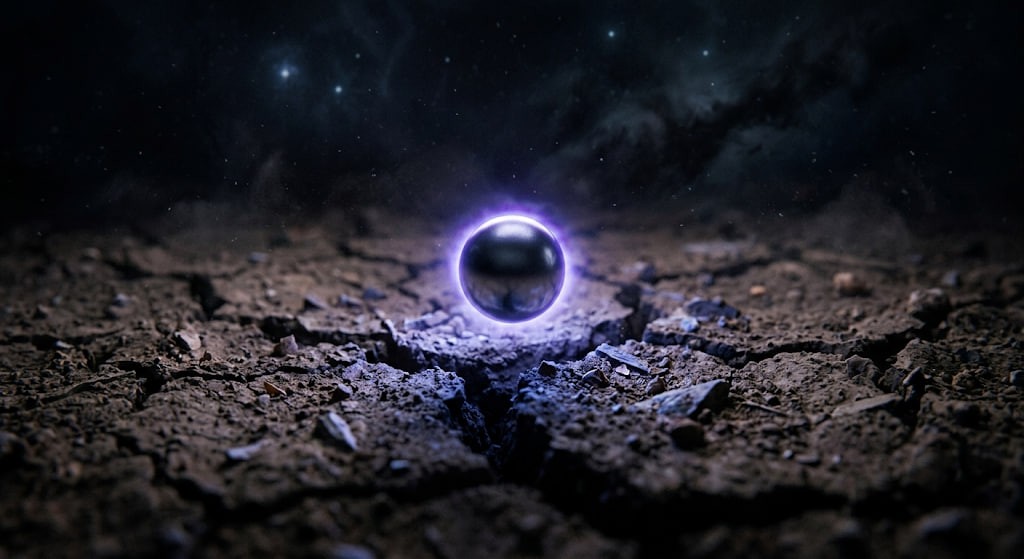
All ordinary matter is made of “up” and “down” quarks — the two lightest quark flavours. Strange matter is a hypothetical state of matter that also contains roughly equal numbers of “strange” quarks alongside up and down quarks. A strangelet is a small nugget of strange quark matter.
The strange matter hypothesis, first proposed by physicist Edward Witten in 1984, suggests that strange quark matter could be the true ground state of matter — more energetically stable than ordinary nuclear matter. If this is correct, then a strangelet that contacts ordinary matter would convert it into strange matter through a catalytic process, because the ordinary matter would be moving to a lower energy state. The converted region would then convert more normal matter, and so on: a runaway “strangelets” chain reaction.
This is not a universally accepted prediction. The strange matter hypothesis requires specific conditions about quark interactions that are uncertain. But it is a legitimate possibility within the Standard Model of particle physics, and it has been seriously evaluated as a potential hazard from high-energy particle colliders.
How Fast Would the Conversion Spread?
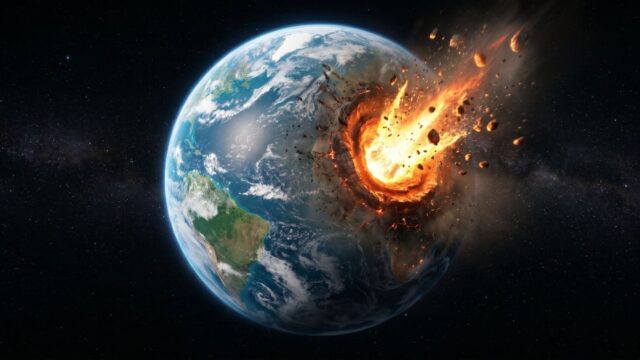
If a strangelet did initiate a conversion chain reaction in ordinary matter, the speed would be limited by how fast quarks can diffuse across the boundary between strange and normal matter. Estimates in the physics literature suggest this could be as fast as 1–10% of the speed of light — meaning a strangelet at Earth’s core could convert the entire planet in roughly 30 minutes to a few hours. The endpoint would be a “strange star” — a compact object roughly 100 metres in diameter containing all of Earth’s mass, composed entirely of strange quark matter.
To picture the scale:
- Earth’s radius: 6,371 km
- A hypothetical strange Earth radius: ~100 m
- Density increase: roughly 1014 times
- Conversion timescale: 30 minutes at 1% light speed boundary propagation
Why Aren’t We Worried About the LHC Creating Strangelets?
The Large Hadron Collider at CERN and its predecessor, the Relativistic Heavy Ion Collider (RHIC) at Brookhaven, have both been extensively analysed for strangelet safety. The key safety arguments, published by physicists John Ellis, Gian Luca Alessi, and colleagues in formal safety assessments, are:
First, cosmic rays have been colliding with Earth at energies far exceeding those of any particle accelerator for billions of years — and we are still here. The flux of ultra-high-energy cosmic rays (energies up to 1020 eV, vastly above the LHC’s 13 TeV centre-of-mass energy) represents a natural, ongoing experiment at collision energies the LHC cannot reach. No strangelet catalysis has occurred.
Second, even if strangelets could form in collisions, the extremely small baryon number of any strangelets produced would make them too small and too positively charged (at collider energies) to catalyse normal matter conversion. They would evaporate via Hawking-like processes before interacting.
Third, neutron stars — which are dense enough to convert to strange stars if the hypothesis is correct and strangelets can nucleate — exist across the galaxy in enormous numbers and show no sign of conversion. Their stability over millions of years is strong evidence against the runaway scenario.
Is Strange Matter Real?
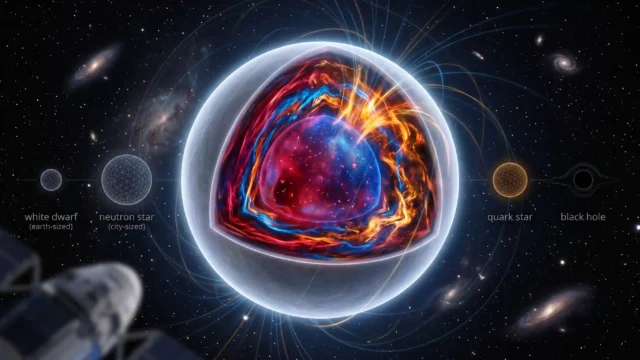
The existence of strange quark matter in the cores of dense neutron stars is considered plausible and is studied by nuclear physicists as a genuine component of quark star models. Dense neutron stars may have quark-gluon plasma cores. What remains unconfirmed is the specific Witten hypothesis: that strange matter is more stable than iron and would catalyse conversion of normal matter. Most current lattice QCD calculations suggest ordinary nuclear matter is more stable, not less, making bulk strangelet conversion essentially impossible. But “essentially” is not “definitely,” and the question remains technically open at the frontier of nuclear theory.
Q&A
Strange matter is a hypothetical form of quark matter containing roughly equal numbers of up, down, and strange quarks. It would be denser than atomic nuclei and, if the Witten hypothesis is correct, potentially more stable than ordinary matter. A lump of strange matter is called a strangelet.
Safety analyses say no — at least not one capable of causing harm. Any strangelets produced at LHC energies would be positively charged and too small to catalyse conversion. Additionally, cosmic rays have been performing equivalent (and higher-energy) collisions on Earth for billions of years with no ill effect, which is the most compelling safety evidence.
A quark star is a hypothetical compact stellar remnant where neutron-star-like conditions are so extreme that individual neutrons dissolve into a soup of free quarks. Strange quark matter may form in the cores of the densest neutron stars. No confirmed quark star has been identified, though several neutron star candidates with anomalous properties remain under investigation.
Quark-gluon plasma (QGP) is the state of matter that exists when temperatures and densities are so extreme that protons and neutrons melt into their constituent quarks and gluons. It existed in the first microseconds after the Big Bang and is recreated briefly in heavy-ion collisions at the LHC and RHIC.
If strange matter converted all of Earth’s mass, the result would be a smooth sphere of strange quark matter roughly 100 metres in diameter — all 6 × 10²⁴ kg of Earth compressed into a body smaller than a city block. Life, the oceans, the atmosphere, and the crust would cease to exist in any recognisable form within hours of the conversion beginning.
Internal links: theoretical physics | What If Vacuum Decay Began in a Particle Collider? | What If Two Braneworlds Collided?