 By
By 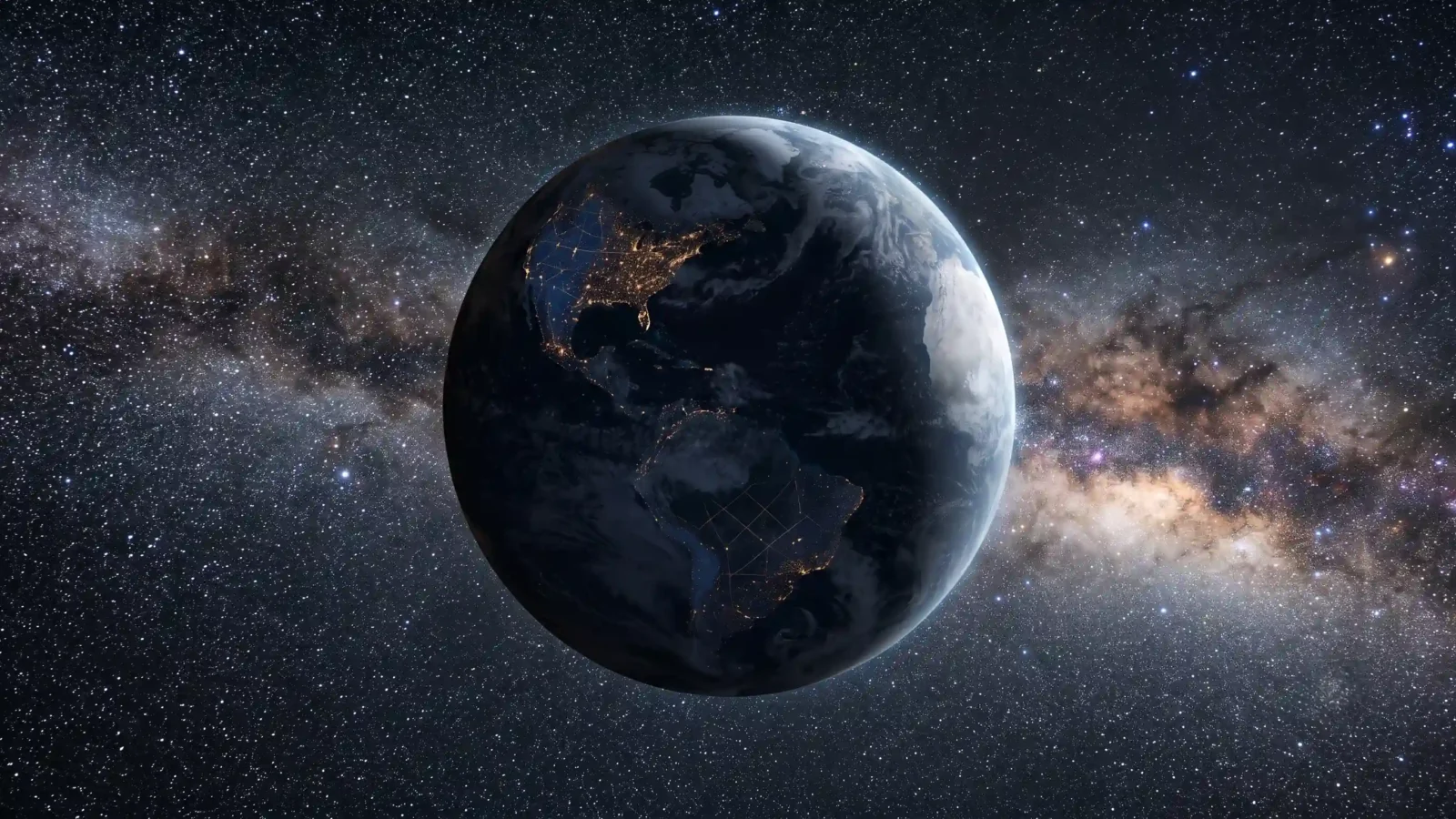
Quick Answer
If the Sun suddenly disappeared, we wouldn’t know for about 8 minutes and 20 seconds — the time it takes light and gravity to reach us. After that, Earth would stop curving around the Sun and fly off in a straight line into deep space, the sky would go dark, and the planet would begin to freeze. Surface life would die within weeks as photosynthesis stopped and temperatures plunged, but deep-ocean ecosystems near geothermal vents could survive far longer.
“What would happen if the Sun disappeared?” is one of the great thought experiments in science — impossible in reality, but a brilliant way to understand light, gravity, and just how completely our existence depends on one ordinary star. This guide walks through the timeline minute by minute, year by year, and explains why a sunless Earth would become a rogue planet drifting through the galaxy.
The First 8 Minutes (light and gravity travel at light speed)
The strangest part of this scenario is that nothing would seem to change at first. The Sun is about 150 million kilometres away, and its light takes roughly 8 minutes and 20 seconds to reach us. So if the Sun vanished this instant, we would keep seeing it shining normally for those 8 minutes — we would be looking at light that had already left.
Remarkably, the same delay applies to gravity. Einstein’s general relativity says that changes in gravity also propagate at the speed of light, not instantly. So Earth would continue to orbit as if the Sun were still there for the same 8 minutes and 20 seconds. Only when the last of the light — and the last of the gravitational pull — arrived would everything change at once.
Earth Flies Off in a Straight Line
The moment the Sun’s gravity cut out, Earth would no longer be held in its curved orbit. According to Newton’s first law, an object in motion continues in a straight line unless a force acts on it. Earth is currently travelling around the Sun at about 30 kilometres per second — roughly 107,000 kilometres per hour.
So Earth would simply fly off in a straight line, tangent to its old orbit, at that enormous speed — like a stone released from a sling. Every other planet would do the same, each shooting off in whatever direction it happened to be moving. The neat clockwork of the solar system would instantly become a scatter of worlds hurtling into the dark. Earth would become a rogue planet, the central idea behind what if a rogue star ejected Earth from the solar system.
How Fast Would the Planet Freeze?
With no sunlight, Earth would start to cool immediately, but it would not freeze all at once. The planet stores and releases heat at very different rates depending on where you look.
Surface vs ocean vs deep sea timelines
- Within days: the average global surface temperature drops below 0°C.
- Within a week: the surface averages around −18°C; most of the world is locked in deep frost.
- Within a year: surface temperatures plunge toward −100°C.
- Oceans: the top layers freeze within weeks to months, but the ice forms an insulating lid.
- Deep sea: beneath that ice, liquid oceans could persist for thousands of years, warmed from below by Earth’s internal heat.
That insulating ice is the key. A thick crust of sea ice would trap the ocean’s heat and Earth’s geothermal warmth, so the deep oceans would stay liquid for an astonishingly long time even as the surface became a frozen wasteland. The atmosphere itself would eventually grow so cold that gases would begin to condense, but that would take an extremely long time.
Could Anything Survive?
Surprisingly, life would not vanish completely. While humans and most familiar species depend directly or indirectly on sunlight, some ecosystems do not.
Geothermal and chemosynthetic life
At the bottom of the oceans, around hydrothermal vents, whole communities of life thrive without any sunlight at all. These organisms rely on chemosynthesis — drawing energy from chemicals in the hot, mineral-rich water rather than from the Sun. Powered by Earth’s internal heat, such ecosystems could continue for thousands of years beneath the frozen surface.
Humans, in theory, could also hold out for a while. A society with access to geothermal energy or nuclear power could keep small sealed habitats warm and lit, growing food under artificial light. But this would be survival on a knife’s edge, not civilisation as we know it.
A Starless, Drifting Earth
With the Sun gone, Earth would join the ranks of rogue planets — worlds that wander the galaxy untethered to any star. Astronomers have discovered that such free-floating planets are surprisingly common, drifting through interstellar space in perpetual night. A frozen Earth would coast among the stars at 30 kilometres per second, taking tens of thousands of years just to travel the distance to the nearest star system.
This is precisely the situation we explore in what if a rogue star ejected Earth from the solar system, where a passing star — rather than a vanishing Sun — flings our planet into the dark. The end state is the same: a cold, starless world drifting through the galaxy.
Why the Sun Can’t Actually Just Vanish
It is worth being clear that the Sun cannot simply disappear. Mass and energy are conserved — they cannot blink out of existence — so there is no physical process that would make the Sun vanish instantly. The value of the scenario is not its realism but what it teaches: that gravity is not instantaneous, that orbits are a balance of motion and pull, and that nearly all the energy sustaining life on Earth traces back to a single star.
The Sun will eventually change — swelling into a red giant in about five billion years — but it will not disappear. The “what if” is a window into physics, not a forecast.
Q&A
Most people would survive the initial cold for some weeks to months as buildings and the oceans released stored heat, but the collapse of food supplies would be the real killer. Small groups with geothermal or nuclear power and sealed habitats might persist for years, but not indefinitely.
Plants would be among the first to go. Without sunlight, photosynthesis stops, and most plants would die within days to weeks. Larger trees with stored sugars might linger a little longer, but the base of the food chain would collapse quickly, taking the ecosystems that depend on it with it.
Possibly, for a time. Earth’s internal heat increases with depth, so deep underground or near geothermal sources it would stay warmer than the frozen surface. Sealed underground colonies powered by geothermal or nuclear energy are the most plausible refuges in this scenario.
They would all fly off in straight lines too, each in whatever direction it was travelling at the moment the Sun’s gravity vanished. The entire solar system would disperse into independent rogue worlds drifting through interstellar space.
The Bigger Question
A vanishing Sun is impossible, but a starless, drifting Earth is not as far-fetched as it sounds. A close encounter with another star could gravitationally fling our planet out of the solar system entirely — turning Earth into a frozen rogue world without the Sun ever going anywhere. That is the scenario we follow in what if a rogue star ejected Earth from the solar system, and the frozen, wandering aftermath is strikingly similar to the one described here.
You can also explore the icy frontier where such stellar encounters would first be felt in our piece on the Oort cloud, or browse more cosmic thought experiments on the Space & Cosmos hub.
Watch the rogue planet scenario to see what life on a sunless, wandering Earth would really be like.