 By
By 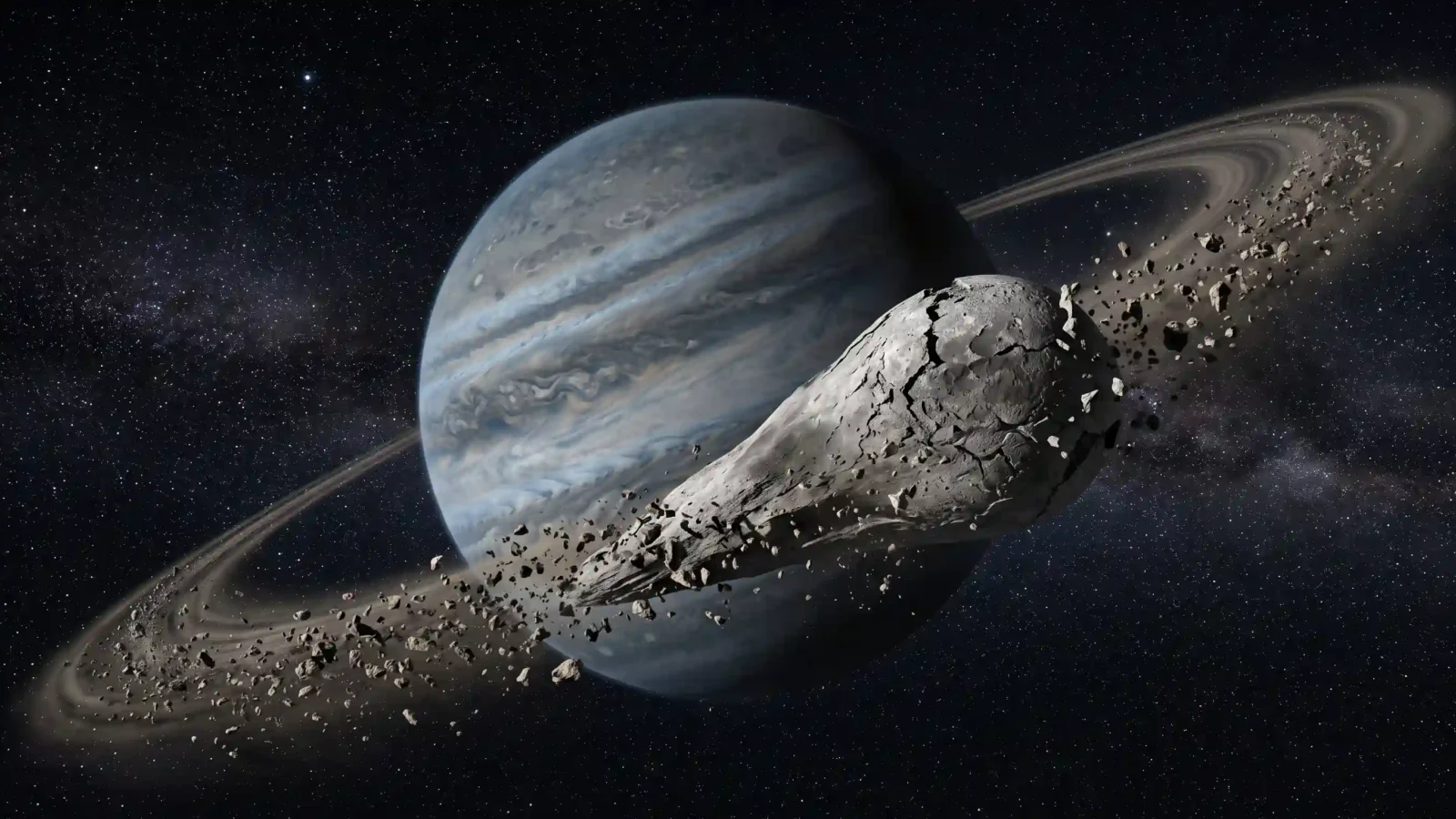
There’s an invisible line around every planet where a moon stops being able to exist. Cross it, and the planet’s tidal forces pull harder on the moon’s near side than its far side — hard enough to overcome the moon’s own gravity holding it together. The moon is stretched, cracked, and torn into a stream of rubble that spreads into a ring. That line is the Roche limit, and it’s why Saturn has rings and not a dozen extra moons. Our own Moon would have to come startlingly close to suffer the same fate.
Tides are a difference, not a pull
The key is that gravity weakens with distance. A planet pulls on the near side of its moon slightly harder than on the far side. Normally that difference is trivial. But bring the moon close, and the difference grows fast — faster than the moon’s self-gravity can resist. At the Roche limit, the stretching force wins, and the moon comes apart. It isn’t crushed or blasted; it’s pulled in two directions at once until it disintegrates.
The Roche limit for a solid body is d ≈ 2.44 × R × (ρ_planet / ρ_moon)1/3, where R is the planet’s radius and ρ the densities. For Earth and Moon: R = 6,371 km, ρ_Earth = 5,510 kg/m³, ρ_Moon = 3,340 kg/m³.
d ≈ 2.44 × 6,371 × (5,510 / 3,340)1/3 ≈ 2.44 × 6,371 × 1.18 ≈ 18,000 km from Earth’s center.
The Moon currently orbits at 384,000 km — more than 20 times farther out — and it’s slowly receding, not approaching. To be shredded into a ring, the Moon would have to spiral in to within about 12,000 km of the surface. It never will. But the line is real, and it’s where every planetary ring is born.
Why Saturn wears rings
Saturn’s spectacular rings sit inside its Roche limit. They’re almost certainly the remains of a moon (or comet) that wandered too close and was torn apart — or debris that could never clump into a moon in the first place, because any clump forming there would immediately be pulled back into rubble. The rings aren’t leftovers from Saturn’s birth so much as a moon that never got to be one. Every ringed planet is displaying a graveyard.
The exception: strength can save you
The formula above assumes a moon held together only by its own gravity — true for anything larger than a few hundred kilometres. But a small, solid body has real material strength, like a rock, and can survive well inside the Roche limit without breaking. That’s why a spacecraft, or a small dense moon, can orbit closer than the limit would suggest. Roche’s line is where gravity-bound bodies fail — not indestructible ones.
The same tides, turned up to eleven
Tidal forces are gentle for the Earth–Moon system, but around the most extreme objects in the universe they become monstrous — capable of stretching anything that comes near into a thin stream, an effect grimly nicknamed “spaghettification.” What tides do to a wandering moon, a dense stellar corpse does to everything: what if a magnetar replaced the Moon?
What we know, and what’s approximate
Solid: the Roche limit is real, it explains planetary rings, and our Moon is far outside it and getting farther. Approximate: the exact distance depends on whether you treat the moon as rigid or fluid (a fluid body deforms and breaks a bit farther out, near 2.9 R instead of 2.44 R), and on its real internal strength. The line isn’t razor-sharp — but the principle is ironclad: get close enough, and gravity itself tears you apart.
A moon is only a moon while it keeps a safe distance. Cross the Roche limit and the same force that raises our ocean tides turns a world into a ring. Saturn has been wearing the proof for billions of years.