 By
By 
Quick Answer
Terraforming Mars means deliberately transforming the cold, airless Red Planet into a warmer, wetter world where humans could one day live without spacesuits. In theory it would involve thickening the atmosphere, warming the surface, melting buried ice, and eventually building breathable air.
In practice, it is far beyond current technology: a NASA-funded study in 2018 concluded there is not enough accessible carbon dioxide on Mars to warm it significantly with today’s methods. Newer ideas, including engineered nanoparticles proposed in 2024, could warm the planet faster, but making Mars truly Earth-like remains a project of centuries to millennia — if it is possible at all.
Mars is the planet that fires the human imagination like no other. It is close enough to reach, similar enough to dream about, and just hostile enough to make the dream a challenge worthy of a century. The idea of terraforming it — reshaping an entire world to suit us — is one of the boldest concepts in all of science.
It is also one of the most misunderstood. Popular culture tends to treat terraforming as a matter of decades and willpower. The science tells a more sobering and more fascinating story. This guide separates the genuine engineering from the fantasy: what terraforming Mars would actually require, which problems are merely hard and which may be impossible, the latest research, and an honest answer to whether we could ever pull it off.
What Is Terraforming Mars?
Terraforming Mars is the hypothetical process of altering the planet’s environment on a global scale to make it habitable for Earth life — ideally to the point where a person could walk outside and breathe. The word, popularised by science fiction and later taken up by serious scientists like Carl Sagan and Christopher McKay, literally means “Earth-shaping.”
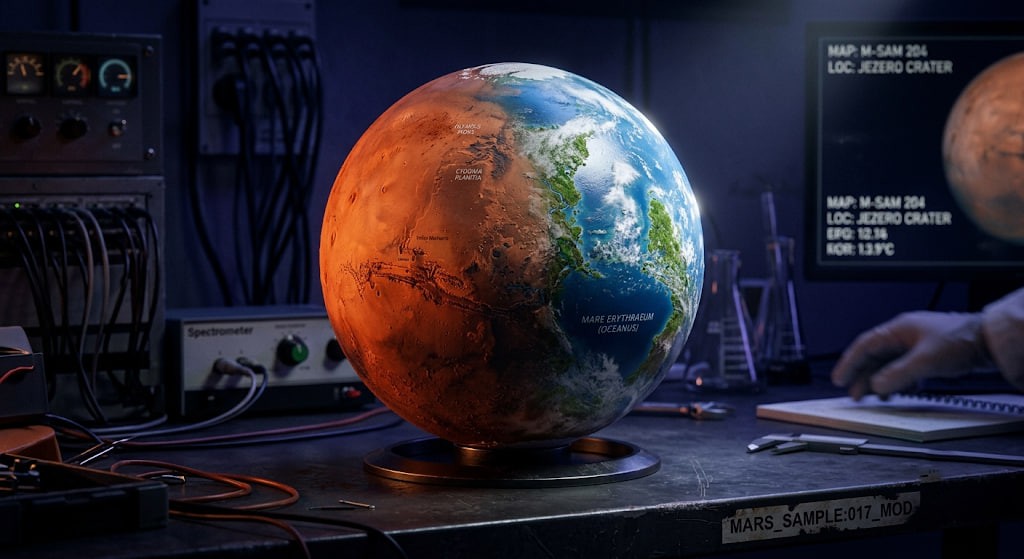
The goal breaks down into a chain of transformations: thicken the wispy atmosphere, raise the freezing temperatures, melt the planet’s locked-away water, and ultimately convert the air into something with breathable oxygen. Each step is a colossal undertaking, and as we will see, they get progressively harder — the last one may lie beyond any foreseeable technology. The most dramatic single proposal, using a giant orbital reflector to melt the polar ice, is the focus of our scenario on melting Mars’ ice caps with a space mirror.
It helps to be clear about ambition levels. “Full” terraforming aims to make the open surface livable. A more modest version, sometimes called partial terraforming, would simply make Mars warm and thick-aired enough for hardy plants or microbes, or for humans in light protective gear rather than full pressure suits. Even that lesser goal is monumentally difficult.
Why Mars Is So Hostile
To understand the scale of terraforming, you first have to appreciate just how unwelcoming Mars is today. It looks Earth-like in photographs — red deserts, dust storms, polar caps — but the resemblance is skin-deep.
The atmosphere is the first problem. It is about 95 percent carbon dioxide, but desperately thin: the surface pressure is only around 0.6 percent of Earth’s at sea level. That is so low that liquid water cannot persist in the open — it would boil away or freeze almost instantly — and an unprotected human would suffer fatal decompression in moments. The planet is also bitterly cold, averaging roughly minus 60 degrees Celsius, with the equator only occasionally creeping above freezing on a summer afternoon.
To feel how thin that is, the Martian surface pressure is roughly what you would find drifting at about 30 kilometres above Earth — twice the cruising height of an airliner, deep into the realm where only pressure suits keep pilots alive. Standing on Mars without protection, your blood would effectively begin to boil at body temperature. This is the gulf terraforming has to close, and it is why simply “adding some air” is such a deceptively enormous task.
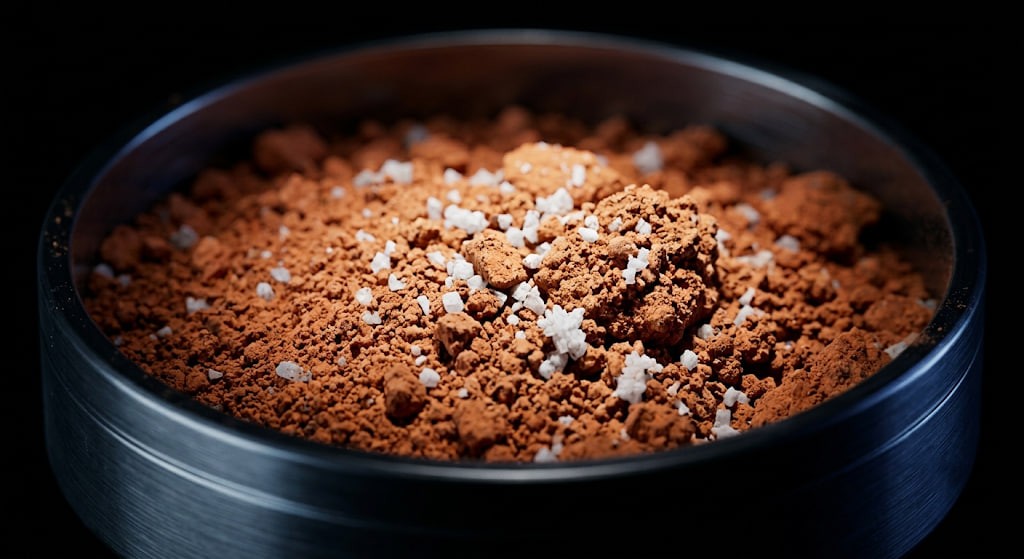
Then there is the radiation. Mars lost its global magnetic field billions of years ago, and with it the shield that protects a planet from the solar wind and cosmic rays. With almost no atmosphere to absorb them either, the surface is bathed in radiation that would be hazardous to unshielded life over time. The story of how the planet lost that protection is told in why Mars lost its atmosphere. Finally, the soil itself is hostile: Martian regolith is laced with perchlorates — chlorine-based salts, present at roughly half a percent to one percent, that are toxic to the human thyroid and would need to be cleansed before crops could grow in it.
Two more obstacles round out the picture, and neither can be engineered away. Martian gravity is only about 38 percent of Earth’s, a fixed property of the planet’s mass that no amount of terraforming can change; the long-term effects of living and raising children in such low gravity are simply unknown. And the planet is periodically wrapped in continent-spanning dust storms that can last for weeks and dim the sunlight any warming scheme would rely on. These are reminders that even a “terraformed” Mars would never be a perfect copy of Earth.
The one piece of good news is water. Mars holds enormous quantities of it, frozen in its polar caps and locked beneath the surface as ice, a resource explored in our article on liquid water on Mars. The raw material for oceans is there. The challenge is making the planet warm enough, and its air thick enough, for that water to flow.
The Four Problems You Would Have to Solve
Terraforming is often discussed as a single goal, but it is really four separate problems stacked on top of each other, each far harder than the last. Lumping them together is the source of most of the hype. Separating them is the clearest way to see what is merely difficult and what is closer to impossible.
- 1. Warmth (hard): raise the surface temperature above freezing. The most tractable problem, and the one recent research targets.
- 2. Pressure (very hard): thicken the atmosphere enough for liquid water and reduced need for pressure suits — limited by how much gas Mars actually has.
- 3. Breathable air (extraordinarily hard): convert the atmosphere to one with enough oxygen to breathe — a process that could take many thousands of years.
- 4. Keeping it (a problem in itself): stop the solar wind from stripping away whatever atmosphere you manage to build, given Mars has no magnetic field.
Crucially, solving problem one does not get you problem three for free. You could, in principle, warm Mars and even thicken its air with carbon dioxide while leaving it utterly unbreathable — a warm world you still could not step onto without an oxygen supply. Keeping these goals distinct is the single most useful mental tool for cutting through terraforming claims.
Step One: Warming the Planet
Warming is the foundation, because a warmer Mars would naturally release some of its frozen carbon dioxide, which would thicken the air and trap more heat in a self-reinforcing loop. Several methods have been proposed, ranging from the classic to the cutting-edge.
Super-Greenhouse Gases
One long-standing idea, championed by the engineer and Mars advocate Robert Zubrin, is to manufacture powerful artificial greenhouse gases — perfluorocarbons and similar compounds — in factories on the surface. These molecules trap heat thousands of times more effectively than carbon dioxide and are extremely long-lived. The catch is the sheer industrial scale required, and the fact that the necessary raw elements like fluorine are not abundant on Mars.
Giant Orbital Mirrors
Another concept is to place enormous, gossamer-thin reflectors in space near Mars to focus extra sunlight onto the poles, sublimating the frozen carbon-dioxide ice and kick-starting the warming. The mirrors would need to be hundreds of kilometres across — a staggering construction project — but the underlying physics is sound. This is the idea dramatised in melting Mars’ ice caps with a space mirror.
Engineered Nanoparticles (the 2024 breakthrough idea)
The most exciting recent proposal came in August 2024, when researchers led by Samaneh Ansari and Edwin Kite published a study in Science Advances on warming Mars with engineered dust. Their idea is to release tiny conductive nanorods — roughly nine micrometres long and made from iron and aluminium already abundant in Martian dust — into the atmosphere. These particles forward-scatter sunlight down to the surface while blocking heat from escaping, and the team calculated they could warm Mars by more than 30 degrees Celsius, potentially over just a decade or so.
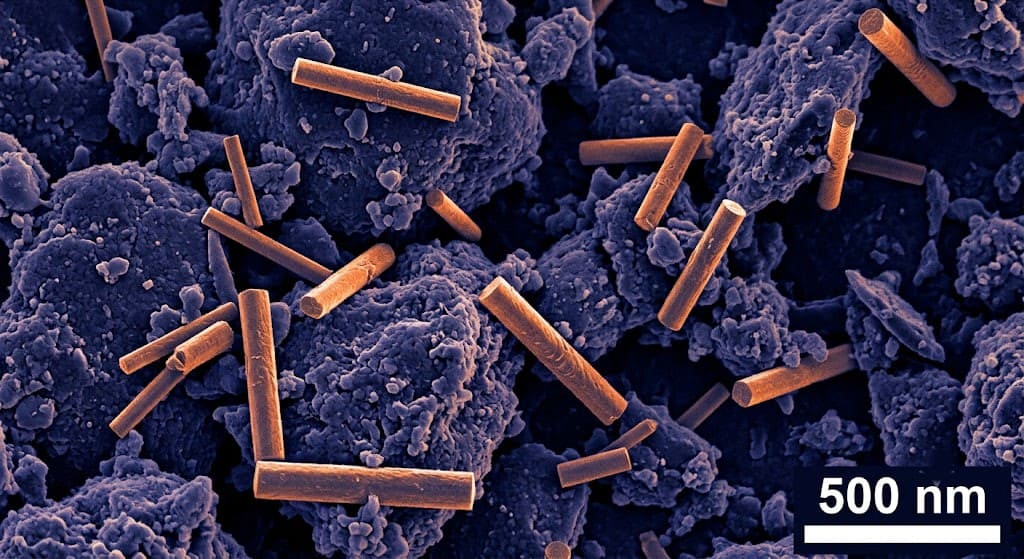
Strikingly, the method could be thousands of times more efficient than pumping out greenhouse gases. It is still only a warming step, not a full terraforming solution, and it remains untested theory — but it is the freshest evidence that the temperature problem, at least, may be more tractable than once thought.
The CO2 Problem: The Study That Changed the Conversation
Here the optimism runs into a hard wall, and it is worth understanding clearly because it is the single most important result in the field. In 2018, a NASA-funded study led by Bruce Jakosky and Christopher Edwards, published in Nature Astronomy, took two decades of spacecraft data and asked a simple question: if you released every bit of carbon dioxide that Mars has — from its ice caps, its soil, and its rocks — how thick an atmosphere could you actually build?
The answer was deflating. Even mobilising all of it, you could raise the pressure to only about 7 percent of Earth’s — nowhere near enough to warm the planet substantially or to let liquid water flow freely on the surface. And much of that carbon dioxide is locked away in forms that could not be released with anything resembling current technology. The study’s blunt conclusion: terraforming Mars is not possible using present-day technology.
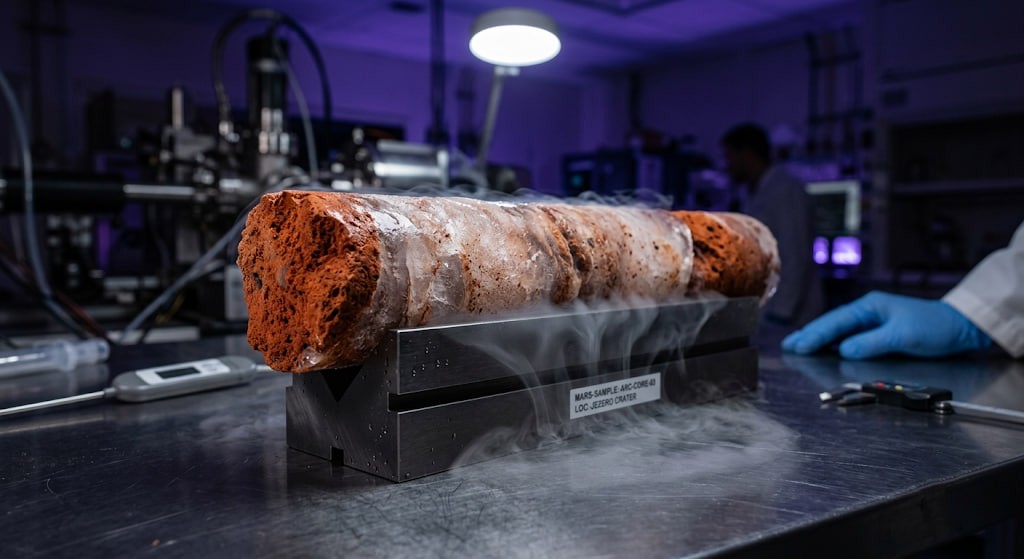
This is the finding that should temper every confident headline. It does not say terraforming is forever impossible — future technology could import gases from elsewhere, or use methods we have not imagined. But it demolishes the simplest version of the dream, the idea that we could just warm Mars and let its own buried carbon dioxide do the rest. The cupboard, it turns out, is nearly bare.
Importing Gases From Space
If Mars does not have enough carbon dioxide of its own, perhaps it could be given more. One of the more audacious proposals is to import volatiles from elsewhere in the solar system, redirecting ice-rich comets or small asteroids to strike Mars and deliver their water and gases. Ammonia-rich bodies are especially prized in these schemes, because ammonia is both a potent greenhouse gas and a source of the nitrogen a future atmosphere would need.
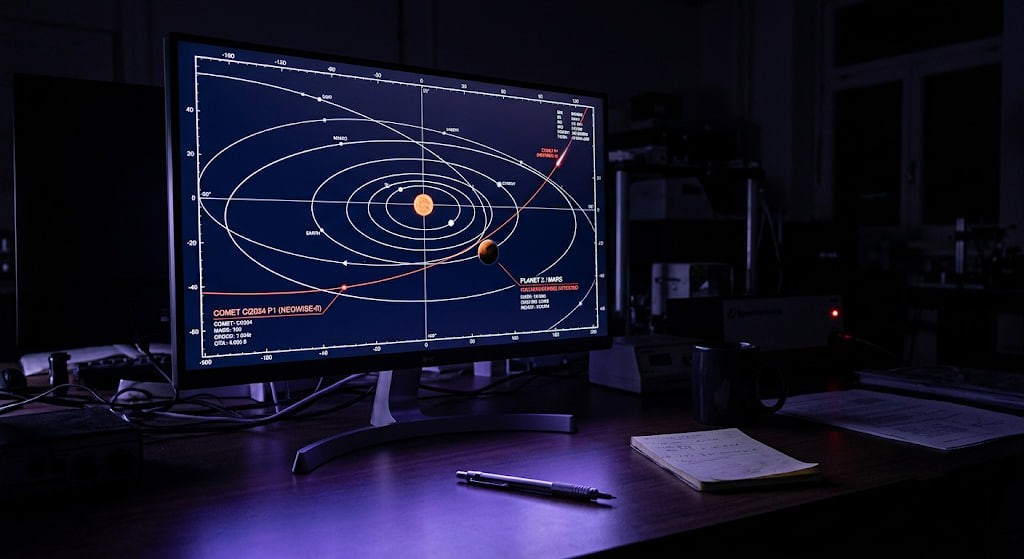
The energy involved is almost beyond comprehension. Nudging even a single sizeable comet onto a Mars-bound path, then repeating that thousands of times, would demand propulsion capabilities far past anything we possess, and each impact would be a planet-scale catastrophe in its own right. The concept appears in serious terraforming literature precisely because it tackles the carbon-dioxide shortage head-on, but it underlines how the easiest-sounding fixes tend to require the most staggering engineering. For now, importing an atmosphere belongs to the same far-future toolkit as the rest of full terraforming.
The Air You Could Never Simply Breathe
Suppose we cleared every hurdle so far — warmed Mars, thickened its air, set rivers running. You still could not breathe. A thick carbon-dioxide atmosphere is lethal to humans no matter how warm or dense it is; we need oxygen, and Mars has almost none in its air.
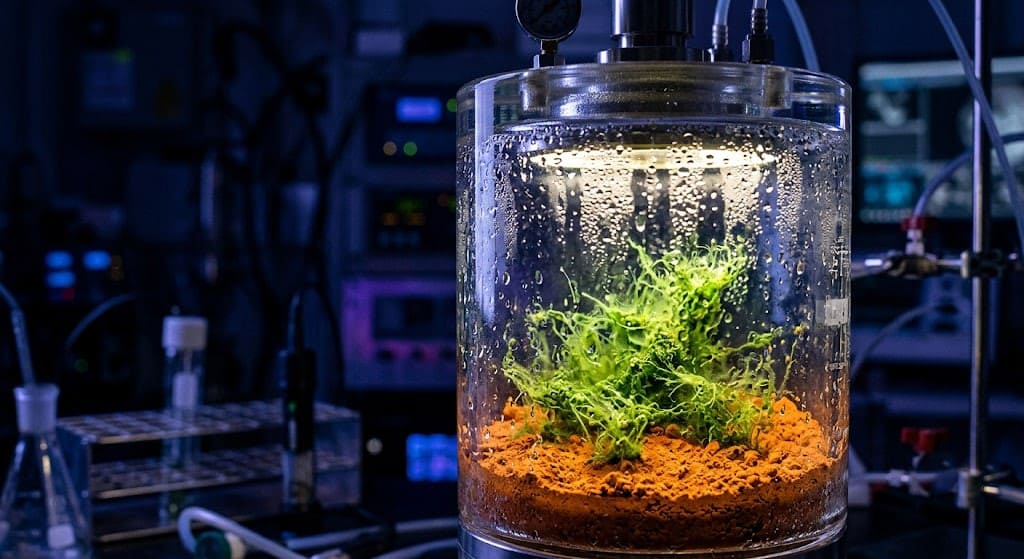
Producing a breathable, oxygen-rich atmosphere is the hardest problem of all. On Earth, it took photosynthetic life — cyanobacteria and later plants — roughly two billion years to oxygenate the air. Even with engineered organisms working far faster, or with industrial oxygen factories running at vast scale, estimates for oxygenating Mars run into many thousands of years. This is why even the most ambitious realistic plans stop short of a fully breathable world, aiming instead for an atmosphere thick and warm enough that humans need only an oxygen mask rather than a full pressure suit. The dream of strolling bare-faced across a green Martian meadow belongs, for now, firmly to fiction.
Holding On to an Atmosphere
There is a deeper question lurking beneath all of this: even if you built Mars a new atmosphere, would it stay? Mars lost its original thick air largely because, without a global magnetic field, the solar wind slowly scoured it away into space over billions of years.
The reassuring part is the timescale. That stripping happens over hundreds of millions to billions of years, so a freshly built atmosphere would not vanish overnight — on human timescales it would be effectively stable, and you could keep topping it up faster than it leaks. Still, some scientists argue a true long-term solution would mean restoring planetary protection.
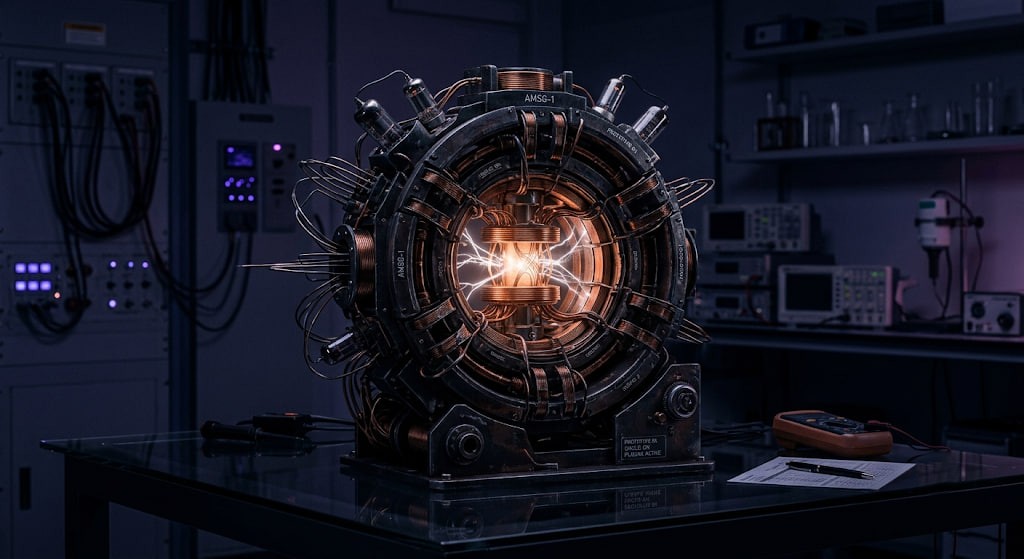
The most discussed concept, floated by NASA’s Jim Green and colleagues in 2017, is to station a powerful artificial magnet at the Mars L1 point, the gravitationally balanced spot between Mars and the Sun, creating a magnetic shield that deflects the solar wind before it reaches the planet. Their modelling suggested this could let Mars’s atmosphere gradually rebuild on its own. It is bold, speculative, and far beyond current engineering — but it shows the problem is at least conceptually solvable.
Paraterraforming: The Realistic Near-Term Path
Given how daunting planet-wide terraforming is, many researchers think the realistic first step is far more modest: paraterraforming, or building enclosed, pressurised habitats rather than transforming the open planet. Picture domed settlements, buried bases shielded by metres of regolith, or vast “worldhouses” that seal off and pressurise a region while leaving the rest of Mars untouched.
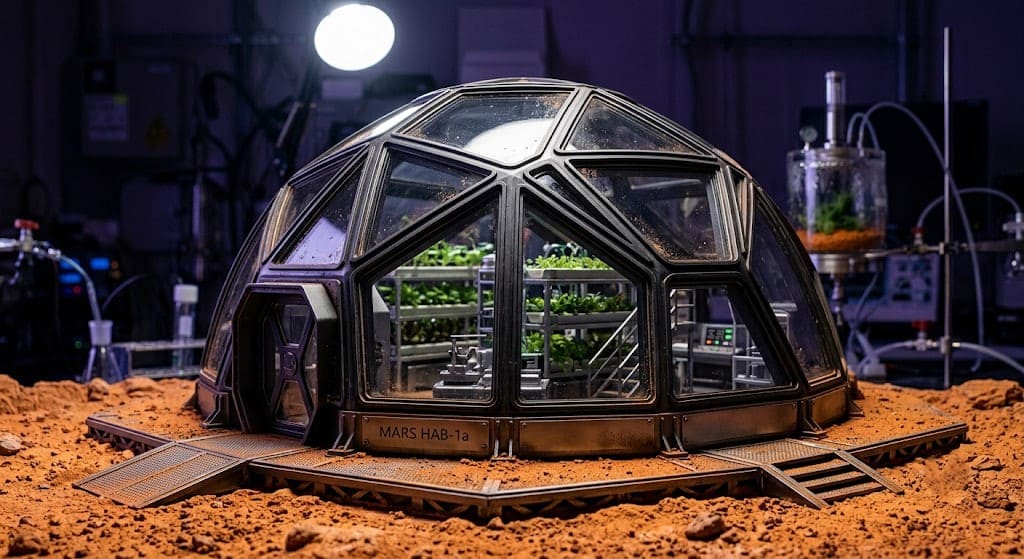
This approach sidesteps the impossible parts. You do not need to warm the whole planet or fill its sky with oxygen; you create a small, controlled Earth-like bubble and expand it over time. It is essentially what the first Martian explorers and settlers will actually do, and it is the bridge between “visiting Mars” and the distant dream of “transforming Mars.” Full terraforming, if it ever happens, would likely come long after generations have already lived under domes.
What Would a Terraformed Mars Look Like?
It is worth picturing the payoff, if only to keep the goal concrete. A partially terraformed Mars — the realistic best case — might have a sky that has shifted from butterscotch toward a pale blue, temperatures that climb above freezing across much of the day, and shallow lakes or streams of meltwater pooling in the lowlands and ancient channels. Hardy, engineered plants or lichens could take hold in sheltered spots, slowly tinting the landscape green.
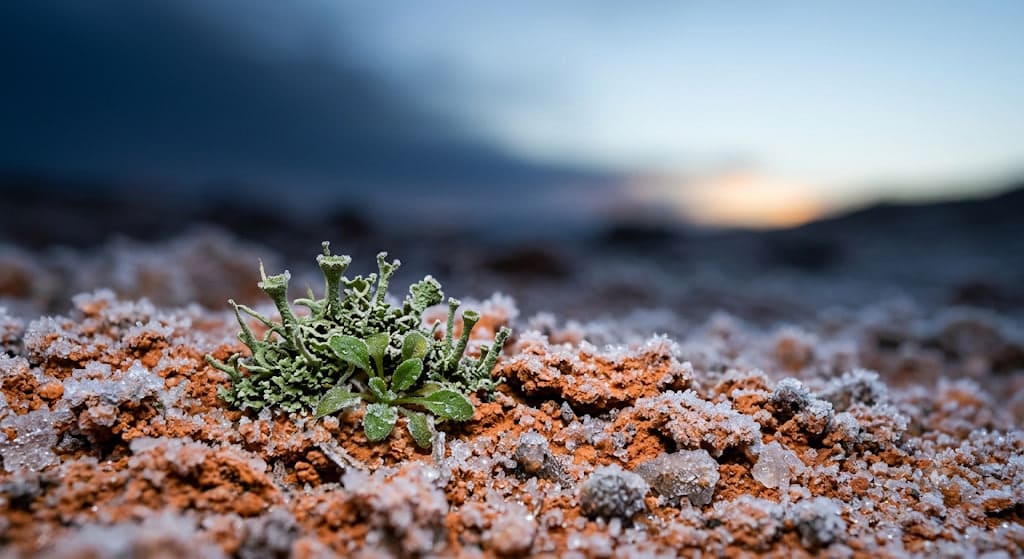
But the human experience would still be alien. You would walk in gravity little more than a third of Earth’s, bounding rather than striding. For a long time you would still need an oxygen mask, because the air, though thick and warm, would not yet carry enough oxygen to breathe. Sunsets would glow blue at the horizon, the reverse of Earth’s red ones, a quirk of how fine Martian dust scatters light. It would be a world transformed and yet unmistakably not home — which is part of what makes the vision so compelling.
How a Real Attempt Might Unfold
Stripping away the science fiction, a plausible long-term sequence would proceed in stages, each laying the groundwork for the next and each far slower than the one before.
- Stage 1 — Survey and settle (this century): robotic missions map water and resources, and the first crews arrive to live in sealed, buried habitats. This is paraterraforming, not planet-wide change.
- Stage 2 — Warm the planet (decades to a century): deploy warming technology such as engineered nanoparticles or orbital mirrors to raise temperatures and release some frozen carbon dioxide.
- Stage 3 — Thicken the air (centuries): build up whatever atmosphere the available and imported gases allow — enough for liquid water and a reduced need for pressure suits.
- Stage 4 — Seed life (centuries): introduce hardy, engineered microbes and plants to begin processing the atmosphere and slowly building soil.
- Stage 5 — Oxygenate (many millennia): the longest and least certain stage — gradually raising oxygen toward breathable levels, if it can be done at all.
The striking feature of this roadmap is how the difficulty and the timescale balloon at every step. The early stages are plausibly within reach of the coming century; the final stage may never arrive. Anyone promising a breathable Mars within our lifetimes is quietly selling the last stage at the price of the first.
Is Terraforming Mars Actually Possible?
The honest answer is: not with anything we can do today, and perhaps not for a very long time — but it is not flatly ruled out by the laws of physics. That nuance matters, because the public conversation tends to swing between two false poles, “we’ll do it in twenty years” and “it’s pure fantasy.” The truth sits in between.
What we can say with confidence is that warming Mars partially may be achievable within decades, using methods like the 2024 nanoparticle concept. Thickening the atmosphere meaningfully is blocked for now by the simple shortage of accessible carbon dioxide. And creating a fully breathable, open-air world is a project of many thousands of years, if it is feasible at all. Realistic timescales for any serious transformation run from centuries to millennia.
The people pushing the idea forward span a wide spectrum. Robert Zubrin has long argued terraforming is an achievable long-term goal and a moral calling. Elon Musk and SpaceX have championed crewed Mars settlement and floated dramatic shortcuts — most notoriously the suggestion of detonating nuclear weapons over the poles to release carbon dioxide, an idea the 2018 study and most scientists regard as unworkable given how little accessible gas there is. Cautious scientists like Christopher McKay frame terraforming as a multi-generational scientific question, not an engineering project we are ready to start. All of them agree on one thing: the first humans on Mars will live in sealed habitats, not on a terraformed surface.
Should We Even Terraform Mars?
Beyond the engineering lies a genuine debate about whether terraforming would be right, not just possible. The most serious objection concerns the possibility of native life. If Mars harbours microbes — perhaps in briny subsurface water — then flooding and reshaping the planet could wipe them out before we ever studied them, destroying the only other example of life’s origin we might ever find. This is why “planetary protection” rules already govern how carefully spacecraft are sterilised before visiting Mars.
There are other questions too. Who would have the authority to remake an entire world, and by whose values? Is it wise to pour centuries of resources into a second planet when those efforts might instead safeguard the one we have? Critics argue that the romance of a green Mars can distract from the far cheaper, more urgent work of protecting Earth’s own biosphere. Defenders counter that becoming a multi-planet species is a hedge against extinction, and that the science learned along the way is invaluable regardless. There are no settled answers — but the fact that we can debate the ethics of engineering a planet at all is a measure of how seriously the idea is now taken.
Q&A
Not with current technology. A 2018 NASA-funded study found there is not enough accessible carbon dioxide on Mars to thicken and warm the atmosphere significantly using today’s methods. Terraforming is not ruled out by physics, but a meaningfully transformed Mars is a project of centuries to millennia, requiring technology well beyond what we now possess.
Estimates range from centuries to many thousands of years, depending on the goal. Partial warming might be achievable in decades with newer methods, but creating a breathable, oxygen-rich atmosphere could take thousands of years even with engineered life or massive industry — comparable to how long natural processes took to oxygenate Earth.
Probably not. Elon Musk popularised the idea of detonating nuclear weapons over the Martian poles to vaporise frozen carbon dioxide, but the 2018 study showed the poles simply do not hold enough accessible CO2 to warm the planet meaningfully. Most scientists consider the approach ineffective, and it would also raise serious contamination concerns.
Mars lost its global magnetic field billions of years ago, leaving its atmosphere exposed to the solar wind, which slowly stripped it away. The good news is that this loss happens over hundreds of millions of years, so a rebuilt atmosphere would be stable on human timescales. A long-term fix might involve an artificial magnetic shield, as NASA scientists have proposed.
That is the hardest goal of all. Even a warm, thick Martian atmosphere would be mostly carbon dioxide and unbreathable. Building up enough oxygen would likely take many thousands of years, so most realistic plans aim only for air dense and warm enough that people could use an oxygen mask instead of a full pressure suit.
In 2024, researchers proposed releasing engineered conductive nanorods, made from iron and aluminium found in Martian dust, into the atmosphere. These particles trap heat far more efficiently than greenhouse gases and could, in theory, warm Mars by over 30 degrees Celsius within about a decade. It is a promising but unproven warming step — not a complete terraforming solution.
No active terraforming project exists. Current efforts, including SpaceX’s, focus on reaching Mars and building sealed habitats for crews, not transforming the planet. Terraforming remains a research topic and long-term aspiration rather than a funded program, and the first settlers will live inside pressurised domes and buried bases.
It is a common and fair objection. Critics argue the resources are better spent protecting Earth’s biosphere, which is vastly easier to keep habitable than to build one from scratch. Supporters see becoming a multi-planet species as insurance against catastrophe and value the science gained. The two goals need not compete — but terraforming is certainly no substitute for caring for Earth.
Possibly, and it is a serious concern. If microbial life exists on Mars, perhaps in subsurface brines, large-scale terraforming could wipe it out before we ever discovered it — erasing a second, independent example of life’s origin. This is why planetary-protection rules exist, and why many scientists urge a thorough search for Martian life before any transformation is attempted.
No one can give a meaningful figure, because no workable full plan exists. The undertaking would dwarf any project in human history, spanning centuries and demanding industry, transport, and energy on a planetary scale. Even the cheaper first steps — sealed habitats and initial warming experiments — would run to many tens or hundreds of billions of dollars.
The Bigger Question
Terraforming Mars is humanity’s grandest “what if” — a vision of turning a dead world green that sits right at the boundary of physics and fantasy. The science says the warming step may be within reach, the atmosphere is a stubborn problem, and breathable air is a dream for the distant future. But imagining the attempt teaches us an enormous amount about Mars, about Earth, and about the limits of engineering a planet. The boldest single move in the whole vision — unfurling a vast mirror in space to melt the polar ice — is explored in our scenario, melting Mars’ ice caps with a space mirror.
To understand the water that any green Mars would depend on, read liquid water on Mars, and to learn how the Red Planet lost the thick atmosphere we would have to rebuild, see why Mars lost its atmosphere. Explore more of the universe on the Space & Cosmos hub.
Watch the terraforming scenario to see what would really happen if we tried to melt the Red Planet’s ice.