 By
By 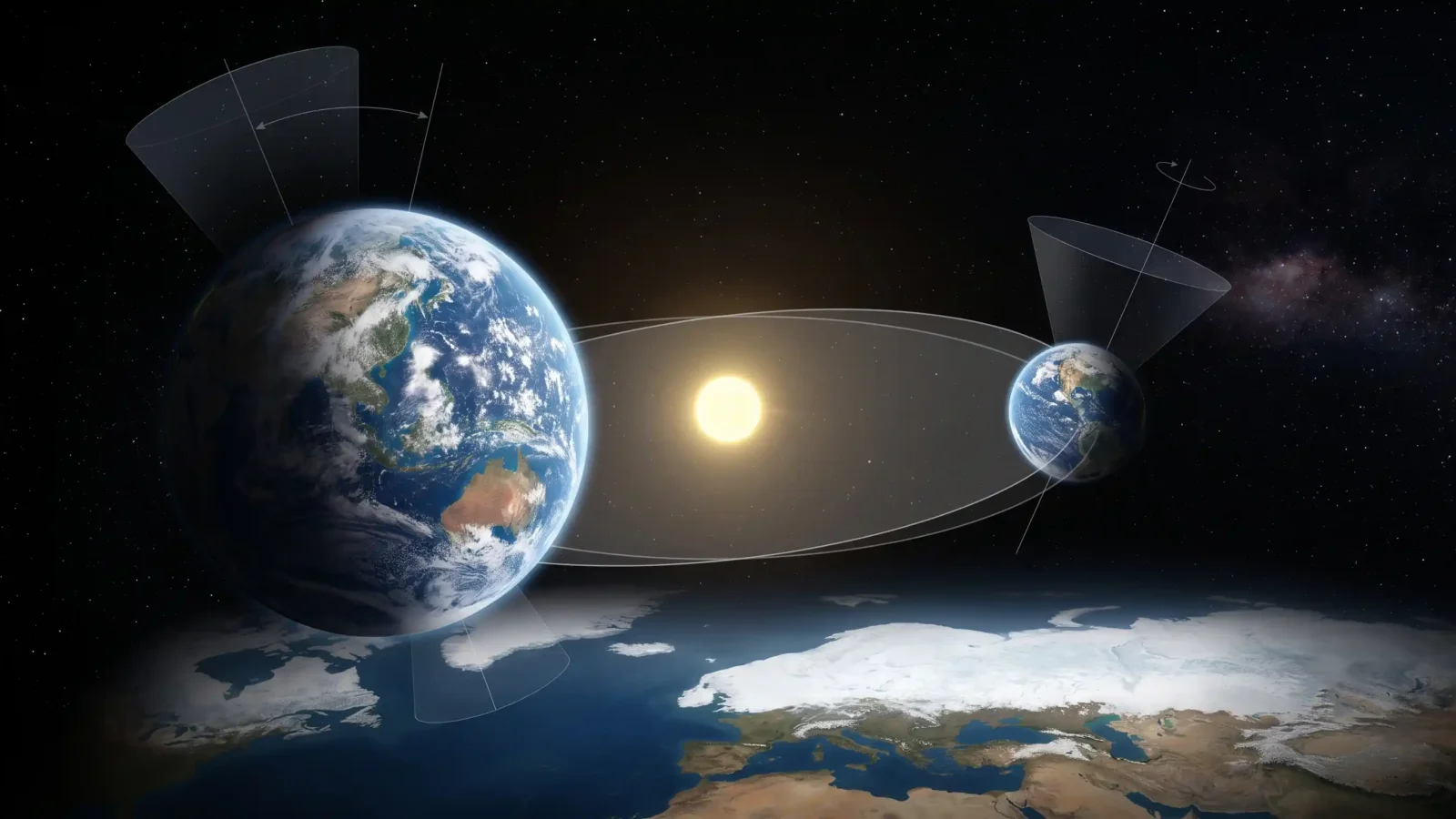
Quick Answer
Milankovitch cycles are slow, predictable changes in Earth’s orbit and tilt that alter how much sunlight reaches different parts of the planet — and they are the main natural pacemaker of the ice ages. Three cycles work together over tens of thousands of years: the shape of Earth’s orbit (eccentricity), the angle of its tilt (obliquity), and the wobble of its axis (precession). By changing the strength of the seasons, they determine when great ice sheets grow and retreat.
Why does Earth swing between frozen ice ages and warm interglacial periods on a roughly regular schedule? The answer lies not in the Sun’s output but in the subtle geometry of Earth’s journey around it. This guide explains what Milankovitch cycles are, the three orbital rhythms that drive them, how they combine to trigger ice ages, and where we stand in the cycle today.
What Are Milankovitch Cycles?
Milankovitch cycles are periodic variations in the geometry of Earth’s orbit and the orientation of its axis. They are named after the Serbian scientist Milutin Milanković, who in the early 20th century calculated how these slow changes alter the amount and distribution of sunlight (called insolation) that Earth receives over thousands of years.
Crucially, these cycles do not change the total amount of energy the Sun puts out. Instead, they change where and when sunlight falls on Earth — especially how strong summers and winters are at high latitudes. That redistribution turns out to be enough to tip the planet into and out of ice ages, because it controls whether snow and ice can survive through the summer and build up year after year.
The Three Cycles
Three distinct orbital cycles combine to produce the overall effect, each operating on its own timescale.
Eccentricity
Eccentricity describes the shape of Earth’s orbit, which slowly shifts between more circular and more elliptical (oval) over cycles of roughly 100,000 and 400,000 years. The gravitational tugs of other planets, especially Jupiter and Saturn, drive this change. When the orbit is more elliptical, the difference in the Sun’s distance between the closest and farthest points of the year is greater, amplifying the seasonal contrast.
Axial tilt (obliquity)
Earth’s axis is tilted relative to its orbit, which is why we have seasons. But the angle of that tilt is not fixed — it varies between about 22.1° and 24.5° over a cycle of roughly 41,000 years. A greater tilt means more extreme seasons (hotter summers, colder winters), while a smaller tilt makes seasons milder. Milder summers at high latitudes allow snow to persist and ice sheets to grow, so obliquity is a powerful lever on the ice ages.
Precession
Precession is the slow wobble of Earth’s rotational axis, like the wobble of a spinning top, completing a circle roughly every 26,000 years. This changes the timing of the seasons relative to Earth’s closest approach to the Sun. Over thousands of years, precession determines whether the Northern Hemisphere’s summer occurs when Earth is near or far from the Sun, which strongly affects how warm those summers are.
How They Combine to Drive Glacial Cycles
No single cycle controls the ice ages alone; it is their combination that matters. The decisive factor is the strength of summer sunlight at high northern latitudes, because that is where the great continental ice sheets form. When the three cycles align to produce unusually cool northern summers, winter snow does not fully melt, ice accumulates year after year, and the bright ice reflects more sunlight — reinforcing the cooling and helping push the planet into a glacial period.
When the cycles later align to deliver warmer northern summers, the ice melts back and the planet enters a warm interglacial period. Over the past million years, this orchestration has produced ice ages on a roughly 100,000-year rhythm, faithfully recorded in ocean sediments and ice cores. The Milankovitch theory is now the cornerstone explanation for the timing of the ice ages.
Other Ice-Age Triggers (and the cosmic angle)
Milankovitch cycles set the rhythm, but they are not the only factor. Greenhouse gases like carbon dioxide act as amplifiers, deepening the cold or the warmth. The slow drift of continents alters ocean currents and weathering over millions of years. Large volcanic eruptions can cause shorter-term cooling, and the most extreme freezes, like Snowball Earth, involved runaway ice feedbacks.
There is also a genuinely cosmic possibility. If the solar system drifted through a dense cloud of interstellar gas and dust, it could dim the sunlight reaching Earth or compress the protective bubble around the Sun, potentially triggering cooling independent of Earth’s orbit. That intriguing scenario is the subject of what if the Earth passed through a dense interstellar cloud — an ice-age trigger from beyond the solar system rather than within Earth’s orbit.
Where We Are in the Cycle Now
We currently live in a warm interglacial period called the Holocene, which began when the last ice age ended roughly 11,700 years ago. Based on the orbital configuration, Earth’s natural Milankovitch rhythm suggests the next glaciation would not be due for tens of thousands of years — the current orbit produces relatively stable, mild conditions.
It is important to be precise here: the warming the planet is experiencing today is driven by human greenhouse gas emissions, not by Milankovitch cycles, which operate far too slowly to explain rapid modern climate change. In fact, some scientists think the extra carbon dioxide humans have added may delay the onset of the next ice age even further. The orbital cycles remain the long-term backdrop, but on human timescales, our own influence on the atmosphere is now the dominant driver.
Q&A
Based on Earth’s orbital cycles, the next natural glacial period is not expected for tens of thousands of years. Some research suggests that human-caused carbon dioxide emissions may delay it even longer by keeping the planet warmer than the orbital cycles alone would.
No. Milankovitch cycles operate over tens of thousands of years and cannot explain the rapid warming seen over the past century. Today’s global warming is driven by human greenhouse gas emissions. The orbital cycles are the slow, natural pacemaker of ice ages, not modern climate change.
Over the past million years, full glacial periods have lasted roughly 80,000 to 100,000 years, separated by shorter warm interglacials of about 10,000 to 30,000 years. We are currently in such a warm interglacial, the Holocene, which began about 11,700 years ago.
They are named after Milutin Milanković, a Serbian mathematician and engineer who, in the early 20th century, calculated how variations in Earth’s orbit and tilt change sunlight over time. The ideas built on earlier work by scientists such as Joseph Adhémar and James Croll.
The Bigger Question
Milankovitch cycles show that the timing of ice ages is written into the geometry of Earth’s orbit. But these cycles are only part of the story — climate can also be pushed by forces from outside the solar system entirely. What if Earth drifted into a thick cloud of interstellar dust that dimmed the Sun and chilled the planet on a schedule no orbital cycle could predict? That is the cosmic ice-age trigger we explore in what if the Earth passed through a dense interstellar cloud.
For the most extreme freeze in Earth’s history, read Snowball Earth, and find more on our planet’s survival on the Earth & Humanity Survival hub.
Watch the interstellar cloud scenario to see an ice age triggered from beyond the stars.