 By
By 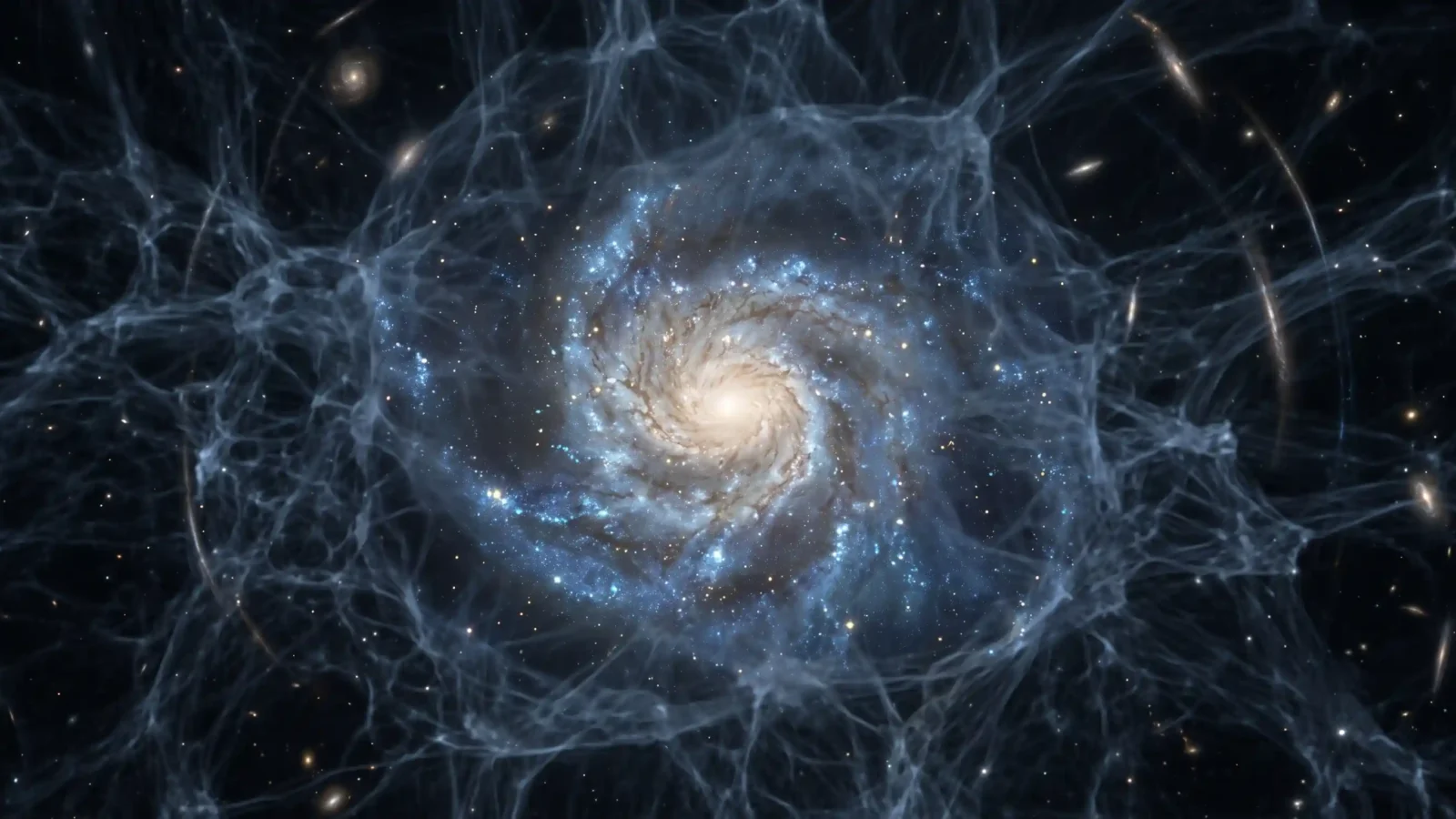
Quick Answer
Dark matter is an invisible form of matter that makes up about 85% of all the matter in the universe, yet emits no light and has never been directly detected. We know it exists because of its gravity: galaxies spin too fast to hold together with only their visible matter, and light from distant objects bends around unseen mass. What dark matter is actually made of remains one of the biggest unsolved mysteries in science.
Everything you have ever seen — every star, planet, and person — is made of “ordinary” matter, and that adds up to only about a sixth of all the matter in the cosmos. The rest is dark matter: a vast, invisible scaffolding that shapes galaxies and holds the universe together. This guide explains what dark matter is, the powerful evidence that it exists, what it might be made of, and how it could even be tied to tiny black holes.
What Is Dark Matter?
Dark matter is a hypothetical kind of matter that does not interact with light — it neither emits, absorbs, nor reflects electromagnetic radiation — which is why it is invisible to every telescope ever built. We detect it only through its gravitational pull on the things we can see. By measuring how galaxies rotate, how clusters move, and how light bends, astronomers have concluded that there must be far more matter present than the visible stars and gas can account for.
Current measurements indicate that the universe is roughly 5% ordinary matter, 27% dark matter, and 68% dark energy. So dark matter outweighs all the visible matter — every star and galaxy combined — by more than five to one. It is not a minor correction; it is the dominant form of matter in the cosmos.
The Evidence It Exists
The case for dark matter rests on several independent lines of evidence that all point the same way.
Galaxy rotation curves
The most famous evidence comes from how galaxies spin. In the 1970s, astronomer Vera Rubin measured the orbital speeds of stars in spiral galaxies and found something startling: stars far from the centre were orbiting just as fast as those near the middle. By the normal laws of gravity, the outer stars should move much more slowly, because most of the visible mass is concentrated in the centre. The only way to explain their high speeds is if each galaxy is embedded in a much larger, invisible halo of dark matter providing the extra gravity.
Gravitational lensing
Einstein’s general relativity says that mass bends the path of light. When astronomers observe the light from distant galaxies being bent and distorted by closer galaxy clusters — an effect called gravitational lensing — the amount of bending reveals far more mass than the visible matter can supply. A spectacular example is the Bullet Cluster, where two galaxy clusters collided and the dark matter (mapped by lensing) clearly separated from the visible gas, providing some of the strongest direct evidence that dark matter is real and distinct from ordinary matter.
What Could It Be Made Of? (WIMPs, axions…)
If dark matter exists, what is it? Several candidates have been proposed, each a different kind of particle or object that would be invisible yet gravitationally active.
- WIMPs: Weakly Interacting Massive Particles — heavy particles that barely interact with ordinary matter; long a favourite, though searches have not found them.
- Axions: extremely light hypothetical particles, now a leading candidate, hunted by dedicated experiments.
- Sterile neutrinos: a heavier, non-interacting cousin of the familiar neutrino.
- Primordial black holes: black holes formed in the early universe rather than from dying stars.
So far, none of these has been confirmed, which is what makes dark matter such a profound puzzle: it clearly shapes the universe, yet its fundamental identity is unknown.
Could Dark Matter Be Primordial Black Holes?
One intriguing possibility is that some or all of dark matter consists of primordial black holes — black holes that formed not from collapsing stars, but from dense regions in the chaotic first instants after the Big Bang. Unlike stellar black holes, these could come in a huge range of masses, including very small ones.
This idea is attractive because it would mean dark matter is made of something we already know exists (black holes) rather than a new, undiscovered particle. Searches using gravitational microlensing — watching for the brief brightening that occurs when a compact object passes in front of a distant star — have ruled out primordial black holes as all of the dark matter across many mass ranges, but certain windows remain open. The possibility that tiny black holes pervade the cosmos is exactly what makes the scenario what if a microscopic black hole passed through the Earth so compelling.
How Scientists Are Hunting for It
The search for dark matter is one of the great experimental quests in physics, pursued on three fronts. Direct detection experiments, such as LUX-ZEPLIN, sit deep underground in tanks of liquid xenon, waiting for the rare nudge of a dark matter particle bouncing off an atom. Indirect detection looks for the radiation that might be produced if dark matter particles collide and annihilate. And collider experiments at the Large Hadron Collider try to produce dark matter particles directly. Dedicated axion experiments add another avenue. Despite decades of increasingly sensitive searches, no candidate has been definitively detected — a result that is itself reshaping which theories physicists pursue.
Dark Matter vs Dark Energy
Dark matter and dark energy are often confused, but they are opposites in their effect. Dark matter behaves like ordinary matter gravitationally: it clumps together and pulls things inward, helping galaxies and clusters form. Dark energy, by contrast, is a mysterious force that pushes the universe apart, driving its accelerating expansion. Dark matter is the cosmic glue; dark energy is the cosmic accelerator. Together they make up about 95% of the universe, leaving the matter we understand as a thin sliver of the whole — a humbling reminder of how much remains unknown.
Q&A
Not directly. Its existence is firmly established through gravitational evidence — galaxy rotation, lensing, and the cosmic microwave background — but no experiment has yet detected a dark matter particle or identified what it is made of. That detection is one of the most sought-after goals in modern physics.
Possibly, but we have not done so. Particle colliders like the Large Hadron Collider have searched for dark matter produced in high-energy collisions, looking for “missing” energy that would signal an invisible particle escaping. So far, no such particle has been confirmed.
It is concentrated in vast halos surrounding galaxies and galaxy clusters, extending far beyond the visible stars. The Milky Way sits within such a halo, and dark matter is also spread throughout the universe in a cosmic web that scaffolds where galaxies form.
It is possible. Some scientists propose alternatives, such as Modified Newtonian Dynamics (MOND), which tweak the laws of gravity instead of adding invisible matter. However, dark matter currently explains a wider range of observations — especially the Bullet Cluster and the cosmic microwave background — better than these alternatives.
The Bigger Question
One of the most tantalising ideas about dark matter is that it might be made of tiny black holes left over from the Big Bang, drifting invisibly through the cosmos — and through us. If so, what would happen if one of these microscopic black holes passed straight through the Earth? That is the gripping question we explore in what if a microscopic black hole passed through the Earth.
The fate of such tiny black holes depends on Hawking radiation, which governs how fast they evaporate. Explore more of the universe’s hidden physics on the Extreme Physics hub.
Watch the micro black hole scenario to see what an invisible piece of dark matter could do.