 By
By 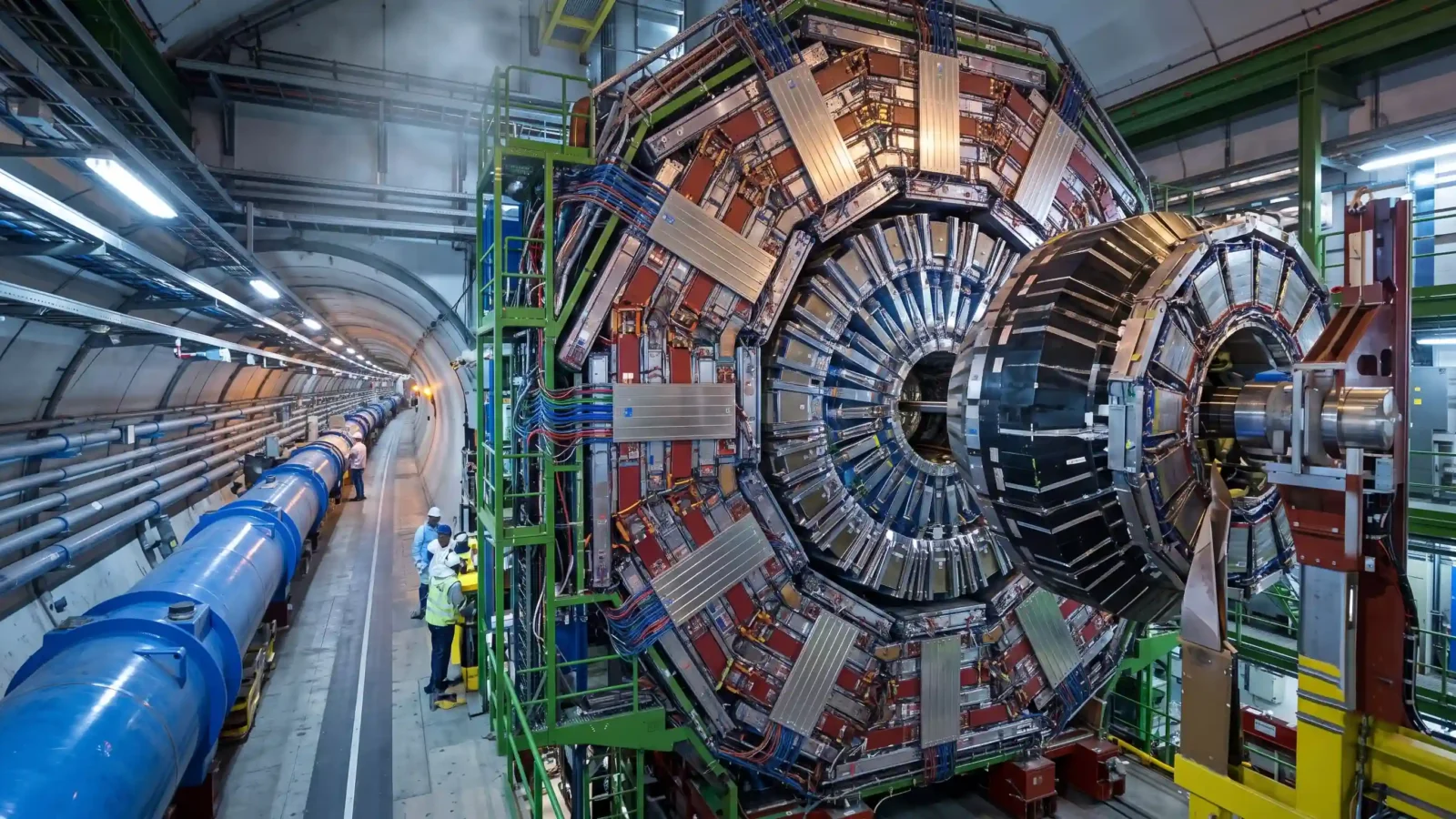
Quick Answer
The Higgs field is an invisible energy field that fills all of space and gives fundamental particles their mass. Particles that interact strongly with the field — like electrons and quarks — behave as though they have mass, while particles that ignore it, like photons of light, remain massless and travel at light speed. The Higgs boson, discovered at the Large Hadron Collider in 2012, is the particle that proves this field is real.
Why does anything have mass at all? For decades that was one of the deepest gaps in physics. The answer turned out to be a field woven invisibly through the entire universe — and confirming it took the largest machine humanity has ever built. This guide explains what the Higgs field is, how it hands out mass, how the famous “God particle” was found, and why the field’s stability is tied to the ultimate fate of the cosmos.
What Is the Higgs Field?
The Higgs field is a field that exists everywhere in the universe — not empty space, but space filled with a constant background value of this field. Most fields, like the electromagnetic field, are zero when nothing is happening. The Higgs field is different: even in completely empty space, it has a non-zero value. Particles cannot avoid it, and their interaction with this ever-present field is what gives them mass.
It was proposed in 1964 by several physicists, including Peter Higgs, François Englert, and Robert Brout, to solve a glaring problem in the emerging Standard Model of particle physics: the equations only worked if certain particles were massless, yet in reality they clearly have mass. The Higgs field was the elegant fix that made the whole theory consistent.
How the Field Gives Particles Mass (the molasses analogy)
A common way to picture the Higgs field is to imagine it as a kind of thick, invisible molasses filling all of space. As a particle moves through it, it drags against the field. Particles that interact strongly with the field are slowed down a lot — that resistance is what we experience as a large mass. Particles that interact weakly are slowed only a little, giving them a small mass. And particles like the photon, which ignore the field entirely, glide through unhindered and remain massless, which is why light always travels at the universal speed limit.
Another popular image is a celebrity moving through a crowded room: a famous person attracts a clinging crowd and moves slowly (high mass), while an unknown person walks straight through (low mass). Both analogies are imperfect — the real mechanism is mathematical — but they capture the essential idea: mass is a measure of how much a particle interacts with the Higgs field.
The Higgs Boson — The “God Particle”
If the Higgs field really fills space, there should be a particle associated with it — a ripple or excitation in the field, just as a photon is a ripple in the electromagnetic field. That particle is the Higgs boson. Finding it was the way to prove the field exists.
The Higgs boson was nicknamed the “God particle” by a popular science book, a label most physicists dislike because it overstates the case and has nothing to do with religion. Its real importance is more concrete: it is the keystone of the Standard Model, the final missing piece that explained the origin of mass.
How the LHC found it in 2012
Detecting the Higgs boson required the Large Hadron Collider at CERN — a 27-kilometre ring that smashes protons together at nearly the speed of light. The Higgs boson is unstable and decays almost instantly, so it cannot be observed directly; instead, physicists detect the specific patterns of particles it decays into. In July 2012, two independent experiments, ATLAS and CMS, announced they had found a new particle with a mass of about 125 GeV (roughly 133 times the mass of a proton) behaving exactly as the Higgs boson should. The discovery confirmed the Higgs field after nearly half a century, and Higgs and Englert were awarded the 2013 Nobel Prize in Physics.
Is the Higgs Field Stable?
Here is where the story turns unsettling. The Higgs field currently sits at a particular value that makes our universe stable and life possible. But physicists describe the field using a “potential” — a kind of energy landscape — and a key question is whether our universe rests at the lowest possible point of that landscape, or merely in a stable-looking dip with an even lower valley somewhere beyond.
The precise measured masses of the Higgs boson and the top quark suggest, intriguingly, that our universe may be metastable — sitting in a valley that is stable for now, but not the deepest one possible. If that is correct, then in principle the Higgs field could one day “tunnel” to a lower-energy state. That terrifying possibility is called vacuum decay, and it is the focus of what if vacuum decay began in a particle collider.
Why This Matters for the Fate of the Universe
The stability of the Higgs field is not just abstract. If the universe is metastable and vacuum decay ever occurred, a bubble of “true vacuum” would expand outward at nearly the speed of light, rewriting the laws of physics inside it and destroying everything in its path — atoms, stars, and life could not exist in the new state. It would be the most complete ending imaginable.
The reassuring news is that, even if our vacuum is metastable, the predicted timescale for such an event to happen spontaneously is astronomically long — far longer than the current age of the universe. Vacuum decay is one candidate among several for how everything might end, a topic we lay out fully in how will the universe end. The Higgs field, in this sense, may quietly hold the universe’s deepest secret: whether our reality is permanent, or merely very, very long-lived.
Q&A
Fundamental particles like electrons and quarks would be massless and would fly around at the speed of light, unable to bind together. Atoms could not form, so there would be no chemistry, no stars, no planets, and no life. The Higgs field is essential to the structure of matter as we know it.
Yes. The Higgs field permeates all of space uniformly, including the vacuum. Unlike most fields, it has a non-zero value even in empty space, which is precisely why every particle that interacts with it acquires mass no matter where it is in the universe.
Probably not the standard Higgs field. Cosmic inflation — the rapid expansion just after the Big Bang — is usually attributed to a separate hypothetical field called the inflaton. Some speculative theories propose the Higgs field could have played that role (“Higgs inflation”), but this is not established.
Possibly. The measured masses of the Higgs boson and top quark place our universe close to the boundary between stable and metastable, leaning toward metastable. If true, it means our vacuum is stable for now but not the lowest-energy state — though any change would take far longer than the universe has existed.
The Bigger Question
The Higgs field explains why matter has substance — but its precise properties hint that our universe might be sitting in a valley that is not the deepest one available. If that is true, the same field that gives everything mass could, in principle, switch to a lower-energy state and erase reality as we know it. That is the chilling premise of what if vacuum decay began in a particle collider.
To see how this fits among the other possible endings of the cosmos, read how will the universe end, or explore more on the Extreme Physics hub.
Watch the vacuum decay scenario to see what would happen if the Higgs field ever let go.