 By
By 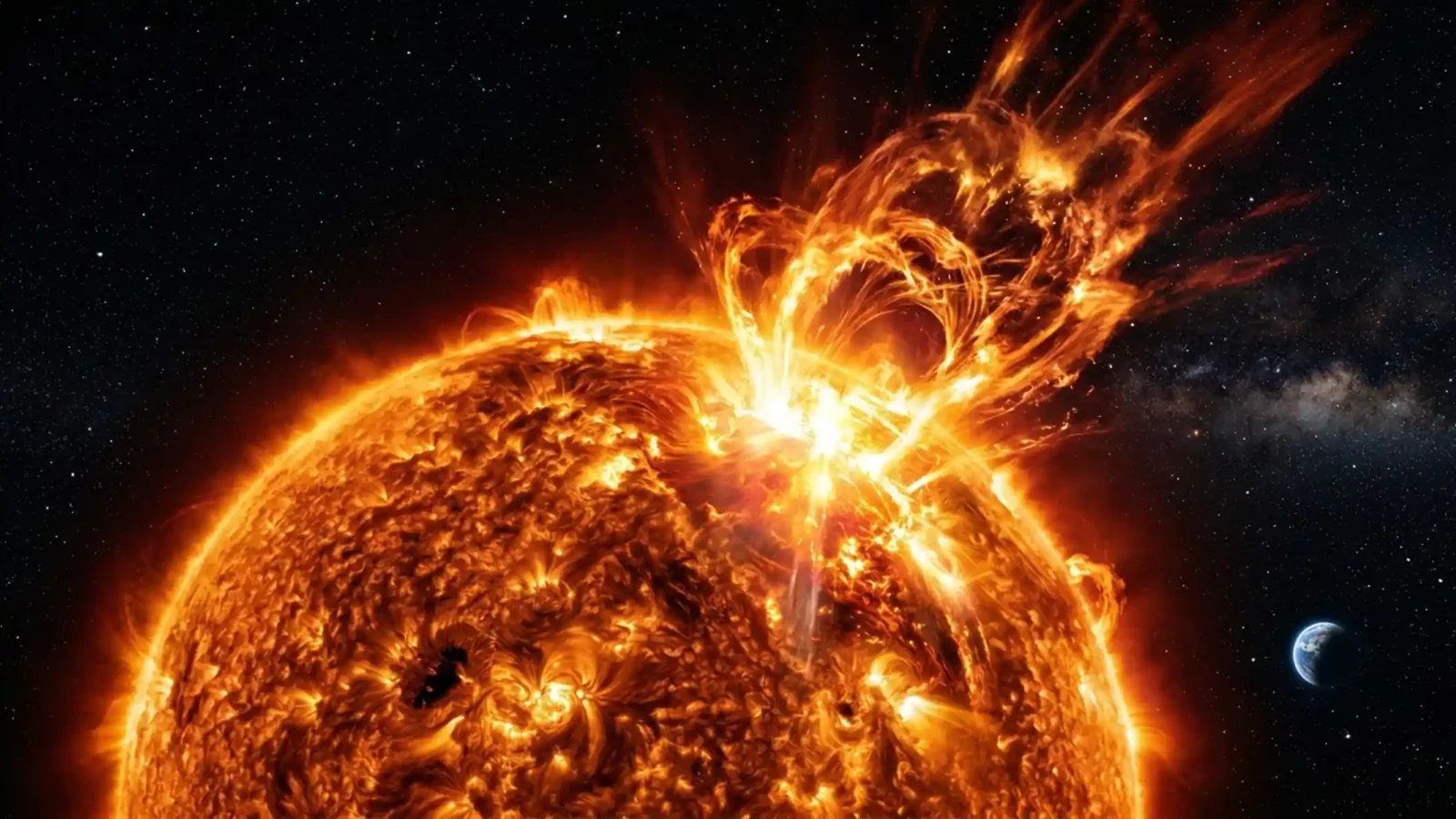
Quick Answer
The Carrington Event was the most powerful geomagnetic storm in recorded history, striking Earth in early September 1859. Triggered by a massive eruption from the Sun, it set telegraph wires sparking, shocked operators, and lit up auroras so bright they were seen near the equator. If a storm of the same size hit our technology-dependent world today, it could cripple power grids, satellites, GPS, and communications for months — causing trillions of dollars in damage.
In 1859, a solar storm overwhelmed the only electrical technology humanity had: the telegraph. More than a century and a half later, our entire civilisation runs on the electronics that such a storm threatens. This guide explains what happened in 1859, what caused it, what a repeat would do today, and how the Sun’s natural cycle makes these events a question of “when,” not “if.”

What Happened in 1859?
On 1 September 1859, the British astronomer Richard Carrington was sketching sunspots when he witnessed something no one had seen before: a sudden, intense flash of white light erupting from the Sun’s surface, lasting about five minutes. He had just observed a powerful solar flare. Independently, the astronomer Richard Hodgson saw the same flash.
Roughly 17 hours later — remarkably fast — Earth was struck by the eruption that followed. The effects were spectacular and alarming. Auroras normally confined to polar regions blazed across the sky as far south as the Caribbean, Hawaii, and Colombia; some were so bright that people awoke thinking it was dawn. Telegraph networks across Europe and North America went haywire: wires threw sparks, operators received electric shocks, and some systems kept transmitting even after their batteries were disconnected, running purely on the electrical currents the storm induced in the wires.
What Caused It — A Coronal Mass Ejection
The Carrington Event was caused by a coronal mass ejection (CME) — a colossal cloud of magnetised plasma blasted from the Sun’s outer atmosphere. The flare Carrington saw was the flash; the CME was the punch that followed. When this billion-tonne cloud of charged particles slammed into Earth’s magnetic field, it set off a violent geomagnetic storm, distorting the field and driving powerful electric currents through the upper atmosphere and the ground.
What made 1859 so extreme was a combination of the CME’s size, its speed, and the orientation of its magnetic field, which connected efficiently with Earth’s own. The result was the strongest geomagnetic disturbance ever directly recorded. For a deeper look at how these solar eruptions work, see our companion article on solar flares and CMEs.
What Would Happen If It Hit Us Today?
In 1859, the damage was limited because the telegraph was the only vulnerable technology. Today, a Carrington-class storm would strike a world utterly dependent on electronics and electricity, and the consequences could be severe.
Power grids, satellites, GPS, the internet
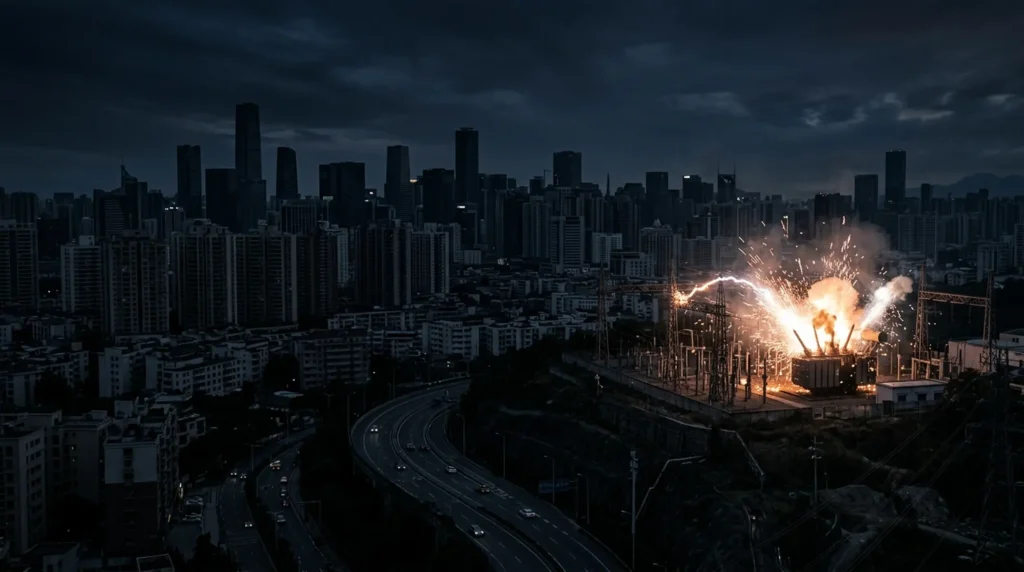
- Power grids: induced currents could overload and destroy large transformers, which can take months or years to replace, causing prolonged blackouts.
- Satellites: increased radiation and atmospheric drag could damage electronics and shorten satellite lifetimes.
- GPS and navigation: positioning signals could be degraded or knocked out, affecting aviation, shipping, agriculture, and finance.
- Communications: radio blackouts and disruptions to internet infrastructure, especially systems dependent on the power grid.
The most serious threat is to the electrical grid. Geomagnetically induced currents can burn out the massive, custom-built transformers at the heart of the power system. Because these are not held in large numbers as spares and take a long time to manufacture, a severe storm could leave regions without power for an extended period. Studies have estimated the potential economic cost of a major event in the trillions of dollars.
Near Misses (the 2012 close call)
This is not a purely historical worry. In July 2012, the Sun unleashed a coronal mass ejection of Carrington-class strength. It tore across Earth’s orbit at extraordinary speed — but Earth simply was not in the firing line at that moment. The cloud crossed the path our planet had occupied only about nine days earlier. Had the eruption happened a week sooner, it would have hit us squarely, and scientists believe the impact could have rivalled or exceeded 1859.
The 2012 near miss was a stark reminder that powerful storms are launched fairly regularly; whether one strikes Earth is largely a matter of timing and aim.
How the Solar Cycle Drives These Storms
Solar storms are not random — they ebb and flow with the Sun’s roughly 11-year solar cycle, during which the Sun’s magnetic activity rises to a peak (solar maximum) and falls to a lull (solar minimum). Flares and CMEs are far more common around solar maximum, when the Sun is covered in sunspots and its magnetic field is most tangled. Solar Cycle 25 reached its maximum in late 2024, keeping space-weather forecasters especially alert.
At the heart of the cycle is the periodic flipping of the Sun’s entire magnetic field, which reverses roughly every 11 years. That process is the focus of what if the Sun’s magnetic field flipped tomorrow, which explores what the engine behind these storms really means for Earth.
Are We Prepared? Forecasting and Hardening the Grid
The good news is that we are far better prepared than in 1859. Agencies such as NOAA’s Space Weather Prediction Center monitor the Sun continuously, and spacecraft positioned between the Sun and Earth can give roughly 15 to 60 minutes of warning before a CME arrives — enough time for grid operators to take protective action and for satellites to be put into safe modes.
Engineers are also working to “harden” the grid: installing devices to block induced currents, keeping critical spare transformers on hand, and designing procedures to disconnect vulnerable equipment during a storm. None of this makes us immune, but a combination of early warning and resilient infrastructure could dramatically reduce the damage. The remaining challenge is that the very largest storms are rare, so the pressure to invest in protection competes with more immediate priorities.
Q&A
No one can predict a specific date. Extreme storms of this size are rare, occurring perhaps once every century or two on average, but they can strike at any time — especially around solar maximum. The 2012 near miss shows that Carrington-class eruptions still happen; whether they hit Earth is a matter of timing.
Estimates vary, but some studies put the chance of a Carrington-scale storm hitting Earth at very roughly 1–2% per decade. Smaller but still damaging storms are much more frequent, which is why power and satellite operators plan for space weather routinely.
Partly. We can see flares and CMEs erupt from the Sun and estimate whether they are Earth-bound, giving days of rough notice. The crucial detail — the storm’s magnetic orientation, which determines its severity — is usually only confirmed by spacecraft about 15 to 60 minutes before impact.
Yes. Earth’s atmosphere and magnetic field protect people on the ground from the radiation, so a solar storm poses no direct danger to human health for those on the surface. The threat is to technology and infrastructure — and to the modern systems we rely on for power, food, water, and communication.
The Bigger Question
The Carrington Event proved that the Sun can reach across 150 million kilometres and disrupt our world in a matter of hours. These storms are driven by the Sun’s restless magnetic field, which builds, tangles, and flips on an 11-year rhythm. What would happen if that magnetic engine did something dramatic? That is the question behind what if the Sun’s magnetic field flipped tomorrow — a closer look at the cosmic machinery that powers events like 1859.
To understand the eruptions themselves in detail, read solar flares and CMEs, or explore more on our home star at the Space & Cosmos hub.
Watch the solar magnetic field scenario to see what the Sun is really capable of.